2015 #181
Peyton Reed | 117 mins | Blu-ray | 1.85:1 | USA / English | 12 / PG-13
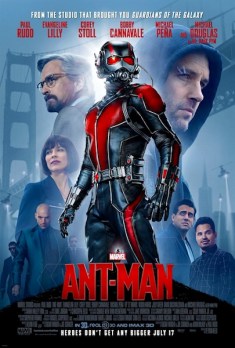 The final film in ‘Phase Two’ of the Marvel Cinematic Universe is perhaps the most fun Marvel movie since Iron Man kicked off the whole shebang seven years ago.
It’s the story of a burglar, Scott Lang (Paul “he’ll always be Mike from Friends to me” Rudd), who is enlisted by ageing genius Hank Pym (Michael Douglas) to pilfer something from Pym’s old company, now controlled by his former protégé and villain-in-waiting Darren Cross (Corey Stoll). Pym discovered/created something called the Pym Particle, which changes the distance between atoms and allows objects and people to shrink or increase in size. He hid his dangerous technology from the world, but now Cross has developed his own version and is seeking to sell a weaponised version to the highest bidder — which naturally includes some very nefarious characters.
Marvel are currently fond of mixing “superhero” with “another genre” to produce their movies — which makes sense, given the standard two-or-three superhero narratives were already becoming played out by the time Iron Man came along, never mind in the raft of movies Marvel Studios have released since. Here, “superhero” is mixed with “heist movie”; more specifically, “heist comedy”. It’s superheroes by way of Ocean’s Eleven, basically. In the key position, you’ve got Lang in the Ant-Man suit, able to shrink, infiltrate places, and control ants to help him; but then he’s got a whole support team: Pym planning and overseeing; Pym’s daughter, Hope (Evangeline Lilly), the inside woman; and a gaggle of Lang’s criminal friends (Michael Peña, David Dastmalchian, Tip ‘T.I.’ Harris), brought in to help them hack security ‘n’ that.
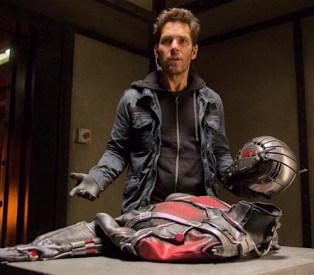 Nonetheless, some have criticised the film for not being especially original. I mean, originality’s good ‘n’ all, but c’mon, what do you expect when you sit down to a superhero movie from the primary purveyor of superhero movies? Ant-Man may blend elements from a few other genres into the superhero mix, but, yeah, it’s a superhero movie that, at times, plays like a superhero movie — just like everything else Marvel Studios has produced (with the possible exception of Guardians of the Galaxy). If that’s not your thing, fine, but there’s nothing so spectacularly rote or generic about Ant-Man when compared to the rest of Marvel’s output that it deserves to be singled out. In fact, if anything, it has a higher dose of originality than its peers. And it doesn’t climax with a giant flying thing crashing to Earth, the first Marvel movie you can say that about for years.
Where the film really succeeds, however, is in being — as noted — fun. Sometimes the structure is a little wonky, sometimes the dialogue is a little off, sometimes it’s a little heavy on the exposition, sometimes this and sometimes that, but it never stops moving at a decent clip, is never too far away from a good laugh, and offers some strong action sequences too. The very nature of the titular heroes’ powers offers us something new. Okay, there have been plenty of shrinking movies before, but not like his. Macro photography and CGI have been used to great effect to bring us into his world, and the fact he can shrink and grow at will adds a real kick to fight scenes.
 It remains tough to talk about Ant-Man without referencing The Edgar Wright Situation. I mean, you could ignore it, but then it becomes the elephant in the room. If you somehow missed it: writer-director Edgar Wright pitched Ant-Man to Marvel as a movie before Marvel Studios even existed, back in 2003, and had been developing it on and off ever since. The ideas he brought to the table — an action-adventure-comedy style, being a special effects extravaganza but with a lighthearted tone — influenced how the studio approached Iron Man and, consequently, the whole MCU. Nonetheless, Ant-Man wound up positioned as the 12th film in the studio’s slate, finally going into production after a decade of prep. Wright had a script almost finalised, he’d cast the film, a release date was set… and then he left due to “creative differences”. And the internet was on his side because Edgar Wright has made Spaced and Shaun of the Dead and Hot Fuzz and Marvel are a studio and studios are always wrong.
The full extent of what these creative differences were hasn’t emerged yet, because it wasn’t that long ago (inevitably, they will one day), but it must’ve been pretty major to walk away from a project you’d been working on for so long and were so close to finally realising. Some reports say Wright wanted the film to be completely standalone, with absolutely no ties to the wider Marvel universe. I kind of hope there’s more to it than that, because while the final version of Ant-Man isn’t completely standalone, it’s one of Marvel’s less connected efforts. Okay, it references S.H.I.E.L.D., Hydra, and the Avengers, and there are cameo appearances by characters from other parts of the universe (including Lang having to fight an Avenger), but its story doesn’t feed directly from a previous MCU film, nor does it make setting up another one an inherent part of the plot. In short, it’s nicely connected — it’s definitely part of the universe — but you don’t need to know a great deal to enjoy it on its own.
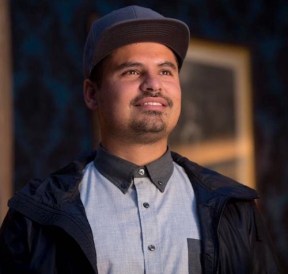 After Wright left, the screenplay was rewritten by a host of scribes (far more than the two extra writers ultimately credited). Other things they’re responsible for include bulking up the supporting characters, especially Hope, which works pretty well, and Lang’s friend Luis (Michael Peña), which we should all be thankful for: Peña’s Luis is one of the best things in the movie, an enthusiastic motormouth who’s consistently entertaining whenever he’s on screen. He’s the standout from an ensemble that is generally strong, with Rudd proving a likeable lead and Douglas committing to the material in a way you wouldn’t necessarily expect an older actor to with ‘just a comic book movie’.
Would Edgar Wright’s Ant-Man have been better than Peyton Reed’s? We’ll never know. Well, one day we’ll have a good guess, because one day what changed will all come out. Wright still has a story and co-writer credit, so obviously a lot of his material survived. Nonetheless, the movie we’ve ended up with doesn’t feel like a compromised, homogenised, studio-controlled disaster. Chances are Wright could’ve brought greater visual and storytelling flair to proceedings, but Reed doesn’t do a bad job, especially when it comes to sequences in miniature. The final fight takes place on a children’s playset, doesn’t involve giant things falling epically out of the sky (is it the only Phase Two film to avoid that trope?), and is one of the best climaxes in the entire Marvel canon. Sometimes less really is more. Especially when “less” includes Thomas the Tank Engine. Whoever thought you’d see Thomas the Tank Engine in a Marvel movie?
I hope Ant-Man will be an important touchstone in what Marvel Studios do going forward. It proves smaller-scale adventures can work — not in the sense that it’s about a hero who shrinks to a few centimetres tall, but in that it’s a story focused on a couple of characters trying to steal something from a building and defeat one guy, not about saving an entire city or an entire planet. 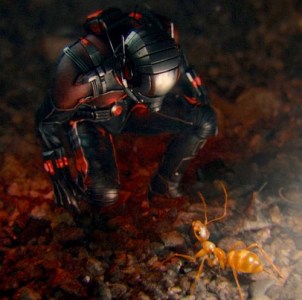 That doesn’t mean it’s a story that doesn’t have stakes, they’re just different stakes. It’s a refreshing change of pace at this point. It’s also pretty much standalone, with nice nods to the shared universe but without being dependent on other films (either before or to come) for its story. Guardians of the Galaxy did that too, but how many other recent Marvel movies is it true of? Even the highly-praised Winter Soldier is a long, long way from being immune to that fault.
Still, I doubt many people are going to call Ant-Man their favourite Marvel movie, although I think it might be the most pure fun I’ve had watching an MCU film since… well, ever. And I like fun.
Ant-Man is available on DVD and Blu-ray in the UK now, and in the US from next week.
It placed 20th on my list of The 20 Best Films I Saw For the First Time in 2015, which can be read in full here.
This review is part of the 100 Films Advent Calendar 2015. Read more here.

 Astronauts head to a Saturnian moon to examine its water in this scientifically-accurate drama.

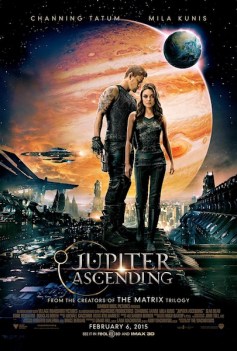 Ah, the Wachowskis. They made
  The plot… oh, do I have to explain the plot? It’s some rubbish about a cleaner (Mila Kunis) getting attacked by aliens and some alien crossbreed in magic flying shoes (Channing Tatum) coming to her rescue, and taking her to a half-bee man (Sean Bean — there has to be a “Sean Bee-n” joke here…), and then into space, because she’s… nope, not the Chosen One (makes a change, at least) but a reincarnation of someone important, and her surviving family members (Douglas Booth, Tuppence Middleton, Eddie Redmayne) have a vested interest in her — which may or not be that they want her dead (again).
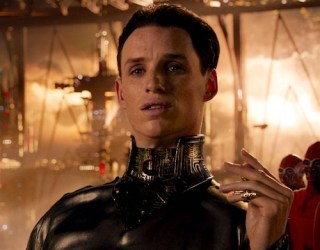 I guess it works for some people, but while it’s not bad, it also didn’t do much for me. And every time something almost works, something else undermines it, like Tatum’s make-up, or his flying boots, or Redmayne’s bizarre, affected performance. Though, to be honest, I think he’s so bad he’s good, a phrase you often hear bandied around but rarely see actually happen.
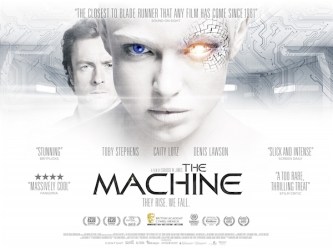 In a near future where Britain is part of a Cold War against China, a scientist (Toby Stephens) has been trying and failing to perfect artificial intelligence at a government research facility. When he hires a new associate (
 This may explain why the performances are a mixed bag. Toby Stephens can’t seem to find much to work with in his lead role, despite supposedly having a couple of emotional arcs. Lawson sleepwalks through his turn as a shady government higher-up. Lotz is unremarkable as a human, but fantastic as the AI-driven machine. Her performance as the latter is the primary reason to consider watching the film.
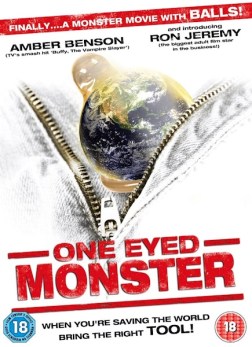 Sometimes, I swear off consciously watching any more likely-to-be-bad movies. And sometimes, I just feel like attempting something like One-Eyed Monster. And this is why: it’s actually pretty fun.
 hide it behind an age barrier in the euphemistically-titled “adult” section of their website. Anyone looking for those kind of kicks is going to be disappointed, although there’s still plenty of vulgar and crude dialogue to justify its 18 certificate. In actuality, it’s mostly above using “we said a rude word!” as a ‘joke’, which is one positive it has over many more mainstream ‘comedies’.
 The second release in Warner Premiere’s series of direct-to-video DC Universe Animated Original Movies (which now stretches to
  However, there are definitely bits that could’ve been sacrificed or abridged further (the Flash’s two early action sequences, for instance) to make more room to tell the story in full.
 I really wanted to like The New Frontier, for all sorts of reasons. It does start well, with moments of promise sparkling here and there, but the longer it spends juggling so many balls, the fewer it can keep flying smoothly. (Do balls “fly” when juggled? Anyway, you get my point.) Considered as a whole, the overall result is fairly disappointing.
 Screened at the London Film Festival earlier this month, then made available on MUBI in the UK (where you can, if you want,
  That’s the whole movie, more or less. I haven’t spoiled it for you because you’re not going to watch it because why would you? There is no discernible story or meaning; there is no characterisation; there is nothing but imagery and snippets of moments that signify nothing. It is a movie that has deliberately left out any explanations. Apparently the director has said it’s all a criticism of global capitalism, or something. Even with that extra-filmic information, it’s still difficult to ascertain much meaning. This isn’t realism — this isn’t avoiding “hello, person who is my brother” dialogue — this is obtuseness for obtuseness’ sake.
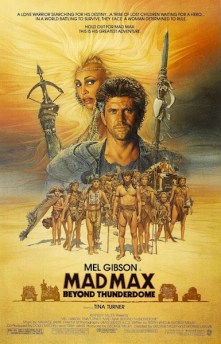 The third (and, for 30 years, final) Mad Max movie sees the titular post-apocalyptic drifter (Mel Gibson) rock up at last-outpost-of-humanity Bartertown in search of his pilfered car and camels. Max finds himself dragged before the town’s ruler, Aunty (Tina Turner), who has a job for him: kill the mutinous overseer of the city’s power supply, Master Blaster. As payment, she’ll arrange for the return of his belongings. The only conditions are he can’t reveal Aunty has employed him, and he has to do it in a fair fight in the town’s arena of combative justice — the Thunderdome. And then the story goes beyond that, funnily enough.
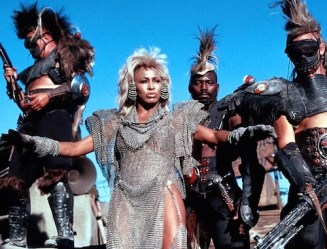 I didn’t even notice the change in level until I read those comments afterwards. The film still reaches a 15 certificate in the UK, so clearly it isn’t toned down that much. And the lack of visible blood doesn’t mean it lacks creativity: Roger Ebert
 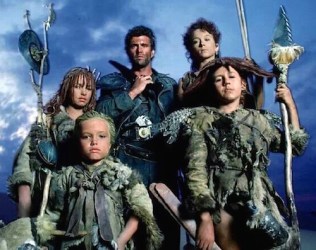 that have been forced to coexist because neither was enough to sustain an entire feature, but at least neither part feels unduly padded, meaning the narrative keeps on rolling. It doesn’t hit the same heights as the exceptional Mad Max 2 — especially with a climax that invites a direct comparison, and is good but not as good — but, as a post-apocalyptic action-adventure movie in its own right, it’s a good film.
 If you’re not au fait with the
  as both sides attempt to rally ordinary people to their cause through the power of the media. It’s a tale that’s as timely as ever, surely.
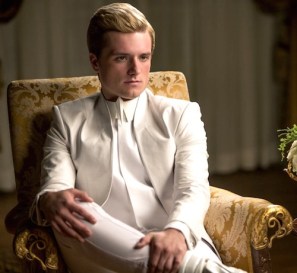 I must say that (as someone who hasn’t read the book) it didn’t feel overly like the first half of something longer to me. Of course there’s a cliffhanger and stuff, but there was at the end of the last film as well. This is no worse than that. If anything, I felt Mockingjay Part 1 built to its ending more successfully — I was quite surprised when
 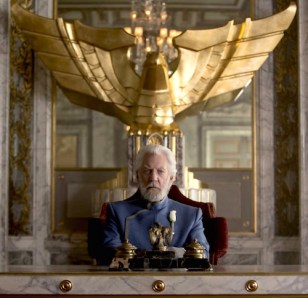 it may be your favourite instalment so far (and you wouldn’t be alone in that view). For me, Catching Fire is the best of the three because it crystallises both of those constituent elements; and if the first film was purely the action side (with a bit of the politics), then here we find its mirror image: purely politics (with a bit of action). Either way, perhaps the ultimate fate of all these films rests on how well
  Director Steven Soderbergh takes the methodology he used to depict the drug trade in
  100Films.co.uk