Badlands (1973)

2016 #87
Terrence Malick | 94 mins | streaming (HD) | 16:9 | USA / English | 18* / PG

BadlandsThe debut feature of Terrence “four films in 30 years” Malick comes with a tagline-cum-plot-description so good I’m just going to quote it wholesale:

He was 25 years old. He combed his hair like James Dean. He was very fastidious. People who littered bothered him.
She was 15. She took music lessons and could twirl a baton. She wasn’t very popular at school.
For awhile they lived together in a tree house.
In 1959, she watched while he killed a lot of people.

As 60-word summaries go, that pretty fairly covers the characters, plot, and, to some degree, the film’s tone. It’s loosely based on a real-life killing spree (which also inspired several other movies, including Natural Born Killers), though it’s told with Malick’s style of cinematic poetry, rather than documentary realism or sensationalised violence. Malick has spoken of trying to give the story a fairy tale tone, to “take a little of the sharpness out of the violence but still keep its dreamy quality.” The latter is definitely true: the extended sequence where the young lovers live in a treehouse in the woods has an ethereal feel, like a daydream fantasy. For me it was probably the film’s most memorable section, though it’s the least related to the central criminal thrust.

As for removing the sharpness of the violence, I’d argue that, if anything, Malick has heightened it. When it comes it is short and shocking, kind of grubby and nasty. While the film may contain dreaminess and poetry, it’s not a pleasant experience. The shabby lives Crazy kidsthe leads start out from bleeds outwards into their time on the run, which Holly romanticises but feels constantly grotty. I suppose a film about killers shouldn’t be nice, but maybe this is why the time in the treehouse stood out for me — a little oasis of pleasantness; a break from the insalubriousness of the rest of the picture.

It’s fair to say I didn’t like the film very much, which is not the same as saying it’s not good. The adjective I keep coming back to is “grubby” — in spite of its occasional beauty, it has a grubbiness in its production, which tells a story of grubby people leading grubby lives in grubby circumstances as they perform grubby acts. I suppose that unpleasantness is a necessary counterpoint to the innumerable movies we have that glamorise violent lifestyles.

4 out of 5

* Badlands was reclassified 15 in 2008, but that was only for cinema releases. I watched it at home, where technically it’s still an 18. Ah, the BBFC. ^

Magic in the Moonlight (2014)

2016 #151
Woody Allen | 93 mins | streaming (HD) | 2.35:1 | USA & UK / English | 12 / PG-13*

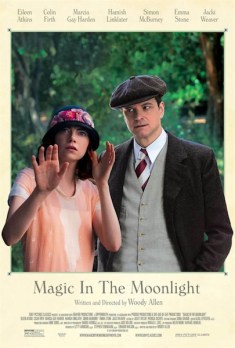
Magic in the MoonlightWoody Allen’s 44th film is a Sunday-afternoon-style period comedy, which nonetheless manages to touch on issues of existentialism and the meaning of life. If that sounds terribly Deep, don’t worry: Magic in the Moonlight may tickle your fancy, but it’s unlikely to tax your brain.

Colin Firth stars as Stanley Crawford, a genius illusionist and renowned debunker of spiritualists, who’s recruited by fellow magician and childhood friend Howard Burkan (Simon McBurney) to expose a young ‘psychic’ named Sophie Baker (Emma Stone), who has enthralled a rich family in the South of France, but whose methods have Howard stumped. Despite his unconcealed cynicism, Stanley too struggles to find the truth, but he does find himself increasingly smitten with Sophie…

After this setup the plot is no great shakes (the one twist is eminently guessable), but the rest of the film is a romantic confection made up of sunny Côte d’Azur locations, pretty vintage costumes, gently witty dialogue, and quality actors gamely playing along. Firth is hardly stretched as a romantic lead — indeed, he has one scene that is virtually lifted wholesale from Pride & Prej — but Stanley’s pompousness and sarcastic cynicism gives the role a little bite. Emma Stone’s big eyes do half the work for her, though she still gives it her all in a way that makes her character and performance endearing. Eileen Atkins, as Firth’s beloved aunt, and McBurney get halfway decent supporting parts, though there’s little time for the rest of the cast, especially Marcia Gay Harden, whose role as Stone’s mother is virtually nonexistent.

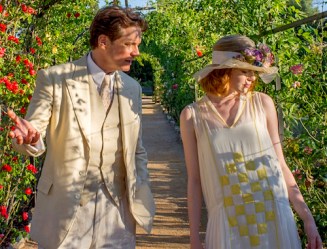
Magic with daylightThe most pleasing aspect is probably Darius Khondji’s photography. He emphasises the region’s beautiful golden light, with saturated colours emphasised by deep shadows, to create a warm and idyllic atmosphere, further accentuated by the twinkling blue ocean and stunning locales. It’s exemplary work that will likely make you long for distant times and places.

It may ultimately be a slight work, then, but it is still a delightfully pleasant way to spend 90-something minutes.

4 out of 5

* for “a brief suggestive comment, and smoking throughout”. So, it’s a PG, really. ^

Pride and Prejudice (1940)

2016 #122
Robert Z. Leonard | 113 mins | TV | 4:3 | USA / English | U

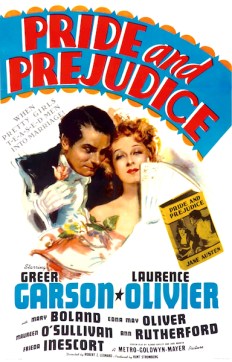
Pride and PrejudiceThe first adaptation of Jane Austen’s ever-popular novel, MGM’s film is a compromised endeavour: by executives softening dialogue and rewriting characters; by changing its setting to permit grander costumes; by Gone with the Wind using all the Technicolor stock, forcing the lavish production to shoot in black-and-white.

Nonetheless, it emerges a solid take on Austen (until the ending goes thoroughly astray). Laurence Olivier is a suitably moody Darcy and, though far too old for the part, Greer Garson makes a witty Lizzy.

Massively overshadowed by later adaptations, this remains an entertaining version for anyone not too concerned about textual faithfulness.

4 out of 5

A Royal Night Out (2015)

2016 #82
Julian Jarrold | 97 mins | streaming (HD) | 2.35:1 | UK / English | 12 / PG-13

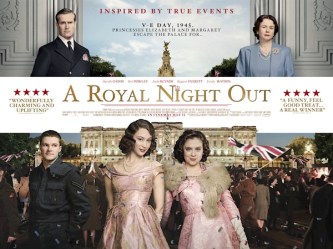
A Royal Night OutA somewhat remarkable true story gets romanticised in this likeable comedy about King Colin Firth (Rupert Everett) and Queen Olivia Colman (Emily Watson) allowing Princesses Elizabeth (Sarah Gadon) and Margaret (Bel Powley) to go out on the town on V.E. Day. When Margaret runs off, Liz teams up with a grumpy squaddie (Jack Reynor) to track her down.

Gently amusing and relatively briskly paced, A Royal Night Out is lightweight and unchallenging, the definition of Heritage-ish lazy Sunday afternoon viewing. That means it will rub some viewers up the wrong way, but others will love its simple, old fashioned charms.

3 out of 5

On Her Majesty’s Secret Service (1969)

100 Films’ 100 Favourites #66
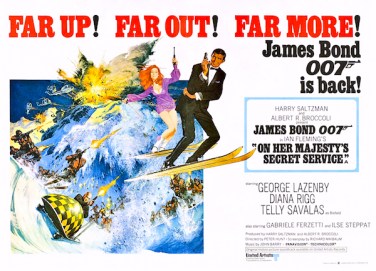
Far up! Far out! Far more!
James Bond 007 is back!

Country: UK & USA
Language: English, German & French
Runtime: 142 minutes
BBFC: A (cut, 1969) | PG (1987)
MPAA: M (1969) | PG (1994)

Original Release: 13th December 1969 (Japan)
UK Release: 18th December 1969
US Release: 18th December 1969
First Seen: TV, c.1995

Stars
George Lazenby (Who Saw Her Die?, Gettysburg)
Diana Rigg (The Assassination Bureau, Theatre of Blood)
Telly Savalas (The Dirty Dozen, Kelly’s Heroes)

Director
Peter Hunt (Shout at the Devil, Death Hunt)

Screenwriter
Richard Maibaum (From Russia with Love, The Spy Who Loved Me)

Additional dialogue by
Simon Raven (Unman, Wittering and Zigo, The Pallisers)

Based on
On Her Majesty’s Secret Service, the tenth James Bond novel by Ian Fleming.

The Story
After James Bond saves the life of Teresa DiVincenzo, her mob boss father offers him information on the location of Ernst Stavro Blofeld, who Bond has been unsuccessfully tracking for years. Operating against orders to drop his investigation, Bond goes undercover in Blofeld’s Swiss research facility to find out what nefarious scheme he’s plotting now…

Our Hero
Bond, James Bond, agent 007 of the British secret service. On this mission, he falls in love and gets married — that never happened to the other fella!

Our Villain
Bond’s second face-to-face confrontation with the head of S.P.E.C.T.R.E., evil mastermind and archetypal uber-villain Ernst Stavro Blofeld, now played by Telly Savalas. It’s a very good villainous performance, though possibly suffers by coming after Donald Pleasance’s iconic turn in You Only Live Twice.

Best Supporting Character
Contessa Teresa Draco DiVincenzo — aka Tracy, the only woman headstrong, intelligent, and bold enough to tie down international playboy James Bond.

Memorable Quote
“It’s all right. It’s quite all right, really. She’s having a rest. We’ll be going on soon. There’s no hurry, you see. We have all the time in the world.” — James Bond

Quote No One’s Going to Use in Everyday Conversation Anymore, That’s For Sure
Bond: “I find her fascinating, but she needs a psychiatrist, not me.”
Draco: “What [my daughter] needs is a man… to dominate her! To make love to her enough to make her love him! A man like you!”

Memorable Scene
As M, Q, and Moneypenny sit around wondering where the devil 007 is, a shadowy man drives an Aston Martin accompanied by the Bond theme. (As in we hear it — he’s not got it on the stereo.) To his surprise, he’s overtaken by a woman. A few miles down the road, he sees her car stopped by the beach, and she’s walking out to sea. He runs after her, scoops her up and carries her back to the shore. As she wakes up, we see his face for the first time — and it’s not Sean Connery! But he does say, “My name’s Bond. James Bond.” Then he has a punch-up. A tradition (keeping the new Bond’s face a ‘secret’ until some kind of reveal*) is instantly born.

* Not that this happens in Live and Let Die. Or Casino Royale, really. Oh well.

Write the Theme Tune…
Regular series composer John Barry aimed to help cover for the absence of Connery by making the score “Bondian beyond Bondian”, and this certainly applies to the main title theme: an instrumental number (of which there are only three in the entire series) which is surely second only to the main James Bond theme in its Bondianness. It’s a fantastic action number that sits just as well over the ski sequences as it does the opening titles. (There’s also a great cover version by the Propellerheads on David Arnold’s Shaken Not Stirred album, by-the-by.)

Sing the Theme Tune…
Nonetheless, the film does contain an original song, composed by Barry with lyrics by Hal David, and — most famously — sung by Louis Armstrong in his final recording: We Have All the Time in the World. Considering the 1967 Casino Royale also produced The Look of Love, it was clearly an unusually fertile time for Bond films to produce songs that transcended their origins.

Technical Wizardry
Various methods were used to capture the Alpine action scenes, including camera operators skiing alongside the stuntmen (backwards while holding a camera!), and using Swiss Olympic athletes for the bobsled chase (with the sequence rewritten to incorporate their accidents). Most remarkable, though, was the aerial photography achieved by cameraman Johnny Jordon. To get flexibility to shoot scenes on the move from any angle, he developed a system where he was dangled 18 feet below a helicopter in a parachute harness. Mad.

Looking good, Lazenby!Letting the Side Down
There’s little doubt that George Lazenby is the worst big-screen Bond (though all of those who came after have their detractors), but he’s not actually that bad — he certainly sells the film’s emotional ending in a way I can’t quite picture Connery managing. If he’d stuck around for a few more movies I imagine he’d be better regarded. What really lets him down is his costuming — that frilly-shirt-and-kilt outfit is half the reason people who dislike the film dislike it so much, I swear. (Here it is bigger, if you want a good look.)

Making of
Various stars of The Avengers (the classic British TV series, not the Marvel superheroes) have appeared in the Bond series — Honor Blackman in Goldfinger, Patrick Macnee in A View to a Kill (plus narrating loads of the DVD documentaries), and of course Diana Rigg here — all after they appeared on the TV show. The exception is Joanna Lumley, who appears in a small part here a few years before joining The New Avengers. Despite the diminutive size of her role, Lumley spent two months on the production, dubbing the voices of Blofeld’s whole cadre of women using German, Chinese, and Norwegian accents. She also taught the other actresses to crochet, so that was nice.

Previously on…
Five James Bond films starring Sean Connery.

Next time…
After Lazenby pulled out of his contract, Connery returned for Bond’s next adventure. There have been 17 Bond adventures on the silver screen since that, and the series continues indefinitely, with a 25th entry due in 2018 or so. On Her Majesty’s Secret Service was adapted for radio in 2014, the fourth of (to date) five Bond radio adaptations starring Toby Stephens as 007.

Awards
1 Golden Globe nomination (Most Promising Male Newcomer (George Lazenby))

How OHMSS Got a Bad Reputation
“I suspect the average filmgoer still believes Lazenby was fired because the movie flopped. Wrong on both counts. OHMSS was not a blockbuster on the scale as Connery’s previous two films, but it was a solid hit. Box-office returns were no reason to fire Lazenby, and he wasn’t fired. He quit. […] OHMSS would go over schedule and over budget and [director Peter Hunt] would continually clash with his producers as well as his star. When OHMSS didn’t prove to be a runaway success, the public would blame Lazenby, but Saltzman and Broccoli and United Artists privately blamed Hunt along with his insistence on creating a tense, serious action film faithful to Fleming. Perversely, the finest film in Broccoli and Saltzman’s series became the model of everything they wanted to avoid in the future. In their desire to run from all that OHMSS represented, they turned the next film, Diamond Are Forever, into the dumbest, sloppiest mess in the series’ history. But Connery had returned so it was another substantial box-office hit, and the producers felt vindicated in their artistically disastrous decisions. The success of Diamonds Are Forever dealt a hit to OHMSS’s reputation. Thankfully, quality cannot go ignored for long and as more people discovered Hunt’s neglected masterpiece, the more admired it has become.” — Jeffrey Westhoff, Culture Spy (that whole piece is excellent, by-the-by)

What the Critics Said
“it is nothing short of miraculous to see a movie which dares to go backward, a technological artefact which has nobly deteriorated into a human being. I speak of the new and obsolete James Bond, played by a man named George Lazenby, who seems more comfortable in a wet tuxedo than a dry martini, more at ease as a donnish genealogist than reading (or playing) Playboy, and who actually dares to think that one woman who is his equal is better than a thousand part-time playmates. […] The love between Bond and his Tracy begins as a payment and ends as a sacrament. After ostensibly getting rid of the bad guys, they are married. They drive off to a shocking, stunning ending. Their love, being too real, is killed by the conventions it defied. But they win the final victory by calling, unexpectedly, upon feeling. Some of the audience hissed, I was shattered.” — Molly Haskell, The Village Voice

Score: 82%

What the Public Say
“Not everybody is wrong about this film, of course. Steven Soderbergh and Christopher Nolan are both fond of this film. As am I. There are problems with this film, to be certain, and the problems do lie (mostly) with Lazenby. […] Having gone with the amateur Bond, they upped the ante for the girl. Diana Rigg was already a star from The Avengers and was perfectly suited to be a Bond girl. [She] is the answer, of course, as to why this film ranks as high as it does on the list of Bond films when Lazenby is so lackluster a Bond. Yes, there are good things in the film beside her – the ski scenes, the bobsled scene (you can tell the close-ups are rear projection but the longshots are real and exciting), the tragedy of the ending. But, for the first 40 years of the series she was the height of the Bond girls and she pulls this film higher than we had any right to originally expect.” — Erik, News from the Boston Becks

Verdict

The history of opinion on OHMSS is a fascinating one: written off as a failure, the series’ black sheep thanks to Lazenby and the less fantastical tone than the films that surround it; then gradually rehabilitated precisely because of that tone, to the point where it’s now almost “the Bond fan’s Bond film” (it certainly still has its detractors, who are either baffled by or in denial of its acclaim in other quarters). The ways it subverts the Bond formula are part of what makes it so memorable, but so are the ways it plays up to it, like Blofeld’s mountaintop base: considerably more plausible than the hollowed-out volcano (it’s a real place, for one thing), but no less incredible. Similarly, there’s an atypical plot, but also incredible action sequences — all done for real, too (well, aside from some iffy back projection). It does have faults that hold it back from being the best Bond movie in my estimation, but it’s up with the series’ best nonetheless.

#67 will be… a Western fairytale.

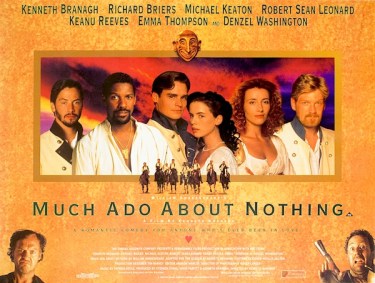
Much Ado About Nothing (1993)

100 Films’ 100 Favourites #64

A romantic comedy for anyone
who’s ever been in love.

Country: UK & USA
Language: English
Runtime: 111 minutes
BBFC: PG
MPAA: PG-13

Original Release: 26th May 1993 (France)
UK Release: 27th August 1993
First Seen: VHS, c.1997

Stars
Kenneth Branagh (Henry V, Hamlet)
Emma Thompson (Howards End, Sense and Sensibility)
Kate Beckinsale (Underworld, Love & Friendship)
Robert Sean Leonard (Dead Poets Society, House)
Denzel Washington (Glory, Training Day)
Keanu Reeves (Bill & Ted’s Excellent Adventure, The Matrix)
Richard Briers (Watership Down, Hamlet)
Michael Keaton (Beetlejuice, Birdman)

Director
Kenneth Branagh (Henry V, Thor)

Screenwriter
Kenneth Branagh (In the Bleak Midwinter, The Magic Flute)

Based on
Much Ado About Nothing, a play by William Shakespeare.

The Story
When Don Pedro and his chums visit his friend Leonato at his villa in Sicily, they wind up arranging a marriage between Leonato’s daughter, Hero, and one of Don Pedro’s men, Claudio. To bide time until the nuptials, the happy friends attempt to reconcile argumentative pair Beatrice and Benedick — but Don Pedro’s good-for-nothing half-brother, Don John, plots revenge by ruining Hero’s reputation…

Our Heroes
The plot hinges on the romance of Claudio and Hero, and the machinations of Don John to disrupt it, but the central characters are Beatrice and Benedick and the witty verbal sparring that characterises their love-hate relationship.

Our Villains
Don John, the bastard. Because he’s an illegitimate son. But also because he tries to ruin someone’s wedding by faking infidelity, which isn’t exactly the nicest way to behave.

Best Supporting Character
Don Pedro, a prince who has just quashed an uprising by his duplicitous half-brother (see above), seems to be an inveterate matchmaker, first arranging Claudio’s marriage to Hero, then plotting to see Beatrice and Benedick coupled — despite quietly professing his own feelings for Beatrice.

Memorable Quote
“He that hath a beard is more than a youth, and he that hath no beard is less than a man. And he that is more than a youth is not for me, and he that is less than a man, I am not for him.” — Beatrice

Memorable Scene
The plan to dupe Beatrice and Benedick into loving each other in action: in the villa’s gardens, Don Pedro, Leonato, and Claudio ensure Benedick is eavesdropping while they stage a conversation about how much Beatrice loves him, and Hero and her maid Ursula do the same to Beatrice.

Letting the Side Down
I’ve always thought the scenes featuring Michael Keaton and Ben Elton hamming it up are a bit… broad.

Making of
The CliffsNotes on the play also cover this film, and notes that “the [opening] scene is cut by more than half, and yet the omissions are seamless to any viewer who has not memorized the lines or is not following the script. Branagh has omitted or cut to the bone several subsequent scenes and their lines, sometimes inserting in their place a visual scene that conveys the incident more dramatically than the words. At other times, he has cut lines and thinned out long speeches to keep the story moving and to eliminate unnecessary details.” Other major cuts are listed at the link.

Awards
Nominated for the Palme d’Or
1 BAFTA nomination (Costume Design)
1 Razzie nomination (Worst Supporting Actor (Keanu Reeves))

What the Critics Said
“Shakespeare’s comedies were always meant for the people […] the subject matter was low: sexual politics, power games, nasty betrayals, romantic deceptions and other quintessentially human activities. […] Maybe these plays were classics of the future, but they were the Benny Hill of their time. With Much Ado About Nothing, Kenneth Branagh has, once again, blown away the forbidding academic dust and found a funny retro-essence for the ’90s.” — Desson Howe, The Washington Post

Score: 91%

What the Public Say
“For those who don’t find Shakespeare’s comedies funny, this is the film to see, because it’s hilarious. It isn’t just the lines that create laughter, but the manner in which they’re set up and delivered. Expressions and actions often play a large part in the comedy, some of which is decidedly physical. These are the kinds of things that don’t appear on the written page. The film also contains its share of drama, and the pathos and poignancy come as easily and naturally as humor. […] I’m not sure if ‘feel good’ has ever been used to describe a picture based on the Bard’s work, but the expression fits.” — James Berardinelli, ReelViews

Verdict

There’s a lot of comedy in Shakespeare — not just in his Comedies, but scenes in his Tragedies too (even a pretty dark one like Macbeth sees the story put on pause to indulge in a comedic monologue). The problem is, to modern ears at least, it’s just not funny (that one in Macbeth is commonly cut). So it’s an even greater achievement that writer-director-star Kenneth Branagh here produced a film that was both accessible and genuinely funny. Combining intelligent cuts to the text with assured performances produces a film that, at its best, plays like a period screwball comedy. Consequently, it was that rare thing: a Shakespeare adaptation that became a box office success. That’s something worth making much ado about.

#65 is… number one. All others are number two, or lower.

Moulin Rouge! (2001)

100 Films’ 100 Favourites #63

Truth — Beauty — Freedom — Love

Country: USA & Australia
Language: English
Runtime: 128 minutes
BBFC: 12
MPAA: PG-13

Original Release: 16th May 2001 (L.A., USA)
UK Release: 7th September 2001
First Seen: DVD, 2002

Stars
Nicole Kidman (Eyes Wide Shut, The Hours)
Ewan McGregor (Trainspotting, Star Wars – Episode III: Revenge of the Sith)
John Leguizamo (Super Mario Bros., Land of the Dead)
Jim Broadbent (Iris, Harry Potter and the Half-Blood Prince)
Richard Roxburgh (Mission: Impossible II, Van Helsing)

Director
Baz Luhrmann (Romeo + Juliet, Australia)

Screenwriters
Baz Luhrmann (Strictly Ballroom, The Great Gatsby)
Craig Pearce (Romeo + Juliet, The Death and Life of Charlie St. Cloud)

Music by
Craig Armstrong (Love Actually, The Great Gatsby)

The Story
Paris, 1899: while pitching a show to the owner of the Moulin Rouge nightclub, writer Christian falls for the venue’s leading lady, Satine. Despite her mutual attraction, Satine has been promised to the Duke of Monroth in exchange for his investment in the cabaret. As preparations for the show continue, Christian and Satine’s love blossoms nonetheless. Will true love conquer commerce?

Our Heroes
Christian is just a poor, miserable poet living among Bohemians in turn-of-the-century Paris, until he meets and falls in love with Satine, the Moulin Rouge’s star act and courtesan.

Our Villain
Unfortunately for Christian, Satine has been promised to the Duke of Monroth, a nasty piece of work who will have his way or have Christian killed.

Best Supporting Character
The Moulin Rouge’s exuberant owner, Harold Zidler, is prepared to essentially sell Satine for investment in his establishment. Which makes him sound like a horrible so-and-so, but actually he cares for her deeply.

Memorable Quote
“The greatest thing you’ll ever learn is just to love and be loved in return.” — Christian

Memorable Scene
Zidler convinces Satine that she must tell Christian she doesn’t love him, to save his life from the murderous intentions of the Duke. As she leaves the Moulin Rouge to break Christian’s heart, Zidler delivers an emotional rendition of Queen’s The Show Must Go On.

Best Song
The film is packed with interesting reinterpretations of modern pop hits. Personally, I love a reimagined cover version, so picking just one is bloody tough. There are a couple of mash-ups that work particularly well: the big number when Christian & friends first arrive at the eponymous establishment, which crashes Lady Marmalade against Smells Like Teen Spirit; and the Elephant Love Medley, which wittily re-appropriates lyrics from a gaggle of love songs (eight, to be precise) into one number. However, the best of all may be a reimagining of the Police’s Roxanne as a dramatic dance number, El Tango de Roxanne.

Technical Wizardry
One of the most controversial aspects of what is a love-it-or-hate-it film anyway is its editing style. Eschewing the familiar trappings of Hollywood musicals, Luhrmann has the entire film shot (by Donald M. McAlpine) and edited (by Jill Bilcock) as if it were a modern music video. In total, there are just shy of 3,600 shots in the film (according to this analysis), which gives it an Average Shot Length (ASL) of just 2 seconds. For comparison, the mean ASL for US films released the same year was around 5 seconds. Even now, over a decade later, the ASL for English-language films sits at about 2.5 seconds.

Making of
It’s now quite well known that musicals need to contain a brand-new song to be eligible for the Best Song Oscar. Obviously this is normally relevant to adaptations of stage musicals, but naturally it applies to Moulin Rouge, too. The film’s one new song is Come What May, but it was ruled ineligible for the Oscar because it was actually written for Luhrmann’s Romeo + Juliet, even though it wasn’t used in that film. The music arm of the Academy really are a tricky bunch.

Previously on…
Moulin Rouge is the third part of Baz Luhrmann’s thematically-linked Red Curtain Trilogy, following Strictly Ballroom and Romeo + Juliet.

Awards
Nominated for the Palme d’Or
2 Oscars (Art Direction-Set Decoration, Costume Design)
6 Oscar nominations (Picture, Actress (Nicole Kidman), Cinematography, Editing, Makeup, Sound)
3 BAFTAs (Supporting Actor (Jim Broadbent), Music, Sound)
9 BAFTA nominations (Film, Director, Original Screenplay, Cinematography, Production Design, Costume Design, Editing, Visual Effects, Make Up/Hair)
5 Australian Film Institute (AFI) awards (Cinematography, Editing, Sound, Costume Design, Production Design)
5 AFI nominations (Film, Director, Actor (Ewan McGregor), Actress (Nicole Kidman), Supporting Actor (Richard Roxburgh))
3 World Soundtrack Awards (including Most Creative Use of Existing Material on a Soundtrack)
2 World Soundtrack Awards nominations (including Best Original Score of the Year Not Released on an Album)

What the Critics Said
“The time, the effort and the sweat are all up there on the screen in this opulent, no-holds-barred and multilayered movie. [It] is wrapped up in such an audacious mix of traditional and contemporary song — including David Bowie, Elton John, Madonna and Nirvana — and staged with a near-insane visual ambition, you will either fall in love with every camp flourish, or find yourself exhausted after 20 minutes. It’s a singular achievement either way.” — Andrew Collins, Radio Times

Score: 76%

What the Public Say
“one of the great movie spectacles of this generation, an undertaking of vast scope made all the more fascinating by how it transforms commonplace undercurrents into rich sensations […] There is a sense that these concepts are simplified for the sake of basic comprehension, but the picture doesn’t so much strip them of complexities as it penetrates to the core of their meaning. That creates a scenario where the story simply observes the indulgences that manifest in the rhythms, the music, the dance moves, the vocals, the dialogue, the facial expressions and the daydreams that inhabit the characters. It seeks no more profound a purpose. Some find the implication startlingly straightforward in an endeavor where the technical achievements are such a subversive triumph, but I applaud it; how frequently has any ambitious Hollywood production been willing to see past the varnish of a formula and deal directly with the ideals[?]” — David M. Keyes, Cinemaphile

Verdict

These days there are plenty of musicals appearing on the big screen, and they’re often contending for the top gongs come awards season. This wasn’t the case back in 2001 — Moulin Rouge, divisive as it is, changed all that (it was the first musical nominated for the Best Picture Oscar in a decade, and the previous one was a Disney animation). Baz Luhrmann’s injection of modern MTV style gave the genre a kick up the arse, which isn’t necessarily to the taste of classic musical fans but certainly brought the genre renewed mainstream attention. Mixing in his theatrical storytelling, melodramatic emotions, and vibrant and extravagant costumes and sets, Luhrmann created a heady film designed to give modern audiences a sense of how visiting the Moulin Rouge would’ve felt in 1899 (well, it’s certainly not the literal experience!) It’s clearly not a film that meets all tastes, but if you’re on its wavelength then it’s magnificent.

The first half of Baz Luhrmann’s Netflix series, The Get Down, was released on Friday, which is a neat coincidence.

#64 will be… a lot of fuss over very little.

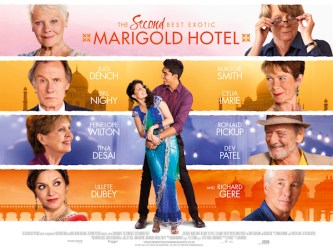
The Second Best Exotic Marigold Hotel (2015)

2016 #38
John Madden | 118 mins | streaming (HD) | 2.35:1 | UK & USA / English & Indian | PG / PG

The Second Best Exotic Marigold HotelThe Best Exotic Marigold Hotel is not the kind of movie you expect to spawn a sequel in the current climate (i.e. it’s not a CGI-fuelled PG-13 science-fiction action extravaganza), but when you consider that it made $136.8 million on a budget of just $10 million, the existence of this follow-up becomes more understandable. The first was based on a novel, but that doesn’t have a sequel, so you’d be forgiven for assuming the movie sequel is a shameless cash-in. Far from it — if anything, it may even be better than the first.

There’s little point me setting up the plot here, because if you haven’t seen the first movie then this one launches out of it enough that you’ll spend forever playing catch-up, and if you have seen it, well, “the storylines continue” sums much of it up. The sequel is given narrative shape both by the forthcoming wedding of the hotel’s owner (Dev Patel), and the fact that he wants to open a second location. For the latter he’s sought funding from a US chain, so when Richard Gere turns up he’s assumed to be a ‘secret shopper’ come to assess the hotel.

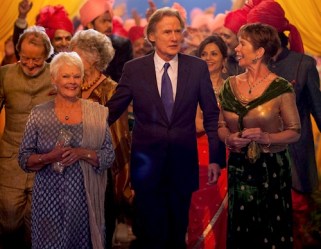
As that story unfolds, along with the film’s raft of subplots, it essentially repeats the tone of the first movie: gentle drama mixed with gentle humour in roughly equal measure; though this time there’s an added dose of romance in pretty much every plotline. It works because the cast are so darn good at delivering their material. Dev Patel and Maggie Smith are both hilarious, though everyone gets a moment to shine in the comedy stakes; conversely, Judi Dench and Bill Nighy carry the heart of the movie — though, again, everyone gets their emotional moment.

It’s easy to dismiss films like this as twee vehicles chasing the so-called ‘grey pound’, but, in this instance at least, that would do it a disservice. When a film is as amusing and emotional as this one, while also exploring an increasingly relevant aspect of life — an aspect which is too often ignored by mass entertainment that’s more concerned with acquiring the easily-earned disposable income of youngsters — and is as well-made, too (in particular, Ben Smithard’s cinematography is rich with gorgeous light, colour, and contrast) — then its audience should reach far wider than the age bracket of its principal characters.

4 out of 5

Brooklyn (2015)

2016 #63
John Crowley | 112 mins | streaming (HD) | 1.85:1 | UK, Canada & Ireland / English | 12 / PG-13

BAFTABritish Academy Film Awards 2016
6 nominations — 1 win

Winner: Best British Film.
Nominated: Best Leading Actress (Saoirse Ronan), Best Supporting Actress (Julie Walters), Best Adapted Screenplay, Best Costume Design, Best Makeup and Hair.


BrooklynAdapted from Colm Tóibín’s award-winning 2009 novel by novelist-turned-screenwriter Nick Hornby and director John Crowley (Boy A, Is Anybody There?), Brooklyn is the story of Eilis Lacey (Saoirse Ronan), a young woman in 1950s Ireland who leaves behind her mother (Jane Brennan) and older sister (Fiona Glascott) for an exciting new life in New York. Lodging at the boarding house of Mrs Keogh (Julie Walters) with a gaggle of other girls and working in a glamorous department store, Eilis comes out of her shell, and falls for nice Italian-American lad Tony (Emory Cohen). When tragedy calls her back to Ireland, Eilis encounters nice Irish lad Jim (Domhnall Gleeson). Will she stick with her new life, or return home as a new woman?

That’s basically the plot of the whole film, bar the details; but the meat of Brooklyn is in the details, and knowing the shape of the story going in may even work to its benefit — it’s the kind of movie that might not look like it’s ‘about’ all that much. An easy point to pick on would be Eilis’ status as an immigrant, what with works of art about “the immigrant experience” being a definite Thing. There’s an element of that in the film, certainly, but I would say it’s not about anything so worthy-sounding. More, it’s a coming-of-age movie, about leaving home, spending time away, and then coming back to find home is different — not because it’s changed, but because you have. You don’t have to emigrate to understand that feeling — anyone who’s done something like go to uni will surely relate.

Guiding us through this, the film’s heart in every respect, is Saoirse Ronan’s leading performance. I will watch Ronan in essentially anything at this point, both because she seems to choose good material and because, even when she doesn’t, she’s great in it. This is probably her first really mature performance, convincing as a somewhat shy young woman who makes her way out into the world, in the process realising all the confidence she should have in herself. It’s the kind of character and performance that works by accumulation; it’s about the journey, not heavy-handed emoting in a scene or two.

As the family members left behind, Jane Brennan and Fiona Glascott get to give equally subtle performances, conveying reams of emotion in relatively few scenes and with their presence as much as their words. Similarly, Emory Cohen and Domhnall Gleeson might have been stranded with no dramatic meat playing Nice Guys, but they each find enough nuance to sustain their roles. It’s always nice to watch a movie that can tell a romantic story without needing to resort to melodramatic histrionics, and Eilis’ choice is all the trickier for the fact that neither reveals a Dark Side or anything so simple. It’s been noted before that Gleeson was in four of the big awards contenders last year, only picking up a few relatively minor nominations himself (at the Saturn Awards, British Independent Film Awards, and Irish Film and Television Awards), but those four roles display his range magnificently. “One to watch” may be an understatement.

John Crowley’s direction is largely unobtrusive, but that is a very different kettle of fish to lacking quality. The subtle changes in framing, lighting, and colour palette as the film moves through its locations and stages helps emphasise how Eilis is changing, and how the world changes in her perceptions, too. It makes the story’s times and places look beautiful without quite slipping into picture-postcard rose-tinted-memories territory.
Brooklyn is a deceptively simple film that might be easy to dismiss as a slight romantic drama with no real stakes, but I think that would be to do it a disservice. It is fairly subtle and largely gentle (the odd shocking development aside), but it amasses a wealth of feeling and personal development that builds, not to a crescendo, but to a point of emotional understanding.

4 out of 5

Brooklyn is available on Netflix UK as of yesterday.

The Lobster (2015)

2016 #114
Yorgos Lanthimos | 114 mins | streaming (HD) | 1.85:1 | Ireland, UK, Greece, France & Netherlands / English & French | 15 / R

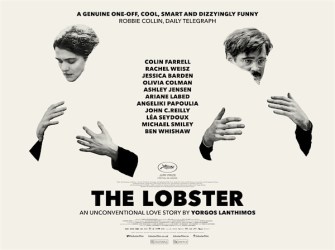
The LobsterThe first English language feature from Greek writer-director Yorgos Lanthimos (of Dogtooth) is set in a relationship-obsessed near-future dystopia. Any person not in a relationship is sent to The Hotel, where they have 45 days to find a partner among the other guests or they get turned into an animal of their choice. Guests can earn extensions to their time in The Hotel by shooting loners — singleton escapees who live in The Woods nearby — during regular hunting trips. The film begins with David (Colin Farrell) discovering his wife has left him, thereby automatically banishing him to The Hotel, where he arrives with his brother — who has been before and failed, so is now a dog. Not an anthropomorphic dog, just a dog. As David makes friends and tries to make a romantic connection, events push him closer to the loners…

The Lobster is the kind of odd movie that critics adore (90% on Rotten Tomatoes) and then, I always feel, spend some of their time looking down their noses at regular folk who don’t get it. In my experience, you have a 50/50 chance of such movies actually being any good. For me, The Lobster straddles that divide. At times it provides wryly amusing absurdist comedy, with the cast’s deliberately stilted performances and the strange situations the characters are subjected to. It also presents almost-thought-provoking observations on the objectively-bizarre rituals of social niceties, filtered through the prism of these unusual individuals and how they use, or don’t, methods of social interaction familiar from our world. If that all sounds a bit pretentious, well, that’s the level you have to engage with The Lobster on if you want to get anything out of it beyond a smattering of oddball laughs.

Even if you accept these goals, Lanthimos’ film eventually goes off the rails. Without meaning to spoil too much, David eventually falls in with the loners, who have their own very specific social rules designed to inhibit partnering up. Revelation: the outsiders are fundamentally the same, just with different rules! That’s about the extent of what I got from this portion of the film; unfortunately, it goes on for a really, really long time. Among this group David meets ‘Short Sighted Woman’ (everyone aside from David is similarly named) and falls in love with her — I mean, of course he does, she’s played by Rachel Weisz. They develop a secret mode of communicating, but will be harshly punished if caught. This storyline is what the film uses to occupy its remaining time, but what it lacks in the offbeat humour of the time in The Hotel it makes up for with… nothing.

At its best, The Lobster is like a Wes Anderson movie run through the mind of a sci-fi-loving sociopath (the dog even gets similar treatment to that of an Anderson movie, again with the same extreme filter). Unfortunately, as you might expect of a sociopath, it doesn’t know when to stop, leaving behind social commentary and alternative humour to drudge through an uninteresting romance to a limp ending. What starts well — though certainly an acquired taste — ends up feeling like a waste of time. Shame.

3 out of 5

The Lobster will be available on Netflix UK from Monday.