
The Jane Austen Book Club (2007)

2008 #54
Robin Swicord | 101 mins | DVD | 12 / PG-13
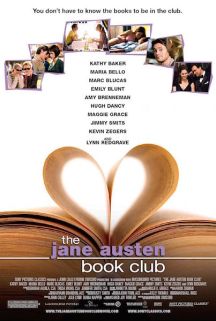
The Jane Austen Book ClubI like to think I have a fairly high tolerance for ‘chick flicks’ — over the years I’ve rather enjoyed films such as Love Actually or Bring It On, and not just because of the male-friendly porn-stand-in scenes or cheerleader costumes — but even I was a bit uncertain about this one at first. However, as it progressed, gradually revealing more about the characters, their lives, and how they cope with what the world throws at them, I found myself increasingly enjoying it. By the time we had to pause it twenty minutes from the end, I found myself itching to continue to find out what would happen.

Inevitably, it’s not flawless. At times it feels like a collection of subplots linked only by the monthly book group meetings, with whichever plot thread is the focus of a scene becoming the de facto main story… until the next scene begins, of course. A working knowledge of Austen’s novels is helpful too. I presumed the film (and book on which it is based) merely invoked Austen’s perennially popular name to boost sales, but there’s actually a fair bit of analysis of the books thrown in, which often reflects what’s happening to the characters. You can get by without an Austen familiarity, but I found the Pride & Prejudice segments made more sense than the others thanks to my (marginally) increased understanding of that particular text.

It would be very easy to pigeonhole The Jane Austen Book Club as a ‘film for women’… and, to be honest, that wouldn’t be at all unfair: it’s as squarely aimed at a female audience as Die Hard is aimed at blokes. It’s also ultimately disposable, apparently with nothing new or revelatory to say about womankind. In spite of all that, I enjoyed it more than I probably had any reason to — and not just because of the male-friendly lesbian character.

4 out of 5

Hairspray (2007)

2008 #53
Adam Shankman | 111 mins | DVD | PG / PG

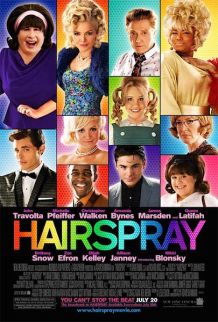
HairsprayWho’d’ve thought a John Waters film could become a bright and breezy musical? It’s a bit of a surprise but, thanks to a successful Broadway version, that’s exactly what’s happened. But while the key to Hairspray’s success may be its positive attitude and memorable songs, perhaps the key to its quality — and the eventual score of this review — are the issues it tackles around those.
It’s the latter that I found must surprising while watching the film. Everything about its advertising campaign, largely young cast and candy-coloured design suggested Hairspray was a light-as-air feel-good flick — no bad thing, but nothing more than a couple of hours of disposable fun. Pleasantly that’s not the case, as the film tackles head-on issues of racism and other such discrimination, with the ‘beautiful people’ — led by a deliciously bitchy Michelle Pfeiffer — doing their best to keep down those who are in any way different, be they black or, in the case of lead character Tracy Turnblad, fat. The apparently fluffy style of the film in many ways makes it perfect to tackle such issues, showing how they can permeate every area of life, not just Serious Social Dramas, and forces those who would normally avoid the latter type of drama to face up to them. Its ultimately happy ending may be more in keeping with the film’s overriding optimism than with reality, but equally it’s wholly appropriate: the crusade against oppression has to end well here, because if it didn’t the concluding message would be “don’t bother fighting, things won’t change”.

The film’s unwavering optimism is perfectly encapsulated by newcomer Nikki Blonsky, leading the cast as Tracy. She’s instantly and constantly likeable, irrepressibly chirpy and yet not annoying — an impressive feat. Equally remarkably, she’s never overshadowed by the heavyweights who round out the cast; instead, they provide able support. Even John Travolta, disturbingly convincing as a housewife (under a ton of makeup), doesn’t steal the show — he comes close, but Blonsky’s performance holds sway. Elsewhere, Christopher Walken, Queen Latifah, James Marsden and Zac Efron all get catchy songs and have a whale of a time — and, unlike the Ocean’s… sequels, the fun the cast is having is infectious.

The first credit at the close is an unusual one: “Directed and Choreographed by Adam Shankman”. Rather than shirking in either department, the rare combination seems to have helped proceedings: the numbers are all exemplarily executed and the direction doesn’t suffer elsewhere. It’s an indication of the music’s quality that even the three cut songs, which play over the end credits, are pretty good and wouldn’t’ve been out of place in the film itself. The first of these is clearly the actual closing number, though the decision to bump it to the end credits, thereby leaving You Can’t Stop the Beat as the final song of the film proper, was a wise one — it makes for a stronger, catchier, more upbeat finale.

Hairspray is a deft mix of issue-driven drama and colourful musical levity. Catchy, optimistic, uplifting, funny and fun, it may just surprise you.

5 out of 5

Hairspray is on Film4 today, Tuesday 11th November 2014, at 6:45pm.

Hairspray placed 6th on my list of The Ten Best Films I Saw For the First Time in 2008, which can be read in full here.

Brideshead Revisited (2008)

2008 #49
Julian Jarrold | 133 mins | cinema | 12A / PG-13

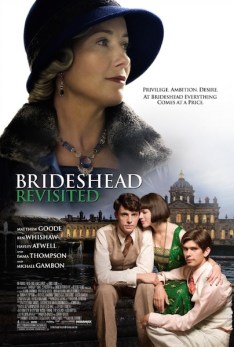
Brideshead RevisitedI’ve not seen the miniseries and I’ve not read the book, but I do know that both are considerably longer than Jarrold’s two-and-a-quarter hours film. So why does it feel so slow? Perhaps it’s the pair of opening flashforwards (easier to refer to them as that than to the majority of the film as one great big flashback), an overused technique these days that here serves no purpose whatsoever: there’s no additional insight on events that follow (or, rather, precede) by placing these snippets at the start, and there’s no new perspective on the snippets when we reach them chronologically (except that, second time round, we actually know who the characters are). It’s the most niggling fault in a film that, like my just-reviewed WALL-E, is of two halves.

The first is very good. It’s entertainingly written and performed, firmly in the tradition of the ‘heritage’ films and TV series that Britain churned out through the ’80s and ’90s — it’s the natural successor to the work of Merchant-Ivory, who of course produced the tonally-similar (at least at first) A Room With a View, which makes this all seem very appropriate. As Sebastian, Ben Whishaw is, perhaps unsurprisingly, the best of the three leads. When he’s off screen you miss him, and the point at which Sebastian leaves the story is arguably when things go off the boil. As Charles, Matthew Goode by and large holds his own — handy really, as he is definitely the centre of the film. Emma Thompson is as you’d expect her to be, which is to say she’s pretty good but ultimately it’s all rather familiar from her other performances.

The second half is where the film falls apart. The focus shifts from Charles and Sebastian’s friendship/possible homosexuality, to Charles and Julia’s love affair. The latter seems to come from nowhere and never takes off, consequently making it hard to accept the lengths they’re prepared to stretch to in order to make it work when they’re finally reunited years later. The plot slowly slides into darker and bleaker territory, needlessly dragging small characters back into proceedings to kill them off and finally pushing towards an Atonement-esque World War II epilogue. Some or all of this is obviously derived from the source, but considering the praise garnered by the novel and miniseries I presume it’s made to work there. Here it doesn’t.

An hour-and-a-half in I couldn’t understand what story there was left to tell, and I continued to be bemused by the sudden import of Charles and Julia’s relationship as the next hour dragged by. It’s a shame, because Brideshead starts out so promisingly and enjoyably, but once it begins to slide it never recovers.

3 out of 5

WALL-E (2008)

2008 #48
Andrew Stanton | 98 mins | cinema | U / G

“Pixar films” seem to have become a bit of a genre unto themselves — yes, they fit into “animation” (always dubious as a genre), “family” (almost as bad), “comedy”, and occasionally a few others, but, much as the Bond films have their own rules and expectations outside the “action” and “spy thriller” conventions, the work of Pixar always achieves special and particular attention. WALL-E subverts some of these expectations (it’s not a buddy comedy, mainly) and has received huge amounts of praise — “consequently”, some might add. It is indeed a very good film, but you’ll surely have heard all that elsewhere; instead, I’m going to draw attention to a couple of things that bothered me.
Most of these issues can be attributed to the fact that WALL-E is a film of two halves. They’re not exactly poorly linked, as elements from each feed into the other, but they are notably different. The first presents a realistically-rendered future Earth, deserted by humans (who are nonetheless represented on hologram screens by live-action actors) and now only inhabited by insects and a trash-collecting robot called WALL-E. Silent but for R2D2-like bleeps, WALL-E quickly endears himself to the audience through his actions. He’s cute, funny and likable, and the early scenes cement him in the audience’s sympathies, which is certainly handy for later. When EVE — a futuristic, iPod-alike ‘female’ robot — turns up, the film becomes a sweet love story, as WALL-E tries to instill the human-like emotions he’s developed into the cold new robot. A very funny and surprisingly touching love story, this is the film’s better half.

The second travels out into space, taking us to meet cartoon humans on a cartoony spaceship. It jars painfully with the realism that pervades the Earth-bound scenes, and the continued use of real actors in holograms highlights the cartoonish style of the future humans. There’s nothing wrong with a cartoon style, I hasten to add — certainly, it works better in films like The Incredibles and Ratatouille than the attempts at realism do in the Toy Story films — but it’s the contrast that’s uncomfortable. The story itself also takes a weak turn here: it becomes a light kiddy-adventure runaround, which is fun and still has flashes of humour and heart, but is nowhere near as daring or as effective as the first half. This is where the sympathies engaged earlier become important, because it’s the audience’s affection for WALL-E that provides most of the genuine quality in this half.

If I were to broadly characterise the two halves, I’d say the first is everything you’d hoped for after the advance hype, while the second is something you could have feared. It’s not bad — it’s still a superior light kiddy-adventure runaround, with exciting-enough sequences and a largely interesting (if unoriginal and preachy) plot — but it’s not as groundbreaking or engaging as the first half. Worst of all is when the cartoon humans land on the realistic Earth, however — it brings to mind films like Who Framed Roger Rabbit, where cartoon characters are placed in the real world. In this instance, that’s not a positive comparison.

WALL-E is a good film. The bits that work do so perfectly, keeping the overall quality high, and the weaker sections are ultimately only poor by comparison. If the whole film were like the second half I’d probably merrily accept it as a cartoon runaround but, coming after that beautiful beginning, it only served to gradually erode the fifth star from my rating. It’s a shame, in that respect. On the other hand, this is still one of Pixar’s very best films — I’d certainly rate it above the even-more-over-praised Ratatouille, and probably slot it close behind The Incredibles or Toy Story 2 at the top of the scale. Being pipped by films of that level — and then only just — is nothing to be ashamed of.

4 out of 5

Almost Famous (2000)

2008 #41
Cameron Crowe | 118 mins | DVD | 15 / R

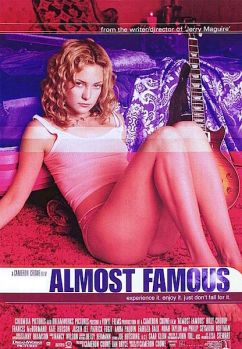
Almost FamousSometimes I find I have quite a lot to say about a film when it comes to writing my review for this blog — recently, witness Cloverfield, Transformers, or Indiana Jones 4 (of course, using Indy 4’s full title more than once guarantees a long review). Other times it’s a struggle to come up with anything at all — try the relatively brief comments on The Fountain, The Adventures of Sherlock Holmes or Field of Dreams. Almost Famous falls into the latter camp. Not because it’s no good, or because it’s middle-of-the-road, but because there’s nothing I’m dying to praise or slate about it.
Everything about it is solidly done. Patrick Fugit is an engaging and relatable lead, ably supported in the acting stakes by a good ensemble, especially Philip Seymour Hoffman (unsurprisingly) and fellow top-billers Billy Crudup, Frances McDormand and Kate Hudson. And there’s Zooey Deschanel, who doesn’t have many scenes, but, y’know, still…

Crowe’s autobiographical screenplay is a good one, with plenty of amusing and dramatic moments to keep it ticking over — the most memorable, on a crashing plane, manages both with aplomb. Likewise, his direction is rarely flashy but always works. The music, costumes, design and cinematography evoke the period well (to me, at least, who didn’t live anywhere near the ’70s). There’s probably some life lessons in here — it’s a coming-of-age film after all (as well as a rock & roll road movie, of course) — but they’re not over-laboured.

In short, I really liked Almost Famous. It’s the sort of film that might creep in at the lower end of a (relatively long) list of favourites, not because there’s anything exemplary about it, but because the cumulative effect makes for an enjoyable experience.

4 out of 5

Almost Famous is on Movie Mix (aka more>movies) tonight, Sunday 31st May 2015, at 1:15am.

The Fountain (2006)

2008 #37
Darren Aronofsky | 93 mins | DVD | 12 / PG-13

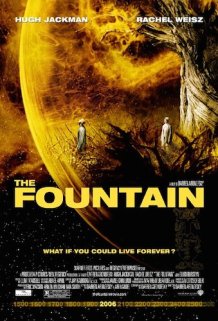
The FountainThe Fountain was one of the more critically divisive films of recent years, eliciting genuine “love it or hate it” reviews all round. I find myself leaning more towards the former. While I can’t claim to fully understand (let alone explain) much of what it means, and while I usually dislike things that can pretentiously be described as “film as poetry” (or similar), there’s something in the qualities of The Fountain that engaged me.
For one thing it looks gorgeous. While the whole film is beautifully shot, it’s hard not to single out the future segments, in which Aronofsky chose to create space with “micro-photography of chemical reactions” rather than the usual CGI. However it was achieved, the important thing is it looks great. Clint Mansell’s score is equally beautiful, both dramatically exciting and romantically tender — sometimes at the same time. Performance-wise, Hugh Jackman is undoubtedly at the centre and is as likeable as ever. It’s only the present-day segments where he really has much to do, in the arguably-clichéd story of a scientist so desperate to find a cure for his wife’s disease he misses out on spending time with her. Rachel Weisz is good as ever as the wife, even if her American accent is occasionally distracting.

Meanwhile, the past segments are essentially an historical adventure movie with some of the plot scenes cut, and the future segments offer near-2001 levels of silent obscurity. By a similar token, the film has an apparently ambiguous finale that, unusually, I’m quite happy to let wash over me. I’m sure there are multiple conclusions a viewer can reach for what it’s ‘about’ — the eternity of love, the repetition of life, or simply a sci-fi/fantasy quest for immortality — but I find myself happy to accept that it may mean one, all, or none of those things and just leave it be. It’s an odd way to feel at the end of a film — not caring about what it meant, but in a good way.

I can only apologise that, a bit like the film, this review is relatively brief, a tad dreamy, and somewhat inconclusive. I can see why some dislike this film, and I think I’d normally be one of them, but in this case something about it captured me. I look forward to seeing it again and, maybe, getting a better idea what it was.

4 out of 5

Notorious (1946)

2008 #21
Alfred Hitchcock | 101 mins | TV | U

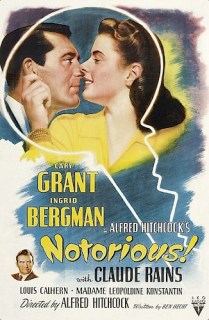
NotoriousCary Grant, Ingrid Bergman and Claude Rains star in Alfred Hitchcock’s 7th best film (according to the ever-changing IMDb Top 250, where it currently resides at #108). Grant is Devlin, an American spymaster who recruits a Nazi spy’s daughter, Alicia Huberman (Bergman), to infiltrate a group of Nazis in Brazil, via her old acquaintance Sebastian (Rains).

Initially the film focuses on the will-they-won’t-they relationship between Devlin and Alicia. A lesser film would have happily made this last the duration, but Notorious moves on to the question of how far an undercover agent should go in the line of duty. Once it has an answer for that it’s on to what the Nazis are actually plotting, and beyond that to the effects of the spy being uncovered. It’s not that the film is restless or doesn’t deal with any of these threads in depth — indeed, my implication that it drops each to move on to the next is disingenuous, as they overlap and weave around each other — but it doesn’t over-analyse or stretch them out interminably. It’s all the better for it.

The second half is where Notorious really comes into its own. Detailing the relationships and situations in the first half is time well spent to set up the second, which contains a brilliant sequence at a society party and a wonderfully tense climax. Hitchcock’s direction shines here, with swooping crane shots and dramatic close-ups — who’d’ve thought a cup of coffee could be so menacing? The villains’ plans may be under-explained, but no matter, because the focus is on how they’re uncovered rather than how they’re prevented. All in, it makes for a highly effective and entertaining spy thriller with a not insignificant dash of romance.

5 out of 5

Notorious placed 7th on my list of The Ten Best Films I Saw For the First Time in 2008, which can be read in full here.

A Room with a View (1985)

2008 #14
James Ivory | 112 mins | download | PG

A Room with a ViewI can’t help but wonder if, back in 1985, there was any audience confusion between A Room with a View and A View to a Kill. One can imagine legions of Bond fans accidentally finding themselves with a witty heritage drama, and legions of old dears accidentally finding themselves with a man twice their age trying to be an action hero. (In actuality the films were released about a year apart — that being just one reason this is a particularly silly notion.)
Putting aside such nonexistent confusion, what of that witty heritage drama? Once again, thanks to the adaptations module of my degree, I’m stuck watching a film straight after reading the novel it’s based on. So far these viewings have supported my long-held theory that reading any novel before watching the film version (especially immediately before) is a Very Bad Idea. However good A Room with a View may be — and it certainly has its share of positives — it still pales slightly in direct comparison to the novel.

The film’s faithfulness is admirable at least, combining events effectively at times and at others leaving well alone. Unfortunately this “copying out” style of adaptation means that the dialogue is exactly as written but sometimes loses important elements through its abbreviation. In the novel, characters frequently mean something entirely different to what they say, but you wouldn’t guess so in the film. Similarly, a lot of the novel’s wittiness is lost — unsurprising, as much is carried in Forster’s narration, which here is largely left unadapted. “Largely”, because chapter names occasionally intrude as intertitles or subtitles. These usually merely skip what would be a few lines of expositional dialogue, but occasionally they’re entirely pointless, and frequently are rendered meaningless by what would otherwise be minor tweaks to the plot. As I suggested at the start, however, a lot of these flaws are only blatant when placed in stark contrast with the novel.

Others aren’t. Julian Sands is disappointingly flat as love interest George Emerson, and he frequently drags Helena Bonham Carter down with him (and not in the “written by Andrew Davies” sense). In my opinion, Bonham Carter is the weak line in an otherwise flawless cast, neither acting nor looking much like my image of Lucy (Sands might not give much of a performance, but at least he looks the part, and Emerson is meant to be quite awkward). This could well be just my personal vision clashing with that of the filmmakers, of course, but there you have it. Those two aside, the rest of the cast are excellent: Maggie Smith and Judi Dench are note-perfect, especially in the handful of scenes they share (it’s a real shame Dench’s character disappears before the halfway mark); Daniel Day-Lewis is the right mix of comical, annoying and unfortunate truth as Cecil; and Simon Callow, Denholm Elliott and a young Rupert Graves are also perfect fits for their roles.

Finally, no Room with a review (ho ho) can be complete without praising how gorgeous Italy looks here. The camera lingers on the art and architecture more like a documentary than a fiction film, taking the viewer on a sightseeing tour just as much as the characters. There are essays to be written (indeed, they have been) on why such spectacle is a bad thing, but if you don’t want to be so pretentious then it’s wonderful to look at. Which, in many ways, sums up the entire film.

4 out of 5

Jane Eyre (1944)

2008 #12
Robert Stevenson | 96 mins | download | PG

Jane EyreI was meant to read Jane Eyre in the first year of my degree, but, given a week to attempt what seemed a positively enormous tome (I partly blame the edition) and a coinciding essay deadline, I didn’t even attempt it. Instead I settled for a friend summarising it for me — I tuned out halfway through the very long retelling due to boredom, though whether that was the fault of the novel or its summariser I still don’t know. I finally got through Jane Eyre the year before last — not the novel, though, but the BBC’s apparently-definitive adaptation (has it been that long already!), following numerous extremely positive reviews at the time. That was good — because or in spite of the novel, I do not know.
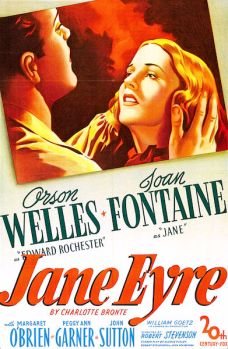
And so I come to this version, made in the wake of Rebecca (ironically, a novel clearly inspired in part by Jane Eyre) and also starring Joan Fontaine, alongside Orson Welles as the brooding love interest, Rochester. Well, he’s supposed to be brooding, but as played by Welles he comes across as merely gruff, apparently with a slightly unusual fake tan. Despite a suitably dramatic entrance, Welles’ stilted and occasionally overplayed performance, as well as a lack of chemistry with the equally weak Fontaine, does nothing to liven up what is already a rather uninspired production. The first 20 minutes are, at best, a Dickens rip-off, though without the appropriate comeuppance for the villains; in this version, it’s less Dickens and more obscene Christian morality play, complete with flat performances and (obviously) an over-reliance on God.

This section moves slowly… and then so does the rest of the film. Considering I’m primarily comparing this hour-and-a-half version to a four-hour miniseries, that’s quite a feat. The plot’s twists and revelations are all sadly underplayed, removing much of their dramatic effect; the same can be said of the abrupt ending. Perhaps there was an assumption that the audience would already be familiar with them, but true or not their weakening helps ruin this interpretation. And that’s all without mentioning the atrocious French accent of Adele, Rochester’s young ward, which often sounds as much like a bad Welsh accent as a French one.

All round, then, a very poor effort. A handful of redeeming features (the odd nice bit of cinematography, brief flashes of some decent performances) keep it from quite sinking to the lowest mark.

2 out of 5

Rebecca (1940)

2008 #10
Alfred Hitchcock | 125 mins | download | PG

This review could be seen to contain some spoilers.

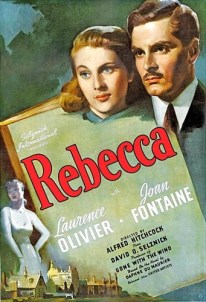
RebeccaI must confess that I don’t think I’ve come to Rebecca under the best circumstances for judging it as a film in its own right. As with last week’s Great Expectations, Rebecca is on my current University module, which means I arrive at it having just read both Daphne du Maurier’s original novel and, the afternoon before viewing, a detailed and very interesting account of the film’s genesis and production from Hitchcock and Selznick: The Rich and Strange Collaboration of Alfred Hitchcock and David O. Selznick in Hollywood (nothing like a snappy title, eh?) by Leonard J. Leff. Such reading conspires to lead me into direct comparisons with the novel (which, as with most adaptations, are ultimately unfavourable due to things having to be cut), as well as a preoccupation with what was going on during production.

But, trying to put such distracting things aside, Rebecca has a great many good points. The cast, for one thing, are perfect. There were serious doubts about Joan Fontaine as the lead, but she is spot-on as the shy, almost childish, Mrs de Winter. Laurence Olivier is equally effective as Maxim, and Judith Anderson’s Mrs Danvers is suitably scary, if significantly younger than I imagined. The production’s technical aspects are also highly admirable: while the early Monte Carlo scenes may be nothing especially exciting, the plot whizzes past and we soon find ourselves at the infamous Manderley, all large halls, fog-filled grounds, dramatic lighting and big camera moves. Especially of note is Maxim’s confession — a long chunk of dialogue in the novel, it would have been all too easy to just use a flashback, but Hitchcock instead employs a camera move across the empty room to suggest the narrated action.

Further comparisons with the novel are inevitable, of course. The film skips nothing of importance, condensing events effectively so that the plot moves at a decent pace. Some events, such as the fancy dress ball and following ship wreck, are even made more dramatic by combining them. Some choices are thoroughly bizarre though: the novel is well known for its first person narrative, something the film attempts to retain by featuring Mrs de Winter in every scene… until the end when, in a deviation from the novel, she remains at Manderley while we follow Maxim and co. to London for some final twists. This does lead to a dramatic reunion upon Maxim’s return to Manderley, but I’m not convinced such a brief moment was worth the modifications.

As expected, viewing in such close proximity to the novel also forces comparisons that aren’t especially warranted — for example, the film loses much of the characterisation of Mrs de Winter by unsurprisingly finding no way to adapt her frequent flights of fancy and imagination. But then, one can always read the novel for those things (and I’d recommend it — get past the famous but dull opening and it often rattles along), and so, judged purely on its own merits, there is a considerable amount to recommend in Rebecca.

5 out of 5