Slumdog Millionaire (2008)

2010 #1
Danny Boyle | 120 mins | Blu-ray | 15 / R

Slumdog MillionaireAs we head in to this year’s awards season, I’ve finally got round to seeing last year’s big winner. It’s the Little British Film That Could, and I do feel like I’m the last person in the country to see it.

With its brightly coloured posters and home ent covers, cute child actors wheeled out at awards dos, and widespread popularity, it’s not hard to believe the pullquote someone at Fox’s marketing chose for the DVD cover: “the feel-good film of the decade”. An uplifting tale of a young no-hoper appearing on the world’s biggest game show and winning millions of rupees thanks to a generous helping of luck that means his multifarious life experiences have provided him with the exact answers to all 15 of Who Wants to Be a Millionaire’s genius-stumping questions, surely?

No.

Everything that claims it’s a “feel-good film” is being slightly disingenuous. It has a happy ending (I don’t think that counts as a spoiler for something that’s billed as “feel-good”), but until those closing moments it’s unrelentingly grim. Realistic, I’m certain, and depressingly so, but it seems designed for anything but making you feel good. The author of that chosen quotation, News of the World’s Robbie Collin, claims that he means the film is cathartic (not that I got that from his review, to be honest) — the happy and justice-bringing endings unleash goodness in the wake of the dire events that lead to them. It’s a sound theory, one that has often worked elsewhere, but not for me with Slumdog.

The problem is the ending. Director Danny Boyle’s recent films have all made a relatively poor show of their conclusion and Slumdog is no exception. True, it’s not close to the mess of Sunshine, but it doesn’t hold up in the way it ought to either. I don’t have a problem with it being reliant on guesswork — coincidence and luck form the backbone of the plot, making it permissible that our hero should win by chance rather than knowledge — but that some of its resolutions are too little too late to make one feel good about what’s already occurred, and the way it seems to bend the concept of Millionaire to fit its story somehow grates for me. I mean, is the name of the third Musketeer really a £1 million question?

But I don’t want to berate it too much because, in spite of the unconvincing finale, Slumdog Millionaire is a rather brilliant film. It’s peppered with convenience and flaws that go beyond the extent allowed in a plot based on coincidence (how come the questions come in the order the answers happened in his life? What about answers to all the questions we don’t see asked?), but these can be allowed to slide as a structural gimmick that facilitates something of an exposé of life for slum kids in India. Whether it has a documentary level of realism or not, and whether it under-sells or over-states the influence of gangsters and ease of mutilation and murder, the film’s unabashed grimness is surely closer to reality than most would dare. No wonder it nearly went straight to DVD.

The real revelation — once you get over the shock of it being, well, shocking — are the child actors. Here is where Boyle earns his Best Director awards, coaxing flawless lead performances out of a very young cast. Dev Patel may have been the focus point for plaudits, and while this isn’t undeserved, it’s the younger kids who play the same characters that arguably give the most memorable turns. They’re put through the ringer in almost every way imaginable and are never less than convincing, a feat for such young actors — so young that, as mentioned, the skill of Boyle (and, one imagines, “Indian co-director” Loveleen Tandan) is what’s really on display.

If there’s one good thing about Slumdog being billed as feel-good it’s that more people will have seen it, whereas promotion based on it being a gritty account of poverty, misery and abuse would surely have turned audiences away. And perhaps for most viewers the catharsis of a happy ending works, though the only person I’ve spoken to who felt that way is the aforementioned Mr Collin (and by “spoken to” in this instance I mean “tweeted”). The journey there certainly works though, and if by the end Slumdog is trying to both have its cake and eat it… well, I like cake.

Now there’s a quote for the DVD cover.

5 out of 5

Channel 4 and 4HD kick off their Indian Winter season with the TV premiere of Slumdog Millionaire tonight at 9pm.

Cinderella (1965)

aka Rodgers and Hammerstein’s Cinderella

2009 #91
Charles S. Dubin | 78 mins | TV | G

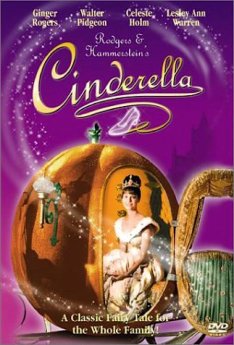
CinderellaThis clearly made-for-TV adaptation of Rodgers and Hammerstein’s Cinderella (the second of three, to date) is a rather weak affair, easily demonstrating why no one seems to remember it.

The story is almost a scene-for-scene recreation of Disney’s version at times, although considering the limited variation in adapting the story — unless one decides to get quite radical or flesh it out, that is — that’s forgivable. The cast are largely unmemorable, the exceptions (not for good reasons) being Stuart Damon, whose acting is poor but singing is fine, and Ginger Rogers, who is barely noticeable as the Queen, particularly as she doesn’t do what she was most famous for. Fair enough, she was in her 50s, but the only other reason for her presence is to provide a star name at the top of the cast list. And Celeste Holm I recognised from High Society, which is neither here nor there.

Dubin does the best he can with TV studio limitations, using colourful painterly backdrops and trying to find some variation in camera angles, but it’s largely as flat as the sets. The musical numbers are quite entertaining, if mostly insipid, not that any approach R&H’s best anyway. I couldn’t tell you much about any of them within a few hours, never mind longer.

Anyone combating the might of a Disney classic is going to struggle, but that doesn’t prevent a decent effort from being produced. Between a below par set of songs from Rodgers and Hammerstein and weak staging, this Cinderella doesn’t even come close to that.

2 out of 5

An American in Paris (1951)

2009 #93
Vincente Minnelli | 109 mins | DVD | U

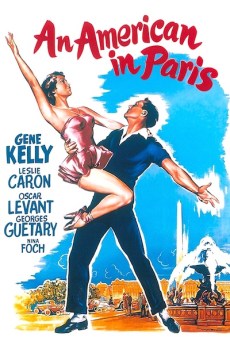
An American in ParisIf anyone is interested in An American in Paris and has found this alleged-review in search of something interesting to read, I’m afraid you’re going to be sorely disappointed. Not because I didn’t like the film, but because I’ve not got anything to say about it.

The main reason for such an oversight is that, getting round to this review a month or so since I watched it, I can’t remember enough of it well enough to provide anything close to meaningful criticism. This could sound like a criticism in itself — designating the film unmemorable — but the sad truth is it’s not all that uncommon for me. This is why I usually write notes (like this (just in case you don’t know what notes might look like)), so that when I do get to a review (inevitably late) I can translate said notes into something passably resembling a review. Viewing An American in Paris over the Christmas/New Year period, however, there was no time for note-taking.

But enough on my lackadaisical reviewing habits, what can I say about the film? Well, it’s got a Gershwin score, and I always like that; particularly memorable is I Got Rhythm being performed by Gene Kelly and a group of young kids who can’t speak English. It’s a different take on a familiar number that’s thoroughly entertaining. The dancing is all great, of course, and Leslie Caron — last-minute replacement for a pregnant Cyd Charisse — shines in her debut role. The film ends with a lengthy ballet which, to be frank, isn’t really to my taste; dance fans of a certain type will undoubtedly love it though.

And that’s your lot, I’m afraid. I can only apologise to you, dear reader, and to all involved with this perfectly lovely film for not being able to offer a more appropriate set of thoughts.

4 out of 5

Harry Potter and the Half-Blood Prince (2009)

2009 #84
David Yates | 153 mins | Blu-ray | 12 / PG

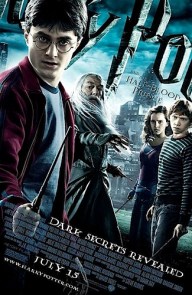
Harry Potter and the Half-Blood PrinceBy this point I imagine everyone has a pretty clear idea what they think of Harry Potter, and this latest film certainly isn’t going to change that. That’s not to say it’s bad — in fact, it’s rather good — but Harry Potter is what it is, and nothing’s going to change that, least of all these thoroughly faithful adaptations.

This particular entry is well adapted from its huge source. I remember the novel as being somewhat turgid, a 600-page slab of flashbacks and exposition provided so one could understand the events of Deathly Hallows (for the uninitiated, that’s the final book, arriving as two films in 2010 and 2011). Thankfully, returning screenwriter Steve Kloves (who has adapted every Potter bar the previous one) and director David Yates liven it up considerably.

Adapting a 600-plus-page book is always a gargantuan task, something the Potter series has struggled with before (at times, Order of the Phoenix felt like an hour-long highlights montage), but Kloves manages to keep the thrust of the dark primary plot while peppering it with humour- and romance-based asides. (Calling it ‘romance’ may be a little generous — ‘teenage snogfest’ seems to be the preferred term by critics. And it is that, really. But ‘snog’ is such an ugly word, so I shall stick to ‘romance’.) The film could have been all Dark and Grim — and people doubtless expected, and probably would have accepted, that — but the sizable amounts of humour and romance keep the tone more appropriate to the series’ kid-centred roots, as well as adding light to the shade in a way that should please everyone. The titular Prince, however, is barely a subplot, but that’s a flaw of the novel rather than Kloves’ work.

Yates pitches the humour right, though the romance is occasionally overbearing for my taste, but the action sequences are well handled. Unfortunately, while entertaining in their own right, the majority are an aside to the main plot, which is perhaps where the two-and-a-half-hour running time comes from. The return of Quidditch is welcome to some fans, but would surely have been dropped without the fan pressure. That said, it feeds into both the Luck potion and romantic subplots, as well as providing its own doses of humour and action. Still, it’s a missed opportunity to further establish the character of Katie Bell, who has a moderately significant part to play a bit later on.

Worse is the opening bridge attack, which feels fairly pointless. Again, in itself it’s a dramatic event, expanded from a passing reference in the novel, but it bears little relation to the rest of the plot. In the novel it has a point — the wizarding world is finally impacting on the normal one — but that thread remains unexplored by the rest of the film, rendering the opening a visually exciting but empty sequence.

The still-young cast are intermittently believable. Rupert Grint still has a talent for comedy — enough to fulfill his role here, anyway — while Tom Felton is finally treated to a decent part as Draco. Formerly just an irritating bully, here he has a larger and more complex part to play, allowing Felton room to become one of the few child actors who can still live up to their part now. The adults are excellent as ever, particularly Jim Broadbent in a guest-star-level part and, naturally, Alan Rickman, who remains underused but may yet be treated to some material worthy of his talents in the final films. Additionally, Julie Walters conveys more with one expression in her brief cameo than some actresses can manage with half a dozen scenes.

With numerous plot elements left brazenly gaping ready for the next instalment (just as in the novel, of course) — including at least one thrown into the mix in the closing seconds — and Yates’ promise of an ‘urban thriller’ style for at least Part I (a genre he mastered in the outstanding State of Play), the two-part Deathly Hallows is a relatively tantalising prospect. Just eleven months to go…

4 out of 5

Avatar [3D] (2009)

2009 #89
James Cameron | 162 mins | cinema | 12A / PG-13

AvatarAvatar is The Film That Changed Cinema. The past tense can safely be used, despite the film only having been out a couple of days — it doesn’t matter if we like it, filmmakers and Hollywood executives have decided it’s the artistic and commercial way forward, and so it shall be. It barely even matters if people actually go to see it; not that it’s in much danger of flopping, coming in the wake of years of extreme hype and numerous sycophantic reviews.

What’s almost more irritating than that, however, is that it’s actually quite good. Flawed, unquestionably, and probably undeserving of the volume of advance praise heaped upon it, but far from a disaster.

It’s too long, for one thing. The end of Act Two feels like the end of the film… until it insists on going on for goodness-knows how long (my watch stopped working, I couldn’t check). It might not be so bad if it didn’t take its time getting to this point. Swathes of it feel like a dramatised nature documentary, only this time it’s about a fictional alien world. Talk of Cameron having created a fully-realised, living, breathing ecosystem are over-egged: there’s a half dozen creatures, at most, and their only relation is that they have these weird tentacle things in their hair that allow them to connect up to one another, like nature’s own biological USB. Maybe he knows who eats what and when and how and mating rituals and all that jazz, and if he does we should be thankful it’s not plastered all over the screen, but the creature creation/world realisation here isn’t anything beyond Jurassic Park.

The story itself isn’t bad. It certainly has an epic quality, which at least justifies the running time, though it’s a collation of elements from elsewhere. Of course, such things can be said of most stories these days, but with Avatar it seems even more obvious — a bit of Aliens here, a bit of The Matrix Revolutions there, a bit of An Inconvenient Truth for good measure, and so on with countless other recognisable tropes. The sin Cameron commits is that he mostly does it in quite a clichéd manner — it’s not just that you have seen it before, but it feels like you have too. Even the learning-to-fly bit, much praised in some quarters, reminded me of something else: slightly-rubbish TV miniseries Dinotopia, of all things. And don’t get started on the dialogue — “Try not to think of anything. That shouldn’t be too hard for you.” Dear God, how many times have we heard that line?

Towards the end Cameron does pull a few things out of the bag, mainly involving who gets killed and who doesn’t. Mostly, the story is a framework to allow the visual spectacle and an ecological/anti-war message. It’s as subtle as a nine-foot-tall blue alien. From crystal clear uses of familiar phrases like “shock and awe” and “hearts and minds”, to unconcealed references to our dying planet, Cameron attempts to criticise both American military tactics (invade, crush the locals…) and the destruction of the planet (…take all the natural resources for ourselves, no matter what the cost). It’s not that the message is wrong, it’s just that Al Gore did it with greater subtlety in a 90-minute lecture on that specific subject. From the outset, the military — specifically marines, of course — are quite clearly The Bad Guys Here, which is a refreshing change from the man who brought us Aliens. Quite what the American public are/will make of this outright criticism of both its military and energy consumption remains to be seen.

All this is realised through unrelenting CGI. It’s very good, but here Avatar falls victim to its own hype once again, because it’s still not 100% perfect. Perhaps it’s the closest yet seen — it certainly remains consistent throughout — but nothing had me wondering if they’d perhaps used prosthetics in addition to the CGI, as Davy Jones did at several points during Dead Man’s Chest, and I remain convinced that wonderful modelwork, as seen in the likes of Lord of the Rings, is still an unbeatable tool for creating convincing environments. Some will argue that we remain unconvinced of the alien creatures’ authenticity because we know they can’t be real, but some occasionally exhibit the plasticky shine of CGI or the jerky movement of motion capture. The Na’vi are certainly a step up from Robert Zemeckis’ dead-eyed humans in The Polar Express or Beowulf, but are they that much better than Gollum? Or even Jar Jar Binks? (In terms of the competency of the effects, I hasten to add.)

It’s hard to resist flaw-spotting with Avatar after reading so many praise-filled reviews. At the risk of sounding like one of those irritating people who sits at their keyboard declaring “ah-ha, I’ve realised something all you professional reviewers weren’t clever enough to see!”, I think this is in part due to the final act. Avatar has a stonking finale, from a huge Apocalypse Now-styled 9/11-echoing moment of destruction, to a thrilling and epic final battle (albeit interrupted by a mass of unwelcome pace-challenging plot). These sequences excel on almost every level, from visual wonder to the odd spot of emotion. And this is what your final impression of the film is, which can banish memories of the crawl through the middle, replete with those niggling flaws. I won’t be surprised if DVD/Blu-ray reviews commonly lose a star, robbed as it will be of the huge screen spectacle and reviewers forced to remember what they had to sit through to reach the big climax.

Oh yes, and Avatar’s meant to be convincing us that 3D is the future, isn’t it? And actually, 3D is quite nice. This is the first time I’ve seen a film in RealD, so I was pleased to discover how perfectly it works. No ghosting that I noticed and minimal discomfort even after such a long film, so from a viewing point of view I was happy with it. It adds depth to the image as well, rather than throwing things in your face — this too was pleasant. As I’ve noted on previous 3D reviews, this depth can bring a scene to life… not in the sense that you believe it’s genuinely happening behind that screen in front of you, but it does liven the images up.

What it doesn’t do is improve the storytelling — but then, what does? Some actors in a black box can convey a story wonderfully — look at Dogville, or any number of theatre productions — you don’t need sets, or costumes, or CGI, or even music or any number of other things we associate with the film experience. You could lump 3D in with these, or you could say it’s even less necessary — sets, costumes, and all evoke a time and place and create a realistic world in a way a black box doesn’t, but what does 3D bring to the table? It’s purely about spectacle, in the same way CGI or helicopter shots or using IMAX usually are. And that’s fine. But directors who’ve expressed an interest in shooting a ‘normal’ domestic drama in the format may be overestimating its import.

But for all the derivative plot, blunt message, cheesy dialogue, thrilling action, spectacular imagery, pretty good CGI and debatable 3D, Avatar may have a greater problem in gaining anything like widespread acceptance. It’s set 145 years in the future, on an alien world with floating mountains and other such fantastical elements, where a significant chunk of the story centres on a group of nine-foot-tall aliens (who fall in love and kiss, much to the loud derision of a group of 13-year-old boys in my screening) in a weird alien jungle with prehistoric-like alien creatures, and semi-scientific religious imagery and plot points that I haven’t even touched on… It’s pretty hard science-fiction, to put it simply. It’s not the accessible historical romance/disaster of Titanic, it’s not the real-world-styled action-based superheroics of The Dark Knight, it’s not an accessible adaptation of a widely-loved book like Lord of the Rings or Harry Potter… One could go on in this vein through all the highest-grossing movies of all time.

Instead, it’s the cover art from a pulp science-fiction/fantasy novel or short story magazine writ large with the budget required to pull it off, and it’s that for almost three hours. For every SF/F-loving sycophant there’ll be a member of the general public who thinks it’s a load of old tosh. The truth is somewhere in between, as ever, but I won’t be surprised if the style of Avatar’s business is closer to Watchmen than Titanic. (I don’t think this is too delusional, incidentally. It will perform more strongly than Watchmen, obviously, because it has that all-important PG-13 certificate in the US and a helluva lot more hype in the mass media. But I remain convinced it won’t manage to be a phenomenon to rival Titanic or The Dark Knight, or The Lord of the Rings, or Harry Potter or Pirates of the Caribbean or Star Wars.)

Avatar is a significant film. Thanks to the hype and importance attached to it, by both Cameron and the industry at large, this can never be taken away from it — even if we’ve heard its story before, seen 3D before, seen effects as good before. I don’t believe The Future Of Film is riding on it as much as some would claim — after all, so convinced are They of its status as a hit that an endless stream of 3D movies heavy on CGI have arrived ahead of it and will continue for years after. In itself, it’s quite entertaining and probably deserves to be seen on the big screen. But, as expected, it’s not the revolution that was promised.

4 out of 5

The Thief of Bagdad (1940)

2009 #66
Ludwig Berger, Michael Powell & Tim Whelan* | 102 mins | TV (HD**) | U

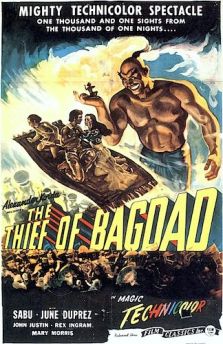
The Thief of BagdadThe Thief of Bagdad is, in many respects, one of the forefathers of the modern spectacle-driven blockbuster, packed with innovative effects designed to dazzle the viewer. One can only imagine how incredible the special effects looked to a 1940 audience. Today the flaws are obvious, but, surprisingly, not by much.

There are too many enchanting sequences to mention — the ginormous genie, the flying mechanical horse, the giant spider, the toys, the flying carpet… Models, huge life-scaled props, matte paintings, early blue screen — all this and more are put to use beautifully. The ingenuity of the effects work contains more artistry and charm — and, frequently, more excitement — than the bland, wannabe-perfect CGI we’re force fed today; and, because of this, and in spite of being almost 70 years old, the sense of wonder remains. It doesn’t matter that it’s not 100% believable — in fact, that’s almost the point: the child-like ability to suspend one’s disbelief and accept the fantastical seems to be the message of the film (or, at least, one of them).

All of this is emphasised by the cinematography. This is one of the earliest films to use Technicolor and use it it does. Everything is vibrant and lush, vivid and otherworldly; especially to the audience of the time, I should imagine, not accustomed to foreign holidays and endless TV travel shows as we are today. But the film’s world is a heightened version of reality and, as with the effects, the fantastical style means it doesn’t really date. Wish You Were Here has nothing on this.

The story itself has a bit of everything: romance, fantasy, action, adventure, humour and, no doubt, more. The cast are up to the task, with John Justin swashing his buckle Errol Flynn-style as dethroned prince Ahmed; Conrad Veidt perfect as slimily evil vizier Jaffar “the usurper”; Sabu suitably valiant, amusing and clever as a peasant hero; and Rex Ingram making a memorably self-centred genie. If Disney fans think some of this sounds familiar, it must seem obvious to anyone who’s seen Aladdin that The Thief of Bagdad was a major influence on the 1992 animated classic.

These days, The Thief of Bagdad may be something of an acquired taste — some viewers will struggle to engage their sense of make-believe enough to accept the rough-round-the-edges effects and fantastical storyline — but that’s their loss, quite frankly. For those of us with some imagination to spare, it remains a magical experience.

5 out of 5

* Although only these three are credited on screen, six directors were reportedly involved. The others were producers Alexander Korda, Zoltan Korda, and William Cameron Menzies. ^

** Though listed by the Radio Times as being in HD, the D didn’t look particularly H to me. ^

The Apartment (1960)

2009 #36
Billy Wilder | 125 mins | download | PG

The ApartmentAn article I once read (but have long since misplaced, unfortunately) asserted that Billy Wilder once said (and I paraphrase heavily here, I’m sure) that, contrary to expectations, when he was feeling happy he’d make a serious picture, and when feeling down he’d make a comedy. Goodness only knows what kind of mood he was in when he chose to make The Apartment, then, because it flits between the two with gay abandon.

It begins almost as a farce, with Jack Lemmon playing up the near-misses inherent in lending your apartment to adulterous men; and though this comedic vein never goes away, the film also develops a dark side. Alongside the affairs and underhand dealings — in which our hero is closely involved — there’s an attempted overdose, discussion of other suicide methods, and respectable men getting divorced. It all seems quite shocking for a film made under the Hays Code, though that was on its last legs (Wilder’s own Some Like It Hot had been released without code approval the year before and still been a huge hit), and Mad Men and its ilk suggest such goings-on by businessmen may not have been so surprising to contemporary viewers either.

On the technical side, Wilder employs long scenes and long takes, but Lemmon never stops bustling through them, always doing something, keeping the film active and moving even when Wilder declines to follow. It’s the latter that makes the former so effective, rendering Lemmon’s character the odd one in an otherwise static world, the one still turning to humour in the face of all life’s bleakness.

Real life always serves up humour alongside tragedy, yet despite that it takes skilled filmmakers to do the same without one lessening the other. Wilder and Lemmon are, of course, among them, and one can imagine few finer examples of such a blend than The Apartment.

5 out of 5

High Society (1956)

2009 #54
Charles Walters | 107 mins | DVD | U

High SocietyCole Porter-scored musical remake of The Philadelphia Story, which is probably most famous for featuring Who Wants to Be a Millionaire? and being star Grace Kelly’s final film before becoming a princess.

Despite rarely singing, Kelly is by far the film’s standout element — it’s easy to believe three different men would be vying for her affection, but she also gets the chance to show the greatest range of any cast member. Admittedly it’s shades of comedy rather than a full awards-worthy display of ability, but she carries the film beautifully. It’s no wonder her husband-to-be, Prince Rainier of Monaco, objected to her appearing in movies when she played roles such as this: a divorcee who at one point allegedly sleeps with another man on the eve of her wedding to a third is surely no role for a princess. (Turns out she didn’t sleep with him, mind.)

Bing Crosby and Frank Sinatra are more-or-less themselves as the male leads, though the sole song they perform together, Well, Did You Evah!, is one of the film’s best — despite being a late addition from a previous Cole Porter musical after it was realised Crosby and Sinatra didn’t have a number together. Louis Armstrong also plays himself, literally, and brightens up the screen whenever he appears. His band’s duet with Crosby, Now You Has Jazz, is another of the film’s highlights.

Despite being adapted from an acclaimed play and film, the plot feels like a relatively slight contrivance to link together a couple of songs — alternately of the Romantic and Comedic variety — and some farcical humour with a romance-based thread. That the right people end up together is no surprise — so little surprise, in fact, that the story doesn’t even bother with such trivial things as making the final entanglements come together believably.

No matter. It’s the journey to the inevitable conclusion, through a few comical scenes and a few decent tunes, that makes High Society a perfectly pleasant dose of entertainment.

4 out of 5

High Society is on TCM UK today, Saturday 4th April 2015, at 4:15pm, and on Sunday at 9:35am.

Solaris (2002)

2009 #13
Steven Soderbergh | 94 mins | DVD | 12 / PG-13

SolarisWhen Andrei Tarkovsky adapted Stanislaw Lem’s thoughtful science fiction novel in 1972, it took 165 minutes. When Steven Soderbergh did it 30 years later, it took just over 90. Lem hated them both, stating that he didn’t write about people’s “erotic problems in space”, but for those concerned with what the film is about rather than what it (perhaps) should have been about, it seems that an abbreviated running time is no barrier to loading any adaptation of Solaris with a weighty thoughtfulness.
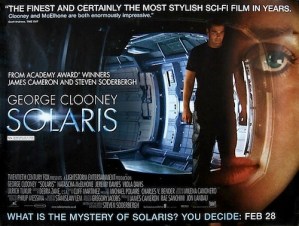
Everyone knows Solaris is a sci-fi film — the title sounds that way, for one thing, and George Clooney in a space helmet on the cover certainly does the rest. It’s a shame that’s so well known, because if one came to this version cold it would take a good few minutes before there was any inkling it wasn’t just a drama. The underplaying of the scientific elements may have angered Lem, but Soderbergh uses them to create a backdrop to the emotional story he wants to tell — Solaris the sentient planet was the point of the novel, as far as Lem was concerned, whereas to Soderbergh it’s a device to explore relationships and grief.

In doing this the film merrily mixes genres: it looks very much like it’s Science Fiction, all futuristic TVs and space station settings, and there are a few scientific concepts touched on; but it’s also a Romance, occasionally; and a Drama about coping with death, amongst other things; and an ‘arthouse’ film about notions of God and memory and reality and humanity; and there’s a huge chunk of Mystery in what the hell is going on; and there are a couple of moments that wouldn’t be out of place in a Horror film… About the only conventions Soderbergh doesn’t bother with belong to Action-Adventure, which as the normal stomping ground of big-name sci-fi certainly makes for a change.

It’s likely this that explains its low rating on IMDb and the like. A slow pace and obtuse storytelling that leaves plenty of gaps for the audience to fill is not the experience implied by an advertising campaign showing a Space Movie starring Movie Star Heartthrob George Clooney. Obviously it doesn’t fulfill these expectations, and will likely have still been too slow and difficult for even more viewers. (As it makes for a slow hour-and-a-half, I wonder how they would feel if told there’s a version over an hour longer.) The question is, does it also deserve such a low rating from those ‘clever’ or accepting enough to ‘get’ it? That depends on your perspective. It’s either Deep and Meaningful, or a bit Pretentious and Pointless. In this respect it’s highly reminiscent of The Fountain (or, rather, The Fountain is reminiscent of Solaris) — an unusual sci-fi/romance angle, slow pace, and ambiguous to the last. As one character says, “there are no answers, only choices.”

Soderbergh’s direction, plus the performances of Clooney and Natasha McElhone on which the film relies, do have the power to hold you, but only if you’re prepared for — and, more importantly, open to — the sort of experience Solaris offers. Undoubtedly not for everyone.

4 out of 5

Marnie (1964)

2009 #6
Alfred Hitchcock | 125 mins | DVD | 15 / PG

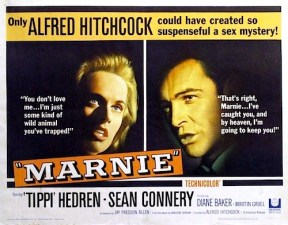
MarnieMarnie is a film grounded in the field of psychoanalysis, though that word is never used and none of the characters are a therapist. Instead, it just concerns itself with a main character suffering under the strain of repressed childhood memories, though this isn’t revealed until the end. Unfortunately, psychoanalysis was only an emerging area at the time of production, and the price Marnie pays for being ahead of the pack in the mid ’60s is that it looks dated and inaccurate now.

For one thing, it’s slow paced. Not necessarily a bad thing, and here it does serve to gradually build some elements, but at times you wonder where it’s all going. Part of the problem is that much of the story’s first half is just a distraction from the main point, in which case I suppose it’s Hitchcock’s famous MacGuffin; but the changes between elements of crime, romance, family drama and internal struggle come across not as a measured part of a considered whole, but as a mishmash of genres. One might consider this a good thing, adding variety and complexity to the film, but as it merrily switches back and fore it doesn’t seem to fulfill any genre to its full potential.

That isn’t to say Marnie is meritless. Plot-wise, the central mystery does get more intriguing as it goes on and the whole film gets better with it. It’s not just that it becomes a more interesting story, but almost every scene is more engaging, better written, acted and directed. Also, without a single frame of grinding, moaning, kicking or screaming, it contains one of the most sinister (suggested) sex scenes in the movies, thanks to the combined skills of Hitchcock and his two stars.

In the title role, a lot is asked of Tippi Hedren — a lot more than she had to manage in The Birds the year before — but she rises to the occasion, most of the time. It’s through no fault of hers that Marnie’s aversion to red is overplayed, especially as it’s the picture constantly fading through red that almost pushes it to the point of amusement. This is again a problem of being one of the first to try to film an entirely internal struggle. In the other lead role is Sean Connery, just two years after he created James Bond on screen, and here he plays a smooth playboy-esque character with a fondness for women and a tendency to violent outbursts. Not straying too far afield then, but he fits the role like a glove.

In this DVD age, I’d also like to point out that the film’s trailer is truly fantastic. Narrated by Hitchcock, he merrily takes the mick out of his own movie for several minutes. It’s a slice of joyous irreverence that makes you wish he’d brought some of it to the actual film, and wonder what would happen if a film was advertised with such a tonally incongruous trail today.

Trailer aside, Marnie is sub-par Hitchcock, but even then his considerable skill coaxes it to greater heights than many — perhaps any — other director could have achieved with the basic material.

3 out of 5