
Debbie Isitt | 106 mins | Blu-ray | 1.78:1 | UK / English | U / PG
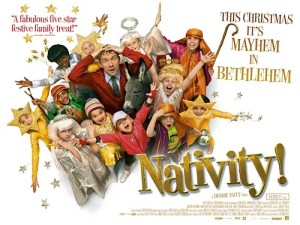 Yes, this is exactly the kind of review I should be posting in April. But hey, it’s Easter! That’s about Jesus too, right? (It’ll have to do, I’m not hanging on ’til next Christmas.)
Nativity! comes from writer-director Debbie Isitt, previously responsible for the entertaining part-improvised comedy Confetti, and this fits in a similar vein… albeit more family-friendly than a movie featuring Robert Webb and Olivia Colman as nudists. This one sees Confetti’s Martin Freeman as a primary school teacher charged with producing his school’s nativity, which always gets bad reviews in the local paper (do any local papers really review nativities?) while their rival private school always gets glowing endorsements. To make matters worse, the other school’s nativity director is an old friend/rival (Confetti’s Jason Watkins), and he must deal with an enthusiastic but unprofessional new classroom assistant (Confetti’s Marc Wootton), and there’s some stuff about his ex-girlfriend (Extra’s Ashley Jensen) who’s gone to LA, and it’s all quite straightforward when you watch it but I’m making a right pig’s ear of describing it. This is why I didn’t use to bother trying to include plot summaries.
It’s not wholly my fault — it’s kind of a daft plot, really. It’s played relatively straight and realist, but it goes off that beaten track at times. Which I suppose is fine — why not, after all? 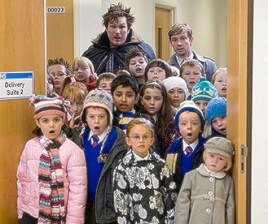 No one promised grim social realism — it’s a Christmas family film, with some moral messages and a sort of romance and sweet kids and a cute dog. And regular readers know how much I love a cute dog.
It’s also cheesy and silly, with an ending so packed with sentimentality it could make Spielberg look like a grumpy spoilsport. But in a feel-good Christmas-time film I think that’s mostly allowed. It’s not deep or meaningful, and it’s not cutting edge or shocking, but it has a charm and a sweetness that sit well at that time of year. The kind of film you flop on the sofa, shove your brain in to neutral, and tuck in to a box of chocolates while smiling along.
Try watching this at any other time of year (like, er, now) and you can knock a star off, but over the Christmas period it’s a fluffily entertaining diversion. Maybe I should’ve held this review back after all.

 Apparently MySpace had some hand in the creation of this movie. Remember MySpace? It’s what there was before Facebook. It was always rubbish, it just took a lot of people a long time to realise that. Anyway, some reviews seem to dwell on its involvement in the production of this movie —
  Most of the cast is drawn from the pool marked “British character actors” — you may or may not know the names, but you’ll probably know most of the faces. The lead is Eddie Marsan (Lestrade in
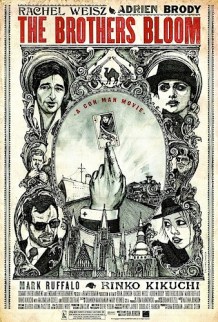 “Crikey, time flies!” I thought when I compiled this listing and saw that The Brothers Bloom was released in 2008. Somehow it felt like it was only last year, not three (or, if at the start of 2008, closer to four) years ago.
 but then the job of a trailer is to sell you a film, so if the end result doesn’t match it 100% is that a failing? How are you meant to summarise the entire tone of a film in a two-minute spoiler-free sales burst anyway? That dilemma is emphasised in this case because it’s the opening that feels least like the trailer. I mean, the pre-titles is kinda quirky-fun, but then it gets a little serious and slow, and later — perhaps half-an-hour or three-quarters of an hour in — you get to all the stuff the trailer was selling. And then the last act is back to something more unusually — or, if we’re to be unkind, unevenly — paced and toned. I can imagine the marketing meetings for this were a struggle…
 Perhaps the problem for others was that the ending doesn’t quite spell everything out. I’m certain every question you might have is answered, more or less, but it doesn’t lead you by the hand back over the film pointing everything out, as many twist-ending-ed films do. Part of me appreciates this assumption of intelligence; part of me would like it all handily explained so I don’t sit here wondering it for myself. I don’t feel completely lump-headed not wanting to do that — there’s no Deeper Meaning or Philosophical Insight gained from sorting this out, I don’t believe; just an understanding of who was being conned and when, and who knew what and why.
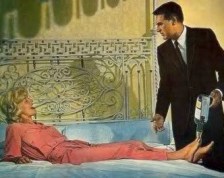
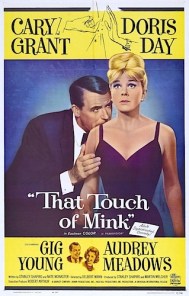 Starring Doris Day as a regular girl who wants to marry Cary Grant’s rich businessman for love, while he just wants to get her into bed, That Touch of Mink is a sex comedy… but being a film produced in ’60s America, no one comes close to using such language. But it’s unquestionably all about that.
 The subplot about his therapist pays such dividends it’s even used for the film’s final gag.
 Holiday stars Cary Grant as an everyday chap who falls in love with a girl who, it turns out, is a wealthy heiress type… but who it also turns out may not share his views on the future. Her kooky sister, played by Katharine Hepburn, on the other hand…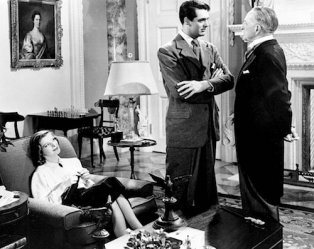

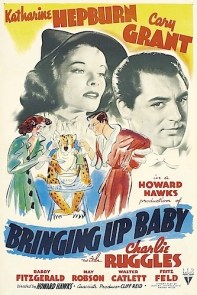 A box office flop on release (which directly led to Hawks being fired from his next film and co-star Katharine Hepburn being bought out of her contract & named “box office poison”), screwball comedy Bringing Up Baby has grown massively in stature since. And deservedly so, because — aside from a first act where Hepburn is no less than irritating, and an occasionally slow middle — it has some real comic high points and can be riotously funny.
 Also worth noting is that it is, perhaps, the first work of fiction to use the word “gay” to mean “homosexual”. Apparently the term originated in the homosexual community in the ’20s (possibly earlier) but would not become widely known until the late ’60s. Its use here was ad-libbed by Grant, though whether that makes it more or less likely to have meant “homosexual” I don’t know. I suppose no one was ever in a position to ask.
 With box office and critical acclaim sliding, Disney abandoned traditional 2D animation for their significant films in the early ’00s, switching to the computer-animated 3D that was doing so well for Pixar and Dreamworks. I don’t know if it helped the box office any, but it didn’t help with critics — it wasn’t the medium that was at fault, it was the storytelling. Notoriously, as soon as Pixar’s John Lasseter was put in creative control of the whole of Disney he instituted a return to 2D animation. The Princess and the Frog was the much-heralded first film after this change.
 there are just too many stacked up back to back for my taste. The voodoo material seems like it might be a bit on the scary side for kids, though maybe that’s just because too many children’s films are sanitised these days — I agree with the regular argument that it was better when films and TV aimed at kids included a bit of a scare or sadness, rather than more modern entertainment’s attempts to keep them wrapped in cotton wool for too long. The death of a character in the climax also sits in the same vein.
 where the musical numbers fit effortlessly into the flow of the story rather than stopping the film for a showpiece. This is also true of the very best entries in the canon —
  Disney’s 50th animated feature is Rapunzel in all but name, for no particularly good reason. It seemed to be met with universal praise on its release last year, critics hailing it as a return to Disney’s previous quality after a run of lacklustre releases, in particular the underwhelming return to 2D in the year before’s
  a number I usually particularly enjoy. It has one, I suppose, but it’s one of the weakest examples I’ve ever heard.
 There doesn’t seem to be much love in the world for Easy Virtue, a witty adaptation of Noel Coward’s play (previously filmed
 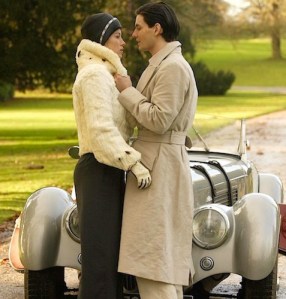 possibly in the soundtrack CD’s liner notes — that the following was Elliott’s idea.) Standards from the era are present and correct, but Cole Porter-styled reinterpretations of modern songs like Car Wash and Sex Bomb raise a smile whenever they turn up unexpectedly. It’s fabulously cheeky.
 It’s still not a big part, nor a showy one, but those little closing tweaks left him standing out for me.
 Like
Like 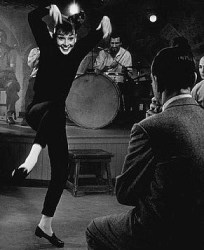 or dismissed the dullness of philosophy for the glamour of couture, but it takes fair jibes at both equally — it’s not mean-spirited or cynical or dismissive, just… quite true.
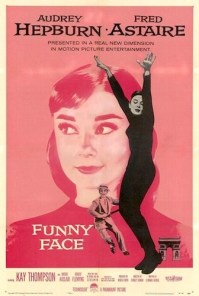
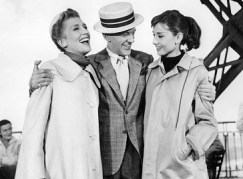 Funny Face seems to have plenty of critics — mainly on the notion that Hepburn could be said to have a funny face. Pretty shallow reason to dismiss a whole film, if you ask me. While there are couple of bits that don’t wash with my appreciation — the age gap; I could take or leave the two scenes at the church — there’s far more to love about the film.
 100Films.co.uk