aka Moriarty
2014 #106
Albert Parker | 85 mins | streaming | 1.33:1 | USA / silent (English)
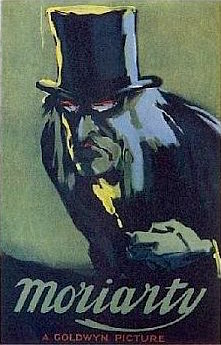 American actor William Gillette was the most iconic portrayer of Sherlock Holmes on stage, penning his own play (with permission from Conan Doyle) that he performed 1,300 times between 1899 and 1923. It was filmed in 1916, a feature long thought lost but announced as found in October 2014 (and to be released on disc by Flicker Alley this coming October — expect a review eventually). Before then, the only thing approaching a filmed record of that iconic interpretation of the Great Detective was this: a 1922 remake starring John Barrymore as the famed sleuth, originally released in the UK as Moriarty (possibly for legal reasons, possibly (according to David Stuart Davies in Holmes of the Movies) due to “the mediocrity of so many of the earlier Holmes films”).
This film was also considered lost, until elements were discovered in the ’70s — not the film itself, but original negatives “in which every take — not every sequence, but every take — were jumbled out of order” (as per William K. Everson’s programme notes for the Theodore Huff Memorial Film Society, via Wikipedia). These were painstakingly reassembled into something resembling the original film, although around 26 minutes are still missing. Nonetheless, the film remains completely followable: nothing important to our comprehension is missing, with some storytelling rough edges the only vague sign that anything may be amiss.
Said story diverges from the canon so much it’s liable to give any particularly canon-focused Sherlockians a conniption. It begins in Cambridge, with what many reviews call a “prologue”, usually preceded by an adjective such as “overlong”. I think it would be more accurate to describe it as the first act. There, a student, Prince Alexis (Reginald Denny), third in line to the throne of somewhere-or-other-in-Europe, has been accused of stealing from the university, but he claims innocence. His friend John Watson (Roland Young) recommends he seeks the assistance of a chap in his year, one Sherlock Holmes (Barrymore). 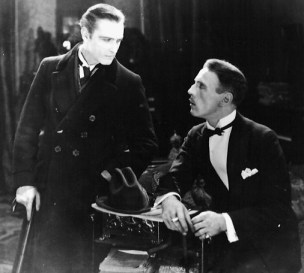 Yes, shades of 1985’s Young Sherlock Holmes. I’m sure you’ll be surprised to learn there are fewer CGI stained glass window knights here, though.
Holmes quickly uncovers the real culprit, another student by the name of Forman Wells (the screen debut of William “The Thin Man” Powell, looking ever so young). However, Wells is acting under duress, forced to commit the theft by Moriarty (Gustav von Seyffertitz), an obviously evil-looking fellow who sits at the centre of a spider’s web of criminal activity. Holmes confronts Moriarty in Wells’ stead, to little effect, the criminal genius swatting the student away as one would a fly. Undeterred, our young sleuth commits to stopping Moriarty as his life’s very purpose.
That and finding a girl he saw once and instantly fell in love with.
Meanwhile, Prince Alexis is informed that his two brothers have died in a car accident, making him heir to the throne, and so he can no longer marry Rose Faulkner, a British commoner he’d been courting. Rose is the sister of Alice Faulkner (Carol Dempster), who just so happens to be the girl Sherlock fell for. When she learns of the split, Rose commits suicide.
And that’s just the so-called prologue. I’m loath to explain the whole plot of a movie, but the tale spun here is actually somewhat intricate. Personally, I thought it was quite a good yarn. It’s flawed in the telling — it’s not particularly Holmesian, and there are far too many overlong title cards (Everson calls it “one of the ‘talkiest’ silents”) — but I don’t hold with criticisms that it’s slow paced, or that the lack of any real mystery is a problem. Sherlock Holmes tales are remembered as “detective stories” because that was his profession, 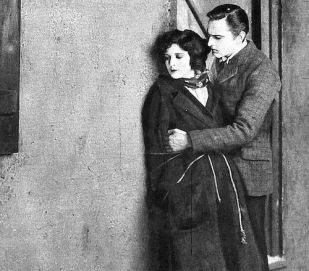 and in many respects they led to the abundance of crime-solving fiction that fills bookstores and TV schedules to this day, but there’s a reason most of Conan Doyle’s stories are prefixed with “The Adventure of” rather than “The Fiendishly Difficult to Solve Mystery of”.
Anyway, after the Cambridge to-do the film jumps forward some years, to find Holmes a respected detective residing at 221 Baker Street (I guess he also acquired 221a and knocked through or something). Moriarty has still eluded him, but the revival of some matters from his student days are about to change that. Turns out Alice has in her possession some letters from Alexis to Rose, which she intends to publish to ruin him in revenge for her sister’s death. Goodness knows what’s in these letters; the ’20s equivalent of sexting, presumably. Alexis attempts to hire Holmes to retrieve the letters, but Holmes isn’t particularly inclined to do so because he rather agrees with the position of the love of his life (not that he’s seen her since that one time they bumped into each other years earlier). However, Moriarty also wants the letters, in order to blackmail Alexis, so Holmes takes the case so as to get closer to his nemesis.
You’ll notice a lack of Watson in most of this outline. He’s rather sidelined, unfortunately. Some would prefer this to the comical treatment he suffered at the hands of Nigel Bruce, but your mileage may vary. I think Watson’s often one of the most undervalued characters in literature, a very capable fellow who’s usually overshadowed by his grandstanding friend. There’s nothing wrong with Young’s performance, there’s just not much of it.
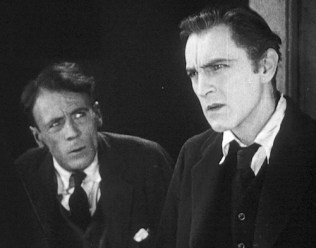 Barrymore makes for a solid, if perhaps unremarkable, Holmes. He has the right look for the role, and makes good use of the same staring-contemplatively-into-the-distance furrowed-brow expression that Basil Rathbone would employ a couple of decades later. He has down the precociousness of student Holmes, which develops into a kind of righteousness when older. He’s not as stand-offish and borderline unlikeable as some interpretations of the character, nor as affable as others. As I say, he sits in the middle, doing nothing wrong but not getting a chance to mark himself out either.
The thing that does go terribly wrong, however, is the romantic subplot. Even if you set aside that such palaver doesn’t fit with the traditional Holmes character, this version is unconvincingly handled. Not only has Holmes apparently spent years pining after a girl he met once (it’s unclear why the Great Detective hasn’t been able to find her in all that time), but when he does meet her there’s no chemistry whatsoever. According to Fritzi at Movies Silently in her review, we should attribute the fault here to Dempster. I see no reason to disagree. Apparently Barrymore so disliked his co-star that he refused to perform the final scene with her, which would certainly explain the none-too-subtle way the actress’ face goes unseen at that point.
Young Mr Powell probably gets the best part, in particular a scene in a cab on the way to Moriarty’s lair where we learn his tragic backstory.  He crops up in the years-later narrative too, used by Holmes to go undercover in the house where Alice is being held hostage by some of Moriarty’s many villainous associates. A major part of Holmes’ plan hinges on him turning up at these villains’ house, telling them what to do, and them obeying him. That this method succeeds is not due to Holmes’ considerable skill, but more due to the screenwriters’ lack of it.
Von Seyffertitz gives a very good Moriarty, though does err on the side of OTT. In part this is his look: I thought they had perhaps gone a little far with the make-up, turning him almost into a caricature of a villain, but having Googled the actor I think that it may mainly be his face… Still, what a perfect face for playing villains! Naming the film after him for the UK isn’t wholly inappropriate, especially as his role is expanded from Gillette’s play (the prologue confrontation being the main addition) and one of the throughlines is Holmes’ focus on apprehending him. It would certainly differentiate it from all of the other films called simply Sherlock Holmes.
The 1922 version isn’t the best film to bear that moniker, but nor is it the worst. I don’t think it’s a great interpretation of Holmes, but I found it to be a pretty entertaining adventure in its own right. I’d even quite like to see the plot rejigged (and the holes ironed out) to make it more truly Holmesian. Even having enjoyed the film, I must say how entertainingly dismissive I found Everson’s notes: he thinks that “one of the most painstaking recovery jobs ever […] quite overshadows the fact that the film itself 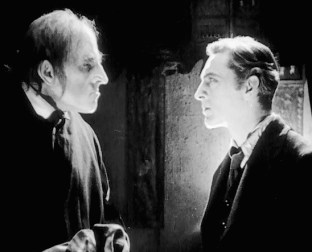 hardly seems worth such devotion except on a purely academic level.” He goes on to say that “it must be one of the blandest misuses of potentially exciting material ever,” that “it literally has no highlights,” that it “has no pictorial style of its own,” that Barrymore “clearly lends his profile to Holmes, and not much more,” that “if it is a major find, it is also a major disappointment.” Ooh, burn. (The whole thing is worth a read.)
Now, with the discovery of the Gillette film, one wonders if this Sherlock Holmes is destined to become even more of a curio than it already is. It’s not wholly undeserving of such a fate: it’s not bad and I found it solidly entertaining, but one for Barrymore fans and Holmes completists only.
Sherlock Holmes, aka Moriarty, is available on YouTube here.
This review is part of The Barrymore Trilogy Blogathon. Be sure to check out the many other fantastic contributions collated by host In the Good Old Days of Classic Hollywood.

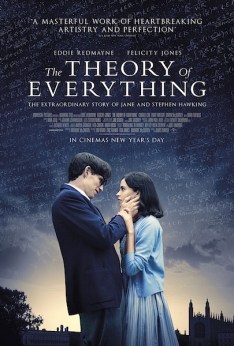 Biopic of genius cosmologist Stephen Hawking and his wife/caregiver Jane, on whose memoir the film is based.

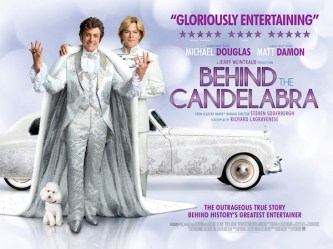 Steven Soderbergh’s supposed last-ever film (or, if you’re American, Steven Soderbergh’s first project after he supposedly quit film) is the story of Scott Thorson (Matt Damon), a young bisexual man in the ’70s who encounters famed flamboyant pianist Liberace (Michael Douglas) and ends up becoming his lover, which is just the start of a strange, tempestuous relationship.
 It looks great, too. The film, that is, not Rob Lowe’s face. The design teams have realised an excellent recreation of the period, which is then lensed with spot-on glossy cinematography by DP
 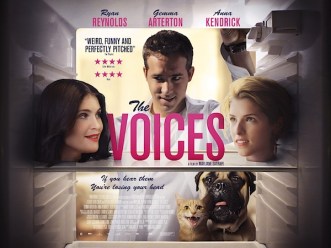 Jerry (Ryan Reynolds) is a nice guy living in the small town of Milton, working in shipping at Milton Fixtures and Fawcetts, where he fancies the English girl in accounts, Fiona (Gemma Arterton), and doesn’t notice how much another girl in accounts, Lisa (Anna Kendrick), likes him. He also talks to his dog, Bosco, and cat, Mr Whiskers, and they talk back. That’s why his psychiatrist (Jacki Weaver) encourages him to take his medication, but he doesn’t. When he accidentally murders Fiona (as you do), it’s Mr Whiskers that encourages him to cover up the crime.
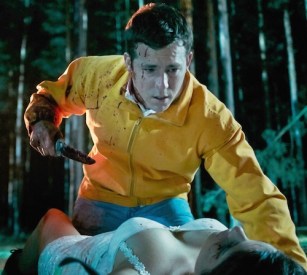 what happened in his past to make him this way (flashbacks and hints are scattered, leading to an eventual reveal), and how will it all end for him? We’re conflicted here, because he’s a nice guy who we like, but he’s also a murderer, in horrific fashion, and so surely justice is due. Screenwriter Michael R. Perry and director Marjane Satrapi (of
 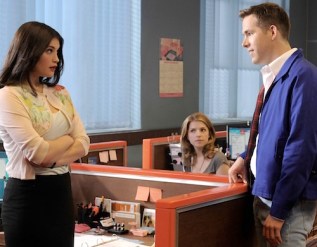 Able support comes in the form of three women in Jerry’s life. Gemma Arterton has a ball, first as a bit of a bitch, then as a ludicrously-chipper super-English talking head. Anna Kendrick, meanwhile, is sweet and likeable, and while we may be on Jerry’ side when he accidentally slides his knife into Fiona, we’re keen for him not to make the same mistake with Lisa. Whether he does or not is where the real battle for his sanity lies. The third is Jacki Weaver’s psychiatrist, who is central to the climax but also has the least to do of all three, really. Never mind.
 The Voices is the kind of film you say is “not for everyone”, which are often the best kind if they are for you. For me, it wasn’t quite funny enough — I’d’ve liked more of the dog and cat, who get the lion’s share of the best material. I also felt that Jerry’s backstory, the reasons for why he is how he is and does what he does, weren’t explored quite enough. The Blu-ray’s deleted scenes hint at more of this, particularly with an alternate climax, which was perhaps cut because there was too little material specifically building up to it. Rather than losing that ending, it would’ve been better to keep it and find more scenes that contributed to it.
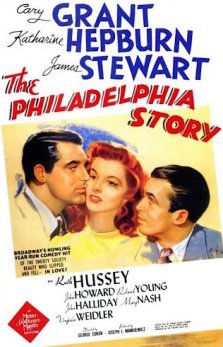 Katharine Hepburn is the
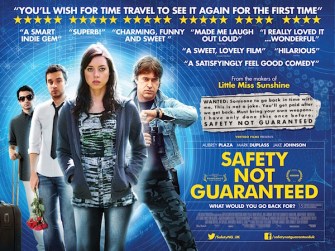 The debut feature from the director of all-conquering box office behemoth
  Maybe I’m missing something, I don’t know, but where other directors currently making a similar transition (Gareth Edwards, Josh Trank, Duncan Jones) showed some signs of a reason for the upgrade in their debut and/or sophomore features, I can’t fathom what singled Trevorrow out. He seems to have done alright with it though, so never mind.
 Action comedy starring John Cusack as a hitman who has to face the life he left behind when he’s assigned a job in his hometown on the same weekend as his high school reunion.
 Disney’s ’80s/’90s renaissance more-or-less came to an end with this adaptation of Edgar Rice Burrough’s jungle hero.
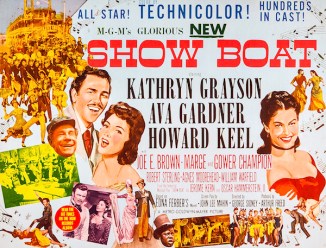 You’d be forgiven for thinking MGM want people to forget this movie even exists: it was dumped on US DVD back in 2000, it’s never had a UK disc release, and a long-rumoured special edition has never emerged. That’s a shame, because there’s a good-quality musical tucked away here.
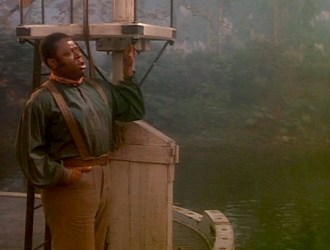 a bit fatalistic for a bright little musical about two people falling in love on a show boat? No, it’s just an indication of where things are going — into darkness, as modern parlance would have it, because from here on out everything goes to pot. To detail the ins and outs would be to spoil the narrative, but much of the film is more tragedy than cheesy Hollywood musical.
 Perhaps it isn’t a film to ease back with on a Sunday afternoon, but not every old film or musical needs to be. If you can get past the opening, Show Boat offers a tough, emotional, perhaps even challenging, view of the world that marks it out as a film deserving of some rediscovery. Can we have that special edition now, please?
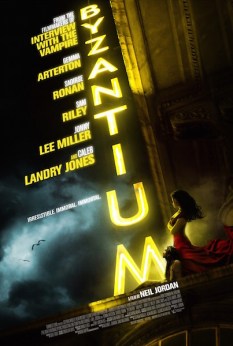 18 years after he adapted Anne Rice’s seminal vampire novel Interview with the Vampire into a seminal vampire
 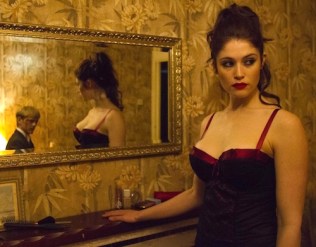 The most effective part of the movie isn’t so much its plot or its mythology, though, but its atmosphere. Vampire movies take place in castles or drawing rooms, or high schools in more modern iterations. They are grand and sensuous. Any glamour in Byzantium is discarded and decrepit, like the titular hotel that Clara reshapes as a whorehouse; faded and left to ruin. The seafront is characterised by graffitied concrete, the glaring lights of arcade machines, heroin-chic Eastern European prozzies. The pier appears to have burnt down at some unspecified previous time and just been left. The only people left behind are the ones without a means of escape, stuck with their miserable lot. Clara and Eleanor fit in almost seamlessly.
 Other alleged faults include the film not giving enough time or heft to facets individual viewers want it to cover. For one example, someone criticised it for not fully exploring the issue of voluntary euthanasia. I’d argue it doesn’t explore it at all, because it’s not trying to. That Eleanor chooses to only kill people she perceives as wanting to die is not her making a moral statement on a contentious issue, but finding a way to marry her conscience and upbringing with the necessities of her vampiric life; and it’s probably practical, too. That’s not to say a vampire movie can’t be used to explore a topic like voluntary euthanasia, but if you want that I’m afraid you might have to write your own.
 Technically, DoP Sean Bobbitt grants us some gorgeous cinematography. There’s a cruel, aptly soulless beauty to the faded town, while some countryside vistas, both past and present, offer more traditional scenic pleasure. A remote rocky, misty isle — central to the mythology and so repeatedly visited — is particularly notable. Captured entirely on digital cameras, it seems sometimes that Bobbitt tried to push his equipment too hard: some shots during the climax look flat-out weird, as if someone has applied a Photoshop “comic book” filter or something. Also of note is the score by Javier Navarrete, which makes particularly good repeated use of The Coventry Carol.
 For all its dual-period storytelling and its grubby settings, it’s a resolutely modern kind of take on vampire mythology.
 100Films.co.uk