Starter for Ten (2006)

2007 #99
Tom Vaughan | 92 mins | DVD | 12 / PG-13
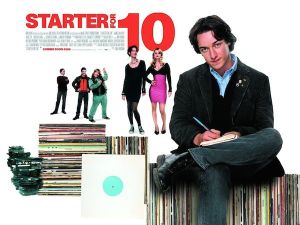
Starter for TenA predictable British rom-com, enlivened only by a few good moments and performances, as well as the excellent ’80s soundtrack.

You’d assume the plot would focus on the characters’ aim to win University Challenge, coupled with a woefully predictable romantic subplot; sadly, it turns out the woefully predictable romance is the main plot and the quiz only turns up now and then to lend some structure. The final contest is almost entirely devoid of tension thanks to this and the other conclusions hold no surprises.

McAvoy is likeable, though held back by Brian’s near-unbearable ignorance about life. The best performances come from Benedict Cumberbatch and Rebecca Hall, both actors worth watching.

2 out of 5

Starter for Ten is on BBC Two tonight, Sunday 31st August 2014, at 10:30pm.

Great Expectations (1946)

2007 #98
David Lean | 113 mins | DVD | PG

Great ExpectationsClassic adaptation of the acclaimed novel. While my experience of Dickens is woefully limited to screen adaptations, this tale is one of my lesser favourites; the first act and elements of the climax are wonderfully Gothic (and here beautifully directed to that effect), but it seems to lack the depth or importance of works such as Bleak House, Oliver Twist or A Christmas Carol.*

Though, aside from the dully straightforward middle, there’s little to dislike about the adaptation. John Mills is too old to convince as a 20-year-old Pip, but his performance is good and he’s ably supported. However, the main highlights are undoubtedly all in Lean’s brilliant direction.

4 out of 5

* I don’t remove anything when I repost my old reviews, but I must add that I now find this comment to be suitably embarrassing. ^

A Study in Scarlet (1983)

2007 #97
Ian Mackenzie & Alex Nicholas | 48 mins | DVD | U

A Study in ScarletPeter O’Toole is again the voice of the famous sleuth in this disappointing animated adaptation of the first Sherlock Holmes mystery.
The adaptation is faithful to the original novel’s structure (sadly, as it’s a somewhat bizarre one, and ripe for a more interesting interpretation), but loses any elements pertaining to Holmes and Watson’s first meeting. The animation seems more basic than the other entry in this particular series that I’ve seen, and O’Toole’s performance is flatter. The rest of the cast don’t fare any better. The story itself isn’t a bad one, but after being pleasantly surprised by The Sign of Four, I just found this to be disappointing.

2 out of 5

Before Sunset (2004)

2007 #96
Richard Linklater | 77 mins | DVD | 15 / R

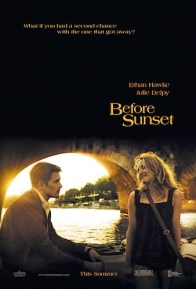
Before SunriseNine years on, Jesse and Celine meet again in Paris…
It’s as simple a premise as Sunrise, and in many ways is very similar: it’s essentially two people talking, laughing and philosophising. It’s an odd sort of sequel — it doesn’t just take the same characters into a new story, or directly continue the original. These are the same people, but they’re older and changed. It’s very reflective; it’s almost about the first film, from a different perspective. You also don’t miss a thing — its in real time from beginning to end, showing us every second the characters spend together.

Personally I didn’t think it was as good as Sunrise — it’s not as funny and it sadly closes off some of the original’s beautiful ambiguities. Part of the problem may be that I’m close to the character’s ages in the first film but a good decade out here (though, I hasten to add, that’s not solely it). In the end, it works quite nicely as a companion piece, but (perhaps) not as a film in its own right.

4 out of 5

Recently, Sunset beat Sunrise by a noteworthy number of places in Empire’s 500 Greatest Movies poll, which was an interesting result. I stand by my assertion that the first one’s better, and can only theorize that the second installment gains something if you had to wait a decade for it and, perhaps, were closer in age to the characters — the latter I believe is a fairly important aspect in what you get from films of this nature.

Before Sunrise (1995)

2007 #95
Richard Linklater | 97 mins | DVD | 15 / R

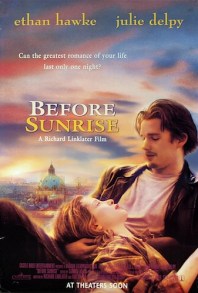
Before SunriseTwo 20-somethings meet on a train from Budapest to Paris, get off in Vienna and spend the night there until one of them has to fly out in the morning. A simple premise, though you may wonder how it sustains 95 minutes.
The answer is, very well. Ethan Hawke and Julie Delpy make for a likable couple and it’s no chore to spend so long with, essentially, just them chatting to each other. Some of the attempts at philosophising may wear thin (Delpy especially seems more adept in the lighter parts), but the funny and romantic sections do work beautifully.

Bittersweet in all the right ways. Probably best watched while still fairly young.

4 out of 5

See also my review of the sequel, Before Sunset.

The Black Dahlia (2006)

2007 #94
Brian De Palma | 116 mins | DVD | 15 / R

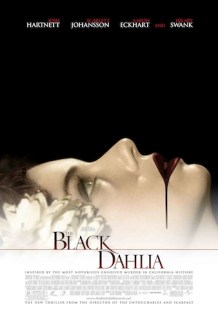
The Black DahliaNoir-wannabe, adapted from the James Ellroy novel based on a real, unsolved case. That case is far from the focus here: from the start the apparently-central crime is anything but, meaning the biggest let-down is that events barely follow the eponymous story.

It’s one of many problems in a film that tries hard to be a proper noir but fails in almost every respect: performances (most of which wind up flat), corny dialogue, plot, pretty-but-vacant direction, and even voice-over narration. I haven’t read the novel, but apparently it’s a poor adaptation too. What you want is a ’40s-style thriller; what you get is a weak ’40s-set character drama.

2 out of 5

Gone with the Wind (1939)

2007 #93a
Victor Fleming | 224 mins | DVD | PG / G

Gone with the WindI thought I’d seen Gone With the Wind but, watching it again, it’s clear I hadn’t properly.
This is partly because I first saw it on TV, in two halves, a week apart, each starting at 1am. I just about managed to follow the story, in between drifting off for whole chunks. Another reason is the quality of the restored print on the DVD: it looks stunning, every frame is beautiful; it’s a shame no films look like this today.

The performances are uniformly excellent, especially (of course) Vivien Leigh and Clark Gable; though special mention must be made of the fantastic Oscar-winning Hattie McDaniel as Mammy (the first African-American to be nominated for and win an Oscar, and deservedly so). The direction is brilliant, displaying styles you think weren’t invented for another 20 years; all of the design work is gorgeous; and the story is epic and expertly told, moving across genres (romance, war, melodrama, comedy) with ease.

It’s easy to see why this is the most popular film ever made. First time round I just thought it was very good; now it’s firmly one of my favourites.

5 out of 5

Letters from Iwo Jima (2006)

2007 #93
Clint Eastwood | 135 mins | DVD | 15 / R

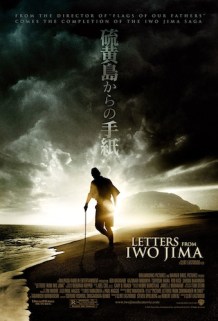
Letters from Iwo JimaCompanion to Flags of Our Fathers, and widely considered the better of the two, showing the same battle from the Japanese perspective.

Letters focuses on the human angle, getting to know the characters as they prepare for battle (the Americans don’t arrive for almost an hour) and through flashbacks. The film aims to humanise ‘The Enemy’ but only succeeds in showing that there were some good people in a society of old-fashioned ideas; the obsession with pointless suicide over genuine use of men may be true, but still seems savage and unpractical (probably more a flaw of the real military attitude than of the film, then). No character who follows this is a good guy; likable ones survive or are Westernised. The Americans we see are a mix too (one shoots captured soldiers for no reason, for example), but this feels like a hollow attempt to depict the filmmakers’ countrymen equally rather than genuinely aiding the concept of the Japanese as good guys.

The action sequences and cinematography owe a lot to Saving Private Ryan — desaturation is becoming a war film cliché. That said, it works here, fitting the bland sandy environment and emphasising bursts of colour from blood and flames.

A mixed film then, the value of which lies not in presenting a view of war, humanity or Japanese culture, but in providing a view (or, indeed, half a view) of this one particular battle.

4 out of 5

My thoughts on the first half of this pair can now be read here.

The Cat’s Meow (2001)

2007 #92
Peter Bogdanovich | 109 mins | DVD | 12 / PG-13

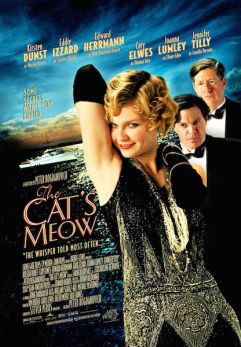
The Cat's MeowPossibly-true ‘murder mystery’ set in 1920s Hollywood.

As with the similar Gosford Park, the point lies less in plot and more in characterisation — there are some good performances, especially from Eddie Izzard, Joanna Lumley and Edward Herrmann, though Kirsten Dunst seems a bit flat in comparison. The era’s style suits her though, and the whole period is beautifully evoked; for my money the prettiest scenes are the black & white bookends.

Sadly the similarity to Gosford Park is the film’s main shortcoming: once realised, it’s clear that The Cat’s Meow doesn’t have the same subtle complexity in its story or performances. In its own right, though, there’s much to like.

3 out of 5

Neon Genesis Evangelion: Death & Rebirth (1997)

aka Shin seiki Evangelion Gekijô-ban: Shito shinsei

2007 #91
Hideaki Anno, Masayuki & Tsurumaki Kazuya | 107 mins | DVD | 15

Neon Genesis Evangelion: Death &a RebirthThe genesis of this film is a long story (at least, longer than I’d like for this review!) The anime series Neon Genesis Evangelion ends with bizarre theme-centric episodes that fail to conclude the story; a film was produced to re-tell the end from a story-centric position and/or to provide an alternate ending (depending who you believe). This is not that film, but something that was released a bit before that.

The first 69 minutes (titled Death) are an intriguing reorganisation/summary of the series in a somewhat impressionistic way, including a few new scenes. It’s either quite clever or just a jumble. The final 27 minutes (titled Rebirth) are an all-new continuation of the story.

There are answers, revelations, some great sequences, and a great cliffhanger! Unfortunately this is also the start of the concluding film, which ultimately renders this as just one thing: a fan-only curio. Its main value, in my opinion, is the neat cliffhanger, which makes for a tantalising ending (instead of the first act plot point it must be in the next film).

If you’re curious about Evangelion and think a filmic summary sounds a good idea, don’t watch! Get hold of the series, it’s worth the time. (I’ll undoubtedly share my thoughts on the conclusion, The End of Evangelion, as soon as Play.com get it back in stock.)

2 out of 5