
Michael Bay | 138 mins | DVD | 12 / PG-13
 As I’m sure you know, Transformers is a live action adaptation of the ’80s cartoon inspired by a toy line, which managed to become the highest grossing non-sequel of 2007 (though, of course, it’s still very much part of a franchise. But taking that into account places it 5th, which doesn’t sound as impressive. If anyone’s interested, the highest-grossing non-franchise movie was Ratatouille… though you could argue that’s basically in the Pixar franchise, so the honour would then slide to I Am Legend… which you could argue is in the Will Smith franchise, but that would be pushing it).
Firstly, I have to admit that I’m inadvertently something of a Michael Bay fan; or, at least, a fan of his films. He’s hardly the world’s greatest director — certainly not in an award-winning sense — but his movies set out to be big and fun and, more often than not, they achieve it. I always think I’ve seen very few of them, but I’ve actually been fairly comprehensive: Bad Boys and, especially, The Rock are both entertaining action flicks; Armageddon I half-watched once and it seemed a bit crap; the only bits of Pearl Harbor I’ve happened across have been even more laughable than reviews led me to believe; Bad Boys II was overlong and overrated, but had its moments; conversely, The Island was cruelly slated — I could write a whole review of my thoughts on that, but this isn’t the place. So I’ve actually taken in all of his films (one way or another), bar this latest — another huge-budgeted, action-packed, CGI-heavy extravaganza. Same old same old?
Not quite. Thanks to its kid-friendly basis, and in spite of much slaughter and gags about masturbation, Transformers is probably Bay’s most family-friendly offering. That said, it’s still very much a Boys’ Film, packed with soldiers, fights, explosions, and female characters who are either hot teens with a surprising knowledge of mechanics or hot twenty-somethings with a surprising knowledge of computers. Or comedy mothers. But most of all, there’s a serious technology fetish — the film nearly bursts with so many cars, planes, guns, army vehicles… Of course, if there’s one film where a tech fetish is acceptable, it has to be one about giant robots who can reshape themselves into everyday items. In these moments the CGI is frequently astounding, as thousands of parts move and rearrange to change a plane/car/hi-fi into a robot being. It happens so fast that, unbelievably, it’s rarely even the focus of the scene. It’s also mostly photo-real, though it becomes hard to judge just how real because the physical impossibility means the viewer reasons it has to be CGI. That doesn’t stand in the way of the achievement though, and how the effects team lost out to The Golden Compass at the Oscars is beyond me (to be fair, I haven’t seen that Pullman adaptation, but the CGI looked decidedly under-impressive in the trailers).
It’s not all so good. The music is indistinguishable from that in every other Bay film, which means it usually serves its purpose but is beginning to sound a tad tired. The opening is a little dry, with too much focus on faceless soldiers and not enough on the infinitely more entertaining story of Sam Witwicky, who’s played with charm by Shia LaBeouf, rising (risen?) star du jour. Once the Autobots (they’re the good robots) turn up en masse halfway through the film really hits its stride, suddenly becoming funny, exciting, and even stirring on occasion. The finale’s a bit of a muddle however, with no clear idea of which robot is which and who’s fighting who, or what the strategy/point actually is. It’s disappointingly anticlimactic in some respects, especially the duel between Optimus Prime (head Autobot) and Megatron (head Decepticon — they’re the bad robots), which amounts to little more than a couple of clashes. Why can no one seem to manage a good final battle these days? Megatron is underused in the film as a whole, only coming to life very late on and affording Hugo Weaving about five lines. It seems a waste.
Despite these flaws, I really enjoyed Transformers, certainly more than I expected to. It may be clichéd in places, with too much of a tech fetish, shallow female characters, too many faceless soldiers, bouts of weak dialogue, a muddled climax… But it’s still fun, with enough likeable moments and characters to carry it through. Hopefully they can focus in on what worked — or, at least, maintain the same level of quality — in next year’s sequel.

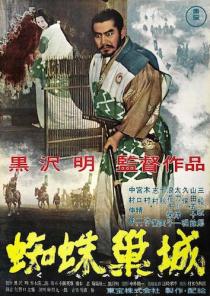 Kurosawa moves Macbeth from Scotland to 16th Century Japan in this retelling of Shakespeare’s infamous Scottish Play. I’ve heard this described as a loose adaptation — perhaps those reviewers have never read the play. Kurosawa sticks very closely to the structure of Shakespeare’s version of the story (though based on real events, Shakespeare changed key details), often choosing to adapt it scene-for-scene. It works well in the new setting, with some of the themes — honour, respect, betrayal — perhaps becoming more understandable when placed in samurai culture. Kurosawa changes other elements too — character names are understandably localised, there’s only one witch, there’s no version of the famous “Is this a dagger which I see before me?” monologue, and so on. It’s not all omissions however, as Kurosawa adds imagery and symbolism of his own. Again this helps to place the story in its new context, but also covers the loss of Shakespeare’s original language (a major sticking point for some critics).
 I’ve grown up with Indiana Jones around. Not in the way Harry Knowles may have (
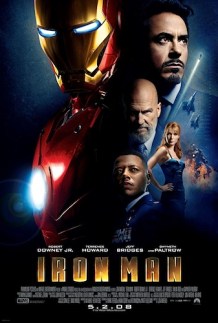 “Iron Man, Iron Man, does whatever an iron can. Flattens clothes, nice and smooth; burns a hole if he doesn’t move. Look out! Here comes the Iron Man!”
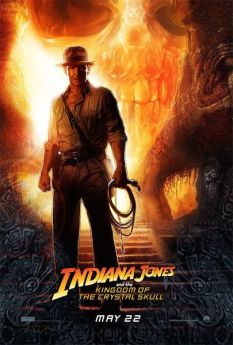 I couldn’t make it to the local midnight showing of
  Tim Burton and Johnny Depp collaborate for the sixth time (as the DVD’s blurb is so keen to point out) for a film adaptation of Stephen Sondheim’s musical adaptation of the classic tale of the titular barber who slaughters instead of shaves and sells the resultant meat to all of London in the pies of his accomplice, Mrs Lovett.
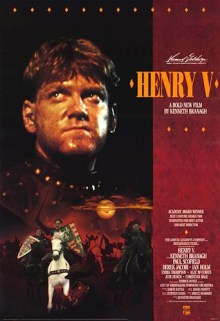 Once more unto the breach, dear friends, as I delve into a second version of Henry V in as many (viewing) days. (I dread to think how many reviews of this film began with a similar quote-based pun.) Inevitably, having watched them so close together, this is as much a comment on the relative merits of Branagh’s and
  Or The Chronicle History of King Henry the Fift with His Battell Fought at Agincourt in France, as the title card (and therefore
 Vantage Point is nothing like
 100Films.co.uk