
Dave Filoni | 98 mins | Blu-ray | PG / PG
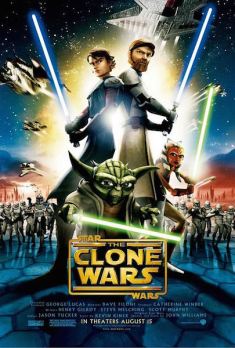 The Clone Wars can boast an awful lot of firsts within the Star Wars franchise: the first animated Star Wars in cinemas, the first not to feature Frank Oz as Yoda, the first not to open in May, the first not to have a text-crawl intro… It’s also the first not to open at number one at the box office. None of these facts are likely to endear itself to die-hard Star Wars fans. I’m not one, but it did little to endear itself to me either.
Things go wrong immediately. For fans, the Warner Bros. logo is horrendously incongruous (so I’m told — the original six films were all released by Fox), but for even the casual viewer there’s something seriously odd within minutes: no opening text crawl! This is meant to be Star Wars? Instead, a chunk of exposition — which sounds exactly like the opening crawl would, and so has clearly been designed to replace it — is read over a montage of the events it describes. Do they think children can’t read? In fairness, I’ve been to Star Wars screenings where there were children young enough that parents were having to read the crawl to their kids… but considering the live action films are “kids’ movies” too (as Lucas was so keen to remind us when everyone hated the prequels), surely what’s good enough for them is good enough for this?
Omissions such as this could be forgiven if more important aspects went well. But they don’t. The script is so good it could’ve been written by George Lucas himself. There are too many weak dialogue exchanges to even consider listing them, but Ahsoka’s habit of calling R2-D2 “Artooey” is memorably grating. Much of the voice acting is just as bad, with James Arnold Taylor’s Obi Wan accent particularly off-centre.  Catherine Taber’s Padmé impression is probably the most convincing of the lot and, coincidentally sharing the same scenes, Corey Burton’s Truman Capote impression as Ziro the Hutt is entertainingly obvious. Count Dooku doesn’t particularly benefit from the involvement of Christopher Lee, but at least Samuel L. Jackson is vaguely recognisable lending his actual voice to Mace Windu. Most of the cast deliver the kind of performance you typically find in kids’ cartoons — i.e. not all that good, no doubt due to the pressures of producing as many episodes as possible as cheaply as possible. Dubious line readings abound, though in fairness this may be down to the awkward lines they’re forced to deliver.
In between the poor dialogue there are plenty of action sequences. The first battle is a bit dull: masses of troops just firing at each other, until the bad guys suddenly decide that actually they ought to retreat because of the cannons — cannons that have been firing on them throughout. At least the repeat performance ten minutes later features some tactics and diversions. Later fights are better, though not by a huge amount. There are certainly a fair few, though there’s little real variation between them. The big battles and space dogfights are adequate, if lacking in focus, but the lightsaber duels miss the heft of their live-action equivalents, animation robbing them of the physical skill involved in a real sword fight (even if those in the prequels involve a fair degree of CGI themselves). The much-trumpeted vertical battle is a great idea that’s competently executed, but the change in perspective is too little used — apart from the odd moment or shot, they may as well be progressing slowly on a horizontal plane.
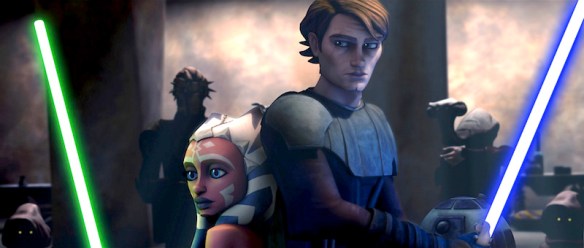
All of these sequences are scored by stock-sounding ‘epic action music’. Kevin Kiner’s music is nothing like as original or distinctive as John Williams’ work on the main series. Other than re-using some of Williams’ themes, it’s a rather generic action score — perfectly pleasant for what it is, but not particularly memorable. A slight remix of the main Star Wars theme gives the opening a distinctive air… as if the Warner Bros. logo, war talk over the Lucasfilm logo, and lack of text crawl didn’t do the job by themselves.
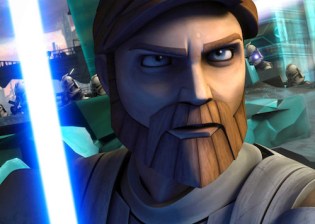
The animation itself is certainly stylised, which annoys some, but then it’s not billed as an Avatar-esque “it’s real, honest” style, or even the lower level achieved (if one can call it an achievement) by Beowulf. It’s surely a sensible decision — look how far from real Beowulf turned out to be on a feature budget and timescale, and when you’re churning out a weekly series (as this was always intended to be) such aspirations as photo-real CGI are far too lofty, not to mention expensive. Personally, I quite like the style. The painterly textures are slightly odd, but probably preferable to flat slabs of colour, while the cartoonisation of the cast (allegedly inspired by Thunderbirds) fits the lightweight tone and keeps things visually interesting. Besides, as noted, the visual style is the least of the film’s problems.
 It may sound like a piece of trivia that this was originally conceived as three episodes of the TV series that now follows it, but where the breaks would fall is disappointingly clear — note, for example, that at around 25 minutes the first battle is won, Anakin resolves himself to teach the Padawan he previously objected to, and Yoda arrives to kick off the next part of the story. It could only be more like the end of an episode if credits rolled. It’s also the apparent need to fit two or three action sequences per episode that keeps them coming at regular intervals in a film which sticks three back-to-back.
There’s an overarching plot, thank goodness, which is immediately established… before being put on hold for half-an-hour while the events of what-would-have-been-episode-one play out: a battle that isn’t particularly significant in itself and has absolutely no relevance to the rest of the story, immediately betraying the three-episode origins. After that’s done the main plot resumes in two clearly-divisible chunks — the precise moment of the second transition isn’t as obvious as the first, but which subplots belong to which half is. Maybe the story joins are invisible to those who don’t know the production’s history or something of narrative structure (i.e. normal people), but they were blatant to me. It particularly shows in the final act/third episode, as the story switches from epic battle sequences to some out-of-nowhere political wrangling and lower-key lightsaber-based confrontations.
Although it has high-quality animation, a largely cinematic scale, particularly in the battles, and direction that isn’t as obviously TV-only as some TV-bound productions, The Clone Wars still feels like watching a compilation of TV episodes rather than a film in its own right. It’s partly the episode structures that remain unconcealed, partly the shortage of real voice talent indicating a lower budget, partly the relative insignificance of the story —  it just doesn’t have the epic quality that imbued all the other Star Wars films. Not every film has to be an epic, even ones set within the same universe/storyline, but by wheeling out all the main characters and then showing them complete just one moderately low-key mission, The Clone Wars does feel like a single instalment of a TV series and not an appropriately-scaled cinematic experience.
This might’ve made a pretty strong set of opening episodes to a half-hour TV show, and I hear the series has gotten quite good as its first season progressed. If that’s true, it’s a shame such a weak beginning will have put so many off giving it a go, because as a standalone film The Clone Wars falls far short.

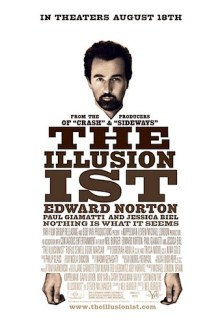 A Blu-ray release of The Illusionist has just
 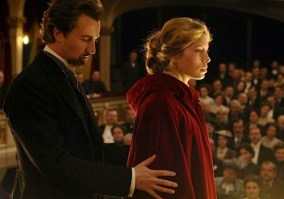 The story itself — you remember those? It’s the bit between the attention-grabbing opening and preposterous-twist finale — is mediocre with or without the finale. It’s a something-and-nothing account of a Poor Boy who loves a Rich Girl he can’t have and… oh, I can’t even be bothered to explain it.
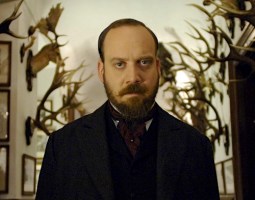 As comparisons with The Prestige are inevitable, particularly as both films were ultimately released around the same time, I’ll briefly put them head-to-head. Both concern stage magic in a similar-enough period setting, debate about whether the tricks are just that or actually supernatural powers, a love story that goes awry, which involves a fatal rivalry… But they’re actually very different films. The Prestige jumps about in time in a more complex way than The Illusionist, but this also has a point. The former’s story is more original, more engaging, its use of magic — real or not — more captivating. I fear I could go on, but it’s succinctly summed up thus: in this comparison, The Illusionist comes up short.
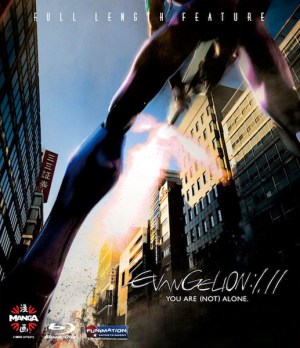 When I (first) reviewed
 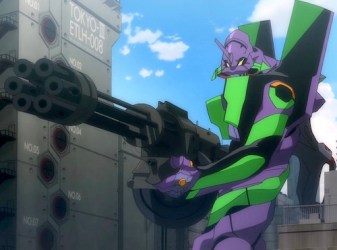 is a new addition I swear, while he also listens to a (digital, at least) cassette player rather than an iPod (other MP3 players are available, naturally). It’s not a major flaw — unlike, perhaps, the fact that the “covert” and top-secret Nerv organisation has great big signs plastered all over town and everyone seems to know about them — but, still, maybe a new bit of animation to replace the tape-playing close-ups would’ve been nice.
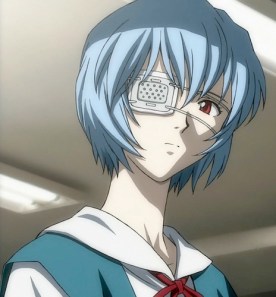 The pros and cons of the series remain. Shinji is alternately interesting, perhaps even complex, and a whiney little irritant. Here he has a character arc at least, suggesting he may be more sufferable next time out. His relationship with Major — sorry,
 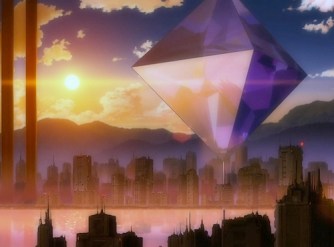 Another factor thrown up by the TV-series-to-feature conversion is the image quality. An HD big screen is a mixed blessing here. On one hand, it looks great on Blu-ray, with crisp lines and solid colours, the result of re-filming, colouring and CGI-ing the original animation elements rather than using the finished TV shots. On the other, such clarity sometimes shows up a lack of detail in the original animation — these elements were created for 4:3 mid-’90s TV, not a hi-def (home) cinema — and the solid colours and money-saving techniques (for example, showing something static rather than a lip-synched (ish) mouth during conversations) can remind the viewer of cheaper TV roots. Perhaps I’m being overly critical though, because much of it does look fabulous; at the very least, the thorough ground-up rebuild means it looks better than the TV series ever will, never mind has.
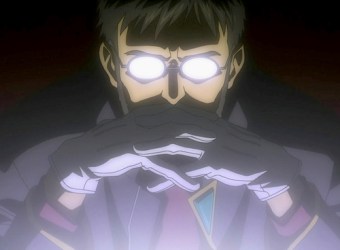 It’s enough to make one scurry back to the series for answers, though the three movies still to come promise whole new characters, plots and a — frankly, much-needed — brand-new ending. After two misfires (one in the series, one in
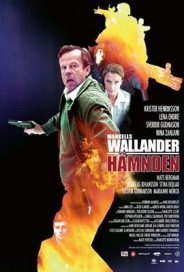 Krister Henriksson returns as the titular Swedish detective for a second — and final — series of feature-length investigations, though this time only this first has received a theatrical release (which means it’s likely the only one I’ll review, unless the series finale offers something that persuades me otherwise).
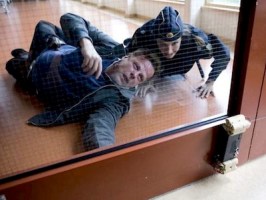 The climax is a case in point. There’s no grand shoot-out or serious race-against-time-for-the-last-bomb, just Wallander and the criminal having a calm chat. OK, so there’s a kidnapped government minister, a gun, snipers and a big vest-bomb, but these are set dressing to the conversation. It’s proof if proof were needed (it isn’t) of Henriksson’s controlled skill in this role. As great as Branagh could be, it’s hard to imagine his introspective interpretation of a weepy Wallander slotting into this scene without making it unpleasantly histrionic.
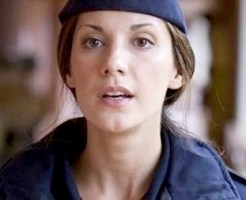 but also by adding two new recruits to Wallander’s team, Isabelle (Nina Zanjani) and Pontus (Sverrir Gudnason), and the introduction of prosecutor Katrina (Lena Endre). All are set up as key new characters for this run, though it’s clearly Only The Beginning here. Katrina is a little too blatantly a potential love interest for Wallander, while Isabelle and Pontus are… well, new characters. There’s little to say about them yet.
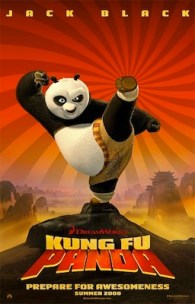 I nearly watched Kung Fu Panda on a plane once, but planes are rubbish places to watch films so I decided against it. (I watched
 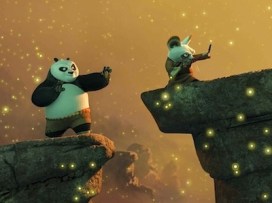 Panda features some beautiful animation — not a phrase you usually associate with CG ‘toons (though Pixar are pushing into this area with the likes of
  I think that — along with
 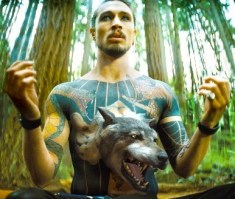 bring back the dead and let you see a teeny bit into the future, shortly before some baddies explode in puffs of green smoke and some more baddies are revealed to have full-on superpowers. Where did these come from? No idea. The film offers no explanation, be it mutant gene or radioactive exposure or plain old training, instead just assuming viewers will accept that this is the real world… oh, but some people have these cool powers.
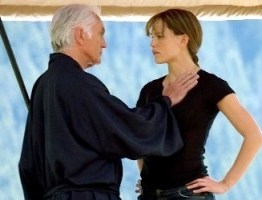 here there might at least be a reason to keep watching, but the weak action is just icing on the cake of the clichéd story and bland characters. Director Rob Bowman claims he made an R-rated film which he was forced to cut to PG-13, the implication being that neutered the whole thing. Maybe that’s where all the action went, though on the evidence of what’s left I’m not sure I believe him.
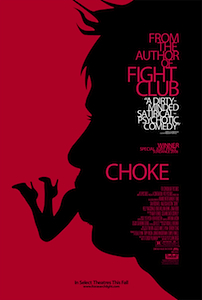 Choke is adapted from a novel by Chuck Palahniuk, the author of Fight Club, and you can tell.
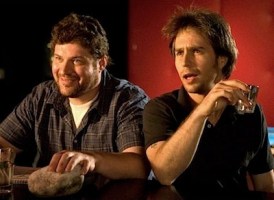 The cast are without fault. Sam Rockwell is brilliant as ever, continuing to build a body of work that suggests he’s been underrated. Perhaps there’s a similarity to some of his roles, but he has a sort of rough likability that can make one overlook that. I’ve still not seen
 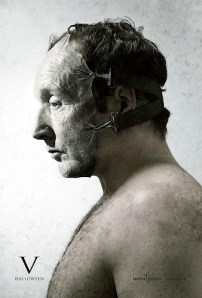 And so the never-ending Saw franchise trundles on to its fifth part. Indeed, Saw Part 5 might be a more apt moniker for this film: it picks up directly from the end of
  One of the franchise’s Big Things has always been the last-minute twist. Signalled by the Saw theme beginning to play and emphasised with an explosion of very brief flashbacks to earlier in the film, the twist shows us what we’ve missed all along and turns the story on its head. The
 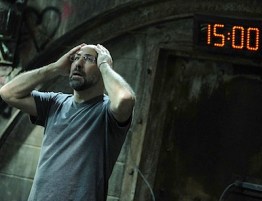 In fact, it’s this side of the film that holds a bigger and better twist than the highlighted arc plot one, though some viewers may miss its significance as it goes so unheralded. (Arguably this ease with which it might be missed says something about how significant it is; equally, perhaps I’m assuming a lack of intelligence on the part of Saw’s regular audience by implying they would miss it.)
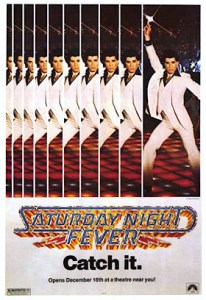 Saturday Night Fever couldn’t be more ’70s if it were made today as a period piece (if you can see how that isn’t a contradiction). From the posters on Tony’s walls, to the fashions, to how it’s shot, it seems to have been designed specifically to exude seventies-ness in a way few other things seem to. It feels natural, then, that some of its original elements have become shorthand definitions for the era: the Bee Gees music, the dancing, and in particular that pose.
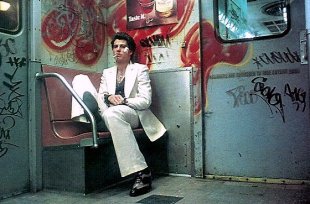 with dead-end jobs, late-night fights, turn-taking back-of-the-car sex, and other unsavoury pursuits. It’s no wonder Tony wants to escape.
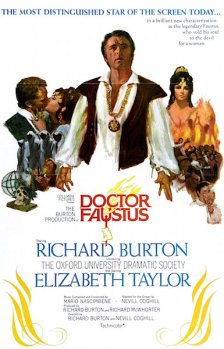 Despite the numerous film versions of the Faust story, this is the only one that adapts Christopher Marlowe’s A-level-favourite 1588 play. It’s a shame, then, that it’s heavily edited from the original text and, despite also being a filmed version of the Oxford University Dramatic Society’s 1966 stage production, has clearly been inappropriately chosen as a vehicle for then-couple Richard Burton and Elizabeth Taylor.
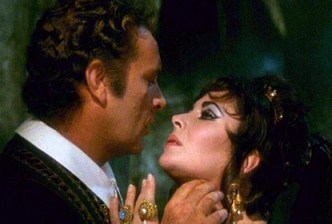 Elsewhere, Burton and Coghill’s vision of Faustus is stylistically reminiscent of a Gothic Hammer Horror, which is either wholly inappropriate or an ingenious genre mash-up — after all, such a genre-mashing trick has been pulled many a time with Shakespeare over the years. There are repulsively horrific corpses, a harem of naked ladies, an array of special effects, plus a medieval-styled gothic atmosphere to all the sets and costumes, though the scene where Faustus mucks about with the Pope feels more Carry On. Using inanimate objects in the roles of the Good and Evil Angels — respectively, a statue of Christ and a skull — is a small but inspired touch.
 perhaps just to heighten the presence of Helen by losing scenes she couldn’t have been shoehorned into; but in the process it both loses some of the best material and destroys any hope the film had of being a definitive filmed version of the play. Ultimately, such oversights proved to be the final straw for the film’s already-tenuous grip on a three-star rating.
 100Films.co.uk