2011 #56
Jon Favreau | 125 mins | Blu-ray | 12 / PG-13
With Thor out a couple of weeks ago and Pirates of the Caribbean 4 just hitting cinemas, 2011’s blockbuster season is well and truly underway. While you all head out to the cinema and enjoy this year’s delights (or disasters), I intend to do some catching up on the tonne of stuff I’ve missed from the last year or two (or three, or more).
Starting, naturally, here…
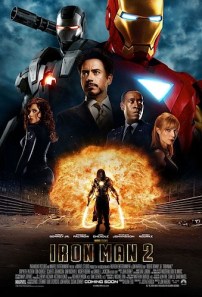 I’ve always contended that the first Iron Man film was overrated. That’s not to say it was a bad film — I gave it four stars and, having re-watched recently, I liked it even more — but I think it took critics and audiences by surprise and that led to a level of praise from both sets that was unduly high. It’s not unreasonable: who would’ve expected anything special from the movie adaptation of a B-list superhero, helmed by a low-recognition director, starring a one-time leading man just about on his comeback? When it turned out to be both fun and funny, I think people overreacted. I saw it later, after hearing all that praise, so I think (without wishing to sound immodest) my view was slightly more tempered.
It’s for similar reasons I think Iron Man 2 has been underrated — I would contend that it is, more or less, as good as the first film. That didn’t seem to be the consensus at the time of release, which ranged from mediocre to rubbish. I don’t agree at all — and, again, I think this is in part due to viewers’ expectations. When one thinks a first film is better than it is, expectations for the sequel are heightened; when said sequel is only as good as the first film really was, it looks a lot worse by comparison — it fails to reach the audience’s over-raised expectations.
That’s my take, anyway. This being a review, I shall now offer more thoughts on why I think it’s a good action-adventure flick.
 For starters, it relies on the story rather than the action. There are certainly some good sequences of the latter (more about those later), but there’s also a lot of story in between them — it’s not wall-to-wall explosions and punch-ups. Neither was the first, if you remember, and so it fits in that respect. It’s helped along by the ending of the first film, in which Tony Stark revealed he was Iron Man. That’s not something you do in superhero movies, which immediately lends this one a few new plot devices to play around with. Considering the burgeoning critical assessment that all superhero movies ever only tell the same two or three stories (an argument I think has a lot of validity), it’s nice to see anything to challenge the norm.
So does the reliance on technology. Yes, Batman uses kit rather than powers gifted via supernatural or ‘scientific’ means, but even Christopher Nolan’s real-world version of that character takes the tech as read and gets on with some moral-based superhero antics. Iron Man does less of the hero stuff (see again: fewer action sequences; also, Stark’s self-centred character) and indulges a little more in arms-race tech-development, a very plausible side effect of this superset being unveiled to the world. The development of the technology is as much part of this story as the genre-typical mental anguish of the hero(es) and/or villain(s), which, again, makes it a little different.
This time, Iron Man faces two enemies. A recipe for disaster, some would say — look at Batman & Robin or Spider-Man 3. That conveniently ignores Batman Returns or The Dark Knight though, doesn’t it. Here it works because they’re two notably different characters and they complement each other — 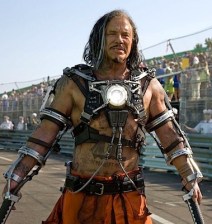 it’s the Penguin and whover-Christopher-Walken’s-character-was rather than Mr Freeze and Poison Ivy, if you will. They play to different sides of the hero: one is fighting Stark, one Iron Man (though there is naturally crossover); though they’re both intelligent, one functions as the brains and the other as the brawn. Mickey Rourke may go slightly underused, but it’s also part of the character, a quiet, thoughtful, intelligent hulk partnered with Sam Rockwell’s jabbering wannabe-Stark.
Turning to the action sequences, I think they’re better all round than the first film’s efforts. Iron Man comes up against things that are his match, rather than just the occasional virtually-unopposed rescue of a third-world village or what have you. The climax is certainly better than that in the original. Iron Man 1‘s climax was a brief encounter lacking punch, literally; here we have a more advanced villain with some variety in his weapons — it makes for a more visually interesting affair. Both films have been criticised for being just robot-on-robot fights, the same fault that riddled Transformers. I disagree. In Transformers you couldn’t tell who was who; in both Iron Mans, you can — that’s kinda important. Sure, a non-robot-suited villain would make even more of a change, but I don’t think it hampers this finale too much.
I also wonder if some negative reaction stemmed from being shown too much in the trailers. I distinctly remember how underwhelming I found Wanted at the cinema because I felt like I’d seen it all; 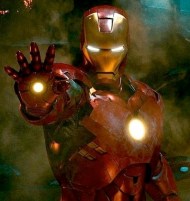 watched again later on Blu-ray, I enjoyed it a lot more. With Iron Man 2 I’m obviously distanced from trailers by a good year or so, and though one of their best moments is missing from the final cut, and the suitcase-suit is unavoidably spoilt by being so thoroughly screened during the promotion, watching now doesn’t have all the trailer-generated expectation to live up to. That famous Onion spoof about the first film’s trailer is, perhaps, even more applicable to the sequel.
Despite that cut I mentioned (the whole little sequence where Pepper throws Iron Man’s helmet out of the plane, for the interested; which, actually, would make a nice counterpoint to one of the final scenes — maybe that cut is a fail after all), other nice moments abound — Rhodey’s opening line, for instance, which acknowledges the change in cast member without harping on about it. Admittedly, however, there’s no comic highlight quite as memorable as the best bits from the first film, though I did laugh out loud plenty often throughout (when I was meant to, I hasten to add).
The greatest negative reaction, however, seemed to be reserved for one subplot: some called the film little more than a two-hour trailer for The Avengers. That’s unfair.  Aside from one unnecessary scene featuring Captain America’s shield and Agent Coulson leaving for New Mexico, and the fact that the film assumes everyone will know who Nick Fury is despite him being introduced fleetingly after the credits of the last film, the whole S.H.I.E.L.D./Avengers Initiative thing is worked into the plot well. If we didn’t know it was the beginning of the build-up to The Avengers, I think it would have sat much better with viewers. Even if it does end up blatantly laying the foundation for further stories, that’s hardly uncommon in franchise films of all kinds these days — at least we know this series will definitely pay it off, unlike so many franchise-wannabes that don’t make it past their first film. Plus, the film’s primary plot has its own villains and comes complete with a resolution; Fury, S.H.I.E.L.D. and co are a subplot that feed other subplots.
Naturally the film isn’t perfect — it’s a bit slow in the middle and some bits could stand to be chopped — but overall I think it stands up much better than the critical and audience consensus implied. While watching I kept waiting for it to turn sour; to suddenly see what everyone had moaned about. Halfway through the screen fades to black, then fades back up to introduce Nick Fury — “oh, here we go,” I thought, “everyone moaned about the Avengers stuff; this must be where the whole film goes south; and handily marked by that fade too” — but no, I kept on enjoying it. The clock kept ticking, it kept not getting bad.
I enjoyed Iron Man 2 more or less as much as I enjoyed Iron Man, and that’s rather a lot.
Iron Man 2 begins on Sky Movies Premiere today at 3:45pm and 8pm, and is on every day at various times until Thursday 26th May.

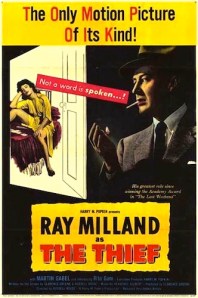 Ray Milland stars as Dr. Allan Fields, a nuclear physicist working at the United States Atomic Energy Commission, who is photographing secret files and passing them to The Other Side, until something goes wrong and the authorities are on his tail. But that’s almost beside the point, because if The Thief is known for anything it’s for its dialogue — as the poster proclaims, “not a word is spoken…!”
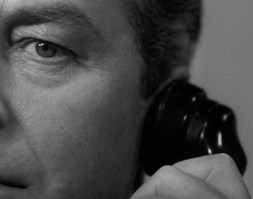 Obviously we can look back to the silent cinema for that kind of thing, but while that era could probably still teach many filmmakers something about visual storytelling, it’s hard to deny that the advent of synchronised sound adds a helluva lot to the ability of film — if it didn’t, it wouldn’t have taken over so fast and remained virtually 100% dominant for the last 80+ years.
 Perhaps this is why the villains are never explicitly named. But they’re definitely not American! Tsk tsk. More crucially, it’s a bit slow at times — it seems to take longer to explain things when stuck doing them through visuals alone. That said, it could probably have survived a speedier approach even doing what it does — perhaps, then, Rouse is playing for time: the film only runs 87 minutes in spite of its pace.
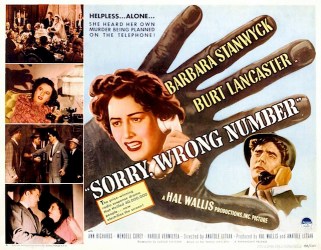 A film noir screenwritten by Lucille Fletcher, “based on her famous radio play” — I love how old movies have credits like that. It sounds like pure hyperbole, but in this case seems to be justified: the original play was broadcast in May 1943 but was so popular they chose to re-stage it with the same lead, Agnes Moorehead, a total of seven times up to 1960. Seven!
 As if keeping us guessing wasn’t enough, our feelings are shifting in this respect too. Arguably it unravels a little late on — when Evans is explaining his part to her, it’s getting a bit implausible — but it’s all redeemed by the finale.
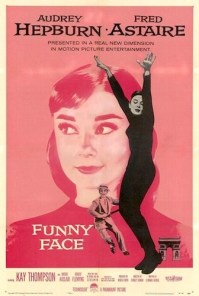 Like
Like 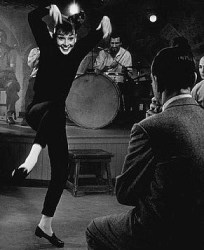 or dismissed the dullness of philosophy for the glamour of couture, but it takes fair jibes at both equally — it’s not mean-spirited or cynical or dismissive, just… quite true.
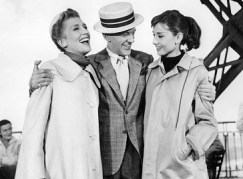 Funny Face seems to have plenty of critics — mainly on the notion that Hepburn could be said to have a funny face. Pretty shallow reason to dismiss a whole film, if you ask me. While there are couple of bits that don’t wash with my appreciation — the age gap; I could take or leave the two scenes at the church — there’s far more to love about the film.
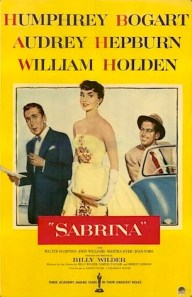 Audrey Hepburn’s next leading role after her star-making turn in
  But it actually feels very mean-spirited — Sabrina is likeable enough that we dislike his machinations. Which means that, for me anyway, there’s no truly supportable lead character. And then at the end he genuinely falls for her, which I found an equally implausible development — as well as seeming totally out of character, it did nothing to redeem what had come before. And he’s old enough to be her dad.
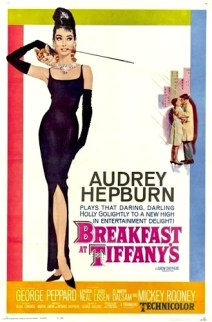 Breakfast at Tiffany’s is a stonkingly famous film — it’s the one most of the famous images in the cult of Audrey Hepburn come from — this despite the fact that, as
 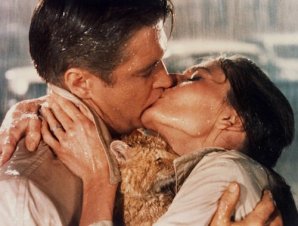 but it works here, especially when sung plainly by Hepburn.
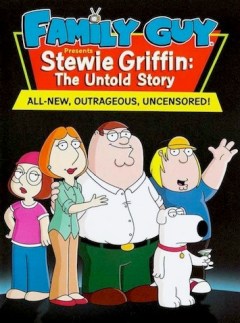 Following Family Guy’s cancellation after three seasons, it somehow found a new lease of life on DVD, posting surprising sales in what was, I suppose, the early years of the format’s mass take-off. This led to a rethink by Fox and a belated (as in, several years later) renewal for the animated sitcom. This story was originally intended to form a three-part opener to the first season back, but Fox wanted a direct-to-DVD movie too — presumably to capitalise financially on that previous success — and so those three episodes were retooled into a feature.
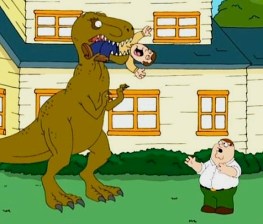
 and the need for it ultimately to be split back up (it was broadcast, censored, as a three-parter at the end of the comeback season). With subplots that begin and end within each half-hour(-ish) segment, it plays about as well as watching a three-parter back to back… which is more than can be said for that Star Wars film. Consequently, it also feels just like regular Family Guy — the same level of humour, basically — though it seemed to me like there were more scatological jokes than normal, some of them going on too long as well. If you’re not a regular viewer of the series, references to running jokes will pass you by; equally, the nature of its humour, often based in cultural references, means that some bits that are obviously jokes will elicit no more than bafflement from a non-versed viewer. Still, there’s plenty of more universal humour too. It relies on the usual style of numerous non sequitur flashbacks and asides. Which, again, is fine — that’s their style; it would be wrong to be anything else.
 the same as the series normally is, shows how arbitrary US regulations are. It feels like there are a few more jokes that are slightly dirtier than normal and there are a few extra swear words, but they consciously didn’t go OTT with them and, thankfully, it shows. But actually, most of the stuff that’s cut (as detailed on the commentary or in full
  And if you’ve always been curious but never given it a go, don’t start here — I don’t think it would be incomprehensible to first-time viewers, but I don’t think it’s the best introduction to the series either, and it probably makes more sense if you know the characters a bit.
 John Carpenter’s rough-and-ready ’70s exploitation B-movie is remade as a slick ’00s action B-movie dressed up as an A-movie by director Jean-François Richet (who would go on to find far greater critical acclaim with his two-part French crime epic
 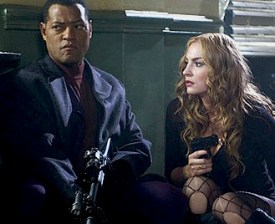 I don’t have hard timings to back this up, but I think the siege starts earlier and lasts longer here. It certainly felt that way, in part because the character of the father (whose act of revenge leads the gang to the precinct in the original) is gone. Of course, the film is about the titular assault on the titular station, so I think this refocussing is more than fair enough. It, naturally, emphasises the siege element of a film about a siege, something the original almost reneged on with its lengthy setup.
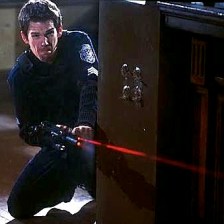 The only reason the prologue is necessary is if you want to begin your movie with an action sequence… so that’s why it there then. It’s also set in a sun-drenched summery atmosphere, totally at odds with the well-evoked wintery New Year that pervades post-titlecard. Consequently, looking back on the prologue, it feels even more out of place. I think it’s also designed to set a Gritty tone, with its rundown apartment and drugs deal and all that palaver; probably because the rest of the film is too far-fetched, if you were hoping viewers were going to be in mind of
  criminals inside the precinct are black or (in one case) hispanic. Ouch. You could try to argue we’ve developed past the need to force anti-stereotyping in casting; or you could argue this is a mainstream studio remake that felt the need to fall back on the familiar. It might not be a noticeable point were it not for it being so markedly different to the original.
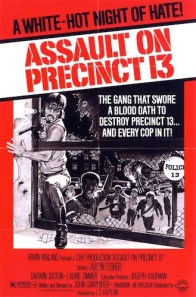 Assault on Precinct 13, it has always seemed to me, is an acclaimed cult classic of the action genre. I could probably find some references to support this — I know it’s on Tarantino’s list of the top seven exploitation movies, for starters — but for speed let’s just assume I’m right. Thing is, on initial impressions at least, I didn’t quite get that. It felt like an unexceptional low-budget ’70s exploitation B-picture to me.
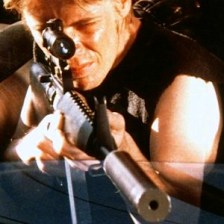 a huge gang who lay siege to the cut-off station. So the cops and the prisoners must work together to fend them off.
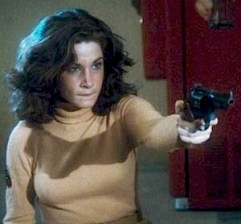 performing voodoo-esque rituals, coming and going as if by magic, doing things our heroes can’t necessarily explain, attacking in almost random waves… They feel almost supernatural; one might go so far as to say they play more like zombies than an organised criminal force. It’s no surprise that Carpenter would next helm
 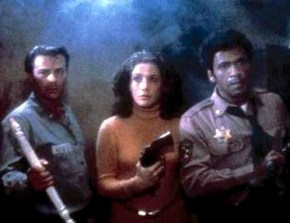 And another says that, “like
  100Films.co.uk