
Thor Freudenthal | 92 mins | TV | 1.85:1 | USA / English | U / PG
 Half a decade ago I would surely have hated this film. I had no love for animals in general, certainly not pets. But in the past few years I’ve become a certified canine convert, and watching it now I loved it.
The story sees orphaned teen siblings Emma Roberts and Jake T. Austin accidentally set up a secret sanctuary for strays in a deserted hotel, with help from a couple of similarly aged pet store workers and a neighbourhood kid who wanders in halfway through. Layer in a couple of half-hearted subplots about the siblings’ quest for a new home, a romantic angle or two, and some evil dog wardens, and you have a whole movie.
Well, sort of. This is definitely one for kids or dog lovers. There’s plenty of varied action for the latter, and the story is too simplistic and implausible to be taken more seriously than as a kids’ film. Most of the subplots are mildly annoying — stock material on teen ‘love’, fitting in to a new school, comedy bad foster parents, etc — but at least they’re not given much screen time. It’s this kind of thing that led reviews like Empire’s to criticise the film for a lack of character development,  but to be honest I could’ve done without some of the meagre scenes we did get, never mind more of them. Supposedly character building stuff like the teeny party to get to know future classmates — bleurgh. Luckily, such things are brief. And someone wanted more of Lisa Kudrow and Kevin Dillon’s failed-rocker foster parent characters? I’d rather have had less, thanks.
So no, character and story aren’t the film’s strong points. There’s enough of a plot to keep it ticking over, to give it drama when appropriate and give it all a shape. Characters are perfunctory at best, and it’s impossible to buy squeaky clean Emma Roberts as a juvenile delinquent. But really all that’s there just to facilitate more doggy action (er, as it were). The four-legged cast members are the real stars, and several of them definitely have more personality than their human co-stars. My favourite was definitely the orphans’ pet, Friday,  a scruffy white terrier with an exceptional ability to sniff out food (featured in every picture, because… aww, just look at him!), but then he reminded me so much of my own dog that I may well be biased. There’s all sorts of mutts here for pretty much every kind of dog lover.
There’s also a good deal of inventiveness on display. Much like the boy from Lemony Snicket, Austin’s character has a flair for invention, and the dog-helping contraptions he magics up throughout the film are delightfully inventive. There’s also a lot of fun filmmaking with the dogs, like the opening sequence that depicts Friday’s ability to sniff out and acquire food with a selection of perfect visuals. This is partly why the animals have so much more personality than the two-legged stars.
 Judged as simply a movie, on its story and its characters and all that regular palaver, I can see why Hotel for Dogs attracts so many poor scores (it has an exceptionally low 4.9 on IMDb). But as a kids’ film I think it works well enough, and as a delivery system for cute dogs I loved it. I don’t think I’ve ever “aww”ed so much in a single film. Yep, I’ve gone all soft. But if you’re neither a child nor a dog lover, don’t bother.

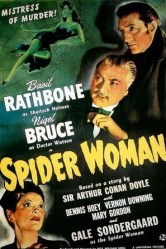 The seventh feature starring Basil Rathbone as Sherlock Holmes and Nigel Bruce as Dr John Watson is the first since
  Gale Sondergaard, is so good that they crafted a sequel around her, albeit Holmes-less. I’ve not seen it and don’t own it, so I’ve no idea what that does for its quality.
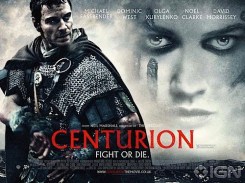 The fourth feature from writer/director Neil Marshall (despite owning his first three on DVD, this BD rental is the first I’ve actually watched — story of my life) is a bit of a departure: where the first three were horror (or at least horror-leaning) flicks, Centurion is an action-adventure crossed with something a little more artsy. Only a little, mind. Think
  Regular readers may know that I have an ever-growing dislike for films that begin at or near the end for no good reason (and most of those that do have no good reason to do so). Centurion’s opening line notes that “this is neither the beginning nor the end” of the lead character’s story. Oh dear, thought I; though perhaps “nor the end” signifies we might reach this point suitably distant from the credits, maybe. Not meaning to spoil it, but we’re there just 10 minutes later. Nice work Mr Marshall.
 The cast is packed with people who, even if you don’t know their names, there’s a fair chance you’ll know the faces (assuming you watch your share of British drama): in addition to Fassbender and Morrissey there’s Dominic West, JJ Field, Lee Ross, Paul Freeman, Liam Cunningham, Noel Clarke, Riz Ahmed, Imogen Poots, Rachael Stirling, Peter Guinness… not to mention Film Star Olga Kurylenko. Recognisability doesn’t guarantee quality, of course, but that’s a pretty good list.
 I really enjoyed Centurion, appreciating its mix between brutally real action and stunning scenery, with a slightly more thoughtful side emerging in the final act. It’s also always pleasant to see a film that runs the length it wants to at a reasonable speed, rather than padding itself to reach two or even two-and-a-half hours. Splendid.
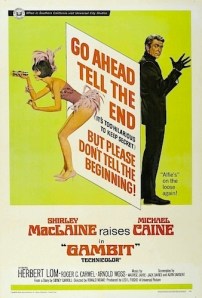 I decided to watch Gambit, which I’d never heard of, after it was recommended on twitter by
  Twists in con movies are par for the course, of course, but here it’s not just the opening that has one: there’s also a salvo in the closing minutes, just to keep you on your toes. You may guess one or two as they rush up on you, but perhaps not all of them. Though as I’ve just warned you they’re coming you stand a better chance than me.
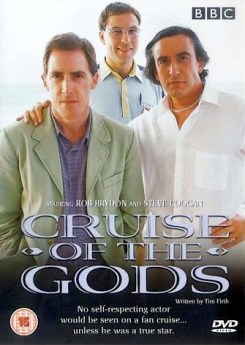 I’ve
I’ve 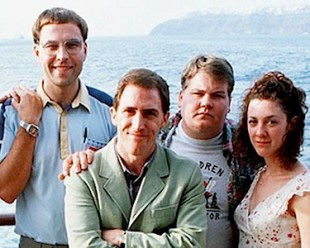 Though the film pokes fun (fairly good-naturedly) at sci-fi obsessives, the underlying story here is about a man overshadowed by his past. In this Brydon gives a strong performance — I think he’s a better actor than he’s normally given credit for — and he’s ably supported by Corden in particular, though to say what gives his role such quality might spoil a twist. He’s another one who’s actually a very good actor, but it gets hidden beneath a public persona that led to such dross as that sketch show with Mathew Horne.
 without ever realising all those disparate things were penned by the same human being. Poor writers.) Lowney, meanwhile, has stuck to TV, with episodes of
 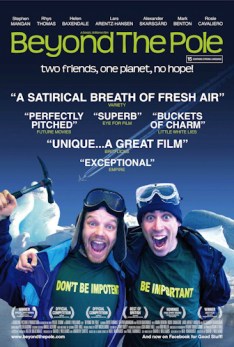 Adapted from a cult Radio 4 series, Beyond the Pole is a British mockumentary about “the first carbon neutral, vegetarian and organic expedition ever to attempt the North Pole”, starring Stephen Mangan Off
 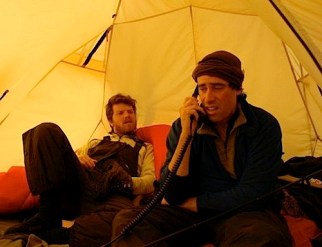 It’s also impressively realised. Its apparent low budget led me to assume we’d, a) see very little of the actual trip, and b) what we did see would be all inside-a-tent and green-screened. But no, it was really shot on floating sea ice off the coast of Greenland, and it makes for a highly effective polar landscape. Good work, filmmakers.


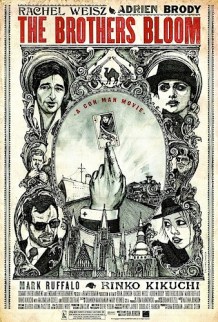 “Crikey, time flies!” I thought when I compiled this listing and saw that The Brothers Bloom was released in 2008. Somehow it felt like it was only last year, not three (or, if at the start of 2008, closer to four) years ago.
 but then the job of a trailer is to sell you a film, so if the end result doesn’t match it 100% is that a failing? How are you meant to summarise the entire tone of a film in a two-minute spoiler-free sales burst anyway? That dilemma is emphasised in this case because it’s the opening that feels least like the trailer. I mean, the pre-titles is kinda quirky-fun, but then it gets a little serious and slow, and later — perhaps half-an-hour or three-quarters of an hour in — you get to all the stuff the trailer was selling. And then the last act is back to something more unusually — or, if we’re to be unkind, unevenly — paced and toned. I can imagine the marketing meetings for this were a struggle…
 Perhaps the problem for others was that the ending doesn’t quite spell everything out. I’m certain every question you might have is answered, more or less, but it doesn’t lead you by the hand back over the film pointing everything out, as many twist-ending-ed films do. Part of me appreciates this assumption of intelligence; part of me would like it all handily explained so I don’t sit here wondering it for myself. I don’t feel completely lump-headed not wanting to do that — there’s no Deeper Meaning or Philosophical Insight gained from sorting this out, I don’t believe; just an understanding of who was being conned and when, and who knew what and why.
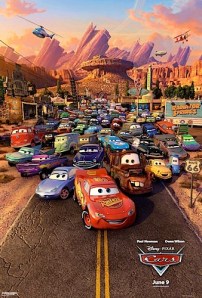 Since the creation of the Oscar for Best Animated Feature, only two Pixar features have failed to win:
  how the building of the interstate killed off so many small towns is both historically accurate (more or less) and emotional — but I imagine it also explains why the film can feel so long.
 having them talk to each other and giving them personalities, and it doesn’t need to make sense because his age isn’t even close to double digits and he’s just playing. But does that make it a viable idea for a film?
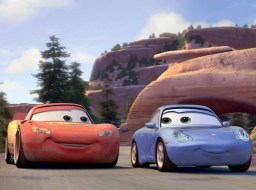 Cars is undoubtedly a below-par Pixar movie. It’s not a bad film — it has funny bits, exciting bits, a good moral message, some nice cameos and references and that kind of thing — but it doesn’t stand comparison to even a regular Pixar outing, never mind the best of their output. But hey, if you can produce 10 features that manage a 90%+ score on
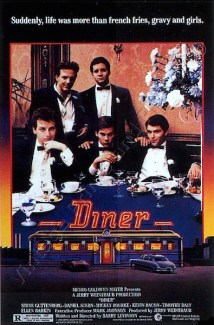 Baltimore, the week between Christmas and New Year, 1959: the lives of six friends in the run-up to one of them getting married, during which period they spend surprisingly little time at the titular establishment.
 There are no big turning points or revelations or developments for any of these characters. One is in trouble thanks to deep gambling debts, but there’s the equivalent of a magic wand that wipes them all out; another is permanently drunk with serious family issues, but neither of those go anywhere; another pines for a girl he barely sees and has never been with — well, except for one significant night — but by the end I’m not sure if they were going to get together or leave it be or… what. Similar things could be said for all the others.
 Like I said, this kind of storytelling works for some viewers and not for others. If it hadn’t been for the pat ending of that gambling debt plot, or the non-development of some other promising threads, maybe I would have liked it more. As it stands, Diner certainly has its moments, but maybe not enough of them for me.
 100Films.co.uk