
James Head | 88 mins | TV | 1.33:1 | USA / English
 A couple of years ago I discovered the ’40s Gothic noir thriller The Spiral Staircase, an exceedingly enjoyable film that I would heartily encourage you to see. It’s been remade twice: first a British effort in the ’70s, then this turn-of-the-millennium US TV movie. I find remakes immensely interesting — they’re almost always reviled, but that doesn’t mean they’re all bad; and even when they are, they can be interesting as an indication of what one era thought was a good idea for updating (or not) something originally made in a different time. The ’00s Spiral Staircase is definitely one of the bad ones, but if you want a snapshot of ’90s (not a typo) US TV movies, it’s bang on.
I believe it was made for a Women’s Network in the States, and it feels like an adaptation of one of those doorstop-sized airport romance paperbacks that I imagine are their stock in trade. (In fairness to doorstop-sized airport romances and the novel from which all versions of The Spiral Staircase stem, I’ve never read either.) Despite the implications of an “X months ago” prologue in which someone is followed by a spooky pair of eyes (presumably a whole person, but we only see the eyes), the first half is more cheap, tacky, romance-of-the-week TV movie than serial killer thriller.
The second half tries harder, seeing a bunch of potential victims locked in an island mansion, cut off by a terrible storm, and then finds reasons to have them wander back and forth around the place until they start being bumped off for no particular reason. This half isn’t necessarily good, but it has more atmosphere and more excitement, if not any more originality, even while contriving ways to divide its characters.
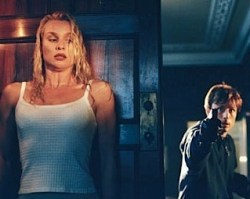 There are about three suspects in the entire tale. One is so clearly being set up from the off that you know it can’t be him; one barely even registers as a suspect; and it’s not the third one. But the film doesn’t pull off a twist because the attempt (by dragging that middle character back into it) comes so out of the blue as to make no sense. They don’t even bother to try to explain it properly! It’s about the only time the film holds back on painful over-exposition, and it’s about the only time it needs it. Either way, it’s not the same as the original film’s, and it’s not as good.
Every character is a cliché: the sweet new girl, the stern housekeeper, the drunk cook, the no-nonsense bed-ridden matriarch, the intelligent brother who stayed behind to look after mother, the playboy brother who only comes home when he needs a loan, his latest gold-digging floozy… The performances don’t help. As the mute heroine, Nicollette Sheridan only has her facial expressions to work with, and they don’t seem to change; she’s also at least a decade too old for the part. As her love interest, former Brat Packer Judd Nelson is awfully wooden. The rest of the cast are various degrees of adequate.
Head’s direction is flat and cheap, which I suppose is exactly what you’d expect from a late-’90s cable TV movie. The sequence where a character stumbles across the titular staircase is quite atmospheric, given added creepiness by it featuring about the only character whose fate doesn’t seem inevitable, but that’s all. Even given a storm in a house with no power, the only atmosphere generated is that which such a situation offers by default.
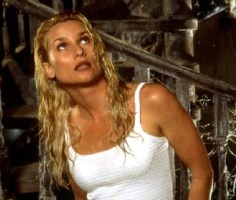 The original story is clearly suited to a Gothic historical setting (the ’40s film didn’t keep the novel’s time period, but it chose one similar enough), but that doesn’t mean a modern-set rendition isn’t without potential. Or maybe it is — it’s hard to be certain from a movie that certainly doesn’t realise what potential there may be. Yet for all its countless weaknesses, I can’t quite bring myself to entirely despise it. Can I really give this wholly derivative remake 2 stars? It may be some kind of Stockholm Syndrome — after 90 minutes with it, I can’t help but find some point in it all; some thing to like.
But no, it’s woeful; and unless you have a fondness for romance-focused late-’90s US cable TV movies, or for seeing just how remakes have changed things (like me… the second, that is, not the first), then I recommend you stay clear.

The 1945 version of The Spiral Staircase is on BBC Two tomorrow, Friday 31st August, at 12:50pm. You can read my review here.
The Spiral Staircase featured on my list of The Five Worst Films I Saw in 2012, which can be read in full here.
 There are a few Oscar nominees from the ’00s that inspire little desire in me to bother seeing them (I’m certain that’s completely true of every era, but I’ve seen most of the ’00s nominees so I tend to focus on them more often), meaning it’s taking me a very long time to get round to them (maybe I never will). Master and Commander isn’t really one of those — it’s no
 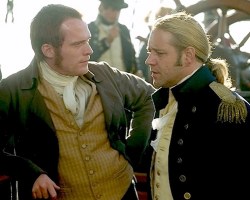 he’s not a naval man and doesn’t always understand their traditions. He’s not a crass audience-cipher in the way such parts often can be, but it does make him identifiable.
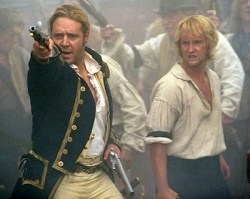 (that makes for a strangely bizarre array of company logos at the start). Despite the fact it’s based on a series of 20 (completed) books, and various people involved have mentioned the possibility down the years, a sequel is so unlikely it seems silly calling it just “unlikely”. And that’s a shame, because this is an entertaining action-drama with likeable characters and an engrossing atmosphere. A little to my surprise, I loved it.
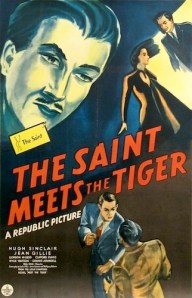 Produced in 1941 but not released until 1943, owing to Saint creator Leslie Charteris’ dispute with RKO over their new Falcon series (which is fairly unashamedly a rip-off of the successful Saint films), The Saint Meets the Tiger is a belated adaptation of Charteris’ first Saint tale, but was to be the series’ final film. Fortunately, it’s quite a good one.
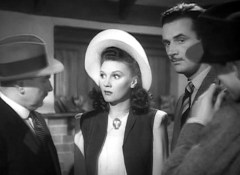 It still lacks the wit and light touch that make the Sanders films so entertaining, with only vague attempts at humour that generally raise little more than a smile. Sinclair doesn’t seem quite as wooden this time out, but he’s a straight-cut hero-type, not the kind of charmer this series really wants. In fact, one moment when he bursts into laughter, only to suddenly cut it short, is actually quite creepy. Perhaps he was trying to emulate Sanders more — the film does feel lighter than Vacation — but he still comes up short.
 The Saint’s gone on vacation indeed — with
  Apparently the villains are Nazis, though there’s absolutely nothing to suggest that here (again, that’s something I’ve since read online). The Saint knows both the villain and a Mysterious Woman of old, but it’s never explained how or why or what their relationships are. It’s like a set of stock adventure-story elements assembled without any understanding of how or why they should connect, which makes for an unsatisfying and unenthralling experience.
 The rest of the cast don’t offer much compensation. Arthur Macrae as the Saint’s cowardly friend Monty is no replacement for the parade of ex-cons he formerly hired as manservants, while Sally Gray of
 As seems to be the case fairly often these days (I feel like I’m noting it in more and more reviews, anyway) there’s a host of famous cameos and recognisable faces. This time I won’t ruin it by listing them, but there’s a regular stream to look out for.
 Tony Scott teams up with Denzel Washington for the fifth time to tell the (kinda) true story of a runaway train with the potential to cause massive destruction.
 are as stock as they come. Also look out for Kevin Dunn playing the kind of role (condescending middle-management ‘bad guy’) he always plays.


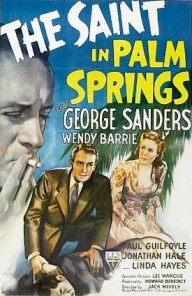 George Sanders is the Saint for the final time in a film that isn’t the series’ best, nor its worst. It also marks the final appearance by Jonathan Hale as Inspector Fernack, and third-and-final turns from both Wendy Barrie and Paul Guilfoyle. For those keeping track (or not), that’s the same four leads as the last picture! Same director too, as Jack Hively helms his third (and, of course, final) Saint adventure.
 Hale isn’t in it nearly enough unfortunately, especially considering this is his last outing. Guilfoyle has the sidekick role and at least his and Sanders’ relationship is a fun substitute. Barrie is, for once, simply the ingénue and not some form of criminal mastermind. Don’t worry, there’s another girl for that: Linda Hayes, who seems a promising match for the Saint but, though prominent early on, is ultimately disregarded. The highlight for both women comes when they get invited along for a horse ride with the Saint and have a good bitch at each other. It’s a pickle quite unlike the ones Templar usually finds himself in! I have nothing against Barrie, but quite why they sought to use her repeatedly I don’t know. And, to be frank, she worked best in
 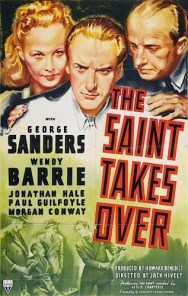 The first RKO Saint film to not be based on a story by the Saint’s creator, Leslie Charteris, is actually one of the better mysteries in the franchise. Sort of. The downside would be that the solution is glaringly obvious. For a mystery you might imagine that would be a major problem, but the process of investigating is nicely done. A bit more work might’ve been done to obscure the culprit, a character who we meet at the beginning and then more or less disappears and so will inevitably return somehow, but I had so much fun I don’t really care.
 One of the highlights of
  100Films.co.uk