
Rich Moore | 101 mins | Blu-ray | 2.39:1 | USA / English | PG / PG
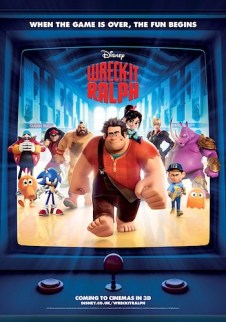 Disney’s 51st and/or 52nd animated classic (depends who you listen to) is, essentially, Toy Story with video games. Arcade games, to be precise. Turns out that all the characters from said entertainments hang out in the plug bar that powers them all, though behind-the-scenes they’re not necessarily like their characters — most of the villains are pretty nice guys, who have Bad-Anon (Bad Guys Anonymous) meetings to share their woes. But as the game he stars in reaches its 30th anniversary, Wreck-It Ralph has had enough of being an outsider, and when the other characters in his game imply he’ll be included if he can win a medal — which he can’t, because he’s a bad guy — he sets out into other games to try to get one.
Cue fun antics as our hero careens through various other games, right? Wrong. He goes to… two. OK, we see glimpses of a few more, and the Bad-Anon meeting takes place in Pac Man, but essentially he pops into one game to get said medal and introduce an apocalyptic MacGuffin, and then another for the rest of the plot. That latter game is Sugar Rush, a candy-themed cart racer. I’m pretty sure the production team must’ve spent the entire production eating candy for “research”, because the gaudy world and much of the film’s pace has all the idleness and restraint of a kid on a sugar high — i.e. none.
 Unfortunately, despite the rarely-filmed milieu of video games, it’s all a bit predictable — like I said, it basically does with video game characters what Toy Story did with toys, both in terms of the story and its themes of acceptance. At least one wearing subplot had me involuntarily exclaim “oh get on with it!” out loud (and I was watching by myself). The pace rarely lets up, and at 101 minutes that becomes tiring. When it does give you a break, you kinda wish it would get a wriggle on, because it’s obvious where things are going and it’s wasting time getting there. Of course, most mainstream films (especially kids’ movies) are going to follow broadly the same arcs — however bad it gets we know the hero will win, etc — but the trick is to make you enjoy the journey, not long to arrive at the destination. I spent most of the third act almost drumming my fingers as I waited for it to get to the latter.
For fans of retro — and indeed current — computer games, there’s plenty of cameos and references to be excited about, both in terms of familiar faces (various characters from Sonic, Mario and Street Fighter, for instance, amongst many others) and clear riffs on other franchises and genres. I’m not really a gamer though, so while I recognised many of them (from the days when I did engage in such pursuits) there wasn’t exactly a thrill in it. I think that pleasure of recognition, and some almost in-joke-level bits, can lead certain viewers to enjoy the film more than it otherwise merits. That’s nice for them, but does nothing for the rest of us.
 Wreck-It Ralph isn’t actually a bad film. There’s a fair bit of inventiveness with the concept, and the makers have worked hard to establish a world with rules (though your mileage may vary on how successfully they’ve done that), but it descends into a breathless, sugar-fuelled, reheated runabout. I imagine young kids will adore its colourfulness and its energy, and won’t be bothered by the over-familiar plotting and life lessons; but, beyond nostalgia for arcade gamers, I don’t believe it has huge amounts to offer a grown-up viewer.

Wreck-It Ralph debuts on Sky Movies Premiere at 1:45pm and 7:15pm today, and is already available on demand through Sky Movies and Now TV.
This review is part of the 100 Films Advent Calendar 2013. Read more here.
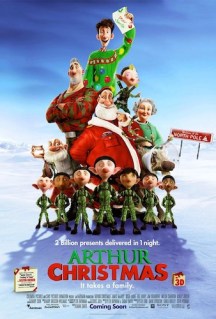 Aardman’s second CG feature attracts a starry cast (not just the leads — check out who’s credited as “Lead Elf”!) to the story of how Santa really delivers all those presents in one night: a giant spaceship-like craft and thousands of SAS-esque elves. But when one child is missed, Santa’s clumsy son Arthur resolves to fix it.
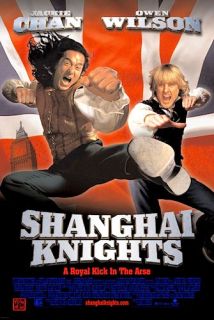 Jackie Chan and Owen Wilson are back as… um… whatever their characters were called, in this follow-up to
 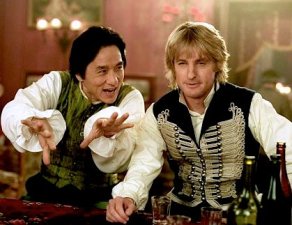 Knights as a whole feels like it moves better than its predecessor — it gets going quicker, without the need to establish these characters and force them together; there’s a greater reliance on those quality action sequences. The guest cast feels a bit bargain basement, though the villains — Aiden Gillen and the aforementioned Yen — are of a higher calibre. This means we’re treated to a pair of great climaxes, with Chan first having that punch-up with Yen, followed by a three-sword duel with Gillen (or possibly a stuntman).
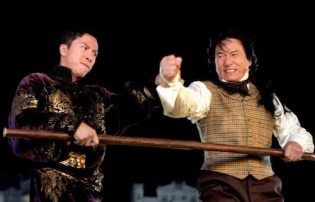 In the end, I’m not sure if I like it more or less than the first film. The Western setting was a smoother fit in many ways, but here there’s a less stodgy plot, a general reduction in the overlong comedy sequences, and even better action sequences. All things considered, I think Knights may actually have the edge.
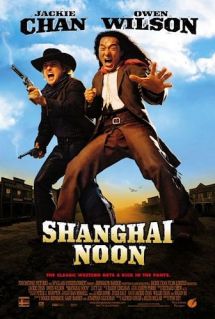 Hong Kong martial arts legend Jackie Chan and Hollywood funnyman also-ran Owen Wilson team up for a film that I don’t think anyone involved could reasonably deny is just “
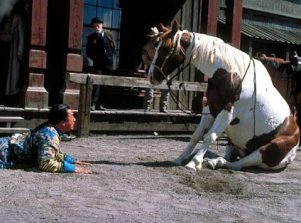 Things that could have (should have) been fixed way back at the writing stage leer out at the viewer. The plot is treated almost perfunctorily, as if it’s not interesting enough to bother explaining or expounding upon. It’s hardly highly original or complex, but it feels as if important beats or character motivations have just been skipped over. For instance, the character/story impact of the final fight would be so easy to build up a bit, but they haven’t and so it falls a bit limp. Not to mention the bit when two characters who are essentially on the same side have a duel when they have more pressing things to worry about — save the Princess first, fight amongst yourselves later! Then there’s all the time given to Wilson’s rivalry with the local sheriff/martial/whatever, which we’re told exists, isn’t really built from anything, and suddenly is half the focus of the climax.
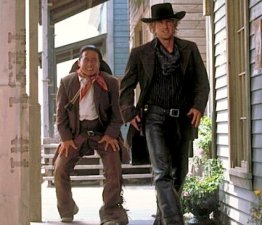 Shanghai Noon should be a lot of fun. It should be Jackie Chan and Owen Wilson engaging in a bit of comedy between skilfully choreographed, occasionally amusing, balletically staged fight sequences. But it isn’t. It’s laden with an underwritten plot, bulked up by clichés, stereotypes, overplayed character scenes, humour that doesn’t work, and a shortage of judicious editing. It is still kinda fun, but it could so easily have been more.
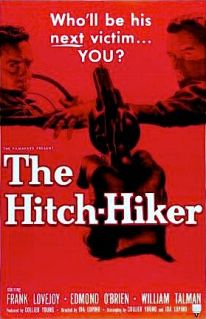 Based on a true story, this film noir sees two chums on the way home from a fishing trip pick up a hitchhiker. As you can tell from the title, he turns out to be rather significant: he’s a murderer on the run, and pulls a gun on the men so they’ll do his bidding, which is take him to Mexico so he can escape justice. Oh dear.
 But does her gender add any different perspective? I think perhaps it does. If you read
  A black and white Swedish movie in which a knight ponders the existence of God while playing chess with Death? Yep, here we have the stereotype of arthouse cinema. Let’s be honest, it lives up to most of those expectations.
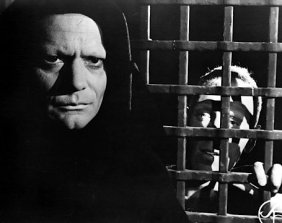 On the more easily-appreciable side, it’s beautifully shot by Gunnar Fischer. It had to be made quickly, on a tight budget, and for that reason Bergman found it imperfect and rough in places. This may be true, but regardless, there are numerous striking compositions, and even more occasions where the rich black-and-white photography looks stick-it-on-your-wall gorgeous. I only watched it on Tartan’s old DVD and, even with mixed feelings about the film itself, I’m sorely tempted to pick up one of the Blu-rays.
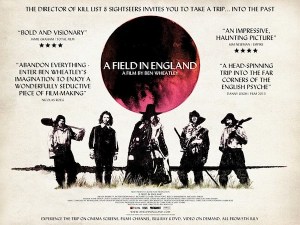 Much was written about A Field in England at the time of its release, so if you frequent the right places online or in the press you can’t’ve missed it. Nonetheless, there’s a good chance you’ll have heard of it more for its release format(s) than for anything in the film itself: the fourth feature in just five years from new British critical darling Ben Wheatley, it was released to cinemas, DVD, Blu-ray, download, video-on-demand, and shown on free TV all on the same day, a first for British cinema. Any casual viewers who checked it out for that reason were in for a shock, because this certainly isn’t an easily-digested mainstream experience.
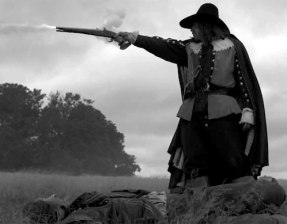 That very subtlety leads some viewers to write this kind of movie off — and fair enough, because if you’re searching for any kind of mass acceptance you don’t do it with a black-and-white film about a few blokes in period dress running around a field doing weird, inexplicable things. Though you might top it off with a shoot-out that is arguably one of the year’s best action sequences, something Wheatley and co do do. And without making it feel tonally out of place, either. Impressive. In keeping but even more memorable is the moment you’ve surely heard about — “when he comes out of the tent with that look on his face”. I wasn’t able to watch the film until something like 24 hours after its Big Premiere, by which time I’d already heard everyone talk about that, and yet it was still uncomfortably uncanny. Kudos, Reece Shearsmith, you’re an odd’un.
 In terms of the new funding models and simultaneous multi-format release and all that… well, it depends what their goals were. If it was to make interesting, alternative, minority-interest films… fantastic, they’ve done it — and got a remarkable amount of interest in the process. If it was meant to be a way of turning a profit, or of reaching a bigger audience… well, it succeeded this time — but how many of those viewers are going to come back? A Field in England is definitely the kind of film that appeals to some people, but it is defiantly not “mainstream cinema”. No bad thing, and something that should be encouraged, supported and funded in some way; but however you do it, it’s not going to continuously bring in big bucks.
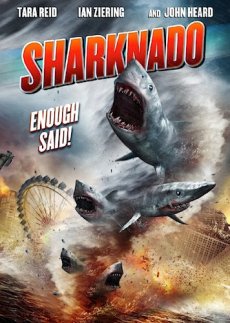 Sharknado is a defining film of 2013. The volume of conversation it generated, which achieved the near-impossibility of higher viewing figures for its repeats, is exceptional. So I was determined to give it its due in a full-length review. But I can’t be bothered — it doesn’t merit such attention.
 If you were looking for the archetype of an epic movie, Lawrence of Arabia would be a strong contender. It has a wide scope in just about every regard, from the desert locations that stretch as far as the eye can see, to the thousands of extras that fill them, to the glorious 70mm camerawork that captures it all, to the sweeping story that also contains a more personal throughline, to the 3½-hour running time.
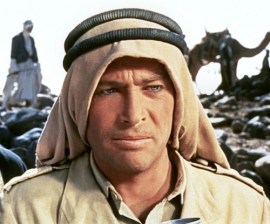 As such, the film hangs on the performance of O’Toole. We’re told Lawrence is an enigmatic figure and his depiction arguably supports that — we never fully get inside his head; we’re always observing him. And yet that’s no bad thing, because even as Lawrence’s confidence waxes and wains, as his allegiances shift and alter, we can feel what he wants to achieve, why he thinks he can. He attempts the impossible and succeeds, which is why he later attempts a bigger impossibility, and must leave the pieces to the more level-headed men, who didn’t have his genius but can therefore play the political game better than he.
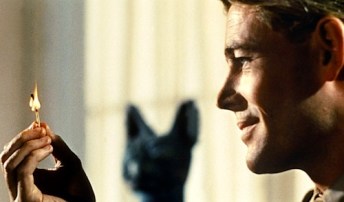 A similar legacy is left by those behind the scenes. Maurice Jarre’s score is the reference point for many a period desert epic — indeed, his music is so synonymous with such settings that it has arguably transcended its source to simply be what music for those locations and times is. It graces a film edited with class by Anne V. Coates, where scenes are allowed to play in luxuriantly long takes at times, while at others smash edits throw us from one location to another. This is undoubtedly supported by F.A. Young’s cinematography, where the wide frame can encompass so much action that there’s no need to cut amongst close-ups; and which can show the world in such majesty that you want it to hold for long, lingering takes. Even viewed on the small screen, the 70mm photography shines, especially on Blu-ray.
 As with any great film, Lawrence of Arabia is at least the sum of its parts. Replace any of the artists I’ve mentioned, or surely many more, and it would not be the film it is. In fact, when working on such a scale, this is more than a film — it’s an experience. And if that sounds pretentious, well, tough. If you haven’t experienced it yet, try not to leave it as long as I did.
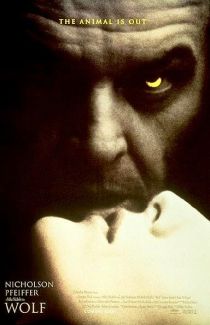 Without meaning to spoil anything, Wolf is rated R for “language and werewolf attacks”! I love the ludicrous specificity the MPAA indulge in sometimes. I know the BBFC’s famous “mild peril” is pretty useless, but at least they draw from an academic- and objective-sounding pool of phrases in their summaries, rather than throwing in ‘advice’ that is meaningless (there are perfectly PG werewolf attacks in other movies).
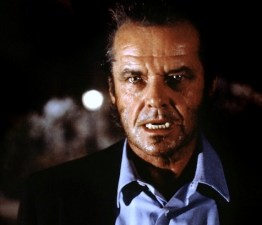 It’s those early sections where the film is at its best, when it tries to stay grounded in some form of realism. Any time it gets too Fantasy, it begins to get a tad silly. The climax in particular seems to come from a different film: Wolf abruptly moves from being an office politics drama with a fantasy edge, to a full-on manwolf-vs-manwolf brawl. As a straight dramatic director, Mike Nichols doesn’t seem to quite have the chops to pull off this fantasy/horror stuff without it beginning to look daft. That might not be entirely his fault, however, as reportedly the film was delayed by months to re-shoot the entire third act. Perhaps originally it had something more in-keeping? That said, he did want Michelle Pfeiffer to wear a red-hood sweatshirt during the finale! She refused, fearing it would harm the film’s credibility. She was right — it’s quite silly enough as it is.
 I can only presume there were hefty paydays for Nicholson and Pfeiffer, both megastars at the time, and possibly Christopher Plummer’s supporting role, maybe Nichols, and on scoring duties (obviously), Ennio Morricone. And maybe those re-shoots were really extensive. Or perhaps they spent it all on the nighttime aerial photography of Manhattan, which is gorgeous — that would’ve been worth it.
 100Films.co.uk