
Ingmar Bergman | 79 mins | DVD | 4:3 | Sweden / Swedish | 15
Since that debate [between New York critics Susan Sontag and Andrew Sarris when the film was first released], writing about Persona has been for film critics and scholars what climbing Everest is for mountaineers: the ultimate professional challenge.
Oh dear.
 That quote comes from Thomas Elsaesser in the introduction to his Criterion essay “The Persistence of Persona”. He goes on to add that, “Besides Citizen Kane, it is probably the most written-about film in the canon. [Every major critic has] written with gravity and great insight about Persona, not counting several books and collections entirely devoted to the film.” Well, I can’t promise gravity or insight. In fact, practically the opposite, because I think that Persona is almost wilfully obtuse.
That’s not because the film is stupid, but because it’s “slow to understand” in the sense that the viewer can’t understand it — people have been debating its meaning for almost 50 years now, and it seems that still no one really knows what it’s about or what it’s trying to say. Obviously that’s some people’s bag, but it leaves me slightly baffled how it can gain such acclaim as to be well-regarded outside of the circles that decide Sight & Sound’s decennial list — I mean, it’s on the IMDb Top 250! There are some great bits, in particular some gorgeous cinematography, but the artistic indulgences (shall we say) and the complete lack of any clarity of meaning by the end make it an unlikely populist choice.
 The plot, such as it is, concerns an actress (Liv Ullmann) who has decided to become mute and her nurse (Bibi Andersson), who travel to a seaside summerhouse to attempt recuperation. After we’re told how they grew closer, events concern the breakdown of the relationship between the two women… or is there only one woman? We might end up inside one of their heads… but whose? Or is it both of their heads? Or…
In his Amazon.co.uk review (which can be found on this page only), David Stubbs reckons that the film is “an occasionally cryptic but overwhelmingly powerful meditation on the parasitic interaction between Art and Life… about the helpless incapacity of art to ‘say’ anything in the face of grim reality.” He may well be right. What the women’s odd relationship/symbiosis has to do with that, I have no idea.
On the bright side, as I mentioned, it is beautifully shot. Some of it is on the surface unexceptional, but carries a simple beauty; other images, however, are strikingly composed and lit. There’s a particular shot that merges the faces of the two actresses together. Even though the similarity of their features is supposedly what gave Bergman the entire idea for the film, he didn’t come up with that shot until the edit. I personally didn’t think Ullmann and Andersson looked that alike, but, nonetheless, the merged shot could not be achieved any better with today’s photo-editing technology — it looks like one, wholly different, person. I’m sure there’s a deep philosophical meaning there, but I was just impressed by the technological wizardry.
 The film’s other most famous bit is a monologue Andersson delivers one night about a foursome she found herself in. As with most of the film its exact meaning is debatable, but it’s another unusual behind-the-scenes story: it was nearly cut, apparently, even though it’s in many respects the pivotal scene. It’s where the nurse opens up the most, leading to the actress’ ‘betrayal’ by repeating the story in a letter, which is what leads to the disintegration of their relationship and all the confusion/weirdness/’deep psychological filmmaking’ that follows. Later, Bergman lets a monologue (yes, another one) play in full twice. The meaning? He had intended to cut back and forth between the two actresses, but couldn’t decide which shots to discard, so just let it all run twice. At least that’s some confusion cleared up, then.
Clearly some people get a lot out of Persona. That’s nice for them. For me, it has moments of brilliance, but the stunted attempt to artistically portray the futility of portraying an idea through art is unenlighteningly ironic.

Persona was viewed as part of my What Do You Mean You Haven’t Seen…? 2015 project, which you can read more about here.
 Sometimes, films are so maligned that you feel you just have to see for yourself. Or I do, anyway. Crime thriller Runner Runner, with its
  Brian Koppelman and David Levien’s screenplay is packed full of dreadful dialogue, which isn’t helped by phoned-in performances from all the principle cast, in particular Affleck. I guess he needed a payday between his Oscar-winning directorial efforts. I’ve seen some assert that the dialogue and delivery are meant to be mannered and stylised, but I just don’t buy it. Unless the style was meant to be “cable TV cheapie”, anyway. The Puerto Rican filming locations are quite prettily shot by DP Mauro Fiore, at least, but that’s scant consolation when everything else is so woeful.
 Adrenaline-addicted photographer L.B. “Jeff” Jefferies (James Stewart) finds himself house- and wheelchair-bound during a New York heat wave. Whiling away time spying on his neighbours around their shared courtyard, he begins to suspect the man opposite, travelling salesman Lars Thorwald (Raymond Burr), has committed a murder and is trying to cover it up. Jeff persuades his high-society girlfriend Lisa (Grace Kelly), visiting nurse Stella (Thelma Ritter) and police detective friend Doyle (Wendell Corey) to help investigate, but no hard evidence is forthcoming. Is Jefferies just bored and paranoid?
 Hitchcock certainly didn’t consider Jeff to be an out-and-out hero, even aside from the very real possibility that he may be wrong — as he put it in one interview, “he’s really kind of a bastard.” After all, what right does he have to be poking his nose so thoroughly into other people’s business? Not only to spend his time spying on all and sundry, which in many respects is bad enough, but to then investigate their lives, their personal business, even break in to their homes. If he’s right, they’ve caught a murderer, and the methodology would be somewhat overlooked; if he’s wrong… well, who’s the criminal then?
 further enhanced by the almost total lack of a score (only present in the opening few shots).
 David Tennant replaces Martin Freeman as the teacher of a primary school class who enter themselves in a Christmas singing competition in this part-improvised sequel to the
 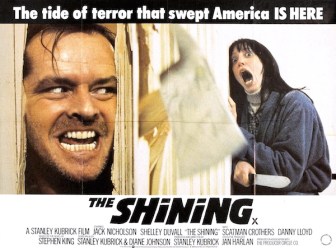 Fêted director Stanley Kubrick turned his hand to horror for this Stephen King adaptation. Poorly received on release (it was nominated for two Razzies: Worst Actress and Worst Director) and reviled by King (he attempted his own version as a
 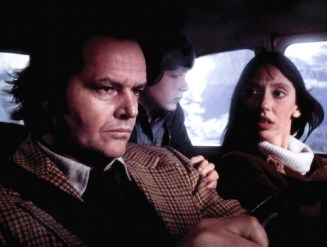 Gradually, inexorably, the film builds a sense of dread; a fear so deep-seated that it feels almost primal. There are few jumps or gory moments, the easy stomping ground of lesser films. There’s just… unease. It’s a feeling that’s tricky to put into words, because it’s not exactly “scary”; even “terrifying” feels too lightweight. There are undoubtedly sequences of suspense, where we fear what’s coming or what will happen to the characters (everyone knows the “Here’s Johnny!” bit, for instance), but that’s not where the film’s impact really lies.
 #36 The Hobbit: The Battle of the Five Armies (2014)



























 Except, goodness, I couldn’t get it down to just five! From Connery alone you’ve got ‘Bond’ being bested in From Russia with Love, the iconic jetpack in Thunderball, and the trend-setting mini-adventure from Goldfinger. As the series rolls on there’s The Spy Who Loved Me and its parachute, Moonraker’s free-fall fistfight (you couldn’t do that today — everyone would assume it was CGI and it’d have no magic), and the perfectly staged training-exercise-gone-wrong from The Living Daylights. The Brosnan era really kicks in the action, first with another peerless mini-adventure in GoldenEye (and the bungee jump…!), then increasingly expansive and suitably witty openers to both Tomorrow Never Dies and The World is Not Enough. Finally, the Craig era tipped the whole shebang on its head with Casino Royale’s moody black-and-white quickie, and Quantum of Solace’s attention-demanding car battle. Skyfall may have moved back towards the Brosnan mould, but it’s an exceptionally well done one.
 a supporting character who’s come and gone over the years, initially seeming one-note but revealing more in more recent seasons — but here you get that kind of arc condensed into 90 minutes. Barr is every bit his equal, the pair forming a genuine if sometimes complicated bond. That it acknowledges but dodges the whole “mid-life-crisis man and teenage girl” iffiness is further to its credit.
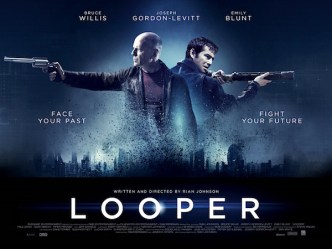 Writer-director Rian Johnson re-teams with the star of
  Firstly, the less you know the better. I pretty much knew the above before I went in, and that meant the film had surprises from the get-go. For instance, the near-future world most of the action takes place in has been well-realised by Johnson and his design and effects teams, and time travel is not the only SF concept or imagery employed here, which I wasn’t aware of. Their vision is
  Heading up the cast, Gordon-Levitt does a good Bruce Willis impersonation — believable, but not a slavish impression. That was probably quite necessary, because I don’t imagine Willis has the thespian chops to emulate an older Gordon-Levitt. Notoriously, the younger actor does the whole thing under prosthetics designed to make it more plausible he’d age into Willis. They’re a bit weird: not badly done — far from it, in fact — but you’re always kind of aware they’re there. A highly able supporting cast flesh out the rest of the characters, though most memorable is young Pierce Gagnon as an imperilled child you wouldn’t necessarily mind getting killed. And I mean that in a nice way; about the film and his performance, if not the character.
 Even if there are some logic issues, it doesn’t fatally undermine the movie. Looper comes with the joys of a well-imagined future, a captivating storyline, engaging characters, and enough twists and turns along the way to keep you guessing at the outcome. The best genre movie of 2012? That was a year of stiff competition among SF/F pictures, but Looper may have the edge.
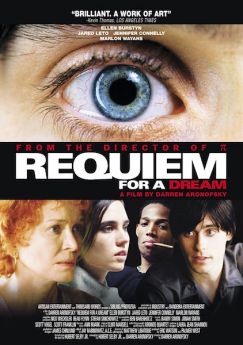 On Coney Island, the faded and decrepit one-time pleasure place of New York City, four people — Harry (Jared Leto), his girlfriend Marion (Jennifer Connelly), his best friend Tyrone (Marlon Wayans), and his mother Sara (Oscar-nominated Ellen Burstyn) — find themselves accidentally drawn into a whirlwind of drug addiction. Not to put too fine a point on it.
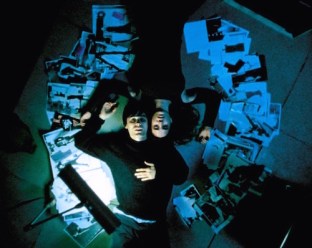 Harry and Tyrone by getting rich through selling drugs — and it all goes horrible awry.
 Requiem for a Dream may have a bit of a reputation at this point; one that might put you off viewing it, or possibly only deigning to attempt it in a certain frame of mind. While there is an element of truth to that, it is a brilliant film — not “enjoyable” in the easily-digested blockbuster sense, but as a mind-boggling and awe-inspiring feat of filmmaking, yes. Incredible.
 Jack Palance is an actor wanting out of his studio contract in this stagey film noir.
 Partially driven by a seeming twist that’s obvious from the outset (which, in fairness, the film reveals only 40 minutes in), the story never quite comes alive. Palance and Corey make parts worth watching, but at other times it’s a bit of a slog, not helped by an awful score that chimes in now and then, loudly. Expansive cinematography (so much headroom — was it shot to be cropped for widescreen? Perhaps it was) combats any feeling of claustrophobia the single location and oppressive moral situation might have leant it.
