Michael Clayton (2007)

2009 #87
Tony Gilroy | 115 mins | DVD | 15 / R
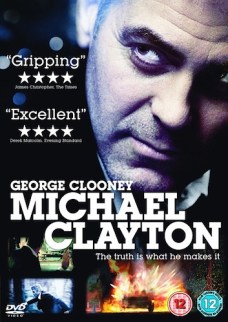
Michael ClaytonWhen Michael Clayton turned up among the contenders for 2008’s Best Picture Oscar I was a little surprised, because as far as I could recall I’d never heard of it. Then as I read about it a memory came floating back… a memory of a half-page (at best) review in Empire, of a George Clooney film that sounded like it should be good but was, they asserted, only worthy of three stars. As you’ve surely guessed, when I dug out this review it was indeed of Michael Clayton.

It is, I suppose, technically speaking, a thriller. That it’s not particularly thrilling doesn’t have to be a problem — this is the world of class action lawsuits, after all, which take years (decades sometimes, I imagine) of meetings and paperwork and ‘polite’ lawyer-arguing, and often writer-director Tony Gilroy seems to want to depict a moderately realistic version of this world. Clooney’s titular lead, for example, is effectively a middle-management dogsbody, albeit a highly talented one (so we’re told, anyway — the scenes of him doing his job don’t particularly convey this); but he’s certainly not some crusading young hotshot who is just gonna do what’s right, goddammit.

He does have the requisite seriously flawed personal life however, though Gilroy manages to make this feel fairly fresh. The latter is a big part of the film but feels unconnected to the main story… until the end, of course, when it all dovetails. Thankfully not in a cheesy “the bad guys kidnapped the kid” or “I have to do what’s right to get the girl” way, but rather as a means of motivating Clayton into doing… well, what’s right, more or less.

If this sounds more legal drama than legal thriller, it is. Where this comes unstuck is that Gilroy does seem to want it to be a legal thriller, and so uncomfortably squidged into the mix are a pair of surveillance experts/assassins and one of the least-tense car chases in movie history — 15 minutes in we see Clayton’s car blown up, with him safely on a hillside; the rest of the film takes place over the preceding days, eventually reaching that first night, where we see the bomb planted in Clayton’s car, and the assassins following him around trying to get signal to detonate it… and we might care, if we didn’t already know they don’t succeed until he’s wandered off up a hillside to cry over some horses.

The obvious point of comparison is Damages, the excellent TV series that also concerns such high-profile big-business lawsuits, but which pulls off every one of Michael Clayton’s facets with a higher degree of skill, interest and excitement. Company-sponsored murder sits believably in that world, but so does the characters’ personal life dilemmas and the court room (or, rather, pre-court room) battles between attorneys. And Damages sustains it for over 9 hours to boot, replete with cliffhangers and plot twists so far beyond what Clayton’s surprisingly straightforward (once you get down to it) story has to offer that Gilroy isn’t even dreaming of being that good.

Michael Clayton does have good bits, like the supporting parts played by Tilda Swinton and Tom Wilkinson, or any number of scenes or plot elements scattered around. What it falls short of doing is connecting it all up into a coherent whole: part realist legal/personal drama, part heightened Grisham-esque legal thriller, if it had settled on just one it might’ve been better.

3 out of 5

Michael Clayton is on BBC Two tonight, Friday 4th April 2014, at 11:05pm.

(Originally posted on 5th March 2010.)

Murder on the Orient Express (1974)

2009 #94
Sidney Lumet | 122 mins | TV | PG / PG

Murder on the Orient ExpressMurder on the Orient Express is arguably Agatha Christie’s most famous novel, perhaps because of its widely-known twist ending, or perhaps because it’s inspired in part by a high-profile true story, or perhaps because of this multi-Oscar-nominated all-star adaptation.
The plot is the stereotypical Christie set up: a group of fairly well-off people find themselves in a confined setting, one is killed, a sleuth works out who. This time it’s a train rather than a luxurious mansion, but the basics are there. This isn’t a criticism — I enjoy a good Christie adaptation as much as everyone else who’s kept the current TV incarnation on air for 21 years (and counting) — and here at least Christie has a number of twists to her usual style. As mentioned its launching point is a true story, the Armstrong kidnapping and murder being based on the Lindbergh kidnap of 1932 (just a couple of years before the book was written); the snow-bound train’s location (very apt after our recent weather) is certainly different to a stereotypical country estate setting; and then there’s the infamous ending.

I won’t spoil it here, just in case anyone doesn’t know it. Some are very critical of this particular denouement, labeling it an unsatisfactory cop-out that doesn’t make sense. Neither of these things are true. It is not reliant on an extraordinary coincidence — it might look that way at first, but the full explanation reveals it to be anything but — and there are numerous clues along the way as to what it might be, even if some are more thematic than the actual red herrings that almost lead Poirot astray. It’s a shame that knowledge of the ending is quite widespread these days, though that’s perhaps inevitable for a 76-year-old story. Still, I’ve done my bit.

In the lead role, Albert Finney’s Poirot may have received an Oscar nomination and, more importantly, been approved by Christie herself (according to some; according to others, she wasn’t impressed), but he now pales in the inevitable comparison with David Suchet’s definitive portrayal of the Belgian detective. Suchet has defined Poirot in a way few other major franchisable characters have been (Connery may be widely accepted as the best Bond, but there are plenty who’d choose Moore, Craig, Dalton and Brosnan, and you may even find someone who likes Lazenby; equally, Sherlockians may divide themselves between Rathbone and Brett, not to mention Cushing and hundreds of others). He has the advantage of being able to perfect the role across hundreds of hours of television, but nonetheless stands proud as the high-watermark that others can only try to reach (even those who played the role 15 years earlier).

Finney’s version is more obviously comical than Suchet’s. Where humour in the latter is derived from his serious fastidiousness, Finney plays it more for laughs; where Suchet seems almost solemn in his investigations Finney frequently bursts into laughter. It’s a broader interpretation of the character, one that ultimately lacks subtlety. At least Finney is thoroughly subsumed in the role, which means that after a while one does become accustomed to it.

The rest of the cast are well suited to their roles. Ingrid Bergman won the Best Supporting Actress Oscar for her role, though one wonders if it was a weak year for the category as her part is miniscule and not particularly memorable. Elsewhere, famous names such as Lauren Bacall, Sean Connery, John Gielgud, Michael York, and many more, round out a truly star-studded ensemble where each has but a small part to play. It must be relatively easy to attract big names to Christie adaptations — as the TV series still do — when the author is so beloved and the amount of time required to shoot is (for a guest star) so small. Best here, perhaps, is Martin Balsam as Poirot’s friend Bianchi, who’s treated to several good scenes, not least the series of interviews where after each he confidently declares “it was them!”

As a standalone film, Murder on the Orient Express is a skilled effort (I can’t comment on its quality as an adaptation because I’ve never read the book). For a viewer so familiar with Suchet’s interpretation of the character, however, even an all-star cast can’t quite remove the feeling that it’s not quite right. The Suchet-starring adaptation of this particular case has been filming recently, hopefully for broadcast later in 2010 (though knowing ITV we could have to wait as long as 2012), but even though it’ll have the definitive Poirot leading its cast, this film leaves a lot to live up to.

4 out of 5

(Originally posted on 15th January 2010.)

Sky Captain and the World of Tomorrow (2004)

2009 #63
Kerry Conran | 102 mins | TV (HD) | PG / PG

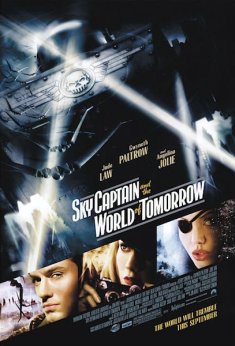
Sky Captain and the World of TomorrowIf the Indiana Jones series was a bit more sci-fi (even than Crystal Skull, that is), it might be rather like this. First time writer-director Kerry Conran evokes ’40s cinema serials more thoroughly than Lucas or Spielberg ever dared with a globe-hopping tale of a mad scientist’s giant robots doing all sorts of damage in a quest for… well, that would spoil the ending.

In the telling, Sky Captain is every inch a Boy’s Own adventure, packing every facet of that genre of storytelling into its brisk running time. There’s secret bases, ray guns, giant robots, flying aircraft carriers, snow-bound Himalayan treks, creature-infested secret jungle islands, huge underground bases, space rockets, planes that are also submarines, tree bridges over impossibly deep gorges… If it’s part of the genre, it’s probably here, and all finally executed with ’00s-level special effects. In some respects it does move between set pieces and locations in an episodic fashion, but then that’s more a trait of the films it emulates — i.e. episodic serials — than a flaw in Conran’s plotting.

Still, some might view Sky Captain as little more than an exercise in filmmaking — it was one of the first movies to be shot entirely on blue-screen, around the same time as Sin City and a couple of others. There’s more to it than that, but it’s also hard to ignore the style this creates. The shooting process is far from perfect if one were trying to recreate real life, but here the whole look is so stylised that it hardly matters. The period setting is nicely evoked, combining myriad influences into an intricately realised retro-future style, coupled with a lovely sepia sheen over everything. It’s beautifully lit, while individual shots and editing are frequently reminiscent of a style from the ’40s (and earlier). Again, Conran is being deliberately evocative of films of the period, rather than a modern film set then; more La Antena than Star Wars.

Another much-discussed feat of technology is the resurrection of Sir Laurence Olivier as the film’s villain. Unfortunately, his brief appearance is underwhelming. Perhaps we’ve become too accustomed to modern technology resurrecting deceased actors for ‘new’ performances (not that it happens that often); but then again, what was done with Oliver Reed for Gladiator — four years before this — seemed more impressive than the small amount of hologram we see here, even though the digitally created shots were equally brief. It’s a shame, because using Olivier for this key role is quite neat, certainly better than casting a glorified extra. In fairness, then, it’s a part so small that very few appropriately-big names would agree to it, which perhaps permisses resurrecting Olivier after all

Among the real performances, the acting is a bit flat. Perhaps this is deliberately in-keeping with the emulated style, though Jude Law is always this bad so maybe not. Similar comments could be made of the screenplay, if one were being unkind. What it does manage is a good amount of humour — an essential part of the genre, as any Indiana Jones fan will tell you, but it’s by no means guaranteed in these over-serious times (thankfully, the likes of Star Trek and Transformers are occasionally breaking down this barrier to fun).

Breaking free of any self-imposed period constraints, Conran also produces a few exciting action sequences, such as a plane chase through the streets of New York. It’s incredibly hard to create spectacle these days, but Sky Captain occasionally manages it. There are also lots of fun little references to other things for the keen viewer to pick out. 1138 crops up, inevitably, but my favourite is some dialogue lifted from Orson Welles’ War of the Worlds.

Sky Captain is a healthy dose of retro-styled fun. Perhaps that makes it an acquired taste, but there’s certainly nothing wrong with that.

4 out of 5

My review of the proof-of-concept short that inspired Sky Captain can be read here.

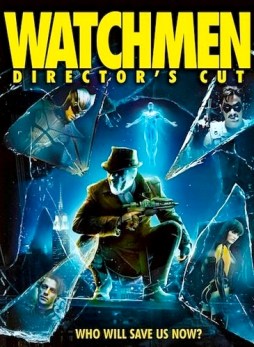
Watchmen: Director’s Cut (2009)

2009 #79
Zack Snyder | 186 mins | Blu-ray | 18 / R

This review contains spoilers.

Hitting US Blu-ray so long ago that it’s shameful I haven’t watched it ’til now, and finally arriving in the UK next Monday, the Director’s Cut is Zack Snyder’s final vision of Watchmen: The Movie. The Ultimate Cut (currently available in the US but with no confirmed UK release), which integrates the animated Tales of the Black Freighter into the main feature, is, in Snyder’s words, “an experiment”. Maybe one day he’ll change his mind and say that’s actually his definitive version; I suppose these days — when it seems every major film has a proliferation of different cuts across theatrical release, home entertainment release, and home entertainment re-release — such a thing as a “definitive version” doesn’t necessarily exist. But that’s a debate for another day: for now, this — not The Ultimate Cut, and certainly not the theatrical cut — is Snyder’s Watchmen.

That said, I wouldn’t be inclined to say it’s vastly different to the previously seen version. There are some obvious new scenes and extensions, especially if you’re familiar with the original novel, but ultimately I didn’t find the additional 24 minutes created a vastly different experience. Most of the flaws still remain, from the unfixable — Malin Akerman is somewhat miscast; sometimes episodic storytelling (a largely unavoidable side effect of faithfully adapting a novel that is very much a story in 12 parts, as opposed to a story divided into 12 chunks) — to those that Snyder could potentially have rectified — the alley fight/Manhattan interview crosscutting still doesn’t quite work; Bubastis is inadequately explained; too little time is devoted to the large cast of secondary characters in New York to give Adrian’s plan the same emotional kick it has in the novel; and so on.

By the same token, none of the great bits are ruined, while some are enhanced. Although mostly faithful to the novel, the changes Snyder and co have made are almost all for the better: Rorschach’s “what do you see?” beats the fan-favourite landlady scene (goodness knows why it’s a fan favourite), and Matthew Goode’s slightly built, faintly Germanic Veidt seems a more natural fit for the character now than Gibbons’ more butch version (possibly only in my opinion, that one). Best of all is the modified climax, which retains all the significance of the original but, by changing the way in which it’s brought about, streamlines and tidies up the storytelling. The giant squid is a great comic book image, but this is superior plotting, especially in the abridged form a film adaptation must take.

As for the new bits themselves, some are slightly misguided — Rorschach’s escape from Blake’s apartment, for example, is wholly unnecessary; it shows him injuring a policeman, an incident now referred to over the next few scenes, but we don’t need to see it to follow the references, and showing it gets in the way of the previously perfect match-cut from the Minutemen photo in Blake’s apartment to the same one in Hollis Mason’s. By and large, however, the extensions add depth via little lines and moments. The most noticeable are a better building of Laurie’s backstory, and Hollis Mason’s death. The latter is a little ancillary to the main plot, its excision from the theatrical version easily justified to keep the running time down, but in itself is a well-played and tragic scene that adds further resonance to the end of Dan’s story.

Whatever you thought of Watchmen after the theatrical cut, this extended version is likely to change your opinion no more than any other re-viewing would. That said, with a little extra room to breathe and a few worthwhile extensions, and in spite of the odd tweak that doesn’t work, this is the superior cut of the film.

5 out of 5

Most of the comments in my lengthy review of the theatrical cut still stand, so I invite you to read it here.

Watchmen: Director’s Cut placed 3rd on my list of The Ten Best Films I Saw For the First Time in 2009, which can be read in full here.

Ripley’s Game (2002)

2009 #67
Liliana Cavani | 106 mins | TV | 15 / R

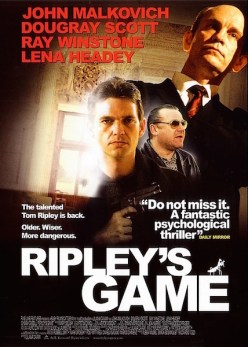
Ripley's GameMatt Damon is back as… Oh, wait, no he isn’t — he’s turned into John Malkovich.

Not quite — there’s no reasonable way Ripley’s Game can be considered a sequel to Anthony Minghella’s The Talented Mr Ripley. Though it’s adapted from a later novel in Patricia Highsmith’s Ripley series (previously filmed as the Dennis Hopper-starring The American Friend, incidentally), the action is relocated to the present day, and it’d be a pretty hard sell to believe Matt Damon would grow up to be John Malkovich.

Despite the acclaim of Minghella’s effort just three years earlier, and a cast that includes recognisable faces such as a Ray Winstone, Dougray Scott and Lena Headey alongside Malkovich, Ripley’s Game snuck out with barely anyone noticing, including going straight to TV in the US. There are surely reasons for this, reports of a problematic shoot probably among them, but the neglect is undeserved. In 2006, Roger Ebert saw fit to include it in his Great Movies list, though other critics are less favourable (the Radio Times, for one handy example, rate it just three out of five). While Ebert is in my opinion overselling the film by including it in a list of the best films ever made ever, it’s certainly an above average, consummately made, and constantly entertaining Euro-thriller.

Perhaps the difference in opinion about the film stems from one, arguably crucial, sticking point: the Radio Times criticises the humour included in the murders and thriller sections, viewing it as a failure of director Liliana Cavani; conversely, Ebert approves of it, praising them as appearing somewhere “between a massacre and the Marx Brothers”. There’s undoubtedly more to the diverging opinions than this, but it’s at least emblematic. I’m inclined to agree with Ebert: these sequences do have tension — not the most one’s ever experienced in a thriller, but enough — but they marry the humour to it, leaving you chuckling on the edge of your seat.

For the most part the story keeps moving, twisting and turning in sometimes unexpected directions. Other films would happily take the first half-hour or so of this and stretch it to a whole feature, but screenwriters Charles McKeown and Cavani — adapting from Highsmith’s novel, of course, so the credit lies with her — take the premise further and in new directions. It’s not flawless, with the climax by far the biggest let down: Ripley and Trevanny hole up in the former’s villa, preparing for a veritable war as Ripley anticipates goodness-knows how many men to turn up. When it’s only two, it seems more believable than a whole army of mafia goons descending on the relatively insignificant pair, but it’s also distinctly anticlimactic after the hype. Still, at least the story has a final twist up its sleeve.

Malkovich may be a fairly respected actor, but to me he’s always seemed detached, flat, or mannered — often all three. Here, he’s still all three, but it suits Ripley’s unusual character down to the ground. His dry wit and incessant matter-of-fact delivery craft a quietly sinister, stalking nature, aiding the character’s believable unpredictability — that is to say, you’re never certain what he’s going to do next, but when he does it’s not surprising. I’ve never read a Ripley novel (there are five) nor seen another Ripley film (there are four), but Malkovich’s performance fits so perfectly I have little doubt this is precisely how Ripley should be played.

Among the rest of the cast, Ray Winstone is landed with a role he could play in his sleep, Lena Headey is perfectly fine as an unremarkable wife, and Scot Dougray Scott plays a none-more-plummy Brit. Unfortunately this accent sometimes seems to be the main focus of his performance, and it occasionally falters when he gets highly emotional, but it’s not really a problem… though it is rather odd to hear if you’re familiar with how he normally sounds. His character, Trevanny, is primarily a pawn in Ripley’s titular amusement, leaving Scott with only a passing hint of the character arc with which the role could have been gifted.

As noted earlier, there are numerous tales of problems on set, not least the multinational cast coping with a multinational crew in multiple nations, culminating in Cavani leaving towards the end of shooting and directorial duties being fulfilled by Malkovich. But as many have noted before, happy sets can produce dreadful movies and unhappy sets masterpieces, and while I don’t quite share the view that Ripley’s Game is entirely the latter, it certainly errs more in that direction than the other.

4 out of 5

Wallander: Before the Frost (2005)

aka Mankell’s Wallander: Innan Frosten

2009 #74
Kjell-Åke Andersson | 93 mins | TV | 15

You’re likely familiar with Swedish police detective Kurt Wallander — in passing if not in detail — from the Kenneth Branagh-starring BBC series broadcast at the end of last year (a second series has just finished filming). For the sake of omitting excusatory clauses from the next paragraph, I’ll assume that’s all you know (not that I mean to sound like an expert, because, well, I’m not).
Wallander is adapted from a series of novels by Swedish author Henning Mankell, previously filmed in their original language, between 1994 and 2007, as a series of TV movies starring Rolf Lassgård. A different series of Swedish Wallander films began in 2005 — so, concurrent with the TV adaptations — featuring Krister Henriksson as the titular detective in original stories based on plots by Mankell. Three of these thirteen films received a theatrical release, the remainder going direct to DVD. It’s this latter series that BBC Four are currently halfway through showing, and it’s their theatrical releases that will see three of them reviewed as part of 100 Films 2009.

Before the Frost is the first of this series, and is actually an exception: where the others are original stories, this is adapted from a spin-off novel starring Wallander’s daughter, newly-qualified policewoman Linda Wallander. This leaves Kurt as something of a guest star in the first episode of his own series, but we still see enough of Henriksson to get a feel for his Wallander. Where Branagh is soul-searching, constantly staring silently into the distance, occasionally with a few tears for company, Henriksson is just a guy trying to do his job; struggling to be a good dad and maybe struggling with his health, but still a regular guy. Maybe the introspection and crying come later.

As the de facto lead, Johanna Sällström gets the best of the material. Linda’s troubled relationship with her father, including her decision to work in the same station as him when she could’ve gone anywhere but, are major threads. Sällström plays this central contradiction well, only occasionally (and, thankfully, briefly) slipping down into stroppy teenager histrionics, such as when she storms away from a crime scene early on. As Linda’s friend Anna, Ellen Mattsson also has daddy issues to contend with, though sadly they’re underwritten by comparison. Nonetheless, her significant role is finely portrayed.

Sadly, the majority of the detective story isn’t up to the personal relationships. The villains turn out to be Evil Christians — always a good enemy in my book — with a variety of nefarious plans that lead the story to touch (briefly) on hot-topic issues like abortion, single-parent artificial insemination, and same-sex marriage. While a British or American drama might feel the need to include more of a debate about the morals of such acts, here they seem accepted as a right that the Evil Christians want to steal. Though this arguably leaves them under-considered, it’s a refreshing change of pace.

More problematic is that the villains are never properly introduced or explored. Some events are undersold — a woman is murdered for no decent reason, a case of wrong-place-wrong-time, but once her body is discovered no thought or mention is given to her unfortunate luck or her family’s grief. Obvious deductions stare Wallander and his team in the face yet they fail to make them — the length of time it takes anyone to twig that the fundamental Christians might intend to attack the high-profile gay wedding is astounding. All of these faults rob a few plot twists of their full potential, though at least one still left me surprised and feeling like I should have spotted it (which, of course, is what a competent twist ought to do). Arguably, however, there’s too great a reliance on coincidence to connect all the dots.

Visually this Wallander is as different from the BBC’s as Henriksson is from Branagh. Where the British one seems to attempt an emulation of what our idea of Sweden might be — all cold, desaturated blues and greys, lingering shots of vast empty countryside, and so on — the Swedish version is more, well, normal. (That said, early on it contains a perversely beautiful shot of two swans in flight while engulfed in flames.) No doubt the differences between series are the product of the British version trying to create a Foreign Culture while the Swedish one is just content with filming it as-is, much the same as British-set British dramas do with Britain. On a broadly related note (in that they’re visual), the subtitles are mostly fine, though some jokes and language tricks are unfortunately lost in translation.

Before the Frost is, sadly, not all it could be. Whether this is the fault of Mankell’s novel or Stefan Ahnhem and Pelle Berglund’s adaptation I don’t know (I’ve never read a Mankell), but while it seems fine as it goes along a bit of reflection reveals all these niggling gaps. That might be a little harsh though, as there’s still much to admire and enjoy in the first of what could be a fine series.

4 out of 5

The second theatrical release, Mastermind, was on BBC Four last week and is available on iPlayer for another 24 hours. The third, The Secret (aka Hemligheten), is episode thirteen and will air later this year.

Red Riding: 1983 (2009)

aka Red Riding: In the Year of Our Lord 1983

2009 #52
Anand Tucker | 100 mins | TV (HD) | 15

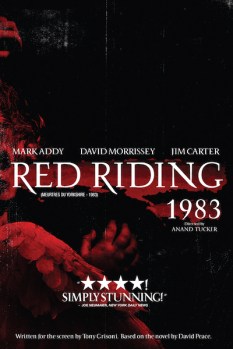
Red Riding: 1983The Red Riding Trilogy draws to a close with its finest instalment, a superior work in just about every respect.

From the off, 1983 returns to the story of the previous films, showing events from different perspectives. It’s dominated by a new story — the search for a child kidnapper in the titular year — but even this harks back to the past, the actual kidnapping closely resembling the one that kick-started 1974. Indeed, it’s 1974 that’s primarily drawn upon, confirming 1980 as little more than an aside in the scope of the trilogy.

1983 doesn’t just reiterate, however, but builds on previously-seen events and characters, both overtly — showing the police investigation into Clare Kemplay, which was the story of 1974 — and more subtly — Hunter’s apparent sidekick being present at secret meetings of the Evil Policemen in 1974. Despite clear links to the past, 1983 may also work well enough on its own. It’s undeniable that there’s more depth when viewed in light of the first two films, but most (perhaps all) of it would be comprehensible simply from what’s presented here.

Tucker’s film bests its predecessors in almost every assessable value. The story and characters have more genuine surprises and suspense than ever, while the performances are at the very least the equal of what’s gone before. Unlike the other two films, where the corrupt cops were little more than cartoon villains despite claims to the contrary, 1983 makes their brutality really felt; here, for the first time in the trilogy, their disregard for the law and their vicious methods made me feel sickened and angry, just as they should.

But best of all is the stunning sepia-tinged cinematography, which uses the popular RED cameras to amazing effect. The instances of beauty are too numerous to mention, from obvious moments such as the final scenes of white feathers drifting in slow motion through shards of sunlight as part of a heroic closing image (even if one finds it tonally incongruous, which some surely will, it looks gorgeous), to low-key scenes like Jobson lost in contemplation, the sepia-toned foreground standing out from the blues of the background. The omnipresence of lens flare, an idea that was so annoying when liberally sprinkled across Star Trek, seems to work perfectly here. Perhaps it’s due to consistency: every light source seems to cast streaks across the frame, not just the occasional flourish. The trilogy isn’t yet available on Blu-ray, but for some of the images in this film alone it really should be.

Sadly, 1983 still isn’t perfect. Many plot threads are tied off, or we can infer our own explanations for the missing bits, but significant others are left hanging, not least what happened to the numerous corrupt police officers. We don’t necessarily need to see them come to justice — though that might be nice, obviously — or even a summary of the rest of their life, but some nod of a conclusion to their stories would be appreciated. Elsewhere, BJ’s narration is slightly twee, which is a shame because his story is both compelling and one of very few that is actually told across all three films, even though he’s barely noticed at first, rather than just starring in one and cameoing in the others.

I enjoyed 1983 immensely, much more so than either of the preceding films, so it’s only minor flaws like these that hold it back from full marks.

4 out of 5

Red Riding: 1980 (2009)

aka Red Riding: In the Year of Our Lord 1980

2009 #51
James Marsh | 93 mins | TV (HD) | 15

This review contains major spoilers.

Red Riding: 1980The second instalment of the Red Riding Trilogy sets out its stall with a stunning opening montage, covering six years of the Yorkshire Ripper case in as many minutes through news footage and faux news footage. In one fell swoop this establishes its own storyline, fills in some of what’s happened since 1974, and sets itself apart from its predecessor: this one’s based on fact. Well, a bit.

Unfortunately, a factual grounding hasn’t helped the story one jot. Where the first idled, this meanders, flitting between the Yorkshire Ripper, the investigation into the Karachi Club shooting (which closed 1974), and the private life of lead character Peter Hunter. It’s the cover up surrounding the middle of these that’s the most interesting, but that’s also the bit with the least time devoted to it. Most is spent on Hunter’s investigation into the investigation of the Ripper case, though by the end it becomes apparent this exists to cover the ‘real’ story — which is, of course, the Karachi Club cover up. Consequently neither are covered with the appropriate depth: the Ripper investigation is never a serious thread, the team we follow uncovering nothing significant and the Ripper himself captured by chance, off-screen, by a previously-unseen regular constable; and the incidents at the Karachi Club, and their lasting impact, are just about clarified but given no serious weight before a last-minute explanation.

If that sounds complicated, it isn’t. As in 1974, it’s all too straightforward: the people you suspect did it actually did, as it turns out, and there’s no serious attempt to conceal that. In fairness, it just about manages one surprise, right at the end, and the moment after this — where Hunter’s murderer shows remorse with one brief, subtle facial expression — is by far the best bit of the film. Worse than the lack of suspense, 1980 seems to forget its own plot all too often. Hunter is employed by the Home Office, for example, and told to report directly to them and them alone. But then we never see those characters again, not even when he’s later dismissed by lower-ranked officers — why not return to the men he was, supposedly, actually employed by? Other plot points are pushed aside too soon, forgotten about or just abandoned.

Characters and locations resurface from the first film — an unsurprising continuity, but pleasingly almost all appear in a context that’s actually relevant to the plot, rather than a mere catch-up on a previously-known person. Some of them have great import now, their role in the trilogy apparently fulfilled, while others remain little more than cameos with no bearing on the story, suggesting an even bigger part still to play. This works quite well, creating a real world where characters come and go rather than one that is obsessively — and unrealistically — interconnected.

The same can be said of the cinematography. Marsh frequently finds a beautiful or unusual shot, enlivening proceedings considerably. The 35mm glossiness doesn’t evoke the feel of a grimy past quite so thoroughly as Jarrold’s hazy 16mm, but as this is now the ’80s perhaps that’s the point. Nonetheless, the setting conveyed is still a drab, dreary — and constantly damp — North.

Underscored by a plot that doesn’t really come together, and largely bears little relation to the other two films, 1980 is the weakest entry in the trilogy.

3 out of 5

Red Riding: 1974 (2009)

aka Red Riding: In the Year of Our Lord 1974

2009 #50
Julian Jarrold | 102 mins | TV (HD*) | 18

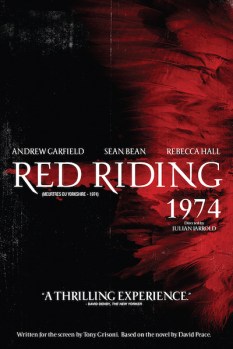
Red Riding: 1974The Red Riding Trilogy covers nine years of police corruption and child kidnap/murder in Yorkshire, amongst one or two other things, and begins here with a very film noir tale, courtesy of author David Peace and screenwriter Tony Grisoni, slathered in neo-noir stylings, courtesy of director Julian Jarrold.

Jarrold is most recently responsible for Kinky Boots, Becoming Jane and Brideshead Revisited, all of which stand in a sharp juxtaposition to the style and content of Red Riding. But turning from his lovely English-as-they-come costume dramas to something altogether nastier should come as no great surprise, for Jarrold is merely returning to his TV roots: in the mid ’90s he directed episodes of Cracker, Silent Witness and Touching Evil.

He certainly seems to know his territory, but perhaps he knows it too well — though this is also the fault of Grisoni and, perhaps, Peace — as the plot that he unfolds is not only familiar but told as if he’s all too aware we know what’s coming. The feeling one gets is of a British James Ellroy, albeit a low-rent, less complex version. (The same is true of 1980, though for me 1983 manages to escape such comparisons.) The story idles along, not exactly slow so much as in no hurry, full of near-clichéd plot points and an unrelentingly standard structure. These things aren’t necessarily a problem, but when you’ve got as big and bold a reality claim as the Red Riding Trilogy they feel out of place.

Another recent point of comparison would be David Fincher’s Zodiac — young newspaperman on the hunt for a serial killer in an inspired-by-fact ’70s setting — though this does 1974 no favours. It may be grittier than Fincher’s film, but it lacks the polish, the originality, and manages to feel slower, despite being a whole 50 minutes shorter. However much arty photography, disjointed storytelling, relatively dense accents and ‘gritty reality’ is plastered over the barebones of the tale, the familiarity of it — to both viewers and the makers, who don’t even seem to be trying — means there’s not an ounce of suspense or surprise to be had.

The cast is made up of established names, familiar faces and rising stars, many of them unfortunately stuck in familiar roles or otherwise left stranded by the unrewarding material. If they’re not quite stereotypes it’s because they’re too bland, lacking enough discernible character traits to reach such lofty heights. Occasionally this is because, with two films to come, some minor parts here have a major role later, but this can’t be said of them all. As the lead, Andrew Garfield’s journalist is as much of a stock character as the plot he finds himself in: a young reporter type, idealistic among journalists who no longer care (if they ever did), hunting to expose The Truth. Again, it could work, but is belied by the insistence — in both promotion and filmmaking style — that Red Riding is something more than Another Murder Mystery. Only Rebecca Hall, as a mother whose young daughter went missing years earlier, is granted the material to give an outstanding performance — which she does, easily justifying her recent BAFTA Rising Star nomination.

Besides Hall, the best thing about 1974 is its dull, desaturated photographing of grimy, desolate locations, where any colour that isn’t beige desperately wants to be. It suits the story and era perfectly, and the choice of 16mm seems to add a level of haziness that is equally appropriate. It’s perhaps indicative of everything this is aiming for that the most beautiful imagery is of an incinerated gypsy camp. Rendered almost black and white by the soot and desaturisation, ash floats through the air like snowflakes as Garfield stumbles through it, the whole picture a vision of Hell. It’s a kind of perverse beauty, true, but that’s also entirely in keeping with Red Riding.

1974 is a stock noir tale, dressed up with fancy filmmaking techniques and claims of realism to look like something more truthful, more real, more Important. And it makes me a little bit angry because of it. Maybe the violence is more realistically depicted than your average genre entry, maybe the police corruption is a little more plausible — then again, maybe it isn’t — but the real story here is so familiar they haven’t even bothered to hide the plot beats and twists properly, no doubt assuming a “gritty” veneer plastered over the top would do the job for them. It doesn’t. Maybe 1974’s grimy setting, brutal violence and unbeatable police corruption are all true to life, but the familiar and predictable plot leaves the realism feeling like no more than a pretence.

I was enjoying 1974 a lot more by the time the unexpectedly satisfying conclusion came around, but the sense that it had tried to pull the wool over my eyes throughout — and not in the good way a thriller should — just leaves a bitter taste.

3 out of 5

* Though I watched Red Riding: 1974 on 4HD, it’s my understanding that it was upscaled. ^

Sherlock (2002)

aka Case of Evil / Sherlock: Case of Evil

2009 #46
Graham Theakston | 89 mins | TV | R

Case of EvilSherlock Holmes is a character so well known in the international psyche that he is open to seemingly endless reinterpretation — a wartime spy in the Rathbone era, his younger self in a Temple of Doom remake, or cryogenically frozen to reawaken in the 22nd Century (no, really). Indeed, this year alone we can expect to see him re-imagined as both a wisecracking martial artist in a period-set action/adventure film from Guy Ritchie, and as a detective in the present day in a new TV series from Steven Moffat and Mark Gatiss. All of which are considerably more exciting than this lame Young Sherlock effort from 2002.

Here, writer Piers Ashworth — who would go on to pen the new St Trinian’s and Goal! III (for which be sure to read the review at The Big Whatsit) — creates a kind of Holmes Begins, showing a young and unknown Sherlock break his first case against renowned criminal Professor Moriarty, gaining a bit of fame before he joins the investigation of a serial killer. Ashworth makes sure to complete the Begins format with introductions for various iconic elements, like the deerstalker (though only in the final scene), the pipe (though, only in the final scene), and even his drug addiction (though Holmes seems to have already been cured of it).

More fundamentally, however, Holmes is recast as a kind of Victorian James Bond, both in terms of his character and the plot structure. It begins with the end of the previous mission (which, GoldenEye-style, will become relevant later), before progressing through various familiar beats, like the villain helpfully explaining his plan and a climactic big shoot-out a la You Only Live Twice or The Spy Who Loved Me, except on a much, much, much smaller scale. To add to the effect, Dr Watson is revealed to be “a bit of an inventor” — a Q in the making? Even Holmes himself is not immune: young, dashing, and womanising. Yes, womanising. He even has a threesome, shot and scored like soft porn, though with a US TV-friendly complete lack of nudity. Or sex. It does feature an unintentionally hilarious striptease though.

The story itself moves at a decent lick early on, complete with some genuine detective work that even, occasionally, displays Holmes’ genius. Most of this (at least, most of it that’s actually relevant to the plot) occurs during a couple of autopsies, which choose not to stint on the gore. (Incidentally, this makes it even easier to believe it was created with US TV in mind. Nudity? Nooo. Gore and violence? Hurrah!) Unfortunately, the longer the film goes on the more it slows and begins to drag, and the mystery-solving is replaced with running around, backstory exposition, and semi-decent sword fights. The best of these is fortunately at the climax, which takes place (amusingly, like Basil the Great Mouse Detective) atop the Palace of Westminster clock tower — or, at least, a poor computer-generated version of it (also like Basil the Great Mouse Detective). To be fair, the interior is a decent-enough set… though quite how the clock faces function when no workings whatsoever are attached to them is a mystery worthy of Holmes. Sherlock was shot in Romania, so such dodgy effects work rears its head any time they wish to depict a London landmark. Thankfully this isn’t often, because every such shot is appallingly realised.

Much the same could be said of the performances. James D’Arcy initially seems miscast as Holmes, but… well, he is — it’s just that everyone else is even worse. Roger Morlidge’s Dr Watson feels like he’s being portrayed by Ricky Gervais — no, worse, like James Corden’s version of Gervais from Horne & Corden — while Vincent D’Onofrio’s accent wavers all over the place and takes his performance with it. In what amounts to a cameo as Mycroft Holmes, Richard E. Grant is dreadful too. I’ve never been much of a fan of his, but this is weak work even by his standards. About the only passable performance among the major characters comes from Nicholas Gecks as Lestrade. There’s nothing exemplary about his role, but by simply doing nothing wrong he fares better than the rest.

Sherlock probably sounds irredeemably awful, and for some it will be (Sherlock Holmes has a threesome for Chrissake!), but despite the numerous flaws it remains largely watchable and even has its moments, particularly for more forgiving non-Sherlockians.

2 out of 5

Sherlock featured on my list of The Five Worst Films I Saw in 2009, which can be read in full here.