
Rachel Lee Goldenberg | 89 mins | DVD | 12 / PG-13
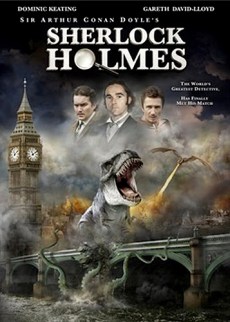 From the company that brought you such pinnacles of cinematic excellence as AVH: Alien vs. Hunter, Snakes on a Train and Mega Shark vs. Giant Octopus comes the latest in a long line of cheaply-produced blockbuster cash-ins, this time tied to… well, I think you know. (While I’m at it, I encourage you to look at their website — the sheer volume of these ‘mockbusters’ they’ve produced now is almost impressive.)
You wait decades for a new Sherlock Holmes film and then two come along at once. One is the Guy Ritchie-directed Robert Downey Jr-starring genuine blockbuster moneymaker. The other is thankfully not the rumoured Sacha Baron Cohen/Seth Rogen/Judd Apatow/other faintly irritating people (I forget who was involved) comedy vehicle, but instead a direct-to-DVD cash-in from mockbuster kings The Asylum. Yes, I’d rather this version, thanks.
I’ve not seen an Asylum film before, but I hear this is one of their best. It’s not exactly “good” by any reasonable definition, but as “cable TV movie” quality goes I’d say it trumps the dull Case of Evil. And dull this certainly isn’t — sea monsters! dinosaurs! dragons! air battles! If you thought Ritchie’s Sherlock Holmes looked disrespectfully blockbusterised, it seems positively Brettian by comparison.
 But, in The Asylum’s favour, their Sherlock Holmes doesn’t hide what it is. Yes, it’s called simply Sherlock Holmes rather than Sherlock Holmes and the Implausible CGI Monsters, but at least said monsters are plastered all over the DVD cover (both US and UK). If you see that and still expect something faithful to Conan Doyle, more fool you. That said, at times it’s surprisingly faithful to Doyle’s spirit. There’s some decent-ish investigation and deduction, the story structured like a mystery rather than an action-adventure.
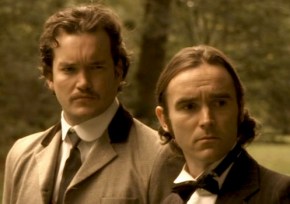
But you can’t escape the dinosaurs, sea monsters and dragons, or the various steampunk elements introduced towards the climax. And so your enjoyment probably depends on your expectations. Some of the acting’s poor — not least Ben Syder’s camp short-arse Holmes, sadly — and the CGI’s weak, looking like a ’90s syndicated TV series. The direction occasionally lacks competence and a couple of action sequences are pointlessly repetitive.
 Anachronisms abound, the best being the first: the film opens in London, 1940, the middle of the Blitz, and the opening shot foregrounds the Millennium Bridge. I don’t think you have to be too familiar with London to know when that was built. Elsewhere we get intercoms on houses, incongruous light switches and period inaccurate telephones, just to mention a couple. It’s shoddy, yes, but almost part of the fun.
But, for all the faults, there are positives. It’s still not “good”, but it is often “quite fun”. Thoroughly daft, certainly, but — provided you don’t demand too much — quite entertaining because of it.

Steven Moffat and Mark Gatiss’ modern-day re-imagining of Sherlock Holmes, Sherlock, starts at 9pm tomorrow on BBC One.
Tomorrow night, my review of the Guy Ritchie Sherlock Holmes.
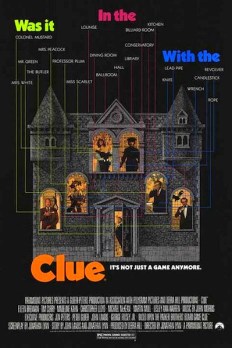 Although Disney have recently treated (I use the word loosely) us to a glut of films based on theme park attractions, movies adapted from good old board games seem a lot rarer. This is probably for good reason — even more so than Disney rides, the majority have no kind of useable narrative. Cluedo (aka Clue in the US) is one of the few that does, and consequently is one of the few (only?) board games that has reached the silver screen. So far, anyway.
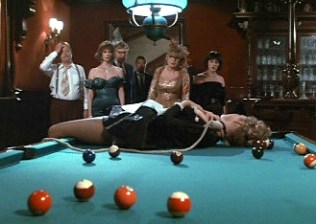 Other than the board game connection, Clue is best known for its three different endings, all of which were released, with each screening having just one attached. On TV the film shows with all three consecutively, and they perhaps work best this way — there’s a rising scale of ridiculousness, and the varied repetition of a couple of gags underlines rather than steals their amusement value. My personal favourite variant was the first, incidentally.
 Not many people seem to like Knowing. Quit the opposite, in fact. I must confess, I’m not really sure why. I can read their reasons, of course, but I still thought it was a decent film. Solidly entertaining even, I’d say.
 those numbers down, and other such technical queries, but that seems like needless nitpicking.
 I will accept, however, that the very last shot is arguably a step too far and a little cheesy.
 I enjoyed the first
  but they’re to embellish its tale, in the same way many higher-class films have — it’s just an entertaining ride, with some exciting action, intriguing clues, and the odd bit of humour.
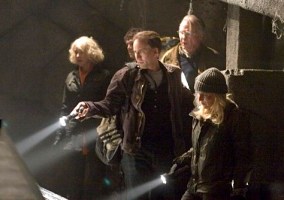 but there are worse ways to spend a couple of hours, particularly if all you want is a bit of well-made light entertainment.
 Seraphim Falls sees Liam Neeson and a crew of hired hands chase Pierce Brosnan across every Old West landscape imaginable — from snow-topped mountains to bone-dry dustbowl — but why?
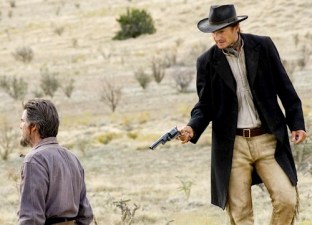 once most everyone else has fallen by the wayside. As the only constants, the various situations and their reactions allow the men to be slowly revealed. It’s not really a character piece, but they’re at least more complicated than your usual Good Guy vs Bad Guy setup — the story has you flip back and forth about which you think is which several times.
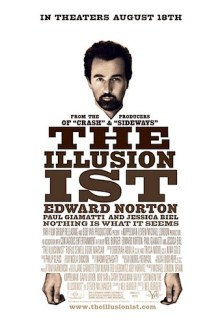 A Blu-ray release of The Illusionist has just
 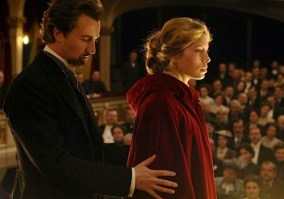 The story itself — you remember those? It’s the bit between the attention-grabbing opening and preposterous-twist finale — is mediocre with or without the finale. It’s a something-and-nothing account of a Poor Boy who loves a Rich Girl he can’t have and… oh, I can’t even be bothered to explain it.
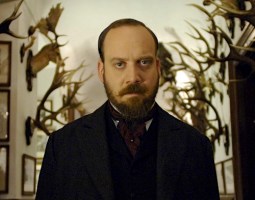 As comparisons with The Prestige are inevitable, particularly as both films were ultimately released around the same time, I’ll briefly put them head-to-head. Both concern stage magic in a similar-enough period setting, debate about whether the tricks are just that or actually supernatural powers, a love story that goes awry, which involves a fatal rivalry… But they’re actually very different films. The Prestige jumps about in time in a more complex way than The Illusionist, but this also has a point. The former’s story is more original, more engaging, its use of magic — real or not — more captivating. I fear I could go on, but it’s succinctly summed up thus: in this comparison, The Illusionist comes up short.
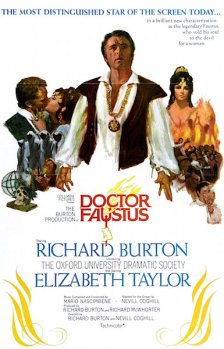 Despite the numerous film versions of the Faust story, this is the only one that adapts Christopher Marlowe’s A-level-favourite 1588 play. It’s a shame, then, that it’s heavily edited from the original text and, despite also being a filmed version of the Oxford University Dramatic Society’s 1966 stage production, has clearly been inappropriately chosen as a vehicle for then-couple Richard Burton and Elizabeth Taylor.
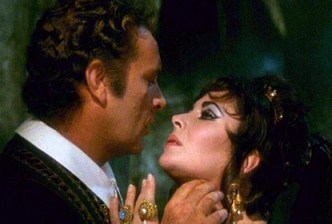 Elsewhere, Burton and Coghill’s vision of Faustus is stylistically reminiscent of a Gothic Hammer Horror, which is either wholly inappropriate or an ingenious genre mash-up — after all, such a genre-mashing trick has been pulled many a time with Shakespeare over the years. There are repulsively horrific corpses, a harem of naked ladies, an array of special effects, plus a medieval-styled gothic atmosphere to all the sets and costumes, though the scene where Faustus mucks about with the Pope feels more Carry On. Using inanimate objects in the roles of the Good and Evil Angels — respectively, a statue of Christ and a skull — is a small but inspired touch.
 perhaps just to heighten the presence of Helen by losing scenes she couldn’t have been shoehorned into; but in the process it both loses some of the best material and destroys any hope the film had of being a definitive filmed version of the play. Ultimately, such oversights proved to be the final straw for the film’s already-tenuous grip on a three-star rating.
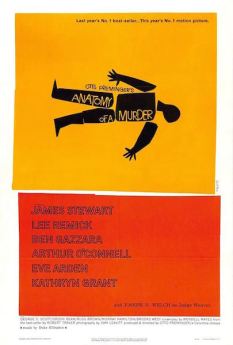 Anatomy of a Murder is a courtroom drama, adapted from a novel by a real-life defence attorney (“defense attorney”, I suppose), who in turn based his fiction on a real case. This background not only adds to the veracity of what we see, but likely explains the film’s style and structure.
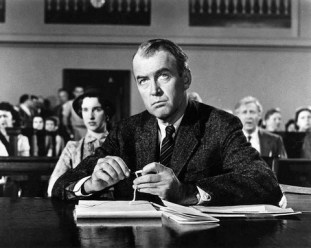 A lot of this support is down to Stewart’s performance — it feels wrong to be cheering the defence counsel of a murderer, even if he had a justifiable motive (which, remember, he may not have) — but we’d probably cheer Stewart on if he was the murderer. His Biegler is always in control, from investigation to courtroom, even when by rights he should be completely out of it. He manipulates the judge, the prosecution, the jury and the crowd to perfection; the viewer sits by his side — we know he’s playing them so we can revel in it — but, in turn, he manipulates us too, tempting us to his team — to laugh at his jokes, to support his case, to loathe the prosecution, even though they might be right. It’s a stellar lead performance.
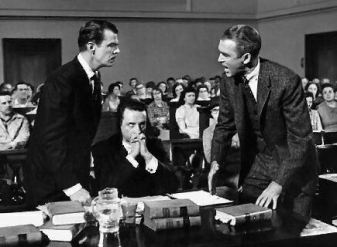 I could just as well go on to praise Ben Gazzara, Arthur O’Connell, Eve Arden, Brooks West, even the smaller roles occupied by Kathryn Grant, Orson Bean, Murray Hamilton and others. Some criticise Joseph N. Welch’s judge, and it’s perhaps true that his performance is a little less refined than the others, but as a slightly eccentric judge he comes off fine. And to round things off, there’s an incredibly cute dog. Mayes’ screenplay is a gift to them all, finding room for character even within the ceaselessly procedural structure, using small dashes of dialogue or passing moments to reveal and deepen each one.
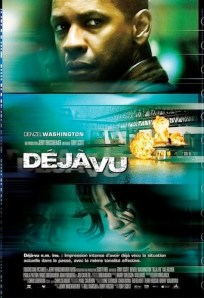 Denzel Washington and Tony Scott have now served as star and director (respectively, as if you didn’t know) on four films, with
  First, a little note on that aka: technically — and, I believe, legally — no such title is attached to this project. However, the initial idea was developed by Koontz and, after he left the project, adapted into his Dean Koontz’s Frankenstein series of novels. Despite the ‘creative disagreement’ (or whatever they chose to call it) that led him to walk away, the film retains significant similarities to the first book. More on these in a moment.
 100Films.co.uk