aka Di Renjie: Tong tian di guo
2012 #52
Tsui Hark | 123 mins | Blu-ray | 2.35:1 | China & Hong Kong / Mandarin | 12 / PG-13
 This year’s 52nd film is, in many ways, thanks to DC’s The New 52 (the comic book initiative/publicity stunt that saw DC relaunch their entire universe across a series of 52 new #1 issues, for those who don’t do comics): it got me back into reading regular comics, and featured in multiple titles for several months was a cool-looking advert for the US release of Detective Dee, complete with the attractive review quote, “Crouching Tiger, Hidden Dragon meets Sherlock Holmes, only a lot more fun”. A little research finds it highly recommended in other arenas too: there’s a host of awards nominations and wins, from the Venice Film Festival to the Hong Kong Film Awards; an 81% rating on Rotten Tomatoes; Blu-ray.com furnished the UK BD release with a glowing write-up; Time ranked it the third best film for the whole of 2011 (behind The Artist and Hugo). Even the unreliable film section of the Radio Times saw fit to give it four stars.
All of which hopefully establishes how I found it to be a massive disappointment.
Days before the coronation of China’s first Empress, a high-ranked man is mysteriously burnt alive from the inside out. Then the man charged with investigating the case suffers the same fate. On advice (from who or what I shall mention later), the Empress assigns the case to Detective Dee — who has been in prison for eight years for rebelling against the Empress. Sounds like a good setup, eh? A super detective, at conflict with his employer, looking into supernaturally-tinged murders; and it’s a Hong Kong movie so you know there’s going to be some impressive action sequences.
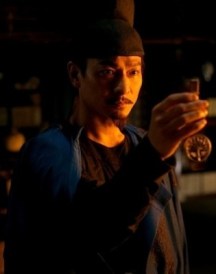 To take Time’s opinion as a starting point, I have to wonder if they would rank Detective Dee so highly if it had been an American-produced film with actors speaking English. I don’t mean if the film was Americanised, but exactly the same, just an American production. In that instance, I think it would very much be viewed as a summer blockbuster, because that’s definitely what it strikes me as. It’s one with lots of talky bits and an over-complicated story, certainly, but then it’s not unheard of for US blockbusters to confuddle the viewer with an under-written over-developed plot (less so these days, I grant you).
Apparently it makes commentary on the economic and political situation in modern China. It must be done quite subtly, then. That’s a good thing I suppose, but I imagine you’re only going to notice it if you already have a familiarity with what’s going on. I don’t. Best I can tell, the film’s message is, “even if you think your ruler’s a bad person who’s done bad things, they’re your ruler and you should let them get on with it and not rebel”. I could have misread it, of course, but that’s what I got from the ending. Not a position I’d personally agree with.
Naturally there are plenty of action sequences (choreographed by Sammo Hung), several of them tacked on for the sake of it. Personally I wasn’t impressed. They’re all clearly shot on digital video (the whole film was, but the smeary fights really show it up), several are under-lit, there’s too much Hollywood-style choppy editing, it felt like some had bits missing, others are stop-start in a way that adds up to not very much… Many of them left me confused about what was meant to be going on,  not in awe of the performer’s abilities or entertained. One of them features the hero fighting a gaggle of cheap CGI deer. Yes, deer. Why?
Detective Dee is a film of moments. There are some pretty shots, occasionally even sequences; the fight in the Phantom Bazaar, an underground river network, is guilty of some of my criticisms but also pulls off a few nice bits. The CGI is what you’d expect from a mid-range US miniseries, but (with exceptions such as the fighting deer) it works well enough, even creating some dramatic vistas, particularly of the 200-foot tall Buddha statue that’s central to the plot. Some of the sets are also incredibly impressive — again, the interior of the Buddha. Occasionally I was frustrated reading the subtitles (which fly by at a rate of knots, it felt to me) because I wanted to look at the detailed, busy production design.
I mention the fast subtitles because the film feels like it’s moving at quite a lick. There’s little room to get to know the characters, or the situation, or their relationships, or their political machinations, before it’s racing on to the next plot point. And yet despite that it feels incredibly slow as a whole — I was clock-watching before the hour mark.
Perhaps one of the things that suffers for this is the film’s relationship with the supernatural. It’s at first supposed that the deaths are some kind of divine intervention, but then this is kicked away — what a silly idea by some foolish characters! But then everyone’s more than happy to accept a talking magic deer (seriously; 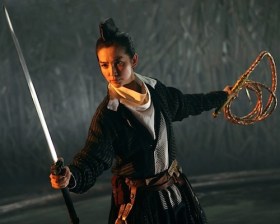 and they happily take its advice (see second paragraph)), a fighter whose arms fly off and turn into… something else (choppy editing means I’m not sure), facial transfiguration (imagine Mission: Impossible’s masks with face-churning magic instead of masks), and so on and so forth. Some of it ultimately has a rational explanation, but why is “divine intervention” so much less believable than “magic”? And why do you have to explain the talking deer and flying arms when the face-churning-thing is left untouched? I can take people flying unrealistically through the air — that’s the style of the genre, much like regular folk breaking out into perfectly-pitched musically-accompanied song is the style of the musical — but not internal inconsistency in other areas.
I’ve avoided the comparison so far, but Detective Dee is like a Chinese version of Guy Ritchie’s Sherlock Holmes, only a less inventive and comprehensible one. And it’s certainly not “a lot more fun”. Dee is a great deducer, a la Holmes, though the film gives him no opportunities to significantly show that off. The plot concerns a series of apparently-supernatural murders that actually have a rational explanation, and are ultimately all about taking control of the country. It stars a period detective who’s been reconfigured as younger and a man of action. But whereas Holmes kept things clear-cut and fast-moving, Dee (as I’ve noted) fudges and obscures motivation and plot and feels tediously long.
There are actually quite a few little things to like about Dee, and maybe there are a few big things too, but I feel like it’s making you work for them — 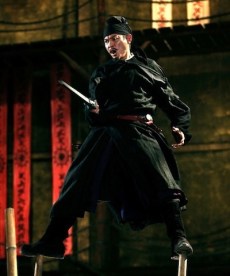 you could enjoy the characters, or the political machinations, but only if you take time to study them slowly and work out what was going on for yourself, because the film’s in too much of a rush to explain it to you. There’s something to be said for entertainment not spelling everything out — it’s often a highly-praised element of anything that achieves it — but Dee doesn’t do that, it rushes headlong past things that could do with more clarity. (One thing I should do is listen to Bey Logan’s commentary — there’s a fair chance he’ll have insights that illuminate me. But in a moment you’ll see why I haven’t done that before posting this.)
Believe it or not, I didn’t hate Detective Dee… but I didn’t exactly enjoy it either. Not fully. I started this review by saying it and I think it’s my key feeling: after getting a little hyped up about something I’d previously ignored the UK release of, I found it to be disappointing. Your mileage may vary.
The UK TV premiere of Detective Dee and the Mystery of the Phantom Flame is on Film4 and Film4 HD tonight, Friday 6th July, at 11:10pm.

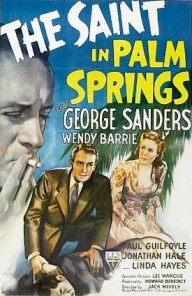 George Sanders is the Saint for the final time in a film that isn’t the series’ best, nor its worst. It also marks the final appearance by Jonathan Hale as Inspector Fernack, and third-and-final turns from both Wendy Barrie and Paul Guilfoyle. For those keeping track (or not), that’s the same four leads as the last picture! Same director too, as Jack Hively helms his third (and, of course, final) Saint adventure.
 Hale isn’t in it nearly enough unfortunately, especially considering this is his last outing. Guilfoyle has the sidekick role and at least his and Sanders’ relationship is a fun substitute. Barrie is, for once, simply the ingénue and not some form of criminal mastermind. Don’t worry, there’s another girl for that: Linda Hayes, who seems a promising match for the Saint but, though prominent early on, is ultimately disregarded. The highlight for both women comes when they get invited along for a horse ride with the Saint and have a good bitch at each other. It’s a pickle quite unlike the ones Templar usually finds himself in! I have nothing against Barrie, but quite why they sought to use her repeatedly I don’t know. And, to be frank, she worked best in her first appearance.
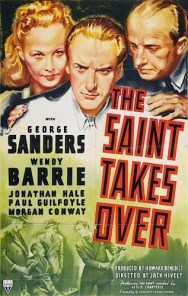 The first RKO Saint film to not be based on a story by the Saint’s creator, Leslie Charteris, is actually one of the better mysteries in the franchise. Sort of. The downside would be that the solution is glaringly obvious. For a mystery you might imagine that would be a major problem, but the process of investigating is nicely done. A bit more work might’ve been done to obscure the culprit, a character who we meet at the beginning and then more or less disappears and so will inevitably return somehow, but I had so much fun I don’t really care.
 One of the highlights of
 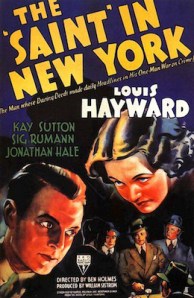 The Saint in New York is a B-movie in every sense of the term, but it’s certainly one of the fun kind.
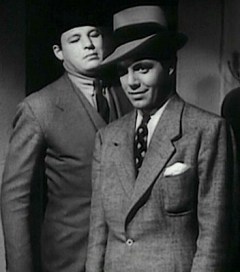 His habit of jumping into moving vehicles, much to the surprise of their drivers, is also fun. The other stand-out character is henchman Hymie, played by Paul Guilfoyle, who is enamoured of the Saint and constantly comments on his actions. Together they make the film a light, fun, amusing experience, with more memorable lines than a film of its stature deserves.
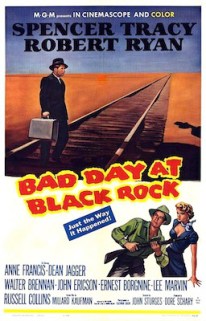 Bad Day at Black Rock comes with an air of the forgotten classic — or, at least, it did to me. I think that’s important to how I ultimately reacted to it. As is that wherever I first heard about it pitched it as a suspenseful mystery with a twist. I forget where that was now, but I remember consciously avoiding finding out the plot’s developments (more so than one naturally would anyway) before viewing.
 I missed the commentary. Indeed, in
  For a film so based in mystery and which has what I’d call a methodical pace (despite its short running time), there are surprisingly good action sequences to look out for: a car chase/battle along a thin path, a one-handed punch-up in a bar, and a climactic shoot-out that’s at its most tense once all the bullets have been fired. It’s not an action movie by any means, but these cinematic sequences stand out nonetheless.
 Remember when M. Night Shyamalan was the wunderkind of Hollywood? Seems so long ago, doesn’t it? But clearly someone somewhere is still invested in him — or he’s managed to limp on well enough that stuff he works on seems worth a punt — because a couple of years ago he was able to launch a series of films dubbed “The Night Chronicles”. I don’t remember the details and they’re not worth looking up, but as I recall the idea is they were a series of low-key/low-budget horror-thrillers conceived by Shyamalan (he has a Story and Producer credit here) but helmed by others. Devil is the first of these. I don’t recall a second turning up yet.
 not the best, but with enough action, intrigue and twists to fill its (admittedly very brief) running time. It comes to a head with a pretty good twist/reveal. Again, it’s kind of ironic that it’s the best twist in a Shyamalan film for years, but it comes in a movie he neither wrote nor directed. Maybe he should take another look at the kind of films he’s choosing to make. (I say “maybe”…)
 As an aside, in my occasional run of Comments Paying Too Much Attention To Certificates, it’s funny what Americans allow at what age rating. Here we have neck stabbing, hanging, creepy devil stuff… Seems a bit much for a PG-13, to me. The UK’s 15 is much more appropriate.
 According to
  a properly chilling murder scene, quite out of step with the film’s age and PG certificate.
 There’s also a hefty dose of coincidence that everyone involved, both on screen and off, conveniently ignores.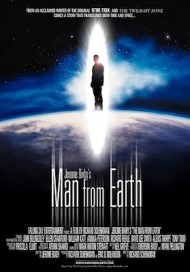
 Judged on its own terms, however, The Man from Earth is what one might call Proper Science Fiction. Most films classed as sci-fi just feature aliens or what have you; they’re space opera, or just action movies where Americans fight off-planet enemies instead of out-of-country enemies; the kind of thing Ray Bradbury termed fantasy rather than sci-fi (I’m inclined to agree, but that’s a discussion for another time). Instead of Shooting And Blowing Up Stuff, or even comedy antics with a twist, The Man from Earth deals in Ideas.
 and are prepared for all the slowness of pace that involves (because compare the experience of doing anything in real life for an hour and a half to how much gets crammed into a movie’s 90 minutes — that’s the speed Man from Earth moves), and are open to a movie that posits an idea and then explores it — including twists and turns of variable merit — then you might enjoy this film. I did.
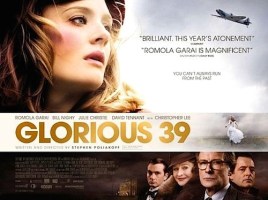 “This year’s
  I, however, thought it was rather good. I can see what turned some people off though. It’s a thriller, but it moves leisurely, especially early on. It’s also quite elliptical at times, not so much requiring you to pay attention as put the pieces together yourself. Plus it lacks a grand finale in which the hero triumphs, or at least loses in dramatic style — it’s quieter than that. Yet I liked the ending, finding it triumphant in a whole other way. But I won’t go spoiling that here.
 What’s better in a thriller than not actually knowing what will come? There should be twists in this genre — genuine twists when possible, not a stock array of “small character played by famous actor turns out to be vitally important” or ” good guy is actually bad guy” or what have you — and Glorious 39, with its balanced uncertainty, pulls some of those off.
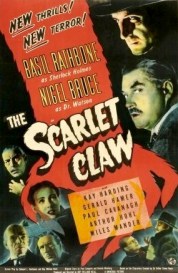
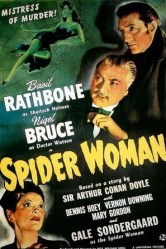 The seventh feature starring Basil Rathbone as Sherlock Holmes and Nigel Bruce as Dr John Watson is the first since
 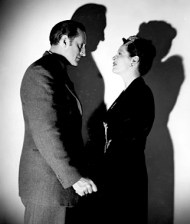 Gale Sondergaard, is so good that they crafted a sequel around her, albeit Holmes-less. I’ve not seen it and don’t own it, so I’ve no idea what that does for its quality.
 100Films.co.uk