
Luc Besson | 107 mins | Blu-ray | 2.35:1 | France / French | 12
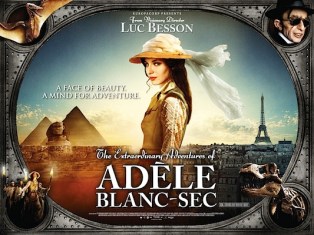 Based on the long-running bande dessinée (aka “comics”) by Jacques Tardi, The Extraordinary Adventures of Adèle Blanc-Sec is occasionally sold to English audiences with a handy quote from Empire: “Amélie meets Indiana Jones”. I’ve never seen Amélie (though, funnily enough, I ordered the Blu-ray in a sale last week), but I still think that’s a pretty fair summing up.
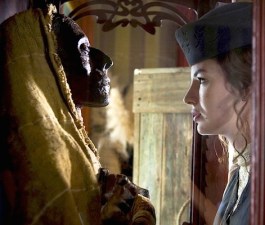
Adapted from two of Tardi’s tales (the first and fourth, fact-fans), Adèle Blanc-Sec is set in 1912 Paris, and concerns the titular adventuress’ quest to resurrect an Egyptian mummy who may be capable of healing her sister, while also having to deal with an escaped pterodactyl. Pretty instantly you can see this isn’t what we Brits typically think of as A French Film… that said, the often farcical tone allies itself with another preconception about the French, so that’s OK.
Indeed, this lightness — fairer to say silliness — might alienate some viewers hoping for more Indiana Jones and less Amélie. There’s a sequence in Egypt that’s very much in the Indy mould, and much of the stuff with the pterodactyl too, but it’s always underscored and surrounded with humour. Caricatures and exaggerations abound.  And if that doesn’t put you off, the introduction-heavy opening minutes might, dense with introductions for disconnected characters and locations. Stick with it, it sorts itself out.
The film finds itself with a 12 certificate in the UK, and that age might be the perfect target audience. There’s dinosaurs and mummies, car chases and fireballs, derring do brushing up against irreverent humour, and even some boobies. Hurrah for the Frenchies’ casual attitude to nudity — its appearance here is in every possible way gratuitous, and yet with a snippet of plot information that means you couldn’t snip it out without creating an obvious jump. It’s only these fleeting nipples that prompt the film to be higher than a simple PG (the BBFC’s explanation is here), though there’s a mildly harsh edge to some of the action too. Should a man being guillotined be funny? Well, it is here.
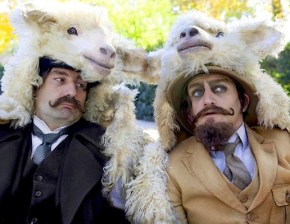
Star Louise Bourgoin is/was a model, which you can believe from her looks but wouldn’t know from her performance. Her Adèle is quick-witted and funny, terse but likeable, and she’s prepared to don all sorts of daft and occasionally unflattering disguises in service of both story and laughs. An able supporting cast includes Bond villain Mathieu Amalric, unrecognisable under heavy prosthetics, who is unfortunately underused. Some reports say this was planned as a trilogy (whether the sequels are still in the works, I know not), so perhaps he was being established for that purpose.
 Director Luc Besson managed to build up something of a following with a regular output of films through the ’80s and ’90s, perhaps culminating artistically with the exceptional Leon, which he followed with US-styled (but French-produced) sci-fi epic The Fifth Element and an ill-received re-telling of the story of Joan of Arc. For much of the ’00s he moved further behind the scenes, writing and producing a flurry of mainstream-flavoured Euro-produced crossover hits — film series such as District 13, Taken, Taxi, The Transporter, and more can all be attributed to him. Adèle Blanc-Sec isn’t his first time back in the director’s chair since the ’90s, but while there’s nothing wrong with its production, nothing suggests Besson in particular needed to be calling the shots either. Maybe someone more intimately familiar with his previous work would see something I didn’t, but though it’s all competently handled, there’s nothing to remind you this is a man who once helmed some truly great films.
The music is by Éric Serra, who murdered the score for GoldenEye with some electronic modern rubbish instead of the classic John Barry-inspired style David Arnold brought for Tomorrow Never Dies through Quantum of Solace (and, one hopes, he’ll bring to Bond 24, after Thomas Newman’s bland and self-copying effort on Skyfall). Serra has clearly spent the intervening 15 years learning how to copy, however, as there’s a distinct John Williams flavour to the music. I’m not objecting — this is an Indiana Jones-esque tale and Indiana Jones-esque music fits like a glove.
 I suppose Adèle Blanc-Sec won’t be to everyone’s tastes. Comparisons to the Stephen Sommers Mummy have been made, but its tone is sillier still than that and not everyone approved then. That’s before we get on to its occasionally scrappy nature, including a slightly overlong third act. But that’s piffle I say, because in the right frame of mind it’s all rollicking good fun. I sincerely hope those mooted sequels happen.

The UK TV premiere of The Extraordinary Adventures of Adèle Blanc-Sec is on Film4 and Film4 HD tomorrow, Friday 1st February, at 9pm.
It placed 10th on my list of The Ten Best Films I Saw For the First Time in 2013, which can be read in full here.
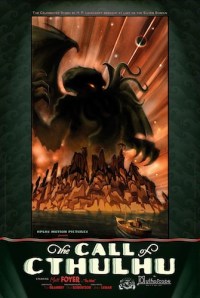 I must admit to not being at all familiar with the work of H.P. Lovecraft. I know the name, of course, and the titles of some of his stories, not to mention being aware of the array of well-known fans. Aside from that, I’ve only encountered his work through its influence — there’s some stuff in the
 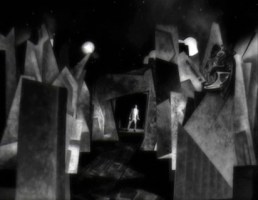 The marriage of low-budget and silent film style is one made in heaven, particularly when you add in the dedication of the makers. They built impressive props, ingenious sets, and employed model work in various inventive ways, all to execute a story that includes a cultist swamp orgy, a mysterious island, a sea battle, and a skyscraper-sized monster. Some online reviews have criticised the effects, but those people are quite frankly idiots. This isn’t meant to be slick CGI — it’s re-creating lo-fi early film techniques, and (aside from one or two rough-round-the-edges spots of greenscreen) it all looks fabulous.
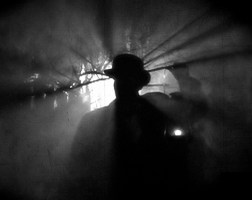 I have no idea how closely it hews to Lovecraft’s original, but there’s a layered stories-within-stories approach (I think it gets four deep at one point) that is difficult to pull off with clarity, but never falters here. Christopher Nolan would be proud. It also effectively builds a sense of uncanny mystery; not outright scares, but a kind of disquieting unease. It’s my impression that was absolutely Lovecraft’s aim too, so another job well done.
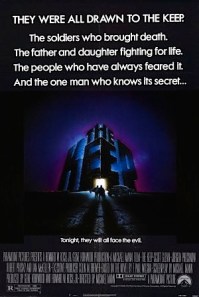 Michael Mann is arguably best known for his modern, urban, slick, intricate crime thrillers — films like
 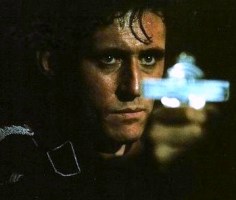 Should we long for a Director’s Cut, then? Maybe that would be an improvement, but I’m not convinced it would be good per se. You see, the film doesn’t just stick to giving us Nazis vs Whatever The Keep Contains, oh no. First the SS turn up, led by a Properly Evil Nazi, played straight by Gabriel Byrne. Escalation, great. Then there’s Ian McKellen as a professor drafted in to make sense of the keep’s mysteries. Also great — even the Good Nazi is going to have to die, right? Who better to root for than a saved-from-a-concentration-camp Jewish professor.
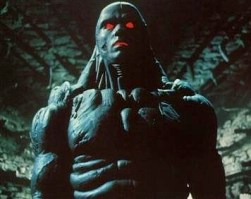 There are plus points, but they all come with a commensurate downside. The creature is well-realised at first, with some nice animated effects that are more effective than much of the over-cooked CGI spectacle we’d get today. The more we see of him, however, the less power he holds — he ends up essentially a very tall man. OK, it’s a bit better than that makes it sound, but the mysterious billowing smoke was spookier. The film on the whole is nicely shot, with some real standout moments of cinematography. But slow-mo and a smoke machine both get overused by the end, lending many of the visuals a tacky ’80s edge.
 One thing the film never manages to be is remotely scary. It’s not aiming for cheap jump- or gore-based shocks (although there is a little goriness, it’s quite light; triply so by today’s standards), but it doesn’t manage any significant senses of dread or creepiness. As noted, early on it seems to be heading in the right direction — even the secluded mountain village, nestled in a harsh landscape but with greener-than-green grass and garishly painted houses, and towered over by the foreboding slab of stone that is the titular structure, is an uncanny start — but it never makes good on the promise.
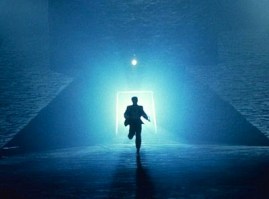 I would love to join their ranks, because there are numerous exciting ideas and moments of quality filmmaking to be found here; but I won’t be, because there’s too much muddled dross packed in around them. The result is that quite-rare thing: a decidedly mediocre film that I’m actually glad I’ve seen. But, unless someone wants to hire me for that remake, never again.
 Following the surprise success of
  Hitler (aka Bruno Ganz) and a cool exit; a really good car chase; and a couple of solid punch-ups, including a particularly good one at the climax.
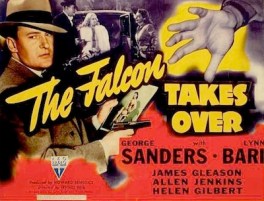 Quite outside of the Falcon film series, this third entry is notable for being the first screen adaptation of a Raymond Chandler novel. Ditching Chandler’s then-unknown Philip Marlowe in favour of the Falcon in the lead role, this is a version of the character’s second mystery, Farewell, My Lovely — which would be
  As usual, it doesn’t have the same je ne sais quoi that makes the Saint films particularly entertaining (yeah, you know I mean wit); and I can well believe it has “
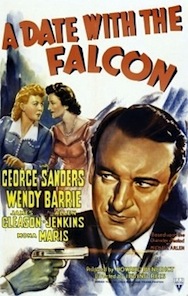 The second Falcon film sees George Sanders’ gentlemen detective investigate the disappearance of a scientist.
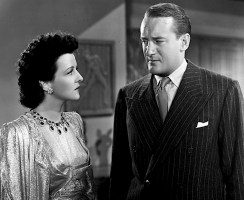 Anyway, aside from him there’s a ‘suicide’ bid and the crowd below’s reaction to it. Again it’s mostly comedy, but unlike some of the series’ DOA running gags it’s actually funny.
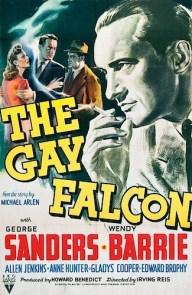 Worried about the cost of renewing the licence to popular hero the Saint, RKO instead acquired Michael Arlen’s the Falcon and essentially modelled him as a replacement, much to the chagrin of Saint creator Leslie Charteris. And who can blame him? They even cast the star of the Saint, George Sanders. Cheeky.
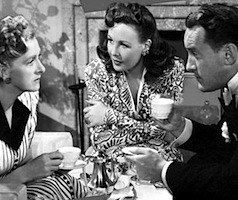 The story (the only one in the series adapted from a work by Arlen) is a solid mystery about jewellery thieves, which doesn’t seem to have quite the scale of the Saint films. Those were often contained to one city, but they felt somehow grander, like the schemes being foiled were of broad significance; here, it’s basically work for the police. To put it another way, if there was always the sensation that the Saint was an anterior James Bond, you could say the Falcon is more like Sherlock Holmes.
 The Gay Falcon makes for solid enough entertainment, mixing thrills with humour to decent effect. But despite attempts to emulate it, not least with the same leading man and woman, it’s no the Saint — they’ve not injected Gay Laurence with quite the same way with words and the supporting cast lacks a Teal or ‘Pearly’ Gates type to really make it click. Whether future entries stray further from Arlen’s original and more into Saint territory, or not, remains to be seen.
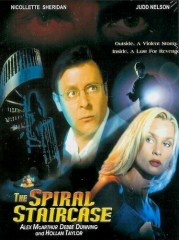
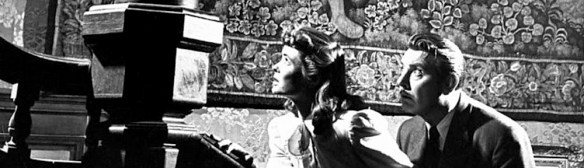

 A couple of years ago I discovered the ’40s Gothic noir thriller
  There are about three suspects in the entire tale. One is so clearly being set up from the off that you know it can’t be him; one barely even registers as a suspect; and it’s not the third one. But the film doesn’t pull off a twist because the attempt (by dragging that middle character back into it) comes so out of the blue as to make no sense. They don’t even bother to try to explain it properly! It’s about the only time the film holds back on painful over-exposition, and it’s about the only time it needs it. Either way, it’s not the same as the original film’s, and it’s not as good.
 The original story is clearly suited to a Gothic historical setting (the ’40s film didn’t keep the novel’s time period, but it chose one similar enough), but that doesn’t mean a modern-set rendition isn’t without potential. Or maybe it is — it’s hard to be certain from a movie that certainly doesn’t realise what potential there may be. Yet for all its countless weaknesses, I can’t quite bring myself to entirely despise it. Can I really give this wholly derivative remake 2 stars? It may be some kind of Stockholm Syndrome — after 90 minutes with it, I can’t help but find some point in it all; some thing to like.
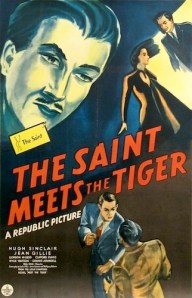 Produced in 1941 but not released until 1943, owing to Saint creator Leslie Charteris’ dispute with RKO over their new Falcon series (which is fairly unashamedly a rip-off of the successful Saint films), The Saint Meets the Tiger is a belated adaptation of Charteris’ first Saint tale, but was to be the series’ final film. Fortunately, it’s quite a good one.
 It still lacks the wit and light touch that make the Sanders films so entertaining, with only vague attempts at humour that generally raise little more than a smile. Sinclair doesn’t seem quite as wooden this time out, but he’s a straight-cut hero-type, not the kind of charmer this series really wants. In fact, one moment when he bursts into laughter, only to suddenly cut it short, is actually quite creepy. Perhaps he was trying to emulate Sanders more — the film does feel lighter than Vacation — but he still comes up short.
 100Films.co.uk