2013 #43a
Mike Newell | 157 mins | Blu-ray | 2.40:1 | UK & USA / English | 12 / PG-13
This review contains major spoilers.
 The fourth Harry Potter film is the pivot around which the series revolves, in oh so many ways. Most obviously, it’s book 4 of 7 — the halfway point. It’s also where the books switch from short ‘children’s novel’ lengths to the huge tomes they eventually became. More importantly, it’s the instalment on which the overarching plot of the entire series hangs. Although each previous entry in the Potter canon contributed something to the mythology (even if sometimes its significance wouldn’t become apparent until much later), they’re still viewable as discrete adventures. So too is Goblet of Fire, for the most part — the exception being its final act, which kicks off the story that will consume the rest of the series.
The film is no less of a turning point, for its own reasons. Note that this is when the films’ marketing began to emphasise the ageing of the actors: the teaser trailer begins with shots of Harry, Ron and Hermione from each of the four films; the promotional TV specials go behind the scenes not only on the new film but also its predecessors; clearly substantial retrospective interviews were conducted too: watch the Creating the World of Harry Potter: The Magic Begins documentary on the Philosopher’s Stone Ultimate Edition and it tells the story of the films’ birth by mixing interviews not only from the sets of the first film and the ‘now’ of the final film’s production, but also in costumes and on sets from the fourth movie.
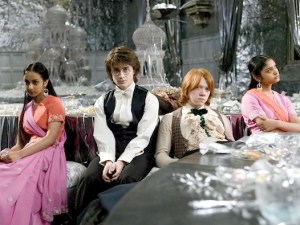 It makes sense: at this point the series was moving beyond your stock franchise length of “trilogy” and into less frequently charted waters, amid speculation that the leads would be recast. With Goblet of Fire being the last point you could reasonably pull that off, I imagine it paid to emphasise that these were the same kids — that we see a cast age in more-or-less real time throughout their childhood, including many small supporting roles as well as the leads, is one of the Potter films’ more unique highlights.
The other big behind-the-scenes decision was one of length. As noted, this is the first Potter story to explode from a short children’s tale, which could be adapted in full in two-and-a-half to three hours, to a lengthy novel that would require masses of time to cover in full. Considerations of spreading it across two films were reportedly dismissed when director Mike Newell promised he could do it in one, essentially by cutting subplots and extraneous material — much as Alfonso Cuarón had on Prisoner of Azkaban, but on a grander scale. (Imagine if they hadn’t made that choice: instead of eight films, the Potter series would have sprawled to 11 instalments!) The result of such editing here is a very direct film, rattling through its plot — even with stuff cut, there’s still a lot of story to cover.
Said story concerns two foreign schools visiting Hogwarts for the Triwizard Tournament, a series of dangerous challenges, into which someone enters Harry against his will. It’s a nice clear through-line: a series of tasks, interspersed with investigations into who forced Harry to participate and why. It all comes to a head in one of the series’ most famous moments, the murder of Cedric Diggory. 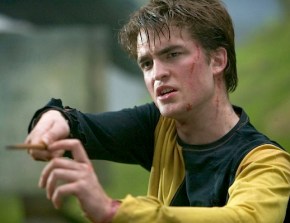 I can’t remember if Diggory’s meant to be a nice guy or an irritating jock, but here he’s played by Robert Pattinson, proving it’s not only his involvement with the Twilight franchise that makes him smug and annoying. Still, the impact of Diggory’s demise is still shocking and effective for those who don’t know it’s coming — this isn’t just a light series of children’s adventures any more. Of course, the death of a single-book supporting character is less impactful with an awareness of the franchise as a whole — there’s much worse to come, leaving this a mere opening move.
The other element that begins to creep in from this point is all the teenage romance stuff. Provoked mainly by the Yule Ball, with the guys having to pluck up courage to ask girls and dance lessons with teachers, the characters’ love lives start to become a notable factor. For all the plausibility and humour with which it’s depicted, there are times later when it will become a bit tiresome, especially in the novels. Fortunately, much of that’s internal monologue and subplot, and so goes astray here. Extra thanks to Mr Newell for that.
One of the more overlooked facets of Rowling’s work is her penchant for allegory and gentle satire. That’s understandable — they’re just Kids’ Books about magic, after all, and occasionally thuddingly written ones at that. Allegory you can take or leave (who’s really going to gain a perspective on HIV from Lupin’s struggle with lycanthropy?), but the satire is nice. Here it’s the press under fire. Rita Skeeter may have a greatly reduced role compared to the novel, 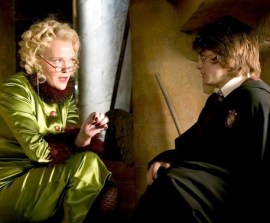 but her Quick-Quotes Quill — which, essentially, just makes stuff up — is present and correct. The next tale, Order of the Phoenix, carries on this motif (the press demonise Harry), as well as setting its sights on blinkered and ineffectual government, and the evils of exam-focused impractical teachers. It’s all rather pleasing, actually, and you have to hope Potter’s millions of readers took it in and learnt something.
It’s easy to let certain events overshadow the entirety of Goblet of Fire; to subsume it into the single long narrative that arguably takes over the later stories. But though it puts broader events in motion, this is still a self-contained tale all its own — and one of the series’ most exciting at that, between storming action sequences and some effective twists. There’s a fair argument to be made that it’s the film series’ best entry.
In about a month, as I’ve already joined the Order of the Phoenix, uncovered the Half-Blood-Prince, and found both parts of the Deathly Hallows, I’ll offer an overview of the David Yates films…

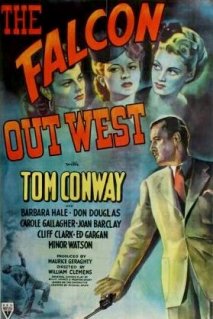 With each passing entry, the Falcon films become less reminiscent of their Saint forebears and more akin to the Poirots and Marples of this world: a gently comical murder mystery, with a finite location and a finite number of suspects, where the ‘game’ of solving the plot is the point.
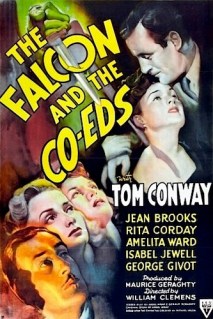
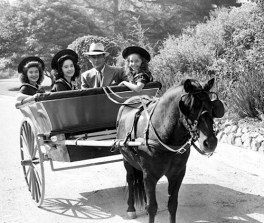 In fact, the worst thing about the film is purely a result of its age, and that’s the occasional bout of misogyny. Let’s face it, the girls going all giggly over the Falcon is pretty defensible (look at modern-day reactions to the likes of One Direction, Justin Bieber, or even Benedict Cumberbatch), but the bit where he picks a twenty-something girl up to smack her bottom is a bit much. Still, it opens with a great bit: the Falcon parks his car, a girl immediately runs up to it: “Mr Lawrence?” “Yes?” She jumps in, instantly kisses him full on the lips, and when she pulls away all he can say, with a slightly surprised look, is, “Nice!” You could put that in something today and it’d still work.
 such thoughts always endear them to me.
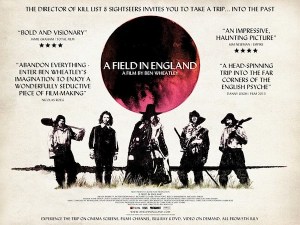 Much was written about A Field in England at the time of its release, so if you frequent the right places online or in the press you can’t’ve missed it. Nonetheless, there’s a good chance you’ll have heard of it more for its release format(s) than for anything in the film itself: the fourth feature in just five years from new British critical darling Ben Wheatley, it was released to cinemas, DVD, Blu-ray, download, video-on-demand, and shown on free TV all on the same day, a first for British cinema. Any casual viewers who checked it out for that reason were in for a shock, because this certainly isn’t an easily-digested mainstream experience.
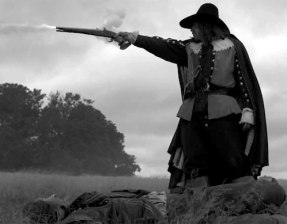 That very subtlety leads some viewers to write this kind of movie off — and fair enough, because if you’re searching for any kind of mass acceptance you don’t do it with a black-and-white film about a few blokes in period dress running around a field doing weird, inexplicable things. Though you might top it off with a shoot-out that is arguably one of the year’s best action sequences, something Wheatley and co do do. And without making it feel tonally out of place, either. Impressive. In keeping but even more memorable is the moment you’ve surely heard about — “when he comes out of the tent with that look on his face”. I wasn’t able to watch the film until something like 24 hours after its Big Premiere, by which time I’d already heard everyone talk about that, and yet it was still uncomfortably uncanny. Kudos, Reece Shearsmith, you’re an odd’un.
 In terms of the new funding models and simultaneous multi-format release and all that… well, it depends what their goals were. If it was to make interesting, alternative, minority-interest films… fantastic, they’ve done it — and got a remarkable amount of interest in the process. If it was meant to be a way of turning a profit, or of reaching a bigger audience… well, it succeeded this time — but how many of those viewers are going to come back? A Field in England is definitely the kind of film that appeals to some people, but it is defiantly not “mainstream cinema”. No bad thing, and something that should be encouraged, supported and funded in some way; but however you do it, it’s not going to continuously bring in big bucks.
 Sean Bean and his ragtag band of knights investigate an unaffected village during Ye plague-adled Olden Days in this folk horror from the director of
 Co-written by geek god Joss Whedon and former
  Some films benefit from knowing as little as possible going in; some are at their best when you know nothing at all. But that’s pretty much impossible — unless you go purely on someone’s “you’ll like this, trust me” recommendation about a film you’ve never even heard of, you’ll be aware of something. Normally this comes from a review or blurb, and you just have to trust that the reviewer or copywriter was kind enough to keep it spoiler-free.
 So here’s what the film lets you in on in the opening moments: in 1993, 13-year-old Nicholas Barclay went missing in Texas. In 1997, a boy claiming to be him surfaced… in Spain. He had Nicholas’ tattoos, but he had a French accent and the wrong colour eyes. And yet the first relative to see him, Nicholas’ older sister, gave a positive ID, and upon returning to America he was accepted into the family. Why did they take in such an obvious fraud?
 but, nonetheless, it makes the documentary itself feel untrustworthy, just like its participants. Is that an intended effect? Arguably the film’s main theme is lies — the lies we tell ourselves, the truths we want to believe; confirmation bias, perhaps, though that term is never mentioned — but the documentary itself never lies to us… I don’t think. It just feels like it might be.
 as the poster prominently tells us, this is “from the producer of
  The Pearl of Death is one of the better-regarded films of the Basil Rathbone Sherlock Holmes canon, but somehow it didn’t quite click for me. That doesn’t meant there isn’t a lot to enjoy, however.
 Elsewhere, Nigel Bruce gets to indulge in a slapsticky scene that, as ever, people who dislike this interpretation of Watson would be happy to do without. Also worth noting is the female lead, British actress Evelyn Ankers: she was a regular fixture of Universal’s horror features, terrorised in no less than
 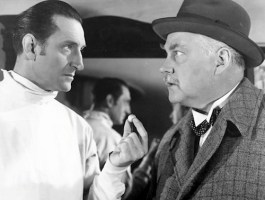 Neill somehow managed to pick one of the least dramatic. Neither of these reveal fudges are ruinous, of course, and are outweighed by the handling of sequences like Holmes setting off the museum’s alarm, the ensuing robbery, the villains stalking round a potential victim’s house, and so on. Still, I was surprised to find them so wanting.
 Final Destination 5 is the latest Final Destination film. Do you really need a plot description? They all have the same story.
 although on reflection it’s meaningless; a clever nod that isn’t really clever, but is neat. And perhaps means the series is finally going to rest.
 Notorious (to me) for unjustly beating
  100Films.co.uk