2014 #134
Steven Spielberg | 107 mins | Blu-ray | 2.35:1 | USA & New Zealand / English | PG / PG
 1981: Steven Spielberg reads a French review of his movie Raiders of the Lost Ark. His high-school-level French serves him well enough, although there’s repeated use of one word he doesn’t know: Tintin.
25 years later: Spielberg has been struggling to make a film version of Hergé’s character for quarter of a century. While developing a live-action version that would feature actors under heavy prosthetics so as to resemble their comic book counterparts, he realises Tintin’s famous dog, Snowy, will need to be computer generated. He reaches out to Peter Jackson and Weta, fresh off their ground-breaking work on The Lord of the Rings. Their test footage is so successful, it gives Spielberg another idea…
2011: after 30 years, Spielberg finally brings the boy reporter to the big screen as a motion-captured animation. Reviews and public reception are mixed, particularly in the US, but they’re all daft because The Adventures of Tintin: The Secret of the Unicorn is bloody brilliant.
Combining events from three of Hergé’s original albums, the story sees Tintin (Jamie Bell) purchase a model ship that is highly desired by the mysterious Sakharine (Daniel Craig). A riddle hidden inside the model sets the ever-inquisitive reporter on a quest to find out what nefarious deeds Sakharine is planning, along the way bumping into drunkard Captain Haddock (Andy Serkis), who holds the key to the entire mystery. Cue a globetrotting adventure that, yes, is very much in the Indiana Jones mould.
 Apparently some Tintin purists weren’t so keen on the actual adaptation — elements of The Crab with the Golden Claws have been mixed in to a plot primarily taken from The Secret of the Unicorn, the sequel/second half of which, Red Rackham’s Treasure, is reportedly used sparingly. Plus, in the original tale Sakharine is a minor character who wasn’t responsible for much, apparently. As someone who’s only read one of those three volumes, and even then not since I was young, such things didn’t trouble me. What superstar screenwriters Steven “Doctor Who” Moffat, Edgar “Cornetto trilogy” Wright and Joe “Attack the Block” Cornish have captured is the spirit of Tintin: an engrossing mystery-adventure, laced with gentle satire and smidgens of slapstick comedy, but with real stakes and peril too.
A talented cast are up to the task. Bell adopts a posh-ish accent for the titular hero, and while some of the accusations of blandness aren’t wholly misplaced, he’s plucky and determined enough to make for an appealing lead. The king of mo-cap, Serkis, is able support as Haddock, while Craig makes for a very effective villain — I hope his post-Bond career, whenever that arrives, sees him playing villainous roles more often. Interestingly, it was his mannerisms that have survived the animation process the most. I mean it in an entirely non-critical way when I say every other character could have any actor behind the mo-cap baubles, but Sakharine’s face and body move with all the recognisable movements and expressions of his actor.
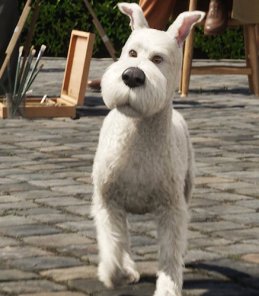 The slapstick is mainly hoisted by Simon Pegg and Nick Frost as the physically-identical Thomson and Thompson — a true advantage of animation, that. I imagine some find their parts tiresome because of their inherently comic role, but they’re likeable versions of the characters. Even more joyous is Snowy, though. Well, I would like him, wouldn’t I? His internal monologue, such a memorable part of Hergé’s books, is omitted (as it is from every film version to date, I believe), but he’s full of character nonetheless. Some of the best sequences involve Snowy running in to save the day. I don’t think they quite got the animation model right (the one glimpsed in test footage included in behind-the-scenes featurettes looks better, for my money), but his characterisation overcomes that.
Bit of an aside, but I think there’s something notable about almost everyone mentioned so far: Moffat, Wright, Cornish, Bell, Serkis, Craig, Pegg, Frost… All British. I know that’s because we’re awesome ‘n’ all, but I think it’s also indicative of Tintin’s status in the English-speaking world — which more or less boils down to “unknown in America”, but also “pretty darn popular in Britain”. At least Spielberg, the man who wanted to cast an American as Harry Potter, seems to know this (further evidence: they’ve hired another British screenwriter for the sequel). For whatever reason, Tintin has never clicked in America, while the books remain very popular over here. It therefore feels like there’s a better chance for the films’ fidelity by using Brits (who have the correct tone and style almost ingrained) than by using people coming to the stories entirely for the first time, and perhaps bringing a more generic blockbuster sensibility. On the other hand, this might just be a horribly xenophobic way of interpreting a coincidental appearance by so many Brits in key roles — after all, Tintin’s Belgian, so it’s not like using Brits is “true to source”.
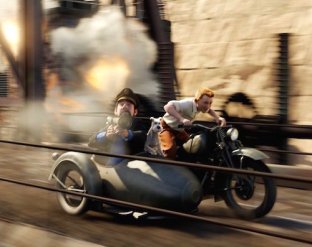 Of course, one very important person is neither British nor Belgian: Spielberg. The screenplay’s balance between peril and comedy is spotlessly enhanced by his peerless direction. In a world stuffed to the gills with lesser blockbusters that palely imitate the groundwork Spielberg and co laid in the ’70s and ’80s, work like this should remind people why he’s still the master of the form. The film is shot with an eye for realism (so much so that some viewers have been convinced it was filmed on real locations with real actors, with some CG augmentation for the cartoonish faces, of course), which helps lend a sense of plausibility and also genuine jeopardy. It’s easy to get carried away when working in CG animation, but often the most impressive works are ones that behave as if they’ve been shot largely within the limitations of real-world filmmaking technology.
That said, Spielberg isn’t afraid to make use of the freedom afforded by working in a computer-generated realm when appropriate: there are some spectacular individual shots, the most obvious being a single-take chase sequence down a hillside through a town. Even better are some of the transitions, which would be literally impossible to realise in live-action — without resorting to effects work, anyway. They’re hard to accurately describe, especially without ruining them, in part because each instance is different; but they do all look incredible, and, again, serve the story rather than being flashy for the sake of it.
 The tone on the whole is resolutely PG — actually, like many an action-adventure blockbuster used to be before everything went slightly darker and PG-13. So, for example, Tintin wields a gun on occasion, but never at another human being. The focus is on the story, which happens to lead to some adrenaline-pumping sequences, rather than a lightweight excuse to link together a bunch of punch-ups and chases. Ironically (though, for anyone who knows what they’re talking about, entirely expectedly) this makes the action all the more exciting. It also mean there’s a lighter touch than many current blockbusters offer; a greater presence for humour, including among the action. I guess that’s not fashionable these days, when everyone’s become so po-faced about their big-budget entertainment. However, with the likes of Iron Man and Guardians of the Galaxy proving immensely popular, perhaps the tide is turning, and maybe the still-on-the-cards Jackson-helmed sequel will find itself better received because of that.
I genuinely don’t understand the muted reaction to this first Tintin, though. It perhaps shows where blockbusters have gone awry in the last decade or two, and perhaps the incidental disdain animation is viewed with among some — I wonder: if the same movie had been produced in live-action, would some of those critics have been better disposed to it? I don’t think it would have actually been a better film, and perhaps it would even have been slightly worse (some of the visual impact would be lost),  but some viewers would have seen it (even subconsciously) as more of a “real movie”.
As I said at the start, those people are Wrong. The Adventures of Tintin is a fantastic adventure movie, and should prove to anyone who doubted Spielberg after Kingdom of the Crystal Skull that, when it comes to globetrotting action-adventures, he’s still the man to beat.
The UK network TV premiere of The Adventures of Tintin: The Secret of the Unicorn is on BBC One today at 4:25pm.
It placed 2nd on my list of The Ten Best Films I Saw For the First Time in 2014, which can be read in full here.

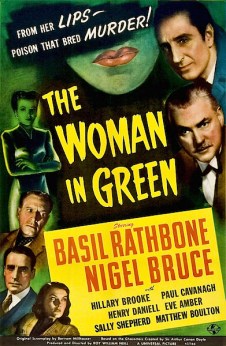 Basil Rathbone’s Sherlock Holmes starred in films which, although they typically involve murder, are best described as “adventures”. The series’ 11th film, The Woman in Green, is one of the few — perhaps the only one — that could genuinely be described as dark and grim.
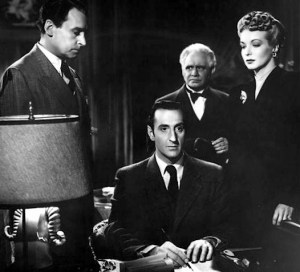 The evil is carried off with aplomb by Daniell. Reportedly a cold actor to work with, he chills on the screen too. This is a man you can believe would carry out such a scheme without a single twang to his conscience. His comeuppance, even with its surprising finality, is welcomed. The titular woman, played by Hillary Brooke, is one of Moriarty’s cohorts, posing as the ‘girlfriend’ of the aforementioned widower in order to set him up. The film is of course in black & white, so we can’t see what colour she’s wearing, and no one ever refers to it — even when they’re hunting for her based on looks alone. I guess someone thought it was an evocative title nonetheless.

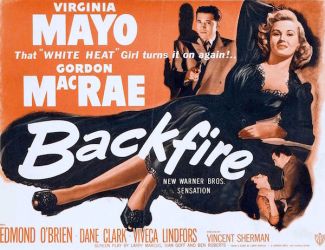 Before he was the romantic male lead in musicals like
  Besides, even if the film seems to forgo the usual gritty noir trappings for a pleasant “English murder mystery”-type tale at first, it actually has its fair share of dark elements and noir-ish features, which only increase as it goes on: secretive gangsters, nightclub singers, revenge shootings… Then there’s the photography which, again, transitions from a fairly ‘regular’ (for want of a better word) style early on, to a world of rain-slicked streets and high-contrast lighting.
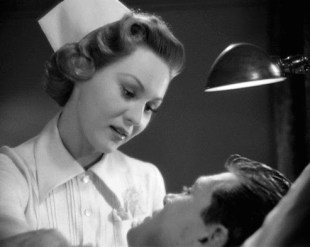 It’s in the latter’s case that the writing gets a chance to shine, too: the chief’s flashback is littered with snappy dialogue that feels kinda like he’s telling you the story himself, not just a matter-of-fact “here’s what happened earlier” objective account. Other flashbacks retain a degree of subjectivity — we only see events the characters could have witnessed, and in some cases the way they witnessed them (like the cleaning lady who only sees customers’ feet, before spying through a keyhole in a shot complete with keyhole matte) — but there’s an idea there, briefly glimpsed in that detective’s flashback, that would’ve made for an even more interesting film.
 It would seem there’s a market in Sweden for series of feature-length crime dramas that begin with a first episode released in cinemas before continuing in regular direct-to-DVD/TV instalments. It’s what happened with the Krister Henriksson
  The specifics of the plot see young university lecturer Puck (Tuva Novotny) invited to spend midsummer on the island home of her supervisor, who’s really asking on behalf of attractive history lecturer Eje (Linus Wahlgren), who Puck has been to a café with three times. A whole gaggle of old chums of Rutger and Eje are also there, including a couple of uninvited guests who arrive out of the blue — and before you know it, Puck finds one of them dead. Eje calls in his chum, detective Christer Wijk (Ola Rapace), and, after the island is cut off from the mainland in a more permanent fashion, the three set about getting to the bottom of things. Cue suspicious actions spied through trees, suspicious conversations partially overheard, suspicious evasion of perfectly reasonable questions, and all the usual suspiciousness you’d expect from a Christie narrative — only subtitled.
 Novotny makes for a likeable lead, though the attempted love triangle between her, Wahlgren and Rapace feels like a non-starter. The biggest surprise is Rapace: previously seen as troubled young copper Stefan Lindman in Wallander and, most famously, as shaven-headed silent assassin Patrice in
 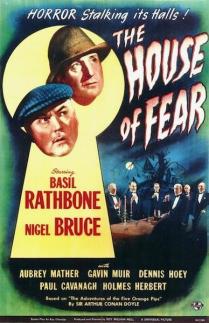 Adapted very loosely from the early Conan Doyle story The Five Orange Pips, this outing for Basil Rathbone’s Sherlock Holmes and Nigel Bruce’s Dr Watson sees them summoned to Scotland to investigate the suspicious deaths of the members of a club, where each killing is preceded by an ominous postal warning.
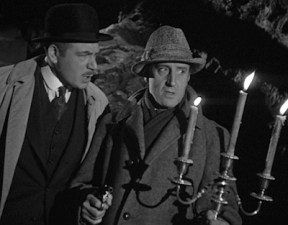 While the club having seven members does mean there’s a fair few suspects, it also means it takes a long time to get through them all being bumped off! It doesn’t sink so low as to be deemed repetitive, but does border it.
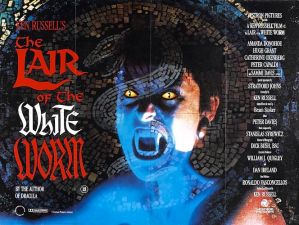 The Lair of the White Worm looks cheap, has a ridiculous story, overacted characters and overcooked dialogue, and by all rights should be a disaster. And maybe it is… but I don’t think so. In the right frame of mind, at any rate, it’s a whale of a time.
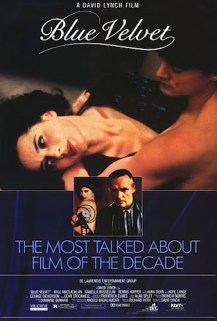 Before he brought the disquieting underbelly of small-town America to television audiences with
 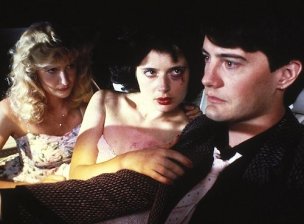 But… is it, really? The white-picket-fence-dwellers are pretty clean; it’s the people inhabiting the scuzzy apartment blocks and industrial estates nearby who are the problem. Those characters are as corrupt and degenerate as their abodes might lead those with regular prejudices to suspect. It’s a less subversive point of view, and I don’t think it’s what Lynch was actually going for. Anyway, the entirety of his moviemaking technique is so outré that you can’t help but find the whole twisted nonetheless.
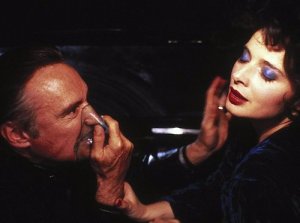 “It’s not a movie for everybody,” Lynch himself said (to Chris Rodley for the book
 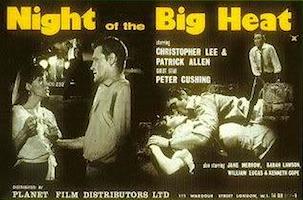 These days largely sold as a horror movie (the old Collector’s Edition DVD is branded as part of a “Masters of Horror” series), probably thanks to its cast (Christopher Lee and Peter Cushing), director (Terence Fisher, of many a Hammer Horror, including five with Cushing and Lee), and rating (an X originally, a 15 now), Night of the Big Heat is not really anything of the sort. Well, maybe a little; but you’re more likely to get scared by a contemporaneous episode of
 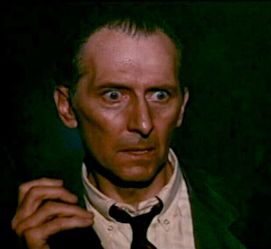 the pair were brought in to redraft because the original screenplay’s dialogue was “unsayable”. Anyone familiar with their ’80s work on Doctor Who, and their associated reputation, will find that highly ironic.) However, when the sci-fi stuff does roll in it’s a bit of a damp squib, leaving the scenes relating to the affair, whether it will be discovered, and what various characters do about their various feelings, as some of the more unique and interesting elements.
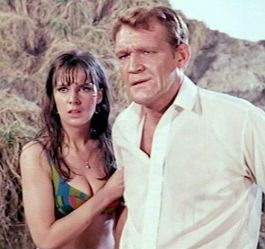 which considering it was shot in February and March is a real achievement. During night shoots the cast had to suck ice to stop their breath being visible, while running around in wet clothing to look like they were drenched in sweat. Poor sods. Said night scenes are a mess of genuine and atmospheric nighttime shooting, alongside the kind of day-for-night filming where everything’s extremely dark except for the sky, and also the kind of day-for-night filming where it’s day and… um… shh!
 Krister Henriksson returns as the Swedish detective for a third and final series of mysteries, starting with this final theatrically-released episode, based on the final Wallander novel. Yes, there is a sense of finality here — albeit one not reached just yet.
 It’s here that Henriksson gets to show off his acting chops the most. At a dinner party with his family, Wallander largely sits quietly with a drink rather than interact with others, occasionally staring aimlessly into the distance, or only remotely engaging with what the others are doing. He witters about a painting of a goat. Later, he has a disproportionately angry response when his friend brings news that he’s been suspended. He dotes on his granddaughter, but one day loses her and her buggy when he pops into a shop — but finds her quickly enough that no one will be any the wiser. Little signs like this are scattered around, clueing us in to where Wallander will presumably end up: retired from the force, and possibly retired from his life. Whether Mankell brought the issues to a head in his novel or not, I don’t know, but here I can only imagine it will build throughout the series.
 The one thing that really cuts through Kurt’s newfound confusedness is when he gets a nose for a case. Quietly, by himself, he sets about digging in to what’s going on, unearthing evidence that’s been missed by others, piecing it together to complete a picture of long-kept secrets and new crimes committed in the name of keeping them. It resolves into a complex conspiracy, one that touches the lives of altogether innocent people. Is there justice at the end of it? Of a sort, but how satisfying that justice is… well…


 100Films.co.uk