
Rob Thomas | 108 mins | download (HD) | 2.35:1 | USA / English | 12 / PG-13
 If you hadn’t heard of Veronica Mars before 13th March 2013, you almost certainly did soon after. That’s the date Rob Thomas, creator of the six-years-dead TV series of the same name, launched a Kickstarter crowdfunding campaign to pay for the long-mooted continuation movie. Aiming for a whopping $2 million, it raised that in just 11 hours, going on to bag $5.7 million by the end of its 30-day campaign. In the process it became the fastest Kickstarter project to reach $1 million (and $2 million), the highest-funded film project ever on the site, with the most number of backers for any campaign, and inspired countless think-pieces on how it was ruining/saving the movie industry, or at least completely changing it forever. In reality, very few (if any) big-name Kickstarter movies have come along since, and those that have haven’t inspired the same fervour as Veronica did three years ago.
The film itself picks up nine years after the end of the TV series. A quick opening montage reminds/informs us that Veronica (Kristen Bell) moonlighted as a private investigator while she was in high school, making plenty of enemies in the process and enduring more than a few tragedies, but she eventually managed to drag herself out of that life and start afresh. Just as she’s about to begin a career as a high-flying lawyer in New York, she sees on the news that her one-time on-off love interest Logan Echolls (Jason Dohring) has been arrested for murder. Then he phones asking for her help. Just when she thought she was out, etc. So Miss Mars heads back to little old Neptune, California, just in time for her ten-year high school reunion and a murder investigation involving all (well, most of) the familiar faces from the TV show.
 There’s no denying that this is primarily a film for fans of the TV series — well, they did fund it, after all. The best way to get the most out of the film is to have watched all 64 episodes of the show first; preferably soon before, in fact, so you can remember who all the minor characters are. However, creator-cowriter-director Rob Thomas is no fool: you don’t produce a successful movie that continues a little-watched TV show by making it a requirement that you’ve watched 64 hours of TV first. (I mean, Joss Whedon knew that with Serenity, and there’s only 14 hours of Firefly.) So Veronica Mars: The Movie is accessible to neophyte viewers. You might sense there’s references and whatnot that are passing you by, but everything that’s relevant is explained.
The long gap between series and continuation actually works to the film’s advantage, too, because this plays as the story of someone revisiting an old life, in a place that’s in some ways different and in others exactly, depressingly the same. The hook here is of Veronica as a kind of addict, but instead of being addicted to booze or drugs, it’s private investigating — she may be nine years ‘sober’, but now she’s being tempted to indulge. Again, this makes even more sense if you’ve watched the TV show, where a subplot deals with Veronica’s mother’s alcoholism, but the general conceit works standalone.
Plus, this is a crime drama — there’s a case to be solved, and that’s self-contained within the film. Okay, most of the players are characters from the series, but everything is introduced and explained within the film. Heck, there are even characters Veronica knew in  school who weren’t actually in the TV series, which might give you a flavour of how it works both for fans and newcomers. The case itself isn’t a bad mystery, but at the same time it’s a little subservient to the other goings-on. I suppose you could argue this is really a comedy-drama about a woman reconnecting with her past life and past friends, and she just happens to have a murder to investigate at the same time.
For fans (who will have watched this years ago, hence why I’m focusing on the newbie experience), the film is immensely rewarding. Obviously, because it finally gives some closure to the cancelled series’ dangling elements; but also, it feels like Veronica Mars, not like something from older people that’s only claiming to be what it once was. There’s the sparky characters, the funny repartee, the raft of neo-noir allusions. As cheesy as “teenage private eye” sounds, one of the reasons Veronica worked was because it really used those noir elements, just grafted on to the high school experience. The town of Neptune is practically a throwback in this regard, with rich kids and businessmen who can buy their way out of trouble thanks to a thoroughly corrupt police department, while the poor schmucks at the bottom of the pile get by as best they can, which often is not well. It didn’t even cave to the usual youthification of adding happy endings; in fact, more often than not, things didn’t end well. The movie isn’t quite as bleak as the TV series often was — there’s clearly an awareness this might be a one-time deal, so Thomas wants to leave things suitably wrapped up — but not everything comes up roses. (Where’s the sequel at?!) And to pay things off fully, there’s a tonne of fun references, not just to the show but also to real life (not least the Kickstarter campaign).
 To bring up Firefly/Serenity again, I think there’s a reasonable parallel between how those relate to each other, and how they can work for newbies, and how Veronica Mars the TV series and Veronica Mars the movie relate. To wit: in an ideal world, you’d watch all of the series and then the film; but TV series can be long commitments, and for a spot of ‘dipping your toe in the water’, you can also start with the movie and go back to the series for the full picture. Sure, some things are going to be spoiled doing it that way round — but hey, not everyone who’s in the series but not the film ends up dead, I promise.
When I first watched the movie, it was at the end of a first-time binge through the TV series, where it sat very happily. To finally write this review, I watched the film again in isolation. I have a memory, so obviously I’m not coming at it from a totally fresh perspective, but it was as entertaining in isolation as it had been as “one more episode”. Fans will get the biggest kick out of seeing old characters resurface, out of learning what’s happened to them in the past decade, out of seeing big-name cameos alongside familiar faces, out of all the callbacks and nods, out of certain things finally being resolved. But that doesn’t mean newcomers can’t get joy from meeting these characters for the first time, from the self-contained mystery and storylines, from the fresh gags — indeed, from all the things that make the TV show entertaining if you started there. And then, if they like it, there’s the joy of there being 64 more instalments to discover.
 More than just a nostalgia trip for people who were there first time round, the movie is a strong addition to the Veronica Mars canon — as someone who didn’t discover the series until the Kickstarter campaign, I thought the film was a heck of a lot of fun, and a wonderful capstone to a mostly-great series. That said, there’s plenty of room for further cases… someday… hopefully…

Veronica Mars is available on Amazon Prime Instant Video in the UK from tomorrow.
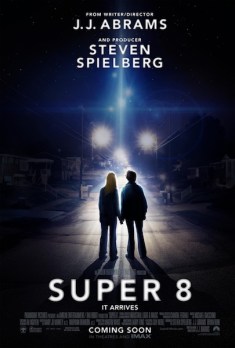 Before he started star warring and between bouts of star trekking, director J.J. Abrams teamed up with producer Steven Spielberg for this homage to the kind of movies Spielberg produced in the ’80s. Those films have endured down the decades; I’m not sure Super 8 endured as far as Abrams’ next
 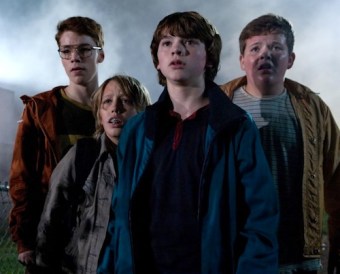 Unfortunately, the longer the film goes on the more it runs away with itself, as characters dash back and forth all over the place, sometimes in credibility-stretching fashion (we never do see how a group of kids manage to escape a heavily-guarded military base and drive back to an evacuated and blockaded town). The adults stumble through the story to little dramatic effect; Joe’s dad even has to be secretly locked up for a good chunk of the film (with no other characters noticing his disappearance) so that his storyline can be paused until he’s wheeled out for his part in the climax. The grown-ups do serve a role — giving us a perspective on events that the kids lack, and being tied to the emotional arcs of the leads — but it wouldn’t have harmed anything to limit them to those functions, rather than trying to half-heartedly give them stories of their own.
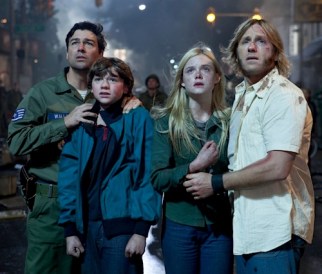 In some respects, the kids’ short film (which plays during the end credits) encapsulates the whole movie: a semi-thought-through SF/F plot, a tacked on emotional arc, the apexes of both tied together in the climax, and a couple of sometimes-shoehorned effects set pieces along the way. Yet for all that, it does enough right that I’d quite like to see Abrams attempt more work along these lines.

 Score:



 A woman wakes up on a beach in the middle of the night. Stumbling away, she comes across a beach house with three strangers inside. They establish that the last thing they remember was being in a nightclub when there was some kind of accident, and then they woke up here. Fortunately, they’re not stupid and quickly twig this place is some kind of afterlife, then begin to work out how to get out — not that they’re helped by the lighthouse beam which causes immense pain, or that if they run away from the house they end up back at the house, or the vicious smoke-monster that’s flying around…
 AfterDeath is billed in part as a horror, emphasised by the skull imagery used on the poster. It’s not particularly scary though, so if you’re after that kind of thrill then it’s one to miss. As single-location mysteries go, it’s not remarkably original or exceptionally engaging, but the story and its revelations are solidly executed and the whole is decently performed, providing you don’t strain your eyes trying to see what’s happening.


 British Academy Film Awards 2016
 A British sci-fi movie from a first-time director will tomorrow take a place at the table (well, in the auditorium) alongside 2015’s biggest awards contenders, as it vies for multiple gongs at this year’s BAFTAs — and it stands a very plausible chance of walking away with several of them, too. I hope it does, because, after a year that brought us awards-quality sci-fi bombast (
 In truth, it’s not the most thorough deconstruction of what it means to be human and whether artificial intelligence can have that right, but it does touch on these issues and, in so doing, leaves them open for the viewer to mull over for themselves, or debate with friends, or however else one likes to consider their movies post-viewing (like, I dunno, writing about them on the internet or something).
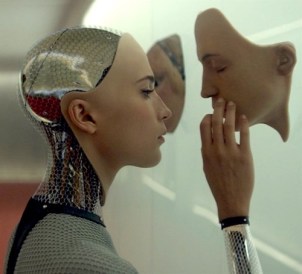 And his dance scene is surely one of 2015’s highlights (there’s an extended version hidden on the US Blu-ray, which is a treat). Garnering the most praise (and awards) is Alicia Vikander’s take on an AI. It’s a tricky role to tackle, because she’s not just a robot — that would defeat the point of Nathan’s exercise — but nor is she fully human. It’s a tightrope of a role, a fine line to walk, and Vikander negotiates it with aplomb. To say too much more would be to spoil it.
 Those after a dissertation-like hard-science deconstruction of the meaning and possibilities of AI will likely find Ex Machina slightly lacking, as will anyone after the crash-bang thrills most mainstream sci-fi provides. Viewers prepared for a decently thought-provoking dramatic thriller about near-future tech, however, should be both engrossed, and grateful that movies like this are (for the time being) still getting made.
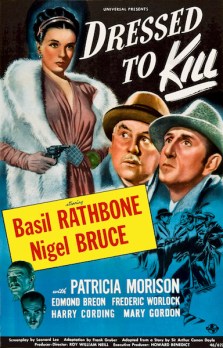 In the seven-and-a-bit years between 31st March 1939 and 7th June 1946, there were a total of 14 films released starring Basil Rathbone and Nigel Bruce as Sherlock Holmes and Dr Watson. By coincidence rather than design, I’ve spent nearly eight years viewing and reviewing them all for this blog — so yes, it’s taken me a little longer to watch them than it did to make them, which is ridiculous, but there you go.
 the story is explicitly referenced in the film, Watson having just had it published; then the film’s villainess turns up, played by Patricia Morison, functioning effectively as an Adler stand-in — and using some tricks she learnt from reading Watson’s story! The series hasn’t featured Adler before, so why not just name this character Irene Adler, have her devise those tricks from her own imagination, and be done with? Who knows.
 Yesterday I wrote about
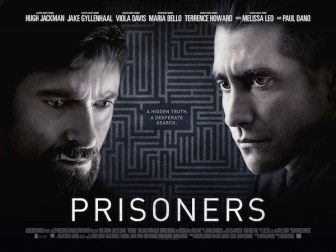
 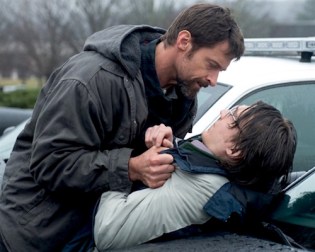 There’s a lot going on in Prisoners. While the basic format is straightforward, it’s realised in the form of a multi-stranded narrative full of well-drawn characters with complications of their own. Jackman and Gyllenhaal may be top billed and on the poster (well, an air-brushed waxwork vague approximation of Jackman was on
 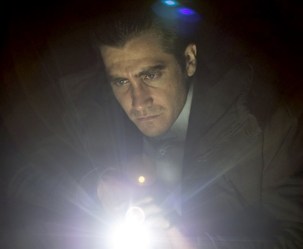 He’s not a bad detective, just not the usual genius-level investigator you normally find in thrillers, and at times you feel he’s muddling his way through the investigation as best he can. Aside from giving Loki the slightly-affected tic of blinking too much, Gyllenhaal offers a reasonably restrained performance. (I’d love to know what the blinking was in aid of, but the film is woefully understocked with special features.)
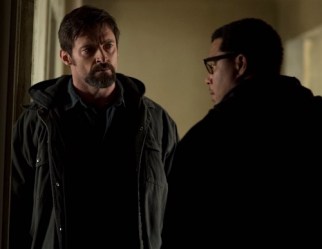 Denis Villeneuve’s direction gives the sense of a non-Hollywood background with the occasional arty shot choice or composition, though not to a distracting extent. He’s aided by serial Oscar loser Roger Deakins on DP duty, who once again demonstrates why he shouldn’t have a golden man already, he should have a cupboard full. The photography here doesn’t flaunt itself with hyper-grading or endless visual trickery, but is consistently rich and varied. Deakins may also be the best action cinematographer working — pair what he brought to
  As a thriller that is also a drama about people caught up in those events, and the lengths to which some of them may be prepared to go, Prisoners is a must-see for anyone with the stomach for some dark material (though don’t let me overemphasise that point — it’s not as bleak as, say,
 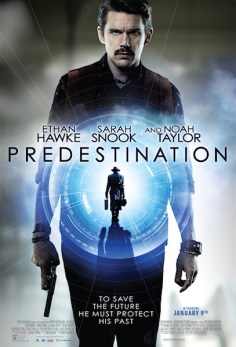 A man walks into a bar in ’70s New York. The bartender strikes up a conversation, which leads to a wager: if the man’s story is the most incredible the bartender has ever heard, he’ll give him a free bottle of whiskey. It had better be pretty good, because what we know that the man doesn’t is that the bartender, played by Ethan Hawke, is an agent for the Temporal Agency, travelling through time to stop crime before it happens; and he’s just had his face burnt off and completely rebuilt while failing to stop a notorious terrorist known as the Fizzle Bomber. Beat that.
 I don’t know how many people will remember, but the pair got a bit of attention back in the early ’00s with their debut feature
  The Coens and Wes Anderson are common reference points in reviews of this slightly quirky Western, which sees Michael Fassbender’s experienced outlaw-type help wet-behind-the-ears Scotsman Kodi Smit-McPhee track the girl he loves, who emigrated for mysterious reasons, also known by the bounty hunters on their trail.
 100Films.co.uk