Barbie (2023)

Greta Gerwig | 114 mins | Blu-ray (UHD) | 2.00:1 | USA & UK / English | 12 / PG-13

Barbie

Once upon a time, a movie based on a children’s toy would’ve been IP slop; or, at best, surprisingly entertaining IP slop. Heck, there are dozens of direct-to-video animated Barbie movies that prove exactly that: they look cheap; they’re there to generate money from little girls (primarily) demanding to see the video of the toy they like; but some of them aren’t actually all that bad.

But that was a couple of decades ago. Now, the majority of our mainstream movie culture is based around originally-for-kids IP that people who have reached adult ages still apparently obsess over. And when it comes to “movies based on toys” specifically, we can look back to The LEGO Movie (released a whole decade ago this month) for a work that transcended what it “should have been” (an expensive 90-minute toy commercial) to become something genuinely entertaining; that used its IP in creative and fun and, yes, even meaningful ways. It’s those footsteps that the Barbie movie seeks to walk in.

And, thanks to some savvy behind-the-scenes choices, it succeeds! Heck, it almost succeeds too well. This is definitely a movie primarily aimed at adults, with enough silliness and bright colours on the side to not alienate kids too much. Though by “kids” I mean “teenagers”. Sure, the 12A and PG-13 ratings are permissive enough to take your six-your-old who actually plays with Barbies, but they’re going to be left floundering — or, worse, bored — as the film debates feminism, the patriarchy, and gender roles in general. This is a film about where Barbie, the toy, sits in our culture; what it represents, and what it should represent, and how successful or not it is at doing that. It’s not an essay film — those themes are smartly addressed along the way as part of a storyline about Barbie-the-toy crossing over into our real world, for various reasons — but nor is it a bright-and-colourful bit of fluff to entertain small kids. Maybe it could have been — that’s what Pixar used to excel at — but it’s not the route the filmmakers chose to go down.

Pretty as a picture

As for the meat of what the film has to say and how it says it… oy, I’m not sure I want to get into that discourse. It’s just asking to have annoying people jump up in your replies. Nonetheless, it’s quite bold for an IP title like this to criticise the patriarchy by inverting it and making a matriarchy the oppressive state; but without feeding into right-wing numpties by saying “see, women would be just as bad!”. People say the film is about feminism, which is true, but it’s specifically about what I’d consider the true meaning of feminism — which is really about genuine equality — rather than what reactionaries imagine it is, i.e. “women are best and should be in control”. It could also have hit that note in a shallow, almost accidental way; for example, if it had been a parade of “aren’t men stupid and annoying?” jokes. Put another way, the film cares as much about the Kens and their right to be individuals as it does the Barbies and their right to be powerful. (I said I didn’t want to write anything particularly ‘risky’ and look what I’ve gone and done…)

Also, thanks to my personal predilections, I particularly enjoyed how the film deconstructed itself; or, rather, the fact it was aware that it’s content based on product and engaged with that to some extent. It sits alongside other recent works like The Matrix Resurrections and Return to Monkey Island as works of art that have an awareness of where they sit in culture and why they exist, and are prepared to engage with that, to deconstruct it and analyse it, in quite an overt and meta fashion within the works themselves. Personally, that’s something I’ve wanted and dreamt of seeing, but never expected to get from studio IP — such self-awareness is kinda frowned upon when it’s saying “I exist for no artistic reason, purely to make more money for the studio”, as The Matrix 4 did most explicitly. What’s great about all three of these works is that they go beyond that obvious point, too.

In something of an about turn, others have criticised the film for not being subtle in the way it handles these issues. My friends, you’re watching a movie based on a toy, aimed at as wide an audience as possible. This isn’t an abstruse Palme d’Or contender — it’s a film that can hit your everyman round the face with a bright-pink hammer three times over and they still might miss the point. Sometimes, it’s the right choice to be, if not “on the nose”, then certainly overt. It’s ok for a story to have a point, and for that point to be clear.

Tarantino's favourite scene

The other point of discourse the film has fired up came after the Oscar nominations, when co-writer/director Greta Gerwig and star/producer Margot Robbie were… nominated, actually, but not in the categories some people felt they should be nominated in. Although, if they’d swapped the nominations around, I expect they’d be annoyed the other way too. So, Gerwig gets a screenplay nod (which she might win, I guess?) but not a directing one (which she wouldn’t have, let’s face it), and Robbie is nominated for producing the film (a definite achievement — she’s spoken a lot in interviews about the efforts that went into making the film they wanted to make, and convincing the studio and toy manufacturers to go along with it) but not for acting (which she probably wouldn’t have won anyway). I don’t mean neither would have been deserving of the other nomination, but the directing gong seems almost sewn up for Christopher Nolan (for various reasons), and actress is a two-horse race between others. Besides, the real achievement is that the film exists as it is, with the content that it has — that’s a feat of writing and producing, not acting or, truly, directing (sure, in many other movies the director is king queen, but you get the distinct impression Barbie was significantly powered by Robbie; and when one person is both (co-)writer and director, surely a lot of their conceptual energy is injected at the writing stage).

Competitors aside, the quality of work can always be argued on its own merits. Gerwig’s direction is pacey and bright and fun, but is it as good as what she did in Lady Bird or Little Women? Which is to say, it fits the material well enough, but is it really special enough for an awards win? And also, who the fuck cares? Awards are kinda arbitrary. She did a good job. When it comes to Robbie’s performance, complaints have focused on the fact Ryan Gosling is nominated. Well, he’s in a different category — the fact he gave one of the five best supporting actor performances in 2023 has no bearing whatsoever on whether Robbie gave one of the five best, er, actressing performances of 2023. But yeah, Gosling does almost steal the film out from under Robbie, because he’s consistently hilarious with just enough introspection to add some character. That’s certainly the initial impression, I think. But Robbie is the film’s emotional core (yes, the movie about the plastic doll has emotions), which ultimately allows her to hang on to her own movie. That’s not something to underestimate: a lesser performer could have been overshadowed. Instead, they’re both excellent, particularly when they’re sharing a scene.
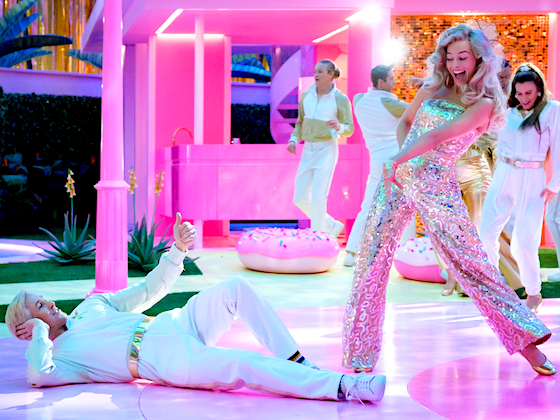
Barbie and Ken

By rights, a Barbie movie should’ve been something inoffensively plasticky for little girls, possibly with some trite “you can do anything you want” message in between all the different outfits designed to sell more toys. Instead, Gerwig and Robbie have gone deeper and further in every respect — taking that “you can do anything”-type aphorism and dissecting it to find how true it is, or isn’t, and why. But they’ve wrapped that up in a movie that doesn’t forget to celebrate the thing it’s about, both by acknowledging Barbie’s good intentions and with piles of references to its history (what we’d call fan service if this was a a boys’ IP with tonnes of Lore or whatever). And, perhaps most importantly for a movie that, remember, is based on a toy — a thing that’s supposed to bring joy and fun and entertainment — they’ve made something full of fun and joy and entertainment.

4 out of 5

Barbie is the 4th film in my 100 Films in a Year Challenge 2024. It placed 9th on my list of The Best Films I Saw in 2024.

2022 | Week 34

Skipping week 33 (when I didn’t watch anything), here are all the films I watched in week 34 — which, if anyone’s interested, was back in August. Somehow, I don’t think I’m going to get caught up on my 2022 reviews before the end of the year…

  • The Winter Guest (1997)
  • Repeat Performance (1947)
  • Carousel (1956)


    The Winter Guest

    (1997)

    Alan Rickman | 105 mins | digital (SD) | 16:9 | UK & USA / English | 15 / R

    The Winter Guest

    The writing and directing debut of actor Alan Rickman, The Winter Guest follows four loosely-connected pairs of characters through a day in their lives, all confined to a small Scottish seaside town where the stark winter has turned the sea to ice. It’s the kind of film where nothing happens: the characters hang out with each other and talk, basically, with their issues ranging from bereavement to stereotypical teenage sex obsession (one boy played by a young Sean Biggerstaff wants… a bigger staff, wink wink. Sorry, the pun was too tempting to avoid).

    The confined setting and characters means the end result feels theatrical in both style and content — it’s basically just a series of two-handers, with quite mannered dialogue. And yet its staging isn’t so limited, because Rickman and cinematographer Seamus McGarvey do an excellent of of evoking the chilly surroundings (most of the film is set outside), giving the scenery a painterly feel. That’s probably in part due to using digital matte paintings to convey the frozen ocean, but it extends to the beaches and town buildings, too. Or it could just be an unintended side effect of the smoothing conferred by watching in digitally compressed SD; but as it’s just about my favourite aspect of the film, let’s assume it was intentional and skilfully done.

    3 out of 5


    Repeat Performance

    (1947)

    Alfred Werker | 93 mins | Blu-ray | 1.37:1 | USA / English

    Repeat Performance

    On the eve of 1947, actress Sheila Page (Joan Leslie) shoots dead her husband (original Saint Louis Hayward). She flees, ending up at the home of her producer (second Falcon Tom Conway) in the early hours of New Year’s Day… 1946. Given the chance to re-live the past year, can she make things right?

    Repeat Performance gets classified as film noir, but I feel like it’s one of those films that sits on the periphery of what qualifies for the genre. The opening — in which a woman shoots dead her husband, in New York City at night — yes, very noir. But what unfurls over the next 90 minutes is more of a backstage romantic melodrama by way of Twilight Zone-style fantasy. But that’s the thing with noir: as a movement that wasn’t recognised and codified as a genre until after it was over, what ‘counts’ can be a very broad church.

    Here, the odd combination of styles makes for an unusual and mostly entertaining film. My only real gripe is that we’re given very little idea what went on in the ‘original’ 1946, so it’s hard to tell how much effort Sheila is actually making to change it, or to follow how successful she’s being. This kind of perspective is perhaps the benefit of a further 75 years of development and refinement in the field of fantastical storytelling — Repeat Performance isn’t a Fantasy film in the true genre sense, more a Thriller with a neat inciting twist, a la Sliding Doors (my go-to example of a Fantasy film that doesn’t care it’s a Fantasy film!)

    The plot is bolstered by strong or likeable performances across the board. Some of the lead cast may be better known for starring in B-movie schedule-fillers, but this is proof if proof were needed that to interpret that as a sign of limited skill on their part would be an incorrect conclusion. Which is a rather torturous way of saying “Hayward and Conway were quite good actors, actually”. Hayward is particularly good here, getting to show off his range from loving husband to psychopathic abuser, plus a few other stages in between. Conway is more at the likeable end of the spectrum as Sheila’s kindly producer, while Richard Basehart’s performance (in his movie debut) as queer-coded poet William Williams (in the original novel, the character is a transvestite) was so impressive that the producers gave him more scenes with Leslie and bumped up his billing.

    4 out of 5

    Repeat Performance is the 52nd film in my 100 Films in a Year Challenge 2022.


    Carousel

    (1956)

    Henry King | 123 mins | digital (HD) | 2.55:1 | USA / English | U

    Carousel

    Carousel is a spectacularly odd entry in the Rodgers & Hammerstein canon of musicals. Based on a play called Liliom (which was previously filmed by Frank Borzage in 1930 and Fritz Lang in 1934), it tells the story of a carnival barker (Gordon MacRae) who’s been dead 15 years, but in flashback we learn of how he fell in love and married, and how he died, and why he now gets a chance to go back for a day to make amends. That almost makes the film sound focused. As it plays out, the storyline has a weirdly aimless quality, not helped by songs that are mostly mediocre or bizarre. That’s before we get to the horrendously outdated views on domestic violence, or the fact that it’s not actually got very much to do with the titular fairground attraction.

    The darker material and themes could work in the right setting, but here they clash with the sunny seaside photography and stereotypically cheerful musical numbers. I mean, this is a story about a physically abusive husband and wannabe small-time crook, who can’t even change his ways when the afterlife gives him a second chance, and we have songs about the beauty of summer and the joys of a clambake (the latter may haunt your memories…)

    A strange film, and not in the good way. At least it’s made me curious to see the Borzage and Lang versions — perhaps as a straight drama it will be more obvious why this has merited adaptation so many times.

    2 out of 5


  • 2022 | Week 22

    Maybe I should’ve called this post “Weeks 21–22”, to ensure that the titles of these roundups had a complete run of weeks throughout the year. But I didn’t actually watch anything new in Week 21 (my only film that week was the Challenge-qualifying rewatch of On the Town), so it seemed inaccurate to include it.

    Week 22, on the other hand, was moderately busy, with this lot…

  • This Means War (2012)
  • To Be or Not to Be (1942)
  • An Unsuitable Job for a Woman (1982)
  • The Pajama Game (1957)
  • The Contender (2000)


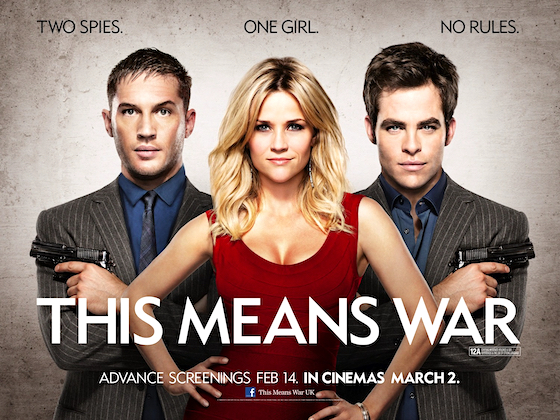
    This Means War

    (2012)

    McG | 98 mins | digital (HD) | 2.35:1 | United States / English | 12 / PG-13

    This Means War

    I bet whoever came up with this thought they were a genius: “spyfi action-adventure + rom-com? It’s the perfect date movie!” Of course, what you actually end up with is a film that struggles to do either part well.

    It stars the unlikely combo of Chris Pratt and Tom Hardy (you definitely can’t imagine Hardy doing a movie like this today) as BFF CIA agents who independently fall for the same woman, played by Reese Witherspoon. Uh-oh. Hilarity ensues as the guys deploy their CIA tricks and tech to influence the relationships. Yeah, it’s the kind of concept that once upon a time sounded like a fun and quirky rom-com, but nowadays seems at best morally dubious, at worst downright creepy. And, indeed, that’s how it plays out, with situation after situation that’s played for laughs but feels a little uncomfortable.

    Of course, the big question is “who ends up with who?” This is one of those films so committed to its storyline, so structured to lead to one correct answer, that… they shot multiple endings so they could decide in post. The one they went with doesn’t feel quite right, but, if you imagine the alternatives, most of them don’t either. Well, I say that: I don’t think it’s really a spoiler to tell you that Witherspoon ends up with one of the guys, when the correct choice would’ve been “neither of them. Run from the stalker-ish CIA agents! Find a normal man!”

    2 out of 5


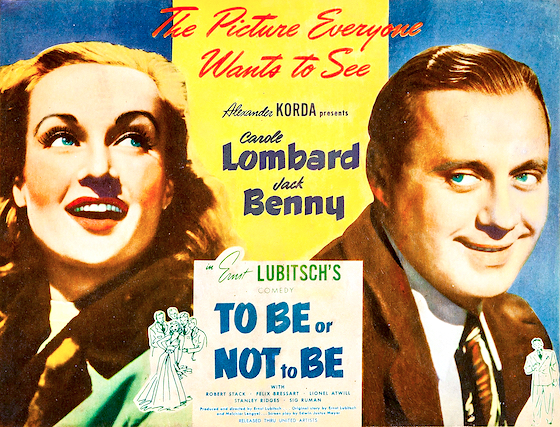
    To Be or Not to Be

    (1942)

    Ernst Lubitsch | 99 mins | digital (HD) | 1.37:1 | USA / English | U

    To Be or Not to Be

    Ernst Lubitsch’s satire concerns an acting troupe in occupied Poland who become mixed up in a soldier’s efforts to capture a German spy before he can undermine the resistance. Made while World War II was still in full force, the film attracted criticism in some quarters for being a comedy about such tragic and ongoing real-life horrors. Lubitsch defended his work, writing to one critic to say, “What I have satirized in this picture are the Nazis and their ridiculous ideology. I have also satirized the attitude of actors who always remain actors regardless how dangerous the situation might be, which I believe is a true observation.” He’s right, of course; at least about the first part. Ridiculously, such debates about whether you can satirise the Nazis persist to this very day — just look at some of the responses to Jojo Rabbit.

    Lubitsch’s film is subtler than Waititi’s, though still undoubtedly a comedy. I mean, with its plucky resistance members taking occupying Nazis for fools, I couldn’t help but think of this as a classier version of ’Allo ’Allo… but I’ve never actually seen a whole episode of that show, so don’t hold my comparison in too high a regard. Whereas that sitcom is famous for its catchphrases and bawdy gags, To Be or Not to Be is less overt, preferring to paint the Nazis as fundamentally incompetent and derive its humour there.

    Despite the distaste some felt, it obviously works for most people, as it appears on several “great movies” lists, not least both the IMDb and Letterboxd Top 250s. To be honest, I feel like I need to give it another spin to digest it more fully, but these thin thoughts will have to suffice for now.

    4 out of 5

    To Be or Not to Be is the 35th film in my 100 Films in a Year Challenge 2022. It was viewed as part of Blindspot 2022.


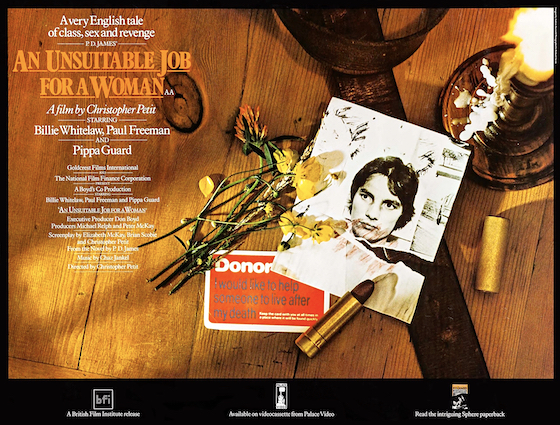
    An Unsuitable Job for a Woman

    (1982)

    Christopher Petit | 94 mins | Blu-ray | 1.85:1 | UK / English | 15

    An Unsuitable Job for a Woman

    I’ve never read the P.D. James novel on which this is based, but I’m assured it’s longer and more complex — the film rather lacks for plausible suspects, making the central murder mystery thoroughly guessable.

    That said, I’m not sure co-writer/director Christopher Petit is all that concerned with producing a true whodunnit. Put another way, I think he’s more interested in the characters, who happen to be involved in a mystery, than in the mystery itself. Which is fine, but I’m also not sure the film does as good a job as it could digging into those characters. I mean, the way the kinda-naïve young investigator becomes obsessed with the deceased subject of her inquiries — almost falling in love with him, it seems, like some kind of gender-flipped riff on Laura — is more nodded at than explored.

    In the end, I felt like I wanted to like the film more than it was actually giving me things I needed to really like it. It’s not bad, but perhaps it could have been great.

    3 out of 5


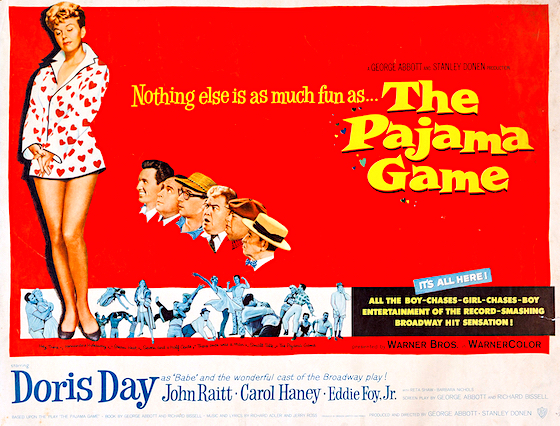
    The Pajama Game

    (1957)

    George Abbott & Stanley Donen | 101 mins | digital (SD) | 4:3 | USA / English | U

    The Pajama Game

    This minor musical is primarily of note for two things: the original Broadway staging featured the choreography debut of one Bob Fosse; and it features the song Hernando’s Hideway — if you don’t recognise the title, I’m sure you’ll recognise the tune. I had no idea this is where it originated.

    The story is about a pay dispute in a pyjama factory (given the current strikes and arguments here in the UK, you might think I watched this deliberately. Nope, total coincidence). On one side there’s the leader of the union’s grievance committee (Doris Day, one of just a handful of replacements made to the original cast when they transferred the stage production to the screen). On the other, the new superintendent (John Raitt, clearly a success on Broadway but less so on film). Of course, they fall for each other, before the pay conflict tears them apart. Can their love overcome such trials? What do you think?

    I saw someone describe The Pajama Game as an overlooked classic, which is taking things a bit far. It’s mostly likeable and quite fun, but rarely transcends that level. The undoubted highlight is Fosse’s choreography, which gives even the lesser numbers a polished dynamism. There are a couple of decent songs, but nothing really stands out, bar the aforementioned. It gets a bit too farcical in places, with some of the storylines ultimately taking a turn into very broad territory that feels misjudged. One primarily for genre fans only.

    3 out of 5


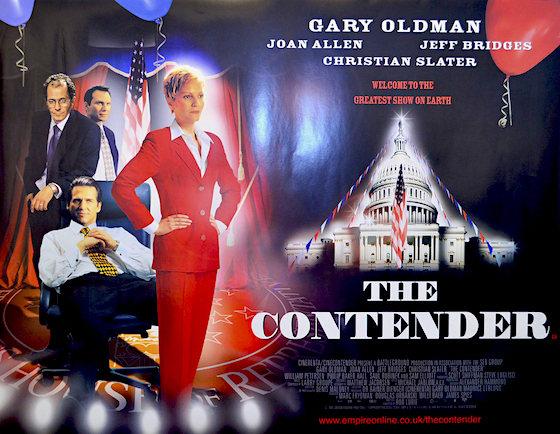
    The Contender

    (2000)

    Rod Lurie | 126 mins | Blu-ray | 16:9 | USA, Germany & UK / English | 15 / R

    The Contender

    I only picked this up on disc because it was part of a bundle of other titles I really wanted, but it also sounded like the kind of thing I’d like. Strange that I’d not heard of it before, then. I guess some films just get lost in movie history, especially when they’re a lesser member of a whole wave of movies. This is a political thriller of the kind they seemed to make quite a few of during the ’90s and into the early ’00s, but don’t really do anymore. I guess they exhausted the well, especially after 156 episodes of The West Wing.

    In this case, the story revolves around Laine Hanson (Joan Allen), the first woman nominated to be Vice President (it only took another two decades for that to happen in real life). There’s the familiar battle between the Democrats to get her confirmed, and the Republicans who’d like to do anything to thwart the Democrats. Amongst the scheming between the two sides, the big revelation is that Laine possibly engaged in a scandalous sex act while in college. She refuses to confirm or deny the rumour — it’s her personal business and shouldn’t affect her appointment. Except, of course, it does.

    Various other allegations come and go throughout the confirmation process, the two sides continuing to go back and forth in their attempts to win. It’s not necessarily the point the film is making, but it’s a reminder that politics is all a game to those involved, even as it can have serious effects on the lives of the rest of us. More overtly, the film tackles the different standards a woman is held to when trying to take public office. Fortunately, it’s not as overbearing with that as it could be. Indeed, all round the film is fairly understated. It’s a solid, unflashy, procedural-based kind of thriller.

    That is until the end, when it throws away the understatement for a grandstanding speech based around a fundamental belief in the greatness and goodness of the American political system. It would be heavy-handed in any circumstance, but the past few years (if not longer) of American politics have shown it for the total lie it always was. It doesn’t wholly undermine what’s gone before, but it does end the film on a sour note.

    4 out of 5


  • Encanto (2021)

    Jared Bush & Byron Howard | 102 mins | digital (UHD) | 1.85:1 | USA / English & Spanish | PG / PG

    Encanto

    The 60th film in Disney’s animated canon was, despite that status, sent straight to streaming in the midst of the pandemic. Possibly because of that, it seemed to catch on quite quickly as their latest major success. Case in point: one of the songs — We Don’t Talk About Bruno — ended up having greater chart success than Frozen’s notorious Let It Go.

    (I’ve got to take the time to say that I find this quite baffling. I don’t love Let It Go (I’m a 36-year-old man, not a six-year-old girl in 2013), but it’s clearly a catchy tune with lyrics that transcend its place in the film — you can understand how it became such a huge hit. But for the life of me I can’t work out why We Don’t Talk About Bruno has surpassed its success. It’s a likeable song that plays well in the movie — and I think hearing it in place is important, because the first time I heard it was on the radio and I couldn’t even work out what they were singing about. So, there’s nothing going on lyrically that makes it applicable in any other context, and I don’t think the underlying tune is so earwormy as to warrant play merely for that reason. Or maybe it is if you’re the right age, because clearly something made it a massive hit.)

    Anyway, the film itself is about a family, the Madrigals, who live in a magical house in an isolated part of Colombia and all have magical powers — except Mirabel (Stephanie Beatriz), for reasons no one understands. But when the family begin to lose their abilities, finding out what’s going on and fixing it falls to Mirabel. Because of course it does.

    Someone's gotta do the donkey work

    Encanto doesn’t look like your typical Disney Princess movie, but it’s not functionally different to them. The Madrigal family’s powers mean they effectively rule over their small town, albeit in a benevolent way, which makes Mirabel a de facto Princess; and she has the usual Disney Princess hangups about feeling under-appreciated and needing to find her self-worth. But hey, at least she doesn’t also need to find a husband! Nonetheless, it’s welcome that the film is less traditional is its setting — present-day South America, rather than the typical fairytale land of historical Europe — and the pace is also up-to-date. In fact, it’s quite frantic. Like, okay, calm down a bit; take your time occasionally; let stuff stay on screen long enough for us to appreciate how good it looks. And the animation does look great, with detailed designs, fluid movement and dynamic camerawork, and an incredibly colourful palette, especially when fired up by HDR/WCG.

    The songs are by Hamilton’s Lin-Manuel Miranda, unmistakably so. It’s something about the phrasing, the rhythm, the rhyme patterns… I’m no musicologist so I can’t adequately explain it, but they’re distinctively his work. But that’s what you want when you hire someone, right — their own voice. If you don’t like this style from his other work, chances are the music here won’t appeal to you either. If you do like it, there’s much to enjoy, from the opening number, The Family Madrigal, which introduces us to the large cast of characters at whipcrack pace, to my personal favourite, Surface Pressure, about one family member’s struggle with all the weight on her shoulders. And yet they put Dos Oruguitas up for the Original Song Oscar, apparently trying to emulate the success of Coco’s Remember Me. Oops. (Obviously they should’ve gone with breakout hit Bruno, but I reckon either of the other songs I’ve mentioned would’ve stood a better chance.)

    One of Encanto’s directors is Byron Howard, whose previous work for Disney has encompassed Bolt, Tangled, and Zootropolis — three films I’d class as among the very best of Disney’s current purple patch. It’s a helluva record. Happily, Encanto continues it. I might rank it a little behind the other three when all is totted up, but being next in line to such strong movies is nothing to be ashamed of.

    4 out of 5

    Encanto is the 28th film in my 100 Films in a Year Challenge 2022. It placed 4th on my list of The Best Films I Saw in 2022.

    2022 | Weeks 14–15

    Only four reviews this time, taking us up to April 17th. It was going to be five, but then Spider-Man got far too long. So, we’re left with…

  • Withnail & I (1987)
  • Munich: The Edge of War (2021)
  • tick, tick… BOOM! (2021)
  • Move Over, Darling (1963)


    Withnail & I

    (1987)

    Bruce Robinson | 103 mins | digital (HD) | 16:9 | UK / English | 15 / R

    Withnail & I

    This may be a beloved cult comedy in its own right, but I can’t help but make comparison to a certain other British cult property. You see, each of the three primary cast members — Richard E. Grant (Withnail), Paul McGann (‘I’), and Richard Griffiths (Uncle Monty) have an atypical relationship to the lead role in Doctor Who. That has no bearing on the film itself, not least because their involvement (or non-involvement, in one case) took place years later, but it’s a correlation I can’t shake. I mean, what other work can claim to star the man who was simultaneously the shortest and longest serving Doctor; the man who was definitely, officially the new canonical Doctor, until he wasn’t; and a man who might well have been the Doctor if things had gone to plan? Nothing else that I can think of, that’s for sure.

    Setting all that aside, everything about Withnail & I screams “cult favourite”, and I guess that’s what it is — not a film that started out with a dedicated fanbase before being subsumed into the mainstream, but one that remains beloved of a relatively few devotees. Perhaps that explains why it’s one of those films I thought would’ve wound up on my Blindspot list by now, but never has: because it lacks that crossover appeal. (Maybe I need to factor in some lists of cult and/or British movies when compiling my Blindspot choices.) Coming to it afresh in 2022, aware of that rep it’s built up over the last 35 years, does it no favours. The characters aren’t likeable or interesting enough to truly enjoy hanging out with (even as they’re convincingly brought to life by the talented cast); the “gay panic” stuff that drives several sequences lands differently now than I suspect it did in 1987; and the supposedly never-ending quotable lines didn’t materialise (there are a small handful of memorable ones, at least). That said, there are quite a few lines that would be fun for a game of “did Paul McGann say this in Withnail or in Doctor Who?” (Oops, sorry to bring that up again.)

    The best bits of Withnail have been dulled by repetition out of context (variations on “we’ve gone on holiday by mistake” are a certifiable meme at this point), and I suspect I personally left it too long to see it, allowing it to build up too much of a reputation. I didn’t dislike it, I just wasn’t won over.

    3 out of 5


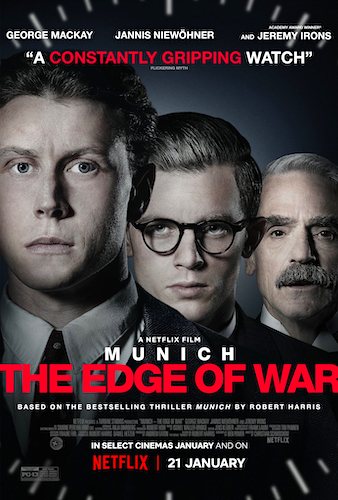
    Munich: The Edge of War

    (2021)

    Christian Schwochow | 129 mins | digital (UHD) | 2.39:1 | UK & USA / English & German | 12 / PG-13

    Munich: The Edge of War

    Robert Harris has been a best-selling author for decades, but his works have had a rockier reception on the screen; perhaps not helped by the fact a couple have been helmed by director non grata Roman Polanski. Harris’s stock in trade is fictionalised tellings of historical events — the eruption of Vesuvius in Pompeii; the politics behind the invasion of Iraq in The Ghost; and so on. His 2017 novel Munich is set around war-avoiding negotiations between Adolf Hitler and Neville Chamberlain that took place in the titular city in 1938. This film adaptation gains a subtitle, presumably to differentiate it from Steven Spielberg’s Best Picture nominee, which retold entirely different historical events.

    The big names aren’t the main characters, however. Those would be a pair of low-ranking civil servants from the opposing sides: Brit Hugh Legat (1917‘s George MacKay) and German Paul von Hartmann (Jannis Niewöhner), former university chums who fell out when Hitler came to power. Now, von Hartmann is disillusioned with the Nazi regime and wishes to pass information to the British, but will only make contact with Legat, thus roping the inexperienced diplomat into the world of espionage, untrained. If the storyline is ringing bells, perhaps you too recently watched The Courier with Benedict Cumberbatch. It’s not an identical narrative — I’m not accusing anyone of plagiarism here — but there are definite parallels. Legat even has a strained relationship with his wife, who he has to leave at home and not tell the truth.

    But where the story in The Courier was true, and thus lent an inherent fascination, the story of Legat and von Hartmann is fictionalised. That’s not necessarily a problem — most thrillers are entirely made-up, of course — but Munich is hampered by feeling kind of muddy. It’s not so bad as to be described as muddled, but does seem like it’s perhaps the victim of being badly truncated from the book, or possibly just in its own edit. It’s not always clear what the point is of what we’re watching, or where certain characters have disappeared off to. That makes the overall experience longer and, occasionally, more plodding than it needs to be.

    That said, though it takes time, it does eventually develop the tension it needs; and it has definite merit for depicting a bit of history that’s normally relegated to footnote status. Indeed, it makes an interesting argument for “what Chamberlain did was good, actually”, which is not the normal point of view on politicians’ pre-WW2 actions.

    3 out of 5

    Munich: The Edge of War is the 27th film in my 100 Films in a Year Challenge 2022.


    tick, tick… BOOM!

    (2021)

    Lin-Manuel Miranda | 120 mins | digital (UHD) | 2.39:1 | USA / English | 12 / PG-13

    tick, tick… BOOM!

    Rent was one of the definitive Broadway musicals of the ’90s, but its creator didn’t live to see its success: composer, lyricist, and author Jonathan Larson died, with poetic timing, the night before the show’s premiere. It came after years of Larson struggling trying to break into the industry, much of which was documented in his semi-autobiographical (almost-)one-man show, Tick, Tick… Boom! This film adaptation broadens out and adds additional detail to become a more direct biopic of Larson, albeit one with musical numbers.

    Struggling musical theatre people in Manhattan… Yes, some people are going to find this insufferable. Others will look upon it as a dream life, especially as any actual hardship (Larson’s apartment didn’t have heating, for example) is played down or romanticised. Even setting that side, it remains the kind of movie that will speak to anyone who’s dreamt of making art (especially if that art is musical theatre), but might leave others (primarily those without such ambitions) identifying more closely with some of Jonathan’s friends — “there are bigger things to worry about,” they say.

    In the centre of it all is a pitch perfect performance from Andrew Garfield. He throws himself into the role, transformatively so: his Larson seems to be powered by a restless enthusiasm that I don’t think I’ve seen the actor portray in anything else. In the musical numbers, he holds his own against much more experienced singers (Garfield couldn’t even sing before production began — he spent a year learning and practicing).

    This is more than just a ‘one good performance’ film, though. Although based on a stage show, the screen version certainly doesn’t feel stage-bound, coming to cinematic life through Alice Brooks’s photography and Myron Kerstein and Andrew Weisblum’s editing as if it had always been meant for the screen. However, many people have been critical of Lin-Manuel Miranda’s direction. While I wouldn’t shout it out as anything amazingly special, I also don’t think it’s bad. You routinely see lesser work in Marvel movies, for example.

    4 out of 5


    Move Over, Darling

    (1963)

    Michael Gordon | 99 mins | digital (HD) | 2.35:1 | USA / English | U

    Move Over, Darling

    Doris Day and James Garner star in this remake of My Favourite Wife, one of the trio of screwball comedies Irene Dunne and Cary Grant made together, and which I watched back in May 2020. Two years ago?! Time flies. Despite which, I’ve not reviewed it yet.

    Well, Move Over, Darling is an incredibly close re-envisioning. If someone authoritative told me it used the same screenplay with only minor tweaks, I’d believe them. I’m sure it’s not that close, in actual fact, but it’s darn near it. Certainly, one bit is definitely new: a fun sequence that sees Day recount the plot of the earlier film. Very meta. Alongside the screenplay, the remake also carries the original’s primary flaw, which is that they both lack the pace and snap of the very best screwball comedies. Day does her best to enliven the material, being a consistent source of fun and clearly game for a laugh — a sequence where she goes through a car wash in a convertible is a highlight. Garner can’t manage to equal Cary Grant, but who can?

    Nonetheless, on balance, I slightly preferred this version. That might just be due to my lowered expectations — knowing it had the double drawback of being (1) a remake, and (2) of a film I hadn’t particularly loved the first time, it was able to overcome that by simply being not too bad.

    3 out of 5


  • West Side Story (2021)

    Steven Spielberg | 146 mins | Blu-ray (UHD) | 2.39:1 | USA / English & Spanish | 12 / PG-13

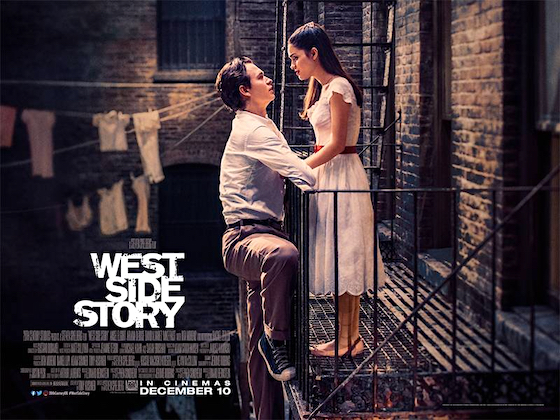
    West Side Story

    I remember when I first heard about this remake, I couldn’t quite understand what they were going to add by redoing it. The original is a widely-acclaimed classic — why remake it? I should’ve remembered one of the golden rules of cinema: always trust Spielberg.

    If you’re somehow unfamiliar with West Side Story, it’s a reimagining of Romeo and Juliet set in 1950s New York City, with the two warring families replaced by two warring street gangs. Although the teenage love story is still present, obv., the strength here is more in its depiction of cultural clashes between different groups of immigrants — essentially, the heart of the American experience. Like most musicals, it started out on the stage before being filmed in 1961. I’m not going to dispute the classic status of that film, but it has dated — most problematically in the use of brown face to depict Puerto Rican characters, but also in its overall style, which, though shot in part on the real streets of New York, is quite stagey. Plus it made various changes to the original work, primarily in the order and therefore context of multiple musical numbers; something that Spielberg, as a fan of the stage production, sort to restore.

    In short, it worked. Well, I’ve never seen the stage production, so I don’t know if this film is more faithful to it, but it feels like a superior execution of the constituent elements. Primarily, it deepens some of the characters and their motives, most especially Tony (the Romeo figure) and Chino (his ostensible love rival, though you’d be forgiven for missing that entirely in the ’61 film). In the original film, I almost felt like Tony and Maria were a subplot, only being regarded as the leads because they’re Romeo and Juliet in what we know is an adaptation of Romeo and Juliet. Here, they get more screen time, both together and apart, and more shades to their characters, so it actually feels like they’re the leads. That doesn’t suddenly make them the most interesting characters, but you can’t have everything.

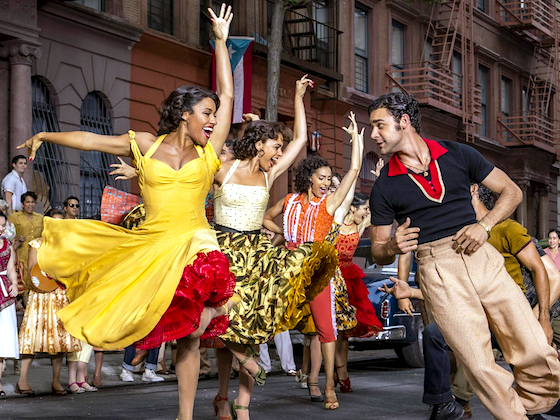
    Dance in the streets in America

    This added depth comes from the screenplay as much as the performances, which were great in the original but are fantastic here too. The Oscar-winning turn by Ariana DeBose as Anita is indeed the standout, but Rachel Zegler is perfectly sweet as Maria, and Rita Moreno thankfully has more to offer than just a tribute cameo in the Doc role. There was a lot of talk that Mike Faist was snubbed by awards for his Riff. He’s good, but doesn’t quite equal Russ Tambyln for me. The weak link is clearly Ansel Elgort as Tony. I had wondered if people were just saying that because of the allegations against him, but he’s not ideal for the role. That said, I do think he’s adequate, and the only reason to find his presence actively distasteful is if you can’t set aside the real-life stories.

    All these comparisons are inevitable, and it’s mostly in the eye of the beholder which individual aspect is better in which version; but I think it’s undeniable that Spielberg’s film looks more cinematic. It’s not just superior to the ’61 film, but a masterclass in itself: the lighting, the shot composition, the camera moves, the blocking; several songs are more excitingly staged than in the original, not least arguably the most famous, America. DoP Janusz Kaminski has been doing sterling work with Spielberg for decades now, so perhaps it’s easy to overlook just how talented they both are. In an era when mega-budgeted films increasingly look like TV shows that lean on green screen to scrape by, this is Cinema at its purest.

    Perhaps that’s why, overall, I prefer this version. Sure, the original is a classic, but Spielberg’s film is ultimately more cinematic (less stage-minded), less campy (though it doesn’t entirely ditch that aspect), and more modern, but appropriately so (with race-appropriate casting instead of awkward brownface). It’s perhaps proof that any remake can be worthwhile if done for the right reasons by the right people.

    5 out of 5

    West Side Story placed 7th on my list of The Best Films I Saw in 2022.

    Archive 5, Vol.2

    I have a backlog of 442 unreviewed feature films from my 2018 to 2021 viewing. This is where I give those films their day, five at a time, selected by a random number generator.

    Today: musical comedies from ’41 and ’51; murder mysteries from ’33 and ’73; and an animated film that changed the Oscars.

    This week’s Archive 5 are…

  • Royal Wedding (1951)
  • A Study in Scarlet (1933)
  • Chicken Run (2000)
  • The Last of Sheila (1973)
  • Road to Zanzibar (1941)


    Royal Wedding

    (1951)

    aka Wedding Bells

    Stanley Donen | 93 mins | digital (SD) | 4:3 | USA / English | U

    Royal Wedding

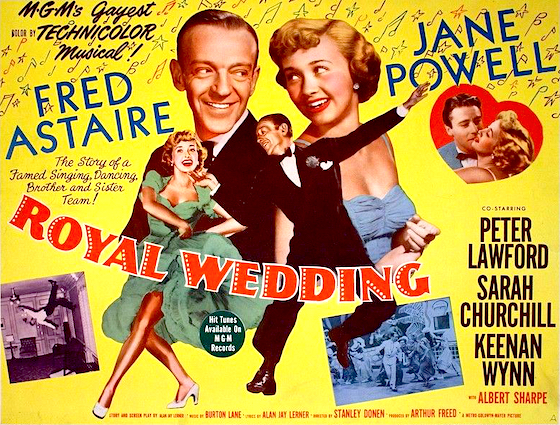
    Cynically, I assumed this US production was designed as a cash-in to a news event, most likely the wedding of Princess Elizabeth (i.e. the Queen) and Philip. Although those are indeed the eponymous nuptials, they actually took place several years earlier, in 1947; and in the UK, for its initial release the film was retitled Wedding Bells so audiences wouldn’t think it was a documentary about the real event. So much for my modern cynicism.

    The actual plot is semi-biographical, inspired by the real-life dance partnership of the film’s star, Fred Astaire, and his sister Adele, and who she went on to marry. Here the sister is played by Jane Powell (almost 30 years Astaire’s younger) as the duo take their successful Broadway show across the ocean to London in time for the royal wedding. Such window dressing aside, the plot that unfurls is run-of-the-mill, with both siblings finding themselves in romantic entanglements, and the songs are unmemorable too. The object of Astaire’s affection is played by Sarah Churchill, daughter of Winston Churchill, which adds a bit of fun trivia, at least.

    There is one noteworthy highlight: a set piece in which Astaire dances up the walls and across the ceiling of his hotel room, an effect that’s achieved seamlessly — there’s no wobble or what have you to give away the trickery, and Astaire’s choreography helps hide the behind-the-scenes technique too. There are one or two other neat bits if you’re a fan of dance-y musicals, but, on the whole, this is a thoroughly middle-of-the-road Astaire musical — not bad, just no more than adequate.

    3 out of 5

    Royal Wedding was #180 in my 100 Films in a Year Challenge 2021.


    A Study in Scarlet

    (1933)

    Edwin L. Marin | 72 mins | Blu-ray | 1.33:1 | USA / English | U

    A Study in Scarlet

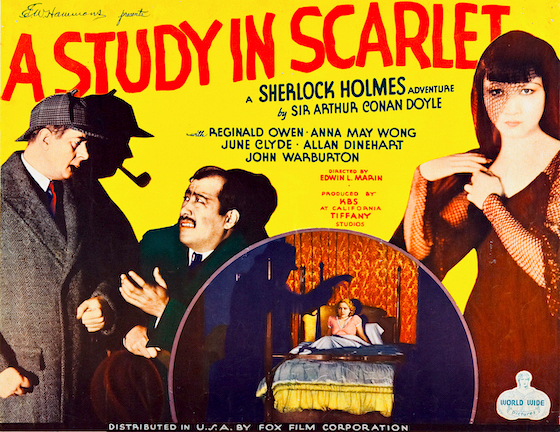
    For some reason, cinema has a long history of taking the titles of original Sherlock Holmes stories but then producing an entirely new plot underneath. A Study in Scarlet — the very first of Sir Arthur Conan Doyle’s Holmes works — seems to be a particularly afflicted tale. It features the first meeting of Holmes and his roommate / sidekick / chronicler, Dr Watson, but I think there are two adaptations that actually show this — and, ironically, neither of them are actually called A Study in Scarlet (one is the debut episode of Sherlock, A Study in Pink, and the other is the first episode of the Russian series The Adventures of Sherlock Holmes and Dr. Watson, which is called Acquaintance). According to IMDb, “the Conan Doyle estate quoted the producers a price for the rights to the title and a considerably higher price to use the original story” — perhaps they did that all the time, hence my observed phenomena.

    Obviously, this ‘poverty row’ effort is one such example of title/story mismatch: this so-called adaptation stars Sherlock Holmes and Dr Watson… and that’s where similarities to the novel end. The pair don’t even live at 221b Baker Street — for no apparent reason, it’s been changed to 221a. Did the filmmakers just misremember one of the most famous addresses in literature? Having only paid for the rights to the title, the producers hired director Robert Florey (the Marx Brothers’ The Cocoanuts; Murders in the Rue Morgue) to write a new story, and actor Reginald Owen — who stars as Holmes — wrote the dialogue. Owen hoped this would be the first in a series of Holmes films starring himself. It wasn’t.

    Physically, Owen isn’t anyone’s ideal image of Holmes, but his actual performance is adequate. Much the same can be said of the whole film: it’s an entertaining-enough 70-minute crime romp, with enough incident to create a brisk pace, and a use of the rhyme Ten Little Indians that makes you wonder if Agatha Christie saw this movie before she published And Then There Were None six years later (or is it just a coincidence? The audio commentators spend a good deal of time chewing it over). Given second billing behind Owen is bona fide Chinese-American movie star Anna May Wong, even though she has relatively little screen time. She makes her mark, though, with a role that doesn’t simply conform to racial stereotypes (possibly an unintended side effect of her late casting rather than genuine progressivism by the filmmakers, but sometimes you gotta take what you can get).

    This particular Study in Scarlet is a long way from being a definitive Sherlock Holmes movie, but for fans of ’30s detective flicks, it’s nonetheless a likeable little adventure.

    3 out of 5

    A Study in Scarlet was #206 in my 100 Films in a Year Challenge 2021.


    Chicken Run

    (2000)

    Peter Lord & Nick Park | 84 mins | digital (HD) | 16:9 | UK, USA & France / English | U / G

    Chicken Run

    I’ve always enjoyed Aardman’s work. I grew up watching the Wallace & Gromit shorts on TV, and have seen all of their feature output — except their first. I’m not sure why it’s taken me 20 years to get round to Chicken Run. I guess when it was originally released I had grown out of “kid’s movies” but not yet grown back into them; but since then, to be honest, something about it never particularly appealed to me. It certainly has its fans: it’s still the highest grossing stop motion film ever; there was a push to get it an Oscar Best Picture nomination, the failure of which led to the creation of a category it could’ve won, Best Animated Feature (trust the Academy to shut the door after the horse had bolted); and when Netflix recently announced a sequel, there was much pleasure on social media.

    So, finally getting round to it, would I discover what I’d been missing all along? Unfortunately, no. I thought it was fine. In no way did I dislike it, but nor did it charm me in the way of my favourite Aardman productions. It’s rather dark for U-rated film — it doesn’t mince its words or imagery about the fact the chickens are being killed — and that contributes to some particularly effective sequences, like when our heroes end up inside the pie machine, or a suitably exciting climactic action sequence. There are some reliably decent gags along the way, too.

    I’m sure I’ll watch the sequel. Maybe I’ll like it more. But, I confess, the fact they’ve now announced a new Wallace & Gromit movie for the year after does have me even more excited.

    3 out of 5

    Chicken Run was #148 in my 100 Films in a Year Challenge 2020.


    The Last of Sheila

    (1973)

    Herbert Ross | 120 mins | digital (SD) | 1.85:1 | USA / English | 15* / PG

    The Last of Sheila

    I’d never even heard of this before Rian Johnson mentioned it as an inspiration for Knives Out 2. Co-written by Anthony Perkins (yes, Norman Bates from Psycho) and Stephen Sondheim (yes, the famous musical composer), The Last of Sheila is a murder mystery firmly in the Agatha Christie mould — despite the writers’ pedigree, there are no significant horror elements (even the deaths are, at worst, on the PG/12 borderline) and certainly no song-and-dance numbers (excepting a magnificently inappropriate song over the end credits, sung by Bette Midler). Apparently Perkins and Sondheim used to host elaborate scavenger hunts for their friends in the late ’60s and early ’70s, and they adapted them into a screenplay at the suggestion of a guest, Herbert Ross, who produced and directed the film (seems only fair).

    Further inspiration came from their professional lives and acquaintances, because the potential victims and suspects are all actresses, agents, and the like, gathered for a Mediterranean cruise aboard a producer’s yacht. He proposes they play a game about secrets and gossip — but clearly one of the secrets in play is too big, because someone winds up murdered. A well-constructed mystery is unfurled throughout the film, although its execution is a little variable: a fun, very Christie-esque first half gives way to long talky scenes in the second, as characters stand around and explain the plot to each other. But when that plot is as good as this — with some nice surprises, plus motives dark enough to give it a little edge — it feels churlish to object too strongly.

    4 out of 5

    The Last of Sheila was #186 in my 100 Films in a Year Challenge 2021.

    * IMDb says it was given a 15 on video, but the BBFC say it hasn’t been rated since 1973, when it got an AA. The BBFC site is crap nowadays; IMDb will accept any old junk users submit. You decide. ^


    Road to Zanzibar

    (1941)

    Victor Schertzinger | 87 mins | DVD | 1.33:1 | USA / English | PG

    Road to Zanzibar

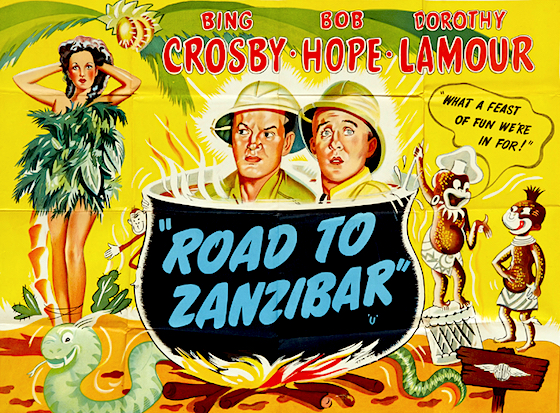
    The second in what became the Road To… series — though it was never intended as such. What ended up becoming Road to Zanzibar was initially an original feature, first offered to Fred MacMurray (this before his roles in the likes of Double Indemnity and The Apartment) and George Burns (an actor I’m not particularly familiar with). After they rejected it, apparently someone at Paramount remembered Road to Singapore had done relatively well, and that Bob Hope and Bing Crosby seemed like a good pairing, and so they were offered it.

    As I wrote in my last review of a Road To film (which was over 11 years ago?! Jesus…), if you’ve seen one Road To film then you’ve a fair idea what to expect from any other — essentially, a suitably daft bit of fluff and fun. This one’s a bit thin — on plot, on gags, on everything — but it skates by on the charm of Bob and Bing, joined, as ever, by Dorothy Lamour. The only serious problem is the same as Singapore: dated depictions of African stereotypes. It kind of gets away with it by being a spoof of “African adventure”-type movies, but maybe that’s me being kind with hindsight. Either way, the bit where the tribe’s African dialogue is subtitled with contemporary American vernacular is one of the film’s more amusing gags.

    3 out of 5

    Road to Zanzibar was #110 in my 100 Films in a Year Challenge 2019.


  • 2022 | Weeks 1–3

    Here we go — finally, and somewhat later than anticipated (it’s been a slow start to the year, viewing-wise) — the new review format for 2022!

    …which you’ll have already seen in Archive 5, of course; and is fundamentally similar to what I was doing before in roundups and what-have-you; and which I’ve already ‘broken’, because my review of Flight of the Navigator came out so long that I posted it alone.

    But still, the intention is this is now my regular review format, popping up every week or two (or three) to review everything in a more timely fashion than I have for many, many years. We’ll see how it goes — I feel like I need to relearn how to write short pieces, because longer reviews feel like they should get their own posts, and that’s happened to pieces intended for every one of these roundups so far this year.


    Anyway — to kick things off for 2022, a film with a broadly appropriate title. Because, despite (deliberately misleading) hints to the contrary, I’m carrying on. Get it? Carrying on watching. And “spying” is a synonym of “watching”, right? (Look, there aren’t any Carry On films with more apposite titles, okay?)

    These weeks’ films are…

  • Carry On Spying (1964)
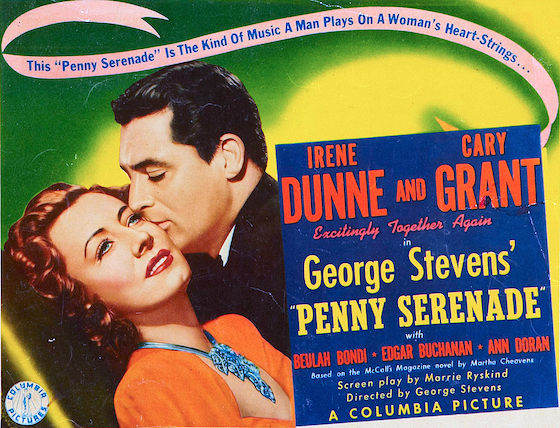
  • Penny Serenade (1941)
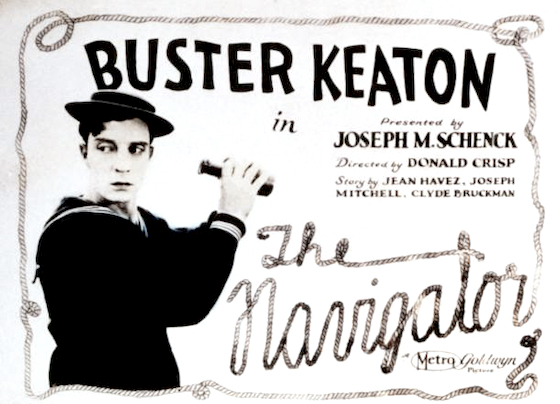
  • The Navigator (1924)
  • In the Line of Fire (1993)
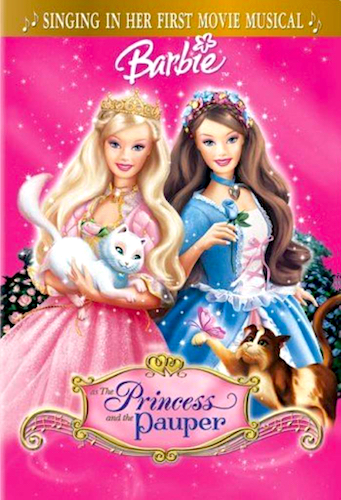
  • Barbie as The Princess and the Pauper (2004)
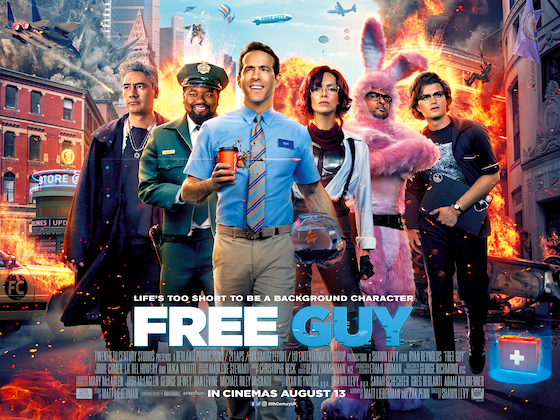
  • Free Guy (2021)


    Carry On Spying

    (1964)

    Gerald Thomas | 84 mins | digital (SD) | 16:9 | UK / English | U

    Carry On Spying

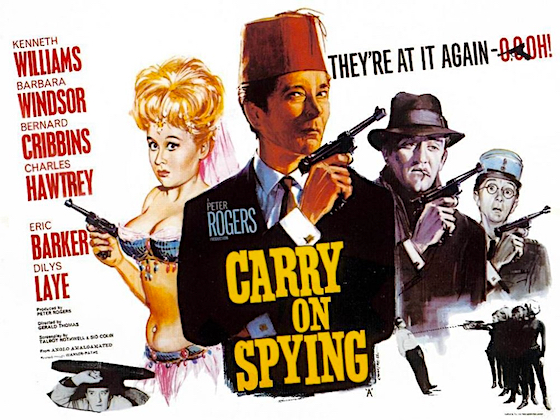
    Believe it or not, I’ve never actually seen a Carry On film before. Maybe that’s not so surprising these days. They were once such a part of British culture that they produced 30 of the things, but I think they were seen as “a bit old fashioned” even before I was born, and by 2022’s standards… oof. But, lest you get the wrong end of the stick (oo-er, etc), this isn’t me intending to finally dive into all of them. Rather, as well as its timely title, I chose to watch Carry On Spying primarily because it’s a James Bond spoof — the first, I believe, seeing as it was released in July 1964, when the Bond series only encompassed Dr. No and From Russia with Love (Goldfinger would follow a couple of months later).

    With Bond not yet even properly into its initial phenomenon phase (the first two films were hits, but it was the next two that skyrocketed its popularity), you might think Spying came too soon, and would be disadvantaged by being produced before the famous Bond formula was fully in place. Instead, it sets its spoofing sights a little wider, including an extended riff on The Third Man. I couldn’t tell you everything it’s drawing on, but its third-act villain’s lair — all sleek metal corridors and little road-train thingies and jump-suited identikit henchpeople — appears to be a take-off of You Only Live Twice, some three years before that film even came out. So I can only presume Spying’s point of reference there is something else, which I can’t quite remember; some other spy fiction that was already doing stuff the Bond franchise would still be pulling off years later. That doesn’t reflect too positively on YOLT, when you think of it, although Bond’s cultural dominance and longevity has come to ensure it’s the one that’s remembered for pioneering all this stuff.

    I don’t know how many Carry On films were genre spoofs, but the series’ reputation is more for smut and innuendo. There’s pleasantly little of that here — some, for sure, mostly based around Barbara Windsor (of course) as a trainee agent; but while it’s all fundamentally juvenile, it’s not as ceaselessly ribald as I was expecting. Satisfyingly, it remains primarily focused on its chosen genre. In that respect, I’ve definitely seen worse spoofs.

    3 out of 5

    Carry On Spying is the 1st film in my 100 Films in a Year Challenge 2022.


    Penny Serenade

    (1941)

    George Stevens | 120 mins | digital (HD) | 4:3 | USA / English | U

    Penny Serenade

    This is the third and final film to pair up stars Irene Dunne and Cary Grant as a married couple (I’ve watched all their collaborations within the past couple of years, but not posted reviews of the first two yet. I thought it was within the last year, but turns out I watched my first in May 2020. These strange days have really messed with my sense of the passage of time!) But where their first two films were screwball romcoms, this is undoubtedly a melodrama, following a couple as they meet, marry, and attempt to start a family.

    Dunne and Grant both make a fair fist of the serious stuff — Grant, in particular, gives an uncommonly sensitive performance at times — although they can’t resist slipping back into a spot of almost-slapstick given half a chance, with various individual sequences playing more like one of their comedies. Those scenes stand at odds with the film’s overall narrative and tone, which goes for full-on weepy. Indeed, if anything, I thought it was overdone, in particular an ending that throws in sudden tragedy followed so quickly by a pat happy ending that it feels almost distasteful.

    The film’s hook is that it begins with Dunne planning to leave, before she discovers a book of records that, as she plays them, take her back through their relationship. Different songs provoking specific memories is a neat narrative device on paper, but doesn’t really come across on screen. Aside from the first track, and maybe a later burst of Happy Birthday (although that could be almost any birthday, surely), the songs don’t seem to have any special relevance to the memories they supposedly call forth. It doesn’t help that, to modern ears, they all sound kinda samey. Plus, that the songs lead everything to unfurl in chronological order, with every major beat of their life story accounted for, is certainly convenient.

    If you can look past such artifice, and just want to revel in an old-fashioned bit of heart-tugging, Penny Serenade is fit to make you shed a tear. Personally, I’d rather the headline duo had given us another bout of screwball tomfoolery.

    3 out of 5

    Penny Serenade is the 3rd film in my 100 Films in a Year Challenge 2022.


    The Navigator

    (1924)

    Donald Crisp & Buster Keaton | 66 mins | Blu-ray | 1.33:1 | USA / silent | U

    The Navigator

    This is my fourth Buster Keaton feature now (I’ve only previously reviewed The General, but Sherlock Jr made it into my 2019 top 3), and he’s established himself as my favourite of the major silent comedians (I rarely enjoy Chaplin’s films as much as I feel I should; and, in fairness to Harold Lloyd, I’ve only seen one of his so far, which I liked a lot). The Navigator was the biggest hit of his career, though is probably my least favourite of his I’ve seen so far — though I don’t want to damn it with false criticism, because it’s still a brisk and entertaining comedy.

    Keaton stars as a spoiled rich kid whose marriage proposal is rejected. He’d already booked the honeymoon tickets, so sets off by himself; but, due to several points of confusion, he ends up adrift at sea on a decommissioned ship, empty but for one other passenger: his would-be fiancée (Kathryn McGuire). It’s up to this pair of brats to get along and survive while they hope for rescue. (Rescue does not come quickly. Considering McGuire’s father is a successful shipping magnate who’s aware of what’s happened, you’d think he’d send a vessel after them; but then, he might have his own problems, owing to a bunch of foreign spies who… look, it’s best not to overthink the logistics and plausibility of the plot.)

    Although Keaton gets the lion’s share of the gags, as well he might, for a stretch in the middle he and McGuire form an effective double act. The two rich kids being hilariously useless at household basics, like making coffee or opening a tin of food, is well observed; a flash-forward to their automated solutions is also fun. While Keaton still gets to show off by himself — particularly in an elaborate underwater diving sequence, naturally saved for the final act — McGuire makes the most of the material she’s given.

    The only outright demerit to the film is that the finale hasn’t aged particularly well: the ship finally drifts near land, but it’s an island with a village-full of black natives, at which McGuire immediately exclaims “cannibals!” That she’s sort of proven right when they start attacking the ship is… well, maybe not even worse, but at least just as bad. Still, by 1920s standards, maybe we can take comfort in the fact that it’s only casual racism…

    More than that, the reason I say it’s my least favourite Keaton so far is simply that it doesn’t have as many comedic highs as his very best work. Nonetheless, his genius regularly shines through in moments and even whole sequences, and there are a couple of individual gags that are all-timers.

    4 out of 5

    The Navigator is the 4th film in my 100 Films in a Year Challenge 2022.


    In the Line of Fire

    (1993)

    Wolfgang Petersen | 129 mins | digital (HD) | 2.39:1 | USA / English | 15 / R

    In the Line of Fire

    Clint Eastwood is a Secret Service agent who failed to stop the JFK assassination, now taunted by John Malkovich’s mysterious wannabe-assassin and his threats to kill the current President. It’s a fundamentally strong idea for a thriller, and works especially well by having the villain constantly phoning the hero for little chats. Malkovich’s always makes for a first-rate antagonist, and his slightly loony personality clashes well with Eastwood’s stoic, dry-witted, old-fashioned tough guy. There are a couple of chase scenes and shoot-outs here and there, but, rather than any elaborate physical action, it’s the verbal sparring that represents the film’s highlights.

    On the downside, the pace is a little on the slow side (perhaps matched to the “too old for this shit” age of Eastwood’s hero — in real life, he’d be a whole decade past the mandatory retirement age) and there are one too many clichés as important plot points (don’t get too attached to the partner who’s always talking about his wife and kids). Plus, there’s a wholly unnecessary romance between 62-year-old Clint and 39-year-old Rene Russo — the film doesn’t need it, even if there wasn’t that age gap. It leads to an (almost) sex scene that’s worthy of the Naked Gun films, which is amusing but tonally misplaced.

    They used to make this kind of political thriller on the regular back in the ’90s, one of those bread-and-butter genres for grownups that have fallen by the wayside in favour of hyper-budgeted kids’-movie spectacle that men of allegedly adult age flock to nowadays. In the Line of Fire may not truly stand out among its brethren of the era, but I do wish they still made ’em like this.

    4 out of 5

    In the Line of Fire is the 6th film in my 100 Films in a Year Challenge 2022.


    Barbie as
    The Princess and the Pauper

    (2004)

    William Lau | 85 mins | digital (SD) | 16:9 | USA & Canada / English | U

    Barbie as The Princess and the Pauper

    One of the many film lists I have my eye on completing is Letterboxd 100: Animation, which lists the highest-rated animated feature films on the site (with a few caveats). There are over 40 titles left that I’ve not seen, and I could’ve chosen to watch almost any of them… but I chose the Barbie one. Well, not the Barbie one, because there are actually two Barbie titles on the list. And that’s not some temporary fluke: they’ve been on there for quite a while now. This merited investigation.

    As you’ve no doubt gathered from the title, this particular Barbie film is a reimagining of Mark Twain’s The Prince and the Pauper. A fairytale-esque story, about a princess, done as a musical? Yep, this is very much a wannabe Disney, but without the production values of that major studio: the computer animation here looks more like a PS2 cutscene. But hiding beneath the cheap animation is a halfway decent musical fairytale. Take the second musical number, How Can I Refuse, for example: it’s every inch in the mould of a “Disney villain’s song”, but is better than some genuine examples, and comes complete with a dance routine by the antagonist and his two henchman. This film has ambition, I’ll give it that.

    Other songs vary in quality. When the eponymous duo first meet, there’s an unintentionally hilarious number in which they sing about how similar they are, the indentured servant and the pampered royal. If you say so, girls. A later track is a typical “you be you” song, but sung to a pet cat who behaves like a dog. That’s a level of barminess I can get on board with.

    I would never have dreamed of watching this if it weren’t on the Letterboxd animation list. Now, I wouldn’t exactly say I’m glad I watched it, but I enjoyed it more than I thought I would — even if sometimes that was due to laughing at it rather than with it.

    3 out of 5

    Barbie as The Princess and the Pauper is the 7th film in my 100 Films Challenge 2022.


    Free Guy

    (2021)

    Shawn Levy | 115 mins | digital (HD) | 2.39:1 | USA / English | 12 / PG-13

    Free Guy

    Ryan Reynolds plays his role again as Guy, a bank worker in city riddled with crime and superheroics. But, it turns out, Guy isn’t real — he’s an NPC in a computer game, programmed to do the same thing over and over and basically be ignored by the real-world players. Until, that is, he spots the woman of his dreams (Jodie Comer) and his programming breaks as Guy becomes self-aware.

    The basic concept sounds like a fun, fresh, and timely idea, right? Video games have never been more popular, AI is ever-improving, and there’s room for both gags and action in the core idea — that’s the winning Marvel formula, right there. Unfortunately, the execution is as if someone found a way to make a new movie by collaging others. Free Guy is just The LEGO Movie + The Truman Show + Wreck-It Ralph + Ready Player One + the PG-13 version of Deadpool 2 — not put in a blender, but cut up and stuck back together side-by-side, with snippets of Groundhog Day, Fortnite, and multiple Disney-owned properties scattered in for good measure.

    That last aspect, the Disney references, has been singled out for particular derision on social media. The film was initially produced by 20th Century Fox, but ended up a Disney title after the buyout, which allows a bunch of stuff they own to pop up in the movie. I know we’re supposed to find this infinitely depressing — a sad reminder that Disney are on course to own all culture, and that’s a bad thing — and it is bad, of course… but the bit with Captain America’s shield still made me laugh. Sorry, not sorry. Yeah, you can be miserable about this stuff, because obviously the total homogenisation of all American media under The Walt Disney Company is not worth that a couple of meta gags; but the homogenisation of all American media under The Walt Disney Company is happening anyway, so we may as well enjoy the gags we get along the way.

    Whether you have that kind of attitude or not will probably dictate how much you enjoy Free Guy. Its originality is surface deep, at best, and at every second it will call to mind some other film that already did the same thing. But, allowing for that, it’s still a fairly entertaining couple of hours of action-comedy.

    3 out of 5

    Free Guy is the 8th film in my 100 Films in a Year Challenge 2022.


  • The Three Caballeros (1944)

    2020 #61
    Norman Ferguson | 72 mins | download (HD) | 4:3 | USA / English | U / G

    The Three Caballeros

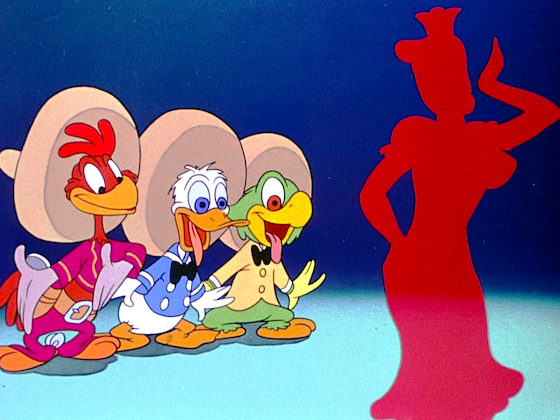
    At one point Disney had a reputation for churning out rubbish direct-to-video sequels to their animated classics, a practice they put a stop to because, well, they were getting a reputation for churning out rubbish direct-to-video sequels to their animated classics. But there have also been a small selection of films in the Disney Canon that were granted sequels also within the canon. I have no insight into why this was the case, but I’d love to know the thinking because some of them are random. Like, okay, Frozen was a mega-hit, so makes sense you’d make the sequel ‘official’. Winnie the Pooh? Sure, Pooh is awesome (and also a reliable moneyspinner). Fantasia? Well, it was a passion project, and I guess its inherently artistic nature seems a reasonable way to mark the millennium. Wreck-It Ralph? Um… The Rescuers? Er… Saludos Amigos? Wait, really?

    Yep, The Three Caballeros is, technically, the first sequel in the Disney Canon, and that’s only really surprising when considered without context. It’s from the period when Disney were bundling together shorter films to make package features, of which there are half-a-dozen spanning the gap between Bambi (Canon #5) and Cinderella (Canon #12). The first of those was Saludos Amigos, which was basically a propaganda film to showcase South America with the aim of improving relations between the continents. Donald Duck starred in two of that film’s segments, and it introduced José Carioca, a Brazilian parrot character. The Three Caballeros is a sequel in that it also presents a series of shorts about lands south of the US, strung together via a linking device of Donald Duck opening birthday presents from his Latin American friends. José eventually pops up, and the titular trio is rounded out with the introduction of Panchito Pistoles, a Mexican rooster.

    The three sex pests

    For all the similarities, I thought The Three Caballeros was considerably more enjoyable than its predecessor. Its depiction of South America is perhaps a little more twee, leaning on culture and tradition rather than the modern cityscapes that were so important to the impact of the first film, but that doesn’t grate too much because it’s not striving so hard to be educational. Because of that, it’s also able to be more straightforwardly entertaining. That said, it very much has the feel of a “kids’ cartoon”, rather than the artistry that’s to be found in Disney’s best efforts. Although Donald Duck comes across as a bit of a sex pest at times, which I guess is just changing attitudes. Conversely, the sequences that blend live-action and animation hold up incredibly well, although that might be because Disney’s use of DNR is so heavy-handed that the live-action practically looks the same as the animation. And the finale, where it suddenly explodes into a psychedelic nightmare, feels like someone didn’t know how to end the film and so had a mental breakdown all over the screen.

    While I’d chalk up The Three Caballeros as a superior movie to its immediate predecessor, it undoubtedly remains a minor entry in the Disney canon. That said, apparently they updated it into a spinoff series a year or two ago (which I only know about because I happened to spot it on Disney+ the other day), so it obviously endures somewhat.

    3 out of 5

    Hamilton (2020)

    2020 #157
    Thomas Kail | 160 mins | streaming (UHD) | 1.85:1 | USA / English | 12 / PG-13

    Hamilton on Disney+

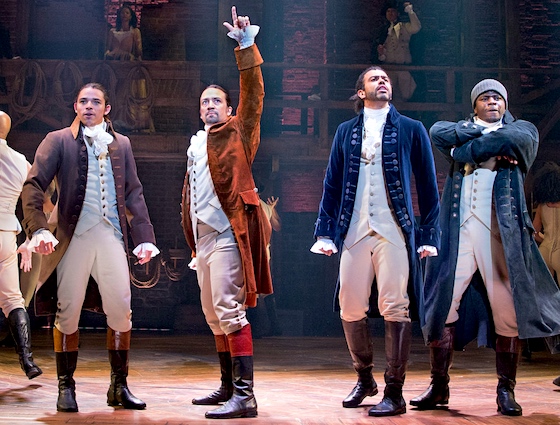
    Hamilton, the original musical, is one of the great works of art of the 21st century so far, and now we all get a chance to be in the room where it happened (provided you’re prepared to pony up some dough to Disney+) thanks to the makers having had the foresight to film a full production with the original Broadway cast back in 2016 (and then flogging that recording to Disney for $75 million).

    The show is a genuine phenomenon, but if you’ve let it pass you by, allow me to explain the basics. This is the life story of Alexander Hamilton, one of the Founding Fathers of the USA; an immigrant who fought in the War of Independence, became the first Secretary of the Treasury, and in between and around all that most assuredly lived a life — there’s friendship and rivalry; romance and infidelity; genuine triumph and heartbreaking tragedy. Here that story is told via music, written and composed by Lin-Manuel Miranda (who also portrays the title role), a fusion of hip-hop, R&B, and more traditional Broadway stylings, performed by a cast mostly made up of people of colour. It’s a tale of outsiders and immigrants and forward-thinkers who battled for the right to be recognised and respected — it’s a history lesson, but oh yeah, it’s timely.

    It premiered back in 2015, so over the past five years the praises of the original show and its successful soundtrack album (the primary medium through which most people have been able to experience the work, given the scarcity and cost of tickets) have been thoroughly sung. To briefly offer my perspective, I came to it ‘late’ — sure, I heard about it (initially thanks to references to its ticket prices), but I overlooked it as just another bit of mass-popular culture that likely didn’t have any weight or staying power. My mistake. Long story short, I finally listened to it in full in 2019 and was blown away.

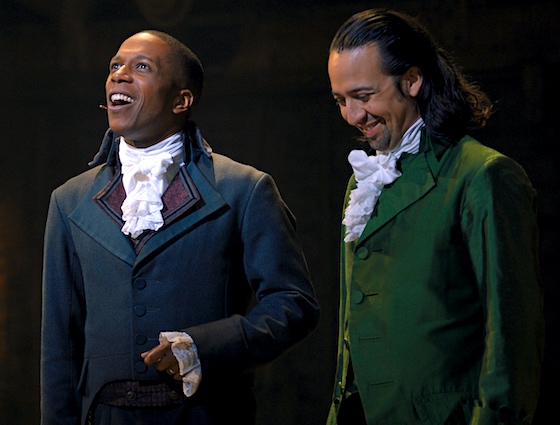
    Aaron Burr, sir

    Adjectives to describe its quality are endless. It’s densely and intelligently written, packed with historical information at every turn, abundant with sly references to other media. Its structure is sublime, laced with callbacks and nods forward from the very opening number; musical motifs repeat, as do lines and ideas, some cropping up before their real significance has been reached, like flash-forwards; elements of plot and character are echoed and mirrored. Many of these are observable first time through; others only reveal themselves with repeat visits. The characters are sharply and smartly drawn, revealing layers and nuances and different perspectives as the piece goes on — it may ostensibly be about Alexander Hamilton, but multiple other characters are at least as richly painted, if not more so. It engrosses like a thriller and packs the serious emotional punch of a finely-wrought drama, but it’s also very funny at times, with numbers as toe-tappingly addictive as a great pop song. It’s hard to think of a more complete all-round experience.

    Well, complete but for visuals if (like me) you’d never seen it performed, only listened to the soundtrack. And, you know, the soundtrack’s not a bad way to experience it — it doesn’t feel notably incomplete. Normally when you listen to a musical’s album, you just get some nice songs from the production. With Hamilton, you get (very nearly almost) the entire soundtrack, and therefore the entire story — you can follow it and not feel like you’ve missed anything. (I do wonder if that’s part of why it’s been such a success.) The lyrics and music conjure up their own imagery in your mind — certainly for me, ever since I first listened to it I’ve pictured whole chunks of it as I’d realise them in a movie version. I’m sure they’ll do a ‘proper’ film of it someday (you really think they’re going to leave all that money on the table?), but I think it’s for the best that’s not the first way I’m seeing it, because I worry it won’t live up to what I’ve concocted in my version.

    As I mentioned at the start, this isn’t a film reimagining like a normal movie musical, but rather a filmed record of the original production. It was shot over three days back in June 2016 (shortly before the original cast moved on), during a mix of live performances and in an audience-less auditorium for the sake of closeups, crane shots, etc. That’s one of the things that elevates this particular film above other recorded-theatre productions I’ve been watching recently (like One Man Two Guvnors, Danny Boyle’s Frankenstein, or the RSC’s Macbeth): whereas they have clearly been filmed live during a single performance, with all the restrictions that implies (limited camera angles; making editing choices in real-time), Hamilton has some extra remove, which has allowed director Thomas Kail to be a bit more creative.

    Looking for a film at work, work

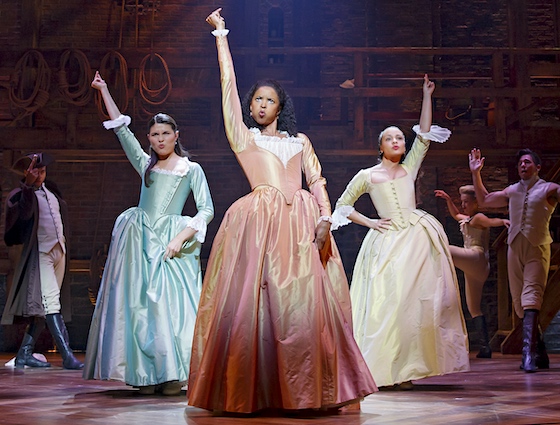
    The camerawork endeavours to add something no theatre performance could, allowing us to see details that would be missed from even the best seats in the house. Closeups let us appreciate the full spit-flecked contempt from Jonathan Groff’s George III in You’ll Be Back; the restrained emotional sacrifice injected into Angelica by Renée Elise Goldsberry during Satisfied; Eliza’s heartbroken defiance from Phillipa Soo in Burn; or the rare occasions Leslie Odom Jr. allows Aaron Burr’s true emotions to break through in the likes of Wait For It and The World Was Wide Enough. That’s not to mention the countless other moments and performers that benefit from us being able to see how much they’re giving their performances; all the subtleties they’re adding.

    At other times the camera angles show off the choreography, for example with punch-ins to highlight specific elements during stage-wide ensemble showpieces, like the rewind at the start of Satisfied, or a bird’s eye view as paper flutters in the air during The Reynolds Pamphlet. Still other scenes are reframed for our convenience, such as an exchange between Burr and Hamilton during Non-Stop that takes place upstage off to one side, but is now centred through medium shots and closeups. If all that sounds like it might serve to undermine the staging, it most certainly does not. When called for, Kail and editor Jonah Moran frequently fall back on wide angles to ensure we see the scope of what’s occurring. Only once or twice during the whole two-and-a-half hours do you feel maybe they chose a less-than-ideal angle or over-edited a sequence.

    Having said that listening to the soundtrack feels like a complete experience, watching it certainly shows what you were missing. There’s so much more to add, from little nuances of performance, to visual-only gags and callbacks, to impressive dance and staging — and if we’re already comparing this to the presumed ‘proper film’ version that will exist someday, I also presume some of that staging will be lost in the visual translation. But while there’s an undoubted “designed for the stage” aspect to the blocking or the way some things are realised, it still works on film.

    Not throwing away their shot

    You can’t ignore that this is a film of a Broadway production — even if you wanted to, an opening subtitle reminds us it’s June 2016 in the Richard Rodgers Theatre, and the audience is frequently to be heard clapping, cheering, and laughing (mixed onto the rear speakers if you’re watching in surround sound, as you’d expect, along with a few other moments and effects that add to the experience if you can benefit from such a setup). But it’s so well staged and filmed that you can buy this as the intended experience. With those other filmed-theatre productions I mentioned, you’re often aware that what you’re watching has primarily been staged for those in the room, and that you getting to observe it from a few fixed camera positions is a nice bonus if you couldn’t be there. With Hamilton, it feels like nothing is missed; not only that, but that this is the way the story was meant to be told, complete with elements of theatrical artifice, like the stripped-back staging and actors playing multiple roles (which roles are shared by the same actors is not without significance). Whenever and whatever they do for that theoretical ‘proper film’, I feel like it won’t negate this version, not just as a record of the original show, but as a film in its own right.

    That’s perhaps the most striking aspect of this particular version: it doesn’t feel like a mere stopgap until they film it ‘properly’, nor a “that’ll do” stand-in for a real theatrical performance, but instead like a legitimate experience in its own right. Hamilton is a masterpiece, and getting to see it performed by the original cast in its original staging via a film so carefully and lovingly crafted is an absolute thrill.

    5 out of 5

    Hamilton is available on Disney+ now. It placed 3rd on my list of The Best Films I Saw in 2020.