Cube²: Hypercube (2002)

2008 #84
Andrzej Sekula | 90 mins | DVD | 15 / R
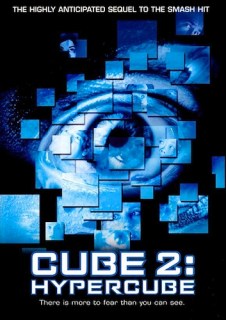
Cube²: HypercubeThe new cube set is bigger, shinier, simpler, emptier, always one plain colour, and devoid of traps. Consequently, but perhaps inadvertently, it seems to symbolise the film itself.

Despite this simplified set, the concept behind the new cube — or ‘hypercube’, so we’re told — and the plot that results from it is incredibly complex. In fact, it seems to be too complex for the writers to grasp, so the viewer doesn’t stand a chance. It’s not the only overdone element either: Sekula’s direction is frequently as inappropriately elaborate as possible, twisting the camera round for no reason other than some misguided attempt at (inaccurately) conveying this cube’s mixed gravity. He also feels the need to illustrate characters’ backstories, something the original left to the dialogue, which is probably because the ragtag selection of flat stereotypes here are far more generic than the lot in the first film.

And there’s loads of them too, though it’s hard to tell if this is to cover for them all being one-dimensional, or a transparent attempt to keep things moving by constantly chucking more people into the mix. As if to underline the point, several are cloned from the first film, but with much weaker acting, and almost none of them are granted a plot thread that actually gets resolved. In fact, nearly every character is entirely pointless. Eventually some of them do get killed off, but every death is too reliant on some middling CGI and abstract ideas. Not a single one is as properly inventive or scary as those found in the original.

Hypercube should at least be applauded for trying something new, when it might have been easier to bung a new group of people into the same cube and come up with new ways of killing them or new puzzles to solve. It dives further into SF territory, dragging in parallel universes and varying timelines, and largely avoids rehashing the first film’s mysteries. In fact, it more picks up where that left off, drawing out questions and providing some answers about the reasons for, origins of, and people behind the cube. Unfortunately, these questions don’t need re-posing and the answers certainly aren’t required. Like other elements of the first film not carried over — the clever deaths, the claustrophobia — it’s nice that they’ve not been duplicated, but equally they didn’t need changing, expanding or explaining.

Even worse, the writers seem to have spent more time mulling over the behind-the-scenes complexities of constructing the cube — and put in all their characters and ideas about this — and not enough time actually crafting a plot. The more the clock ticks by the more obvious this becomes, to the extent that they don’t even seem to have an ending. What minimal logic there was is thrown out the window in favour of some crazy different-timeline horror that barely resolves anything and certainly cops out of almost everything.

Where the original Cube felt like the smart little sci-fi indie it was, Hypercube feels like expensive tosh based on a faux-intellectual idea. Much of the original’s brilliance lay in its simplicity, but the sequel is more complex from the off — and not in a way that rewards the attentive viewer, or even in a way the writers seem to understand. Bigger and shinier, but simpler and emptier, it’s consequently less engaging, less interesting, and far less enjoyable.

2 out of 5

For a brief overview of the Cube trilogy, please look here.

Cube²: Hypercube featured on my list of The Five Worst Films I Saw in 2008, which can be read in full here.

Cube (1997)

2008 #83a
Vincenzo Natali | 87 mins | DVD | 15 / R

CubeI’ve seen Cube a couple of times before, but, as I’ve watched it again immediately before taking on the two heavily-criticised sequels, I thought it might be worth throwing in my opinion on the original too.

Cube has a deceptively simple concept — a sci-fi/horror/mystery in which six strangers are trapped together trying to escape a series of cube-shaped rooms, some of which contain deadly traps — but within that it pulls a lot together. The major element, arguably, is the mystery of what the cube is — where is it, who built it, how does it work, why are those people there, is there a way out? Some of these questions are answered but, crucially, not all of them, and it’s partly due to this, ironically, that it’s a satisfying experience. In its series of careful, measured, necessary reveals, the film strikes a perfect balance between what it lets the viewer know — and the revelations are expertly paced throughout — and what it keeps hidden, either for the viewer to deduce or interpret for themselves, or simply because one doesn’t need to know.

Within the cube and its mystery there are the characters. Depending on your point of view they’re either well-drawn sketches interacting realistically in an unrealistic situation, or archetypes representing different facets of humanity, or simply chess pieces to move the clever construction — of both plot and setting — forward. At times the movie does work like a slasher-horror, picking off characters one by one, but after a few grisly deaths it rather transcends that. The scenes where characters debate and argue aren’t quite as engrossing as when they’re puzzling over the cube, but nor do they drag. Not all the performances are good — Maurice Dean Wint in particular lets the side down for much of the film — but the character arcs are never less than believable and well considered.

Cube manages to effectively juggle gruesome horror deaths, sci-fi mysteries, an awful lot of maths (don’t worry, you don’t need to understand it) and character-based drama. It’s a brilliant low-budget (not that it shows) understated film, which seems to have been somewhat forgotten these days, probably under the weight of the two widely derided and unnecessary follow-ups. But that remains for me to see. Whatever they may be like, everyone interested in the more intelligent end of the sci-fi spectrum should see Cube.

5 out of 5

For a brief overview of the Cube trilogy, please look here.

The Invasion (2007)

2008 #72
Oliver Hirschbiegel | 99 mins | download | 15 / PG-13

The InvasionThe Invasion is a modern thriller aimed at a mainstream audience, which naturally means it begins at the end. Is there a reason for this? As is too often the case these days, no. The only explanation I could come up with is that such an opening suggests there’ll eventually be some some actual scares in this sci-fi/horror, and so is designed to help the viewer persevere through the distinctly lacking film that follows.

Things go sharply down hill from the lacklustre opening ending opening: Jeremy Northam accidentally stabs himself with an Evil Alien Parasite Thing in a blatant genre convention that seems to have moved from the “necessary to get on with the plot” to the “badly obvious cliché”. The order of scenes that follow seems to be a random mess — for example, Nicole Kidman’s kid, Olly, begins to have nightmares again; a few scenes later, his dad (Northam, now taken over by the Evil Alien Parasite Thing) phones wanting to see him after a long absence; a few scenes later, Kidman tells a friend that Olly’s nightmares restarted after he was told he was going to see his dad. This is not an isolated example.

Much of the dialogue is on the level of bad exposition, but, to rub salt in the wound, it explains things we’ve already been shown. Normally reliable actors turn in flat performances with such an awkward script, which ponderously works its way through a plot that’s far too slow-moving considering how obvious it is. We know it’s an Evil Alien Parasite Thing within the opening minutes and even a passing familiarity with the genre will let you know how things are going to end up (as if opening with the ending didn’t give you a hint), but we’re still treated to near-endless scenes of our luckily-immune heroes trying to work out why everyone else is behaving oddly. It takes a full 36 minutes for Kidman to finally realise what we’ve all known from the start, but just in case you’ve missed the bleeding obvious there’s a pile of handy flashbacks. More to the point, how come only two people in the entire world (the other being Daniel Craig) have noticed what’s going on? The possessed have all the subtlety of a Jeremy Clarkson joke, walking around in a permanent mechanical daze.

A lot of articles have noted that the studio disliked how the film ended and so brought in other writers and director(s) to re-shoot the final act, aiming to bolster the action. Thank goodness they did, because it’s at this point that there’s finally something worth watching. The aliens’ dominance is a near-inevitable and obvious eventuality from very early on, and so structurally speaking should have been reached sooner. Unfortunately, when it does arrive, the weak early scenes mean we don’t care about the characters, so while some of the more action-packed scenes are well staged they have little genuine impact. Some good moments sneak through though, like a couple’s very public suicide, or… No, that was the only one I noted.

In this structural imbalance The Invasion is reminiscent of I Am Legend: a ponderous dramatic first half turns into an all-action assault as the only uninfected people are relentlessly pursued by the infected majority. In an inversion of the disappointing (but not dreadful) Will Smith vehicle, The Invasion‘s first half is dire while the second at least has some excitement and jeopardy. In Legend it was a shame that they couldn’t keep the first half running for the rest of the film; here you’re glad the studio intervened and forced some actual events on the film. It would be quite interesting to see how it was all meant to turn out originally, but I doubt it would be entertaining in the slightest.

Once it’s all over there’s a truly dreadful info-dump that explains what happened next. Besides making you cringe and wonder how a piece of exposition so blatant could ever have been greenlit, all it achieves is the delivery of a killer blow — not by blatantly stating the film’s subtext (which it does — not so ‘sub’ then), but with what that subtext actually is: when humanity is taken over by aliens, war stops; ergo, war is what makes us human. Lovely.

2 out of 5

The Invasion featured on my list of The Five Worst Films I Saw in 2008, which can be read in full here.

The Happening (2008)

2008 #44
M. Night Shyamalan | 90 mins | cinema | 15 / R

This review contains spoilers.

The HappeningWhile others have been lamenting the slide in quality of Shyamalan’s work since his breakthrough 1999 hit The Sixth Sense, I’ve been quietly enjoying most of his films since then. I liked Sixth Sense and appreciated its ingenious twist, but it was the fantastic real-world-superhero tale Unbreakable that did the most to cement him in my affections. Signs was another strong effort, an unusual perspective on alien invasion backed by decent family drama and a few good laughs, helped by the always-watchable Joaquin Phoenix and a sweet kid. On the other hand, it suffered from a stretch of a resolution, and that it starred Mel Gibson. His next was the The Village, in my opinion his biggest misfire thanks to a story disappointingly reliant on an easily-guessed twist, further undermined by a third act structure that bent over backwards to hide the reveal for as long as possible. Most reviewers seem to disagree slightly though, as Lady in the Water was widely panned. Personally I liked it, at least on the level at which it was intended, as a modern fairytale.

This, his latest effort, falls mostly in the middle of the road — a bit like a few of its extras, then. You see, the plot concerns the release of a toxin (from where, no one knows) that causes people to begin committing suicide en masse, by jumping off buildings, or shooting themselves, or a variety of other, more gruesome ideas. It’s in these sequences that The Happening is at its best — Shyamalan can still craft chilling scenes and effective jumps, even if their onset is obvious to a moderately seasoned film viewer. Unfortunately, the rest of the film is a tad weak. Mark Wahlberg’s performance is flat, John Leguizamo struggles to do much better, and Zooey Deschanel gets by in a kooky role that is by turns endearing and slightly irritating. The script is mostly passable, though occasionally heavy-handed, repetitive and clunky — one moment especially jarred for me, when in a middle-of-nowhere diner it seems one person’s dialogue has been split between two actors.

Shyamalan nicely keeps the cause of the toxin up in the air — though the most probable cause is first suggested fairly early on, other theories continue to float around — but with no last-minute revelation such juggling feels unwarranted. Instead there’s just a “it could happen again” final scene, that might be chilling if it weren’t so predictable. Part of the problem with the film’s central conceit is that it’s not very believable. Now, I know, being able to see dead people, developing superpowers or finding a mermaid-like girl in your pool are hardly realistic plot points either, but here it strays too close to the realm of “I expect you to believe this is possible” pseudoscience and so, unlike Princeton gardeners, my belief struggled to be fully suspended.

Ultimately, I’d rank The Happening as Shyamalan’s worst film to date. While it’s pleasing that he doesn’t force everything to rely on a final twist, the overall quality is variable — at least The Village had something going for it before the poor climax. The cod-science explanation feels like a big excuse for a topical eco-message, otherwise just being a basis to string together a collection of well-executed creepy sequences. Perhaps Shyamalan should stop trying so hard to come up with amazing new ideas and just concentrate on telling a good story. There are things to like though, enough to scrape the film into the middle of the road. Sort of the opposite to those suicidal extras then.

3 out of 5

They’ve just watched the film…

They've just watched the film...

Cloverfield (2008)

2008 #40
Matt Reeves | 81 mins | DVD | 15 / PG-13

This review contains major spoilers.

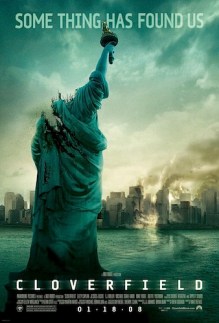
CloverfieldAh, Cloverfield — probably the most hyped “film no one knew was coming” since The Blair Witch Project, if not even longer, and the most widely-discussed marketing campaign since Snakes on a Plane (all of two years earlier). And then, in what can only be described as a surprise, it got good reviews. Less surprisingly, it did pretty well at the box office. Even less surprisingly, they announced a sequel. So far more Blair Witch than Snakes on a Plane, then. Of course, not all reviews were good, and with all this in mind I finally come to see it myself.

Cloverfield works. It has flaws, but overall it works. The opening 20 minutes set up the characters fairly well, though it does take its time. One would hope the idea is to increase the tension by delaying the monster’s appearance, but I can’t help feeling it’s probably just because they think they’re providing a great emotional background. Those who compare these bits to Hollyoaks clearly haven’t seen that risible C4 pile of tosh — Cloverfield’s performances (largely improvised, at least in the early scenes) and direction are much better than that, even if the plot would probably fit snuggly on the teeny soap. I found the opening held my attention well enough, so one has to wonder about the attention span of those who switched off during it. The characters and their relationships may be archetypes, and consequently rather one-dimensional, but at least they show an attempt to make it more than a Big Monster Go Smashy Smashy movie.

That said, it’s when the monster turns up that things kick off. From then the film does a great job of creating an unrelenting chase/escape, drawing the viewer in with its first-person/eyewitness style. You’re never going to be fooled into thinking it’s a real thing that really happened, obviously, but it comes as close as it’s likely to. This is partly thanks to the camerawork, which I’ll get into later. The deliberate drip-feed of information about the monster is well handled also. Those expecting lots of exposition and answers have clearly come to the wrong film, and should perhaps stick to a more straightforward blockbuster. Those who complain that the monster doesn’t make sense, or the bug-parasite-things that drop off it make even less sense, are clearly missing the point — the characters don’t know what this is or what’s going on, so we don’t either; and it’s a sci-fi movie, so any number of explanations you care to put forward could explain things. There are a couple of misfires in this respect — the military’s willingness to explain their plan is unbelievable, and a shot of the monster towering over Hud is a step too far — but mostly it succeeds.

Talking of Hud, he’s come in for criticism, it seems to me for two main reasons: he’s not a great character, and he can’t hold the camera steady. Have the latter viewers ever watched home movie footage? Cloverfield does a spot-on replication of it, which naturally looks odd if you think of it as ‘professional film’ (where even handheld is only slightly wobbly). I challenge anyone to take a normal home video camera and put it through the same things Hud does and come out with any steadier a shot. Sometimes credibility is pushed by having Hud film other characters instead of the more interesting monster (surely where any normal person would point the camera), but it’s only an occasional and minor point. As for his character, he may be dopey, dull, and occasionally even irritating, but his purpose is to be the cameraman — if he were notably likable or, well, notable then you’d want him in front of the camera too. For the sake of the style, someone has to be behind the camera, and Hud’s a perfect fit. You get so used to him as the almost-unobtrusive cameraman that when he’s killed it’s very nearly an audacious shock, though it’s such an obviously audacious move that it’s predictable to most film-literate viewers.

Unsurprisingly, there’s not a huge deal of originality in Cloverfield. The monster itself may look different to the norm, but it stomps through the streets like Godzilla, the attack of its minions/parasites/whatever in a dark tunnel is a sequence we’ve all seen before (nonetheless, it’s effectively done here), and their chestbursting-like birth is obviously straight out of Alien (even if it’s toned down to a PG-13-friendly silhouette). Even the (in)famous handheld style has, of course, been done before. But in marrying all these elements Cloverfield creates something that feels fresh enough (pasting the first-person/handheld/eyewitness style onto almost any genre would give it a new angle, I’d imagine), and, for the most part, it both entertains and intrigues. It may not be quite Empire’s 5-star wunderkind, but it pushes close.

4 out of 5

Cloverfield placed 9th on my list of The Ten Best Films I Saw For the First Time in 2008, which can be read in full here.

Sweeney Todd: The Demon Barber of Fleet Street (2007)

2008 #30
Tim Burton | 112 mins | DVD | 18 / R

Sweeney ToddTim Burton and Johnny Depp collaborate for the sixth time (as the DVD’s blurb is so keen to point out) for a film adaptation of Stephen Sondheim’s musical adaptation of the classic tale of the titular barber who slaughters instead of shaves and sells the resultant meat to all of London in the pies of his accomplice, Mrs Lovett.
As with 2005’s Charlie and the Chocolate Factory, the announcement of Burton as director of Sweeney Todd was one of those “well, of course” moments, despite the vastly different audiences. And with Burton come Depp and Helena Bonham Carter, naturally. But whereas the eventual product of Charlie resulted in a “that’s that done then” feeling of the inevitable, Sweeney is more of an unknown quantity for me — I’m familiar with the basic story, of course, but not this particular version. It’s a dark tale, but told here in a heavily stylised manner — no gritty realism to be found (for that try the Ray Winstone TV movie), but instead there’s bold and striking performances, design, direction, and storytelling. One is tempted to call it “theatrical”, but the direction is anything but and the actors do much more than project for the benefit of the back row. It’s anti-naturalistic in all elements, which suits both the ghoulish and musical subject matters perfectly, but is consequently not to everyone’s taste.

As for the musical elements, Sweeney is done in an operatic style — the majority of dialogue is sung and the story is almost entirely told through these songs, rather than having a couple of numbers peppered throughout (quite how they managed to edit a trailer that was both comprehensible and light on song is near miraculous). Anyone who’s seen an Andrew Lloyd Webber production will be familiar with this way of doing things. Personally, I find it a more immersive style — everyone’s singing from the word go, not disconcertingly launching into song a little way in. The cast’s voices may not be perfect (and I’m far from a knowledgeable judge), but they do the job more than adequately. Rough moments almost add to the film’s style, and the cast’s acting abilities more than make up for them anyway. One casting oddity is Anthony Head, who turns up for a sole inconsequential line. He may not be a regular film actor, but surely he’s bigger (and certainly better) than a glorified extra? He’s not even listed in the end credits. I smell deleted scenes… (A bit of IMDb reading reveals I’m right. Sadly, these aren’t included on the DVD.)

The other striking element of Sweeney Todd is its look. London here is a dingy monochrome metropolis, interrupted only by fanciful fairytale-coloured fantasies like the song By the Sea, and, of course, gallons of vibrant spurting blood. Wisely held off until relatively late in the film, when the blood comes it is all the more shocking. And from that point it flows like wine — or, more accurately, squirts like a stamped-on ketchup bottle — in perfectly judged amounts: it gushes far more than you’d normally see but, because Burton never pushes it to the mad excess that Tarantino did in Kill Bill, it remains on the disturbing side of believable. The stylised theatricality of it almost makes you question the high classifications, but the underlying morals and sheer bloody volume ultimately justify them.

Yet there’s something missing from Sweeney Todd. I can’t work out what it is — perhaps the numerous numbers Burton cut or trimmed have unbalanced proceedings slightly, in some frustratingly ephemeral way? — but despite all this praise and only vague criticisms, I’m certain it’s a four-star film. A very solid four, to be sure, but it doesn’t achieve enough to pass higher.

4 out of 5

Sweeney Todd: The Demon Barber of Fleet Street is on Channel 4 tonight, Saturday 9th August 2014, at 11:10pm.

The Hound of the Baskervilles (1939)

2008 #9
Sidney Lanfield | 77 mins | DVD | PG

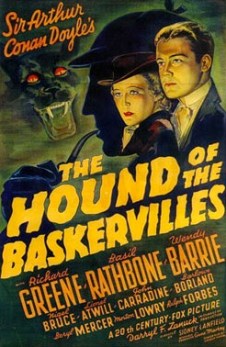
The Hound of the BaskervillesArguably the definitive screen interpretation of Sherlock Holmes and Dr Watson, played by Basil Rathbone and Nigel Bruce, appear for the very first time here, in what would become the first in a series of 14 pictures starring the pair. (Incidentally, this will be the first in an irregular set of reviews of that series. I have the rather lovely Optimum box set, you see, and so shall slowly work my way through it. Though as I’ve already owned it for several years and only just started watching it (as with so many DVDs), I have no idea how long it will be before I finish.)
I’ll start by laying my cards on the table: The Hound of the Baskervilles is a vastly overrated Holmes tale, and one that has been unduly adapted at least 15 other times (that from a quick search of IMDb). As far as I can tell its popularity is primarily due to the circumstances around its original publication (it was the first Holmes story in nearly a decade, following his death in The Final Problem). Holmes is absent for much of the story, which plods along fairly uneventfully (or, at least, inconsequentially) until a slightly dubious climax involving a centuries-old portrait. Naturally, all of these flaws carry over into any faithful adaptation, and this certainly is one.

One of the novel’s strong points is its occasional Gothic styling, and this is something the film version does very well. Dartmoor looks fantastic, like something Tim Burton would have created were he working in the ’30s. It’s clearly a set, but it’s dramatic and moody and completely effective. After the dull and poorly-designed interior scenes in London, it’s fantastic when the film finally moves down into Devon and things… well, don’t exactly get going, but at least there’s something to look at! As with the novel the plot meanders by, diverted by an escaped convict and an entirely pointless (in this version at least) seance, until that painting-based resolution. All is not lost, however, as a particularly vicious-seeming attack by the hound livens things up considerably.

Rathbone is underused as Holmes, which is a shame as he immediately makes the part his own. Bruce isn’t as bungling and comedic as he would later become, though the signs are already beginning to show. And the infamous final line — “Oh Watson, the needle!” — is actually a huge anticlimax if you haven’t seen it before, an entirely pointless, meaningless and misplaced addition.

I feel like I’ve come down a little harshly on Hound of the Baskervilles, mainly thanks to a general unfavourable opinion of the source material. There are many better Holmes stories, often ignored thanks to the fame of this particular one. The following 13 films may be even less faithful adaptations than this, but I’m looking forward to their fun and frivolity, which will hopefully top Baskervilles. The moor really is fantastic though.

3 out of 5

Night Watch (2004)

aka Nochnoy dozor / Nochnoi dozor

2007 #73
Timur Bekmambetov | 110 mins | DVD | 15 / R

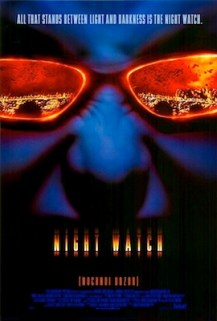
Night WatchUrban action fantasy from Russia; the first part of a trilogy (though, apparently, film two wraps the plot up and film three will be made in the US, looking at a different part of the story).
It makes for a pretty entertaining tale, with a neat ending that both concludes this film’s plot and leaves everything wide open for what’s to come. It also has some very snazzy subtitles (sadly only available on the two-disc DVD; I won’t waste too much space ranting about how crap the one-disc is here).

If you don’t like Films With Subtitles, this one might surprise you.

4 out of 5

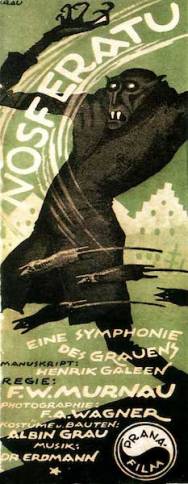
Nosferatu (1922)

aka Nosferatu, eine Symphonie des Grauens / Nosferatu: A Symphony of Horror

Nosferatu2007 #18
F.W. Murnau | 81 mins | DVD | PG

One of the earliest and most-referenced horror films, and the first screen adaptation of Bram Stoker’s Dracula (faithfully, albeit unofficially).

With such a weight bearing down upon it I found it quite hard to watch it objectively, and so was mainly left with the sense that I didn’t enjoy it as much as Sunrise and that I’d rather like to see a fully restored version. Perhaps Masters of Cinema shall treat us to one soon.*

Whatever one’s thoughts on it, it really is a must see for anyone into sci-fi/fantasy, horror, or (again) the history of film.

3 out of 5

* In the years since this review was written, they have. ^