
Patrick Tatopoulos | 92 mins | Blu-ray | 2.35:1 | New Zealand & USA / English | 18 / R
 It never seems to have been fashionable to admit to liking Underworld, the 2003 urban-Gothy-fantasy-actioner about vampires vs werewolves (here, Lycans) in the modern day, but I’ve always quite enjoyed it. It’s far from perfect, that’s for certain, but it has a kind of style-over-substance charm that I quite enjoy.
The 2006 sequel, Underworld: Evolution, is very much Part 2 of the story, but moves away from the urban settings to an array of more traditional Eastern European forests (albeit shot in Canada, I believe) and increasingly intricate myth-based storytelling. But still with guns. It’s also more full of creature makeup and gore (enough to bump the certificate to an 18 after the first film’s 15), and it’s not as good — Underworld may not be wholly groundbreaking (there’s a fair dose of The Matrix in there), but it felt less familiar than its sequel.
This third film is a whole different kettle of fish. With the first film’s dangling story pretty much wrapped up by the sequel (there’s room for more, but the main thrust is done with), this entry jumps back in time several hundred years for an origin of sorts, fleshing out flashbacks and backstory from the first two films. Unfortunately, we learnt pretty much all we needed to know in those flashbacks, and so in terms of both story and world-building Rise of the Lycans has little to add to the Underworld franchise. I suppose you could treat it in the style George Lucas wants us to take the Star Wars prequels and watch it before the first two films, but I don’t think it really fits there either — 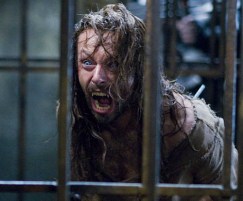 being set in medieval/dark ages times, this has a very different, more traditional feel than the urban original film… albeit with lashings of CGI.
In fact, it probably has most in common with the cycle of fantasy films we’ve received post-Lord of the Rings. There’s swooping shots of towering castles, werewolf armies storming the walls, over-designed armour, all that kind of stuff. It makes for passable fare, and I suppose if you watched it before the other two films you might be surprised with where the story ultimately goes. That said, the one twist aside — and it’s the kind of twist the studio would only have allowed a modern filmmaker to get away with because it was established in the backstory of another film — everything’s pretty standard and predictable, just with more (CG) blood and gore than you’d normally find (I’m surprised they didn’t push to bring it down to PG-13 territory).
The cast is led by two supporting actors from the preceding films, Bill Nighy and Michael Sheen. Nighy hams it up exquisitely, but placing him centre stage makes it a mite less fun than it was in the past. Sheen brings quality to any part and we get no less here. Rhona Mitra, being the franchise’s obligatory ass-kicking-girl (replacing Kate Beckinsale, whose character comes in to play much later in the fictional world’s timeline), is fine. I’ve seen an awful lot worse.
 In the director’s chair for the first (and, to date, last) time is special effects whizz Patrick Tatopoulos, who does a fine job of producing an action-fantasy film. There’s nothing remarkable about it but it largely works, though it’s a little bit on the dark side at times. I don’t know why so many films do this, incidentally — we’ve reached an era where people are mostly watching films in cinemas where the bulbs are under-lit to save money, or at home in probably less-than-ideal conditions, with various lights on and a screen left on factory settings. I wouldn’t mind if these dark movies looked fine once you were properly calibrated, but most of them are still ever so dark. Why do they think this is a good idea? Especially when you flick into 3D (which, fortunately, this film was just ahead of.)
But I digress. If you’re the kind of fantasy fan who was switched off by the urban antics of the first Underworld, this more traditional swords-and-monsters effort may appeal to your sensibilities. Otherwise, it’s really one for franchise devotees only, telling a tale you’ll know in a bit more detail. And for that, it’s not bad.

The fourth film in the series, Underworld: Awakening, which picks up the story twelve years after the end of the second film, is in cinemas in the UK and US from today.
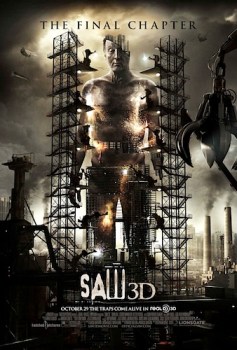 What’s this, the
  With so many characters killed off in the preceding films we’re not left with anyone to really care about — certainly not the new gang of coppers we’re introduced to. Actually, to say we’re “introduced to” them is a kindness — they just turn up and begin to lead that part of the plot.
 a lot more regularly than they were in previous films, and bits of them swing in the direction of the camera, but that’s in keeping with the style of the series and doesn’t jar massively — if you didn’t know it was shot for 3D, you wouldn’t notice most of it.
 The worst side effect of 3D, however, is that the colour looks ridiculous in 2D. I’m glad they’ve shot it with 3D properly in mind — everyone knows the glasses make 3D films darker, but not every filmmaker seems to be compensating appropriately (see, for example, the criticism of
 Sometimes, at least for me, films improve in retrospect. My opinion while watching may be different to when I look back days, weeks, months, or even years later. Films I thought I disliked may benefit from a kind of nostalgia; some films just gain something from extended reflection, even if that isn’t conscious; films I underrated may improve when I gain perspective on their qualities relative to other works; in some cases, it’s just that I’m getting older and wiser.
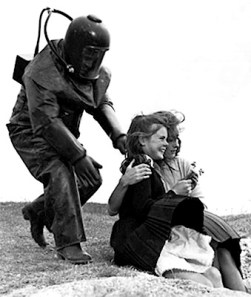 Not necessarily a bad thing, but it has that kind of disconnect from reality that’s markedly ’60s. In
 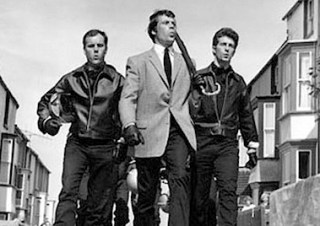 and the kind of inhumanity that might be reached in the quest to survive nuclear war.
 “Sherlock Holmes vs. Jack the Ripper” would be the easiest way to describe this pulpy ’60s effort. It’s far from the only example of this sub-sub-genre:
  and though by the end it’s explained who sent it, I was none the wiser what they’d been intending. And I watched the revelation scene twice too. Still, at least the important bit — who the murderer is ‘n’ all that — is quite neat.
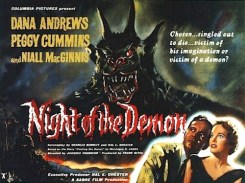 Adapted from an M.R. James story, Night of the Demon sees Dana Andrews as Dr. John Holden, a psychologist arriving in Britain to discredit satanic cult leader Julian Karswell. To cut to the chase, Holden begins to wonder if Karswell has placed a curse on him, and perhaps what he had set out to disprove isn’t such mumbo jumbo after all…
 Tourneur’s film is beloved by some, but I don’t think I quite got it myself. There are some great sequences, but I didn’t always find it hung together in between. Ironically, while many have criticised the actual appearance of the titular beast at the end, I think it works rather well — it’s surprisingly well realised, and you can take it as either a real manifestation or part of one character’s deranged imaginings. It’s an effective climax.
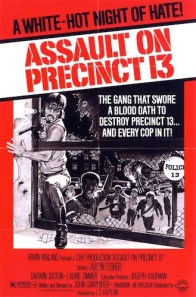 Assault on Precinct 13, it has always seemed to me, is an acclaimed cult classic of the action genre. I could probably find some references to support this — I know it’s on Tarantino’s list of the top seven exploitation movies, for starters — but for speed let’s just assume I’m right. Thing is, on initial impressions at least, I didn’t quite get that. It felt like an unexceptional low-budget ’70s exploitation B-picture to me.
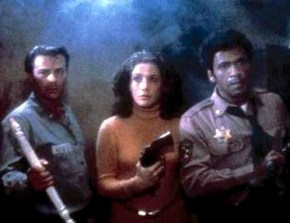
 a huge gang who lay siege to the cut-off station. So the cops and the prisoners must work together to fend them off.
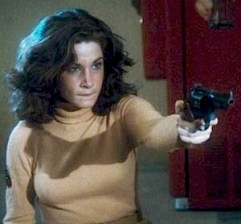 performing voodoo-esque rituals, coming and going as if by magic, doing things our heroes can’t necessarily explain, attacking in almost random waves… They feel almost supernatural; one might go so far as to say they play more like zombies than an organised criminal force. It’s no surprise that Carpenter would next helm
  And another says that, “like
  So begins Monsters. Expecting an epic SF-action movie where soldiers kitted out with futuristic weaponry battle an alien menace? You might be disappointed. Indeed, the relatively low
 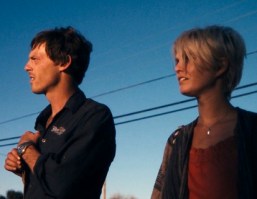 Only without being as worthy or on-the-nose as that makes it sound, I promise. As writer-director, Edwards has made a film that’s relatively Arty (for want of a better word), with lingering shots and wordless scenes. It tells the story visually quite often, letting the Infected Zone signposts or candlelit shrines to dead children or stunning scenery do the talking when dialogue isn’t necessary.
 The CGI is virtually faultless, which is doubly impressive as the vast majority of it is on shaky handheld shots, not nice clean plates. And Edwards created it all by himself I believe. Writer, director, cinematographer, single-handed visual effects unit — it’s no wonder much of the focus on Monsters has been on the clearly considerable skill of its creator. Much of the CGI would, I imagine, pass the casual viewer by: everyone knows the aliens are CG, but the film is littered with signposts and other such set and scenery extensions. It’s the kind of thing a bigger budgeted film would simply have created physically, but, working with next-to-no money, Edwards has managed to paint flawless versions of everything from simple road signs up to border checkpoints with his computer (and even bigger things, but they’d be CG’d in a big-budget movie too, so… well, hopefully you see my point). There’s the odd thing that doesn’t sit with complete realism, but even that depends how hard you’re looking. I’d say they’re the exception rather than the rule and very easy to forgive — nothing ruins its own shot, never mind the whole film.
 it’s easy to think what we saw in the night-vision sequence has led to this. But it hasn’t, because the military were Americans and we’re in Mexico. I’d wager this passes some viewers by, and perhaps it’s meant to, but there’s another clue: one of the soldiers whistling the Ride of the Valkyries; and when we get to the end of the film, as a pair of humvees trundle out to retrieve our heroes (by this point stranded in an evacuation zone just inside the US border), we hear the same soldier whistling again. And here’s where the change comes: rather than reaching the bit we’ve already seen and going beyond it, Edwards cuts off before he even reaches it. To put it another way, the chronological end of events is only at the beginning. It’s quite clever, and it also obscures what happens to the characters (how I shan’t say). That’ll irritate some, especially as even when you piece it back together it’s inconclusive. I’ll leave it to others to argue whether that’s the point and whether it matters. The final shot is clever though: instead of closing on the characters’ finally kissing, it ends on them being pulled apart. Technically their separation is only temporary — they’re both going with the military after all — but, as we saw at the beginning, one of them might not survive the journey home; a more permanent pulling apart. Nice metaphorical linking, Edwards.
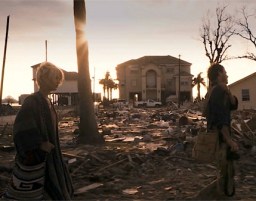 Another review I read somewhere commented that it’s a shame
  emerging with their low-budget, story/concept-driven genre films, not to mention Chris Nolan being allowed to do more or less what he likes in the big budget sphere, it’s easy to see why this is a very exciting time to be a lover of proper science-fiction. If they all continue to make films like this, we can look forward to an astounding future.
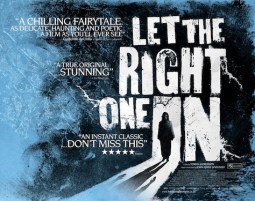 The most recent example of this speedy-remake phenomenon is Swedish vampire drama

 in fact, the director is keen to point out (in a surprisingly unpretentious fashion) that he doesn’t aim his work to slot into any particular genre — while Reeves set out to make a horror movie first and a young-love drama second. Though don’t go expecting out-and-out vampire thrills and gore from Let Me In, because it retains enough of the original’s DNA to make it still a pleasantly unusual genre entry.
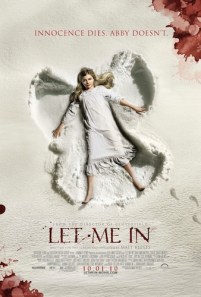 Owen is a 12-year-old loner in New Mexico in 1983, spending his days at school being bullied and filling his evenings spying on his neighbours. Then a girl, Abby, and her father move in next door and it looks like he might finally make a friend.
 The nighttime scenes are bathed in the orange glow of street-lighting, a nice choice of colour scheme as it’s evocative of the real world, especially as it’s not unnaturally overdone: the colour is abundant where there is such lighting, but more natural tones are used in forests, etc. It also provides a very different feel to the original, where a more white, snow-emphasising light was adopted throughout. Despite its realism, though, such a solidly orange palette does make the US one feel more visually stylised. Ironic.
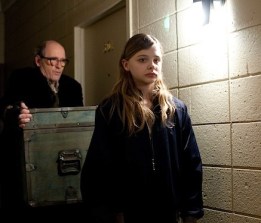 Despite it being easier to spot omissions than additions, Reeves’ film runs the same length as the original and feels faster moving. This may just be because I knew the story well, watching both versions just 24 hours apart, but some things are quantifiable: as well as far fewer scenes with the neighbours — in the original, characters; here, victim-extras — there’s also fewer arty shots of scenery, which helped give the original its sedate arthouse tone. What’s taken the place of all these things? Scenes from the novel, you might think, but from what I’ve read it’s faithful to the film more than novel — stuff I’ve read about being in the novel but not the Swedish film hasn’t been reinstated here either.
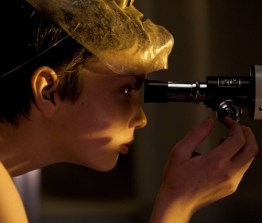 It seems he isn’t innocent in the same way Oskar was, that Reeves is building up his awareness of sexuality… but then he asks Abby to go steady and he still considers it to mean you don’t “do anything special”. What? Also, if she says “I’m not a girl”, surely the logical response is “you’re a boy?!”, not “what are you?” — especially if the only answer she’ll give is “I’m nothing”. But she’s not a boy — probably. It’s not explicit, but she seems much girlier, and of course it would remove any dangerous homosexual element. Or possibly they just wanted to make damn sure they didn’t need to include The Crotch Shot. Considering they’ve changed the bully’s teasing of Owen from “piggy” to “little girl”, it seems even more obvious a shame to have stripped Abby of her androgyny. Unless that’s the point? They tease Owen about being a little girl, before getting their asses kicked — or, rather, bodies ripped apart — by one.
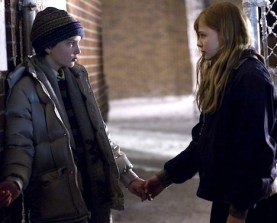 Similarly, the CGI is overdone throughout. It’s not bad per se, just used too overtly. Whereas the original remained grounded and (perhaps surprisingly) plausible, Reeves occasionally indulges in more stereotypical horror movie excess — take Abby’s first attack in the underpass, for instance: superficially similar, but in this version a computer-aided Abby flies all over the place. It draws attention to its has-to-be-fakery and is therefore a less effective sequence.
 It’s probably unfair to judge Let Me In by watching it so close to the Swedish version. I expect it benefits from a bit of distance. It’s still a well-made film, still an unusual take on a familiar genre. But it is — obviously — not as original or innovative. It’s also not as well acted, not as nuanced, not as beautifully made — the images Reeves conjures up do not burn themselves into your mind in the way so many from the original do.
 Oskar is a 12-year-old loner in Sweden in 1982, spending his days at school being bullied and filling his evenings with fantasies of revenge. Then a girl, Eli, and her father move in next door and it looks like he might finally make a friend.
 For instance, when the usual skills do crop up, they’re presented in a very grounded way — any CGI required is used subtly and incredibly effectively — or kept off screen. They’re at the best when used to slightly emphasise Eli’s weirdness — the way she drops ever so slightly slower than is natural from the climbing frame when she first meets Oskar, or to shape and manipulate her face almost imperceptibly at times.
 The story’s central relationships — mainly, Eli/Oskar and Eli/Håkan, he being the ‘dad’ figure who helps Eli survive — can be read various ways. The author/screenwriter, John Ajvide Lindqvist, has one interpretation — indeed, based on what I’ve read, the novel is quite clear on these points — but the film leaves many facts ambiguous. Is Håkan related to Eli? Does he love her? In what way? Does she love him? Does she even like him? Is he just a facilitator? Was he once in Oskar’s position? If he was, is she just manipulating Oskar? Or is it really love? Or is it just friendship? The joy of such well-placed ambiguities in a story is that each viewer can bring their own interpretation, without anyone being clearly right or wrong and without undermining the quality of the story being told. I think I know what I think; but, just as much, I enjoy the fact there are numerous possibilities. (Of course, equally valid is the argument that there are no ambiguities because most if not all have been cleared up Lindqvist and/or Alfredson in interviews. But where’s the fun in that?)
 Though most of Let the Right One In’s irregular take on vampires seems genuinely unique, one of those unusual elements — a 12-year-old girl being a vampire — immediately draws comparison to
  if they’d filmed some of the stuff in the novel, the filmmakers would’ve gone to prison — but also about refocussing the story to be a two-hour film instead of a novel. I’m not sure, therefore, how faithful the climax is, but it’s a sequence that seems made for the screen. I shan’t say much more on this point, just in case you’ve not seen the film and still read this far (tsk tsk), but it seems having a vampire for a best friend is a great way to deal with bullies.
 100Films.co.uk