
Wes Craven | 111 mins | Blu-ray | 2.35:1 | USA / English | 15 / R
 I had heard Scre4m (Scream 4, if you prefer) was dreadful; a misguided, belated attempt to revive a once-popular franchise. Personally, I thought it was fun.
Set ten years after the trilogy-closing Scream 3, the new movie wisely kicks off in years-later-sequel mode, re-introducing us to the (surviving) old characters and setting up a selection of new ones ready to be sliced ‘n’ diced. Unlike some subsequent horror franchises, Scream was never about inventive deaths, so the focus on character and storyline (relatively, at least) makes for a welcome change of pace from gore-riddled modern US horror movies.
One of the hallmarks of the original films, as I’m sure you’ll recall, is that they featured characters who were very aware of the rules of the horror movie. It played on these mercilessly, said characters employing knowledge of decades’ worth of horror films and horror sequels in order to (try to) survive. That’s not gone in Scre4m, which sets its sights on the US horror predilections that have followed since; mainly remakes and reboots. Sadly, there’s probably more on-the-nose dialogue-y exposition-y stuff about the poor quality and predictability of remakes than actually integrating such criticism into the film itself; but then again the parallels to the original Scream are there for those who care to look.
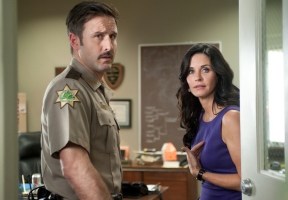 It also leads to quite a good extended bit where some characters reel off a list of recent remakes, which rather highlights just how far it’s gone now. There’s lots of examples of this fun ‘meta’ stuff for film fans; for real-world-stuff too, including references to Courtney Cox and David Arquette’s marriage, Emma Roberts being in the shadow of Julia Roberts, and so on.
In a nod to the rise of ‘torture porn’ films, Scre4m frequently reminds us that the rules have changed. I think what it really proves is there are no rules any more. Which on the one hand is fine — filmmakers have spent decades trying to subvert our expectations and surprise us in the horror genre — but on the other means the intelligent viewer can never be surprised, because every possibility is racing through our mind. Which, again, is fine — that’s the point: like every kind of murder mystery from Agatha Christie on, half the game is guessing the killer. And if you want to get suckered in to the jump scares, or think it through so thoroughly you remain ahead of them, that’s fine too. I think that’s one of the reasons horror movies have always appealed so much to teens: they’re still naive enough, unfamiliar with the rules of film enough, to get caught out by those things; whereas an older, seasoned viewer can see them coming.
 But, ultimately, all the discussion of horror movies and their rules is just window dressing: if there aren’t rules any more (which there don’t seem to be), it’s impossible for the characters to use them to survive, or for it to lend much self-reflexive weight to how the killer behaves. The only moment when it might be of use is when they predict the climax will occur at a party, and it turns out they’re having a party that very night! But then they go ahead with anyway. So much for that then.
Like so much of the film, Marco Beltrami’s score is amusingly overblown. He makes it sound like something terrifying is happening when someone sits in broad daylight typing “I don’t know what to write” on their computer. I had similar thoughts on bits of the acting, the murders, and so on — there’s an element of a wink and a nudge, of deliberately hamming it up. I think that some would see this as a lack of skill in the acting/writing/directing departments, but I think it’s a choice. Or I choose to think it’s a choice, take your pick. Arguably the resultant mix works as well as a comedy as it does a horror movie. This, I think, is part of why the Scary Movie movies are so reviled — they simply take the piss out of something that is, to one degree or another, already taking the piss.
In many respects, Scre4m is kind of old school. It fits better in the era of the original trilogy and/or earlier horror films than with the development of the genre in the intervening decade.  Though as the main development has been torture porn, and it criticises that explicitly from the very first scene, perhaps that’s still OK. In fact, they’re one step ahead again, with a nod to the most most-recent development (the Paranormal Activity-led “found footage” boom), which actually plays a more central role than the torture porn stuff.
It’s fair to say that a chunk of nostalgia for the originals colours my liking of Scre4m. Perhaps it plays best to those who saw the first three at the right age, i.e. mid-to-late teens or so. I shouldn’t think it would engage a new audience all that much, especially ones versed in the gorier Saw and Final Destination franchises. But for those of us with fond memories (to one degree or another) of the first three films, it’s kind of a nice little revisit.

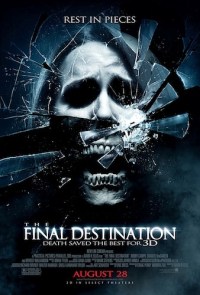 The best thing about The Final Destination is its title, because turning the series’ familiar name into a definitive article for the final entry is really quite a neat move. Sadly, it was a hit and they’ve made more. Why it was a hit… God only knows.
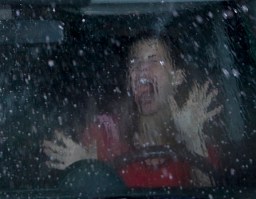 The focus is clearly on the deaths — at 11 it has the highest of the series, and with its short running time that means there’s a fatality every seven minutes. They’re also very gory, more so than in previous films I’d say, but they’re not commensurately more inventive. There’s a very thorough line in misdirection at times, but the whole enterprise feels painfully lacking in creativity. I’m not sure some of them even make sense. But then do they need to? Similarly, there’s some customary low-rent-horror-movie completely-gratuitous nudity too, which I’m sure delighted teenage boys even more in 3D.
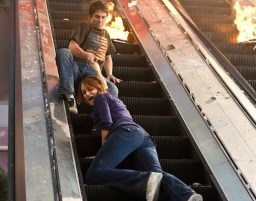 that’s a sure sign it was meant for cheap 3D thrills, but otherwise fine — here, stuff pokes straight out. That means in 2D you see, say, the flat end of a pole, with absolutely zero sense of depth. This happened with one trap in
 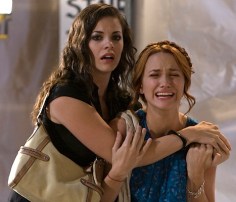 Elsewhere, one character starts talking about déjà vu before getting killed in the same way as the first film’s most famous death. I suppose it’s meant to be Meta and Funny, and maybe it kinda is, but again the CG is so cheap that the half-trained eye will spot an effect is about to happen, and the manner of death once again doesn’t really make sense. Later, we learn that shopping mall sprinklers can instantly extinguish all fires — handy!
 There’s potential in the concept of the Final Destination films, but clearly it’s either limited or the people in charge don’t know how to exploit it, because after making two quite-good films they’ve turned it into a repetitive, stale, uncreative, formulaic disaster. And there’s now a fifth too, and a sixth hasn’t been ruled out — surely it/they can’t be any worse than this? Based on form, maybe they can…
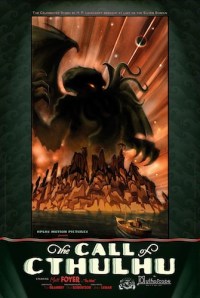 I must admit to not being at all familiar with the work of H.P. Lovecraft. I know the name, of course, and the titles of some of his stories, not to mention being aware of the array of well-known fans. Aside from that, I’ve only encountered his work through its influence — there’s some stuff in the
 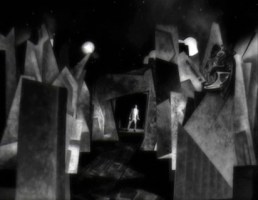 The marriage of low-budget and silent film style is one made in heaven, particularly when you add in the dedication of the makers. They built impressive props, ingenious sets, and employed model work in various inventive ways, all to execute a story that includes a cultist swamp orgy, a mysterious island, a sea battle, and a skyscraper-sized monster. Some online reviews have criticised the effects, but those people are quite frankly idiots. This isn’t meant to be slick CGI — it’s re-creating lo-fi early film techniques, and (aside from one or two rough-round-the-edges spots of greenscreen) it all looks fabulous.
 I have no idea how closely it hews to Lovecraft’s original, but there’s a layered stories-within-stories approach (I think it gets four deep at one point) that is difficult to pull off with clarity, but never falters here. Christopher Nolan would be proud. It also effectively builds a sense of uncanny mystery; not outright scares, but a kind of disquieting unease. It’s my impression that was absolutely Lovecraft’s aim too, so another job well done.
 It’s two-and-a-half years since this was released? Never! If it didn’t say so on multiple websites, I’d never believe it. Where does the time go?!
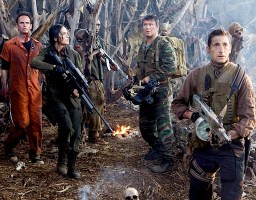 It’s a similar story elsewhere in the film. If you haven’t already accurately guessed what the ‘twist’ is with the doctor just from me even mentioning him, then I’ll be surprised. You may also be aware that Laurence Fishburne is in the film — he’s in the trailer and, naturally, one of the top-billed names. If you weren’t aware, sorry; but if you are (as, indeed, you now are), then his lack of appearance early on will likely clue you in to the circumstance under which he’ll be found. But if you’re not expecting him, that’s all fine and dandy. But now you are. Sorry.
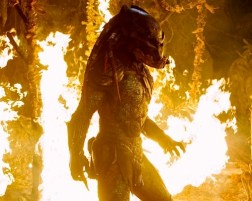
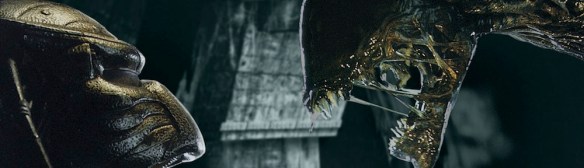
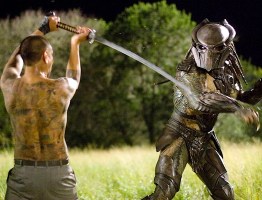 The main draw is still the action, which is suitably exciting on the whole. Best of all is a sword fight between a Yakuza and a Predator. Who’d’ve thought of engaging a Predator in a sword fight, eh? I love a sword fight, and while this is of course an atypical example, it shows the film’s level of creativeness with its inherited elements. It’s also a beautifully shot segment, making it one of the stand-out parts of the film.
 And the ending itself… is it sequel bait? It’s not as bad as
 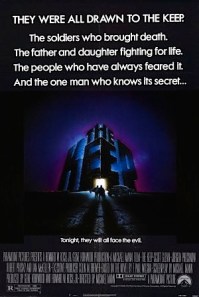 Michael Mann is arguably best known for his modern, urban, slick, intricate crime thrillers — films like
 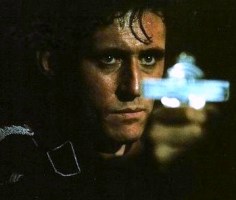 Should we long for a Director’s Cut, then? Maybe that would be an improvement, but I’m not convinced it would be good per se. You see, the film doesn’t just stick to giving us Nazis vs Whatever The Keep Contains, oh no. First the SS turn up, led by a Properly Evil Nazi, played straight by Gabriel Byrne. Escalation, great. Then there’s Ian McKellen as a professor drafted in to make sense of the keep’s mysteries. Also great — even the Good Nazi is going to have to die, right? Who better to root for than a saved-from-a-concentration-camp Jewish professor.
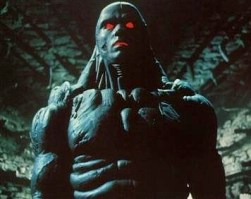 There are plus points, but they all come with a commensurate downside. The creature is well-realised at first, with some nice animated effects that are more effective than much of the over-cooked CGI spectacle we’d get today. The more we see of him, however, the less power he holds — he ends up essentially a very tall man. OK, it’s a bit better than that makes it sound, but the mysterious billowing smoke was spookier. The film on the whole is nicely shot, with some real standout moments of cinematography. But slow-mo and a smoke machine both get overused by the end, lending many of the visuals a tacky ’80s edge.
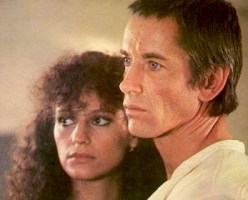 One thing the film never manages to be is remotely scary. It’s not aiming for cheap jump- or gore-based shocks (although there is a little goriness, it’s quite light; triply so by today’s standards), but it doesn’t manage any significant senses of dread or creepiness. As noted, early on it seems to be heading in the right direction — even the secluded mountain village, nestled in a harsh landscape but with greener-than-green grass and garishly painted houses, and towered over by the foreboding slab of stone that is the titular structure, is an uncanny start — but it never makes good on the promise.
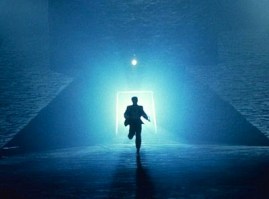 I would love to join their ranks, because there are numerous exciting ideas and moments of quality filmmaking to be found here; but I won’t be, because there’s too much muddled dross packed in around them. The result is that quite-rare thing: a decidedly mediocre film that I’m actually glad I’ve seen. But, unless someone wants to hire me for that remake, never again.


 Remember when M. Night Shyamalan was the wunderkind of Hollywood? Seems so long ago, doesn’t it? But clearly someone somewhere is still invested in him — or he’s managed to limp on well enough that stuff he works on seems worth a punt — because a couple of years ago he was able to launch a series of films dubbed “The Night Chronicles”. I don’t remember the details and they’re not worth looking up, but as I recall the idea is they were a series of low-key/low-budget horror-thrillers conceived by Shyamalan (he has a Story and Producer credit here) but helmed by others. Devil is the first of these. I don’t recall a second turning up yet.
 not the best, but with enough action, intrigue and twists to fill its (admittedly very brief) running time. It comes to a head with a pretty good twist/reveal. Again, it’s kind of ironic that it’s the best twist in a Shyamalan film for years, but it comes in a movie he neither wrote nor directed. Maybe he should take another look at the kind of films he’s choosing to make. (I say “maybe”…)
 As an aside, in my occasional run of Comments Paying Too Much Attention To Certificates, it’s funny what Americans allow at what age rating. Here we have neck stabbing, hanging, creepy devil stuff… Seems a bit much for a PG-13, to me. The UK’s 15 is much more appropriate.
 According to
  a properly chilling murder scene, quite out of step with the film’s age and PG certificate.
 There’s also a hefty dose of coincidence that everyone involved, both on screen and off, conveniently ignores.



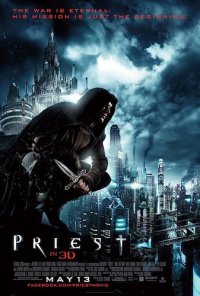 In a dystopian church-ruled future (could there be any other kind of church-ruled world), in which a war between men and vampires raged for centuries but has recently been settled (in man’s favour), no-longer-needed warrior-priest Paul Bettany is called upon to go against his vows and leave the city to rescue his niece after her parents are murdered and she is kidnapped in a vampire attack. I could go on, but it’s the kind of plot that sounds far more complicated in a short summary than it is to watch on screen.
 And after all that meandering, the story is a bit rushed. It tries to generate character and tension, but hasn’t spent enough time building them to earn it. There’s lots of awful dialogue, flooded with clichés… as is a lot of the plot, and the stock dystopian future setting, and the overuse of slow-mo. There’s some ideas with promise, but they’re largely shunted aside in favour of something from The Big Book of Standard Character Arcs. And I say “promising” — you know exactly how they’d play if the filmmakers had bothered to make more out of them.
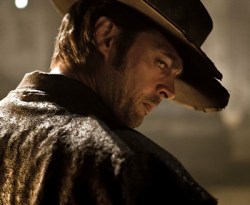 None of this is helped by weak acting, which considering the largely quality cast is probably down to the script and direction. How unlikely is Paul Bettany as an action leading man, eh? I thought Jason Statham was odd enough… And if you want a preview of
  Priest isn’t bad per se — well, depending on your tolerance levels. It’s no
  100Films.co.uk