2014 #34
Michael J. Bassett | 104 mins | Blu-ray | 2.35:1 | UK, Czech Republic & France / English | 15 / R
 The year 1600: British ship’s captain Solomon Kane is not a nice man, a mite too fond of pillagin’ and killin’ and quite possibly other not-nice things ending in —in’. That is until he has a run in with the Devil’s Reaper. Hell has claimed his soul, and its time to collect. Solomon does not plan on being collected, renouncing his former life and trying to hide at a monastery in England. But as a gang of possessed men lay waste to the countryside, burning its towns and enslaving its people, will Solomon be able to stick to his newfound pacifism? Yeah, we all know the answer to that…
Star of a series of pulp fantasy stories and poems by Robert E. Howard, creator of Conan, this version of Solomon Kane is inspired by those works rather than adapted from them. It’s an origin story, showing how Solomon came to be the man he is in Howard’s tales, though you’d be forgiven for missing that: writer-director (and lifelong fan) Bassett has managed to construct a story that feels entirely complete in itself, not mere setup for future adventures. Even though the ending is ready for the planned-but-unlikely sequels, it’s open for, rather than expectant of, them; a pleasing oddity in today’s franchise-driven blockbuster landscape.
The style is a fantasy-horror mash-up, recalling everything from the 1982 Conan to Witchfinder General, and plenty more besides. That’s not to say its a rip-off of those movies, or even some kind of cobbled-together reference-fest, but rather that its roots and inspirations — the previous works it aligns itself with — are discernible for those familiar with them. There’s some creepy creatures and sequences, no doubt thanks to Bassett’s previous directing horror movies, 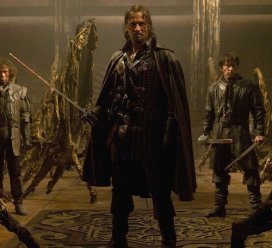 but also a more-than-requisite amount of swordfighting and the like — all told, Kane is more period action-adventure (with demons) than period horror.
Nonetheless, some viewers have found the pacing off. It’s true that after a big opening action scene the story slows down for a time, and that later on events become a tad episodic, but I think this gives the film more of a unique flavour than your usual action-adventure flick, where the action sequences are carefully designed to build in scale and are methodically spaced throughout the running time. The way Bassett plays things allows more time for character and mood to grow, and while his screenplay doesn’t always excel at uncovering those things, a first-rate cast brings the necessary.
In the titular role, James Purefoy is best as snarling action hero rather than when tormented and penitent… but that might just be because all-action Kane is more fun. Indeed, the less-nice version we meet in the opening sequence is perhaps the best of all. On his solo audio commentary, Bassett says that everyone on the crew fell in love with that incarnation, and suggests there might be room for a prequel starring the pre-heroic version of the character. If we’re not getting sequels then we’re certainly not getting that, but Kane’s anti-hero antics do promise entertainment value. (I’ve read that Kane isn’t actually all that nice in Howard’s original stories — perhaps, contrary to the film’s “origin story” aims, more like the movie’s opening version? The film has given me a desire to check out the original works, though I don’t know when I’ll get round to it.)
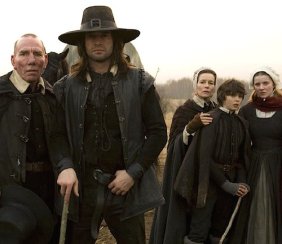 In support there’s the likes of Pete Postlethwaite, Alice Krige and Max von Sydow, all of whom bring instant heft to roles that need it. I don’t mean to say the screenplay doesn’t contain it, but the shorthand the actors bring with them certainly does favours. Cameo-sized appearances by Mackenzie Crook and Jason Flemyng are also effective, and watch out for a pre-Game of Thrones appearance by Rory McCann, aka The Hound.
Although made for a relatively tight budget on a swift schedule, every technical element sings. Dan Laustsen’s cinematography is gorgeous, whether it be the golden hues of an African throne room, the cold blue-whites of an English winter, or the muddy browns and rainy greys of later sections. I’m sure there’s a lot of digital grading involved in all this, but does it really matter how something was achieved when it’s achieved so well?
Full marks too for Ricky Eyre’s production design, David Baxa’s art direction and Lee Gordon’s set decoration. I don’t want this to read like the credits scroll, but the work done on the sets and locations is phenomenal and those responsible deserve the praise. Their work wouldn’t look out of place in something as crazily budgeted as The Hobbit — and hurrah to them for actually building it, whereas the majority of Jackson’s Middle-earth locales now seem to be CGI.
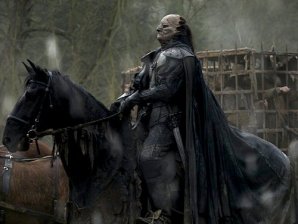 My praise also extends to those responsible for the film’s location shooting. Shot in the Czech Republic, for once that genuinely looks like Britain. OK, the style of some buildings give the game away occasionally (in particular the monastery), but until I read different, I just assumed the fields, forest and coastline had been found in our real South West, on the moors or what have you.
Further kudos to those responsible for the fight choreography (so good that even a deleted sequence (included on the Blu-ray) is better than many films can manage), for make-up, for creature design, for costumes, for the CGI… Rare is the element that lets this movie down. Indeed, my one real gripe is a final-act monster that seems to be beyond the scope of the filmmakers — between slightly jerky animation and a flatly limited choice of camera angles, it literally looks like a modern video game cutscene. Considering the excellent effects in the rest of the film (the opening sequence is a highlight in this regard, particularly the flaming sword that begins to melt Kane’s own), it’s a shame. That said, it’s not bad CGI, just not top-notch. If that’s the biggest complaint, there’s nothing to worry about.
Also, it’s permanently raining. Which looks great. Whoever was in charge of rain did a fab job.
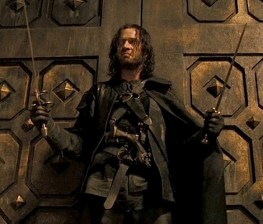 At the end of the day, Solomon Kane is a period fantasy action-adventure, something which doesn’t seem to be everyone’s taste — it has relatively weak scores on the likes of IMDb and Rotten Tomatoes (though, in the context of how this kind of movie often performs in those arenas, they’re far from awful). For my money, however, it’s a great little film. It looks beautiful, it renders the tone of pulp fantasy brilliantly, its action sequences are exciting (so many swordfights! Heaven!) and its creepy bits unnerving. It may not be ‘trash’ elevated to art — it’s not a Tarantino movie — but it is pulp fiction treated with due reverence.
The UK TV premiere of Solomon Kane is on Film4 tonight at 9pm.

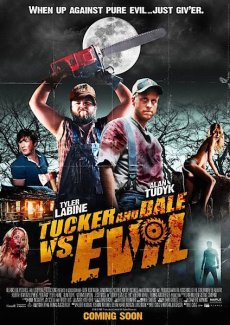 Riffing on the “evil hillbillies” horror sub-genre, a pair of simple country folk on a fishin’ holiday encounter a gang of college kids who, through a series of unfortunate coincidences, mistake them for murderous psychos — and decide to fight back.
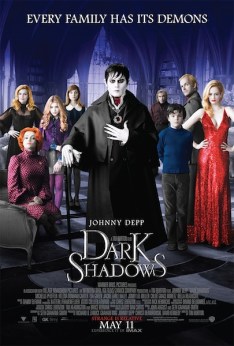 Director Tim Burton’s most recent live-action movie is an adaptation of a 1960s soap opera… albeit one featuring vampires, witches, ghosts and sundry other supernatural goings-on. You wouldn’t get that on
 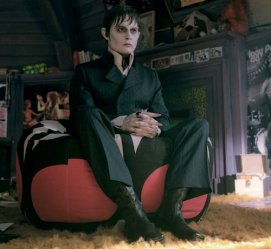 Early on, it works. The first 20 to 30 minutes offer a serviceable prologue and an engaging introduction to most of the characters. It’s funny, it’s occasionally spooky, there’s a good deal of promise for a marginally-more-serious
  It’s a tonal grab bag: at times it seems to be a knowing spoof of daytime soaps, at others pushing for drama almost with a straight face; it’s sometimes deliberately and successfully comedic, at others straining too hard for a desperate laugh; it has a strain of bizarre sexuality that may be aiming at comic but is frequently just uncomfortable. This scrappiness leads to the most cardinal sin of any entertainment: it ends up a bit boring; and, in its out-of-the-blue big-battle climax, crushingly derivative.
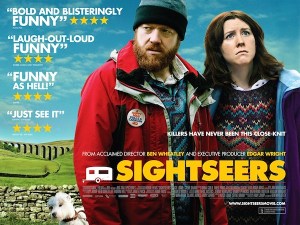 “He’s not a person Tina, he’s a Daily Mail reader.”
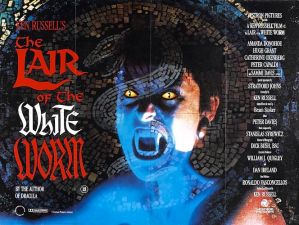 The Lair of the White Worm looks cheap, has a ridiculous story, overacted characters and overcooked dialogue, and by all rights should be a disaster. And maybe it is… but I don’t think so. In the right frame of mind, at any rate, it’s a whale of a time.
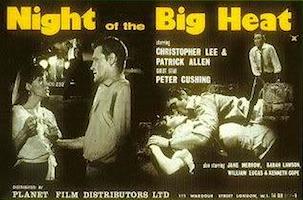 These days largely sold as a horror movie (the old Collector’s Edition DVD is branded as part of a “Masters of Horror” series), probably thanks to its cast (Christopher Lee and Peter Cushing), director (Terence Fisher, of many a Hammer Horror, including five with Cushing and Lee), and rating (an X originally, a 15 now), Night of the Big Heat is not really anything of the sort. Well, maybe a little; but you’re more likely to get scared by a contemporaneous episode of
  the pair were brought in to redraft because the original screenplay’s dialogue was “unsayable”. Anyone familiar with their ’80s work on Doctor Who, and their associated reputation, will find that highly ironic.) However, when the sci-fi stuff does roll in it’s a bit of a damp squib, leaving the scenes relating to the affair, whether it will be discovered, and what various characters do about their various feelings, as some of the more unique and interesting elements.
 which considering it was shot in February and March is a real achievement. During night shoots the cast had to suck ice to stop their breath being visible, while running around in wet clothing to look like they were drenched in sweat. Poor sods. Said night scenes are a mess of genuine and atmospheric nighttime shooting, alongside the kind of day-for-night filming where everything’s extremely dark except for the sky, and also the kind of day-for-night filming where it’s day and… um… shh!
 Originally produced for the 2010 FrightFest film festival, horror director Jake West’s feature-length documentary with the unwieldy title explores the ‘video nasty’ scare that gripped early-VHS-era Britain. Starting with a primer on the birth of home video, and what it was like to watch movies in those days (because, ladies and gents, we’ve now reached a point where even fans of that (second-)most adults-only of genres, the gory horror flick, are young enough to not recall a time before DVD), West uses archive news clips and a wide array of new talking head interviews to take the story from the UK’s first video recorders in 1978, through a newspaper-led panic, up to the infamous Video Recordings Act of 1984, which irrevocably (thus far, anyway) changed the face of home entertainment releasing in the UK.
 Focusing on the scare rather than the films embroiled in it makes this less a “horror documentary” and more a social history/pop culture one, though the liberal use of extreme clips from the movies in question shuts out anyone without a hardened stomach. (If you did want more on the films themselves, the DVD set that contains the documentary — Video Nasties: The Definitive Guide — includes 7½ hours of special features discussing all 72 ‘official’ video nasties alongside their trailers.) There’s room for little asides amongst the main narrative, though. One of the highlights is the story of an interviewee who was invited on to Sky News in the wake of the James Bulger murder and asked if the film many were holding responsible,
  There was some counterargument, however, which leads us to the film’s best interviewee, and surely a new hero to many: Martin Baker. Baker was one of a few (certainly the first, and for a time the only) critical/intellectual-type voices to speak out in defence of the films that were outraging so many. He’s to be commended not only for his valiant defence of, essentially, free speech at a time when his views were immensely unpopular; but also because he remains one of the most lucid and fascinating commenters in the documentary. He makes the clearest points about the need to not forget both what happened and how it was allowed to happen, lest it occur again.
 that force ISPs to attempt to censor what we can and can’t see on the internet, and just yesterday rushed through anti-privacy legislation without proper debate. Sad to say, many of the valuable lessons of the ‘video nasties’ brouhaha — lessons made explicit with superb clarity in Jake West’s excellent documentary — have not been heeded.
 Nicolas Cage fulfils his long-held wish of playing a comic book hero in this peculiar effort from the writer-director of
  The writer-director of
 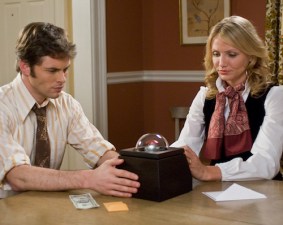 What a nice tribute to his supportive parents and their devotion to one another, eh? At the start, perhaps, but by the end of the film you may be wondering what the writer-director’s subconscious wants to do to his ma and pa…
 What could function well as an indie-level thriller is further undermined by abundant, therefore costly, CGI. Whether that’s Langella’s facial disfigurement (what could’ve been make-up is actually a complex array of tracking dots, green face-paint, motion-control cameras, and so on; all used merely to place him in simple dialogue scenes), or wide shots of ’70s Virginia, with a computer-adjusted skyline, computer-animated cars, and computer-painted snow. It’s not that the effects work is poor (though don’t look too closely at those cars), but that it screams “this must be special effects!” when you don’t want such distractions.
 The Box should have been a film we all discussed for years to come, its “what would you do”-ness providing an
 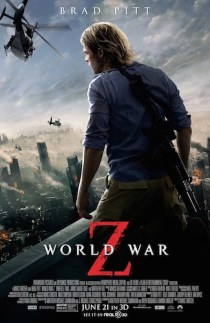 In the weeks leading up to its theatrical release, it was already known that World War Z was going to be an almighty flop. An unscrupulous movie studio had taken a cult novel and thrown away everything but the title, alienating its existing fanbase. They’d spent a fortune making a movie in a traditionally R-rated genre that, if released at R, could never make its money back, and if released at PG-13 would never attract an audience. Then they reshot the entire third act, pushing the budget through the roof and ensuring the resultant film would get critically mauled. A fanbase snubbed, an impossibly huge budget, a genre/rating disconnect, and unavoidably poor reviews to come — World War Z was going to flop, and it was going to flop hard.
 That, at least, is something different. The first half-hour races through stuff we’ve seen time and again: zombie attacks, humans turning on humans as they loot supermarkets, etc. Here the zombies are of the
  It’s a Wales populated by a Londoner, a Scotsman and a Spaniard, but still. I say “more tense” because this is far from the most nail-biting zombie film you could see. The finale is a nice change of pace, and does work as a climax in spite of the bombast that precedes it, but these are zombies as teen-friendly action movie menace, not adult scare-inducers, so don’t except to feel much fear or surprise.
 but I don’t think it was the filmmakers’ aim to make us feel the characters’ plight, but instead to show the scope of a worldwide disaster. It does that pretty well, even if the occasionally-CGI zombies prove to be an
  100Films.co.uk