2015 #21
Neil Jordan | 119 mins | Blu-ray | 2.35:1 | UK, USA & Ireland / English | 15 / R
This review alludes to some spoilers.
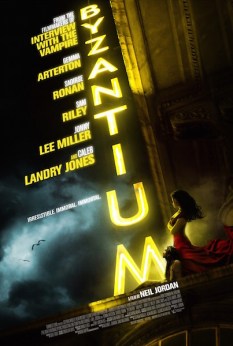 18 years after he adapted Anne Rice’s seminal vampire novel Interview with the Vampire into a seminal vampire film, director Neil Jordan helmed another tale of two inextricably-linked immortal bloodsuckers. However, while the older film was a lavish, luscious, romantic fantasy, Byzantium is an altogether seedier, baser view of eternal life.
The narrative unfurls in two timelines: the present day, where vampire mother Clara (Gemma Arterton) and daughter Eleanor (Saoirse Ronan) find themselves in a washed-up seaside resort while on the run from who-knows-what (well, Clara knows; Eleanor doesn’t); and 200 years ago, when a young Clara found herself entangled with a pair of military officers (Jonny Lee Miller and Sam Riley) that led to… well, you can guess what. Between them the two strands hint at a rich mythology; one we seem to be witnessing a side story of, rather than the usual epic world-altering confrontation of most fantasy cinema. Screenwriter Moira Buffini (adapting from her own play, A Vampire Story) retains enough familiar vampiric tropes to be recognisable to aficionados, but also offers unique twists and tweaks to keep us engaged.
Although the past storyline has its pros, and merges with the present day in time for the climax, the less mythologically-minded viewer will see the meat of the film as being Eleanor’s story. The forever-16-year-old is becoming disillusioned with her secretive existence, longing to share her truth with someone. When she twice bumps into genuine-16-year-old leukaemia survivor Frank (Caleb Landry Jones), it’s easy to see where the broad strokes of their encounter will lead. A back-cover pull-quote describes Byzantium as “the best vampire film since Let the Right One In” — their relative qualities are a separate point, but this adolescent ‘love(?)’ story is an obvious point of comparison nonetheless.
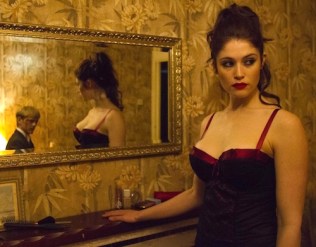 The most effective part of the movie isn’t so much its plot or its mythology, though, but its atmosphere. Vampire movies take place in castles or drawing rooms, or high schools in more modern iterations. They are grand and sensuous. Any glamour in Byzantium is discarded and decrepit, like the titular hotel that Clara reshapes as a whorehouse; faded and left to ruin. The seafront is characterised by graffitied concrete, the glaring lights of arcade machines, heroin-chic Eastern European prozzies. The pier appears to have burnt down at some unspecified previous time and just been left. The only people left behind are the ones without a means of escape, stuck with their miserable lot. Clara and Eleanor fit in almost seamlessly.
Some have picked up on an apparent lack of change or development in the lead characters’ personalities over 200 years, calling it out as a plot hole. Is it? Or is it part of the point? These two haven’t become wiser and more experienced over their long lives, but instead have become stuck in a rut, repeating the same lies and performing the only roles they know. That’s why Clara still works as a whore; why Eleanor still struggles with the guilt from her religious upbringing; why they stick together as protective mother and innocent daughter. It’s just as true of the other immortals we ultimately meet, an organisation stuck in outmoded patriarchal beliefs, who have held a grudge for two centuries. Here, the immortality of vampirism seems to mean not only staying physically the same, but mentally so as well.
 Other alleged faults include the film not giving enough time or heft to facets individual viewers want it to cover. For one example, someone criticised it for not fully exploring the issue of voluntary euthanasia. I’d argue it doesn’t explore it at all, because it’s not trying to. That Eleanor chooses to only kill people she perceives as wanting to die is not her making a moral statement on a contentious issue, but finding a way to marry her conscience and upbringing with the necessities of her vampiric life; and it’s probably practical, too. That’s not to say a vampire movie can’t be used to explore a topic like voluntary euthanasia, but if you want that I’m afraid you might have to write your own.
I don’t wish to imply that Byzantium is faultless in its execution of every point it raises, however, as some do fall by the wayside. Not least of these is Frank’s leukaemia, which has its useful points (bloooood), and I suppose it’s a good thing we’re spared the “wants to become a vampire to survive fatal illness” trope (because his cancer is in remission), but it also feels like it’s there for that trope, and by dodging it the film has nowhere else to go with his illness. A similar fate befalls the character of Frank’s mother, probably by association. What does she think of her sickly son disappearing off with some girl he just met, possibly forever? We’ll never know…
 Technically, DoP Sean Bobbitt grants us some gorgeous cinematography. There’s a cruel, aptly soulless beauty to the faded town, while some countryside vistas, both past and present, offer more traditional scenic pleasure. A remote rocky, misty isle — central to the mythology and so repeatedly visited — is particularly notable. Captured entirely on digital cameras, it seems sometimes that Bobbitt tried to push his equipment too hard: some shots during the climax look flat-out weird, as if someone has applied a Photoshop “comic book” filter or something. Also of note is the score by Javier Navarrete, which makes particularly good repeated use of The Coventry Carol.
Byzantium is a particular kind of experience. It’s the kind of film that hints at an epic mythology but doesn’t explore it, which some will be glad of and others regret; personally, I feel both at once — there’s a grander story left here, but I’m not sure I want it told. The narrative the film does contain is grounded in a melancholic reality; one that finds a kind of splendour in forgotten things and places; that almost elevates the shabbiness of a half-abandoned community to desirability, while acknowledging that it’s nothing of the sort. It takes vampirism and its associated immortality as something tempting but terrible and fantastical but tangible, and finds reflections of that in real-life experiences and locations.  For all its dual-period storytelling and its grubby settings, it’s a resolutely modern kind of take on vampire mythology.
There’s little doubt that the film’s brand of melancholic beauty is not to all tastes — an array of poor and middling reviews are easy to find — but it has qualities that must be recommended, and the potential to be darkly loved.
The UK TV premiere of Byzantium is on Film4 at 9pm tonight.
It placed 5th on my list of The Ten Best Films I Saw For the First Time in 2015, which can be read in full here.

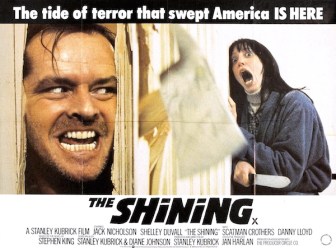 Fêted director Stanley Kubrick turned his hand to horror for this Stephen King adaptation. Poorly received on release (it was nominated for two Razzies: Worst Actress and Worst Director) and reviled by King (he attempted his own version as a miniseries in 1997. It didn’t go down well), it has since been reassessed as a classic. I’ve never read the novel, so have no opinion on the film’s level of faithfulness or (assuming it isn’t true to the book) whether that’s a good thing or not. As a movie in its own right, however, The Shining is bloody scary.
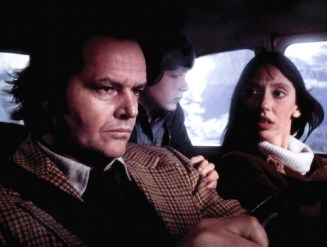 Gradually, inexorably, the film builds a sense of dread; a fear so deep-seated that it feels almost primal. There are few jumps or gory moments, the easy stomping ground of lesser films. There’s just… unease. It’s a feeling that’s tricky to put into words, because it’s not exactly “scary”; even “terrifying” feels too lightweight. There are undoubtedly sequences of suspense, where we fear what’s coming or what will happen to the characters (everyone knows the “Here’s Johnny!” bit, for instance), but that’s not where the film’s impact really lies.
 The first manned mission to Mars is reaching the end of its six-month tour. As they count down the final hours, battling a dust storm and its attendant power outages and communications blackouts, one of the team secretly discovers bacterial life on the surface. Attempting to recover further samples, a sink hole opens beneath him. When the rest of the crew try to recover his body, it’s not there. Then he arrives back at base… only, he’s not quite himself anymore…
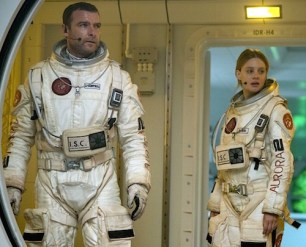 These faults persist despite the best efforts of a quality cast, particularly Romola Garai as (in functional terms) the capable sidekick, and Olivia Williams as the bitch whose heartless practicality becomes an asset when the going gets tough. First-time feature director Ruairí Robinson assembled his cast on the principle of “people who aren’t normally in sci-fi movies”, and that does feed in to the sense of realism. It also looks great, the production, costume and effects designs gelling to create a believable Mars mission, all in spite of a tiny budget (funded by the BFI and the Irish Film Board, it had about a tenth of Gravity’s budget, for example). Credit, too, to cinematographer Robbie Ryan for lensing the Martian surface convincingly (it’s actually the Jordanian desert). The editing may descend into fast-cut blurriness during action scenes — only emphasised by Max Richter’s predictably derivative horror movie score — but during calmer moments the film looks very good.
 and was more sure of its tone. There may be elements to commend The Last Days of Mars in this comparison (the much bigger budget pays off in the scope of the visuals, of course), but as a story and viewing experience, The Waters of Mars wins hands down.
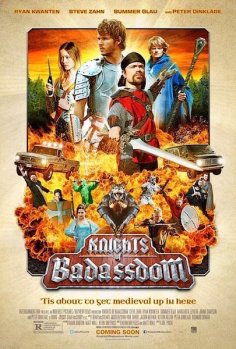 After being dumped by his long-time girlfriend, Joe (
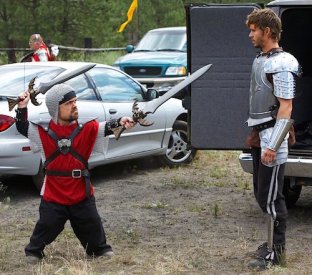 It’s a fine line to tread, and it seems to me that Knights of Badassdom manages it well. You get a sense of why people choose to do this and the fun that it can be — indeed, the final epic battle between the two factions of LARPers, complete with grand pre-fight speeches from each army’s general, and an awesome surprise, is kinda cool. Equally, the film doesn’t hold back from riffing off the sillier aspects of LARPing, including the rules of combat.
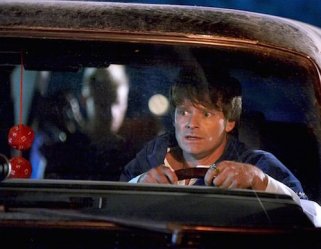 if that’s your bag, there are plenty of films to cater for it; is a comedy about role-players really the occasion? There are elements of the film that could do with tightening up — the beginning is a little slow, as well as the issues with the middle, and towards the climax it’s sporadically jumpy in a way that makes it clear something has been excised — but just adding gore is not what this film needs to improve it.
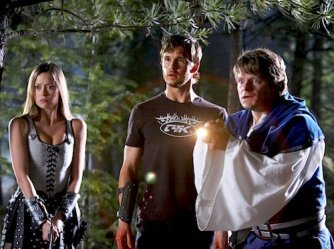 As it stands, Knights of Badassdom is an entertaining way to spend just under 90 minutes. A more restrained approach might yield a tighter movie, one that could be funnier by percentage (the trailer remains popular, and you don’t get more condensed than that), but I think it’s still well enough constructed to keep genre-minded viewers entertained.
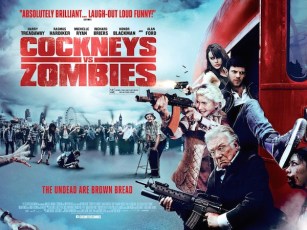 Screenwriter James Moran doesn’t like it when people compare Cockneys vs Zombies to
  And why is their imagination so stunted that they can’t accept them anyway?
 Liam Neeson shoots wolves for an arctic drilling company, but when his flight home crashes, he must attempt to lead the small band of survivors across an icy wilderness to the mere hope of safety — pursued all the way by murderous wolves…
 A behind-the-scenes making-of with a difference, American Movie: The Making of Northwestern (to give its full title) is a documentary about wannabe-filmmaker Mark Borchardt attempting to produce a horror feature film with little more than some mates and good intentions, battling against a lack of money, interest, and dedication. It descends, quickly, into the kind of farcicality that leads some to assume it’s a
  Whatever you take away from it, American Movie feels like a must-see for certain sections of film fandom, particularly anyone who wants to make a movie themselves. Its appeal is broader than that though, an everyday story of adversity that isn’t so much overcome as temporarily averted. It’s not bleak or sad, but it is melancholic. And, whatever the morals of it, often laugh-out-loud funny.
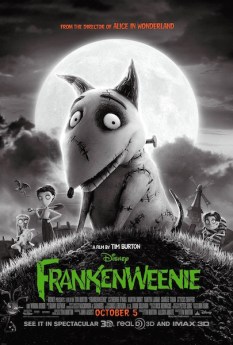 Inspired by two of Burton’s early-’80s shorts (which are most commonly found on
  Some say it doesn’t have enough of an edge. Well, maybe; but I thought it was surprisingly dark in places. Not so considering it’s a Tim Burton film based on resurrecting the dead, but for a Disney-branded animation, yes. Those edgier bits are here and there rather than consistent, but still, I’m not sure what those critics were expecting from a PG-rated Disney animation. I guess there’s an argument that Burton should have pushed it further and aimed for an adult audience, but can you imagine an American studio agreeing to finance an animation primarily targeted at anyone who’s entered their teens? Because I can’t.
 Box office gross is one of the methods most often used to summarise a film’s success and standing, and yet it’s one of the most useless markers of quality — and quotes like the above, from Terrence Rafferty in his article “Holy Terror” for Criterion’s Blu-ray release of Night of the Hunter (and available online
  In another piece in Criterion’s booklet, “Downriver and Heavenward with James Agee” (online
  And yet, as Rafferty explains, “the most radical aspect of The Night of the Hunter… is its sense of humor. More conventional horror movies overdo the solemnity of evil. The monster in The Night of the Hunter is so bad he’s funny. Laughton and Mitchum treat evil with the indignity it deserves.” I wouldn’t say that humour is one of the film’s defining characteristics, to be honest, but it does undercut its villain. He’s not some unstoppable supernatural creature, but a man who can trip over while chasing you up the stairs, and so on. In some respects it’s this very ordinariness that makes him so scary: however much they creep you out during the film itself, you know there’s no such thing as vampires or werewolves or ghosts. There are Powells in the world, though; an everyday evil that you might not see coming, but can still get you. Brr.
 In
In  Based on the cult novel by Cracked.com editor David Wong, John Dies at the End is a bizarre horror-fantasy that defies easy explanation or summary.
 100Films.co.uk