2015 #121
Adam Fields | 80 mins | streaming | 1.78:1 | USA / English | 18 / R
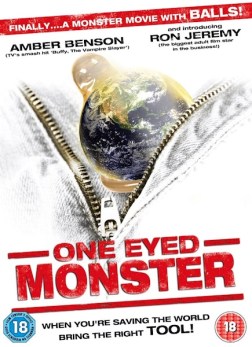
Sometimes, I swear off consciously watching any more likely-to-be-bad movies. And sometimes, I just feel like attempting something like One-Eyed Monster. And this is why: it’s actually pretty fun.
I have been known to suggest in my reviews of films that the writers/producers/whoever surely came up with a title and then tried to base a film around it. I imagine that’s actually the case fairly rarely. Here, however, I feel certain that’s what happened. For the innocents among you… well, maybe you should stop reading now. For the slightly-less-innocent, “one-eyed monster” is a euphemism for a (whisper it) penis. It also contains the word “monster”, like, y’know, a horror movie. What if you made a horror movie where some chap’s one-eyed monster was a monster?!
Someone probably felt very pleased with themselves when they had that realisation.
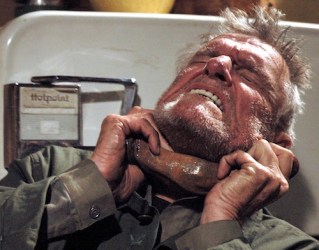
I suppose it follows that the chap in question should be a porn star. I don’t really know why it follows, but somehow it seems natural. The storyline, then, concerns a bunch of porn stars and their small crew travelling to a remote cabin to shoot their latest masterpiece, only an alien lightning bolt (or something) strikes leading man Ron Jeremy (the real-life porn star playing himself) and turns his penis into an evil entity that starts killing people.
Don’t worry, it is a comedy.
Perhaps the first thing to say is that, despite the setup and star, this isn’t actually a porn movie. People assume it is — even the BBFC (who’ve definitely watched the damn thing) hide it behind an age barrier in the euphemistically-titled “adult” section of their website. Anyone looking for those kind of kicks is going to be disappointed, although there’s still plenty of vulgar and crude dialogue to justify its 18 certificate. In actuality, it’s mostly above using “we said a rude word!” as a ‘joke’, which is one positive it has over many more mainstream ‘comedies’.
Indeed, the film as a whole is more fun than it has any right to be, but almost as much as you might hope for from such a silly premise. Okay, perhaps the acting isn’t up to much… or possibly they’re playing it really deadpan. Maybe both. I actually found that side of it very amusing, but I guess some people just see it as crap acting. Either way, there are some genuinely very funny bits. I laughed out loud more than once, which is more than I can say for many a more slickly made comedy.
Look, One-Eyed Monster isn’t any kind of high art, nor is it really an undiscovered masterpiece of the comedy-horror sub-genre. It’s only really scary if you have a (frankly, irrational) fear that you might get strangled by a sentient dismembered member, but it is funny, and those with the right kind of sense of humour (and/or stomach for such things) could find worse ways to spend 80 minutes.
2015 #145
Catherine Hardwicke | 122 mins | download (HD) | 2.35:1 | USA / English | 12 / PG-13
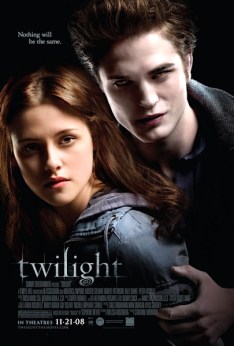
I’m not a big one for Halloween, but I’ve acknowledged the horrific holiday on a couple of occasions now. For 2015, I decided to review one of the most notorious supernatural films of recent times. A movie so horrific, it sent critics cowering behind their sofas. A film so evil, it’s perverted the minds of children — and some adults — the world over. A movie so renowned, it strikes fear into the hearts of even hardened movie lovers.
I speak, of course, of Twilight.
(That was more surprising when it was in a generically-titled post as an introduction to a whole week of reviews for the entire saga, but then it turned out I had better things to watch in October than four more Twilight films, so you’re only getting this one for now.)
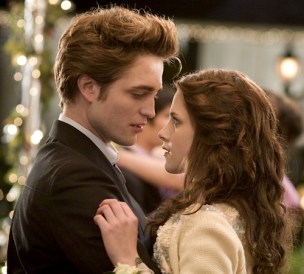
For thems that don’t know, Twilight is the story of Bella Swan (Kristen Stewart), a teenager who moves to live with her father in the small town of Forks, Washington (apparently it’s actually a city, but the film would have you think it’s almost a village). Attending the local high school, she’s intrigued by the introverted Cullen siblings, in particular Edward (Robert Pattinson). To cut a long ramble short, it turns out they’re vampires, but friendly vegetarian vampires. Bella instantly falls in love with Edward in all of three seconds, because he’s kinda dangerous but pretty and sparkles in sunlight (we shall come back to this), though his lust for her brings out his blood-drinking side. Just to make things complicated, there are some other vampires visiting the area who have fewer qualms about drinking human blood…
Twilight is adapted from a young adult novel by Stephenie “one too many Es in her name” Meyer that no one had heard of (bar its legion of bloodthirsty fans) before someone thought it would make a good movie. It would probably have been better if things had stayed that way. There are many reasons for that, but let’s take them in the order they must’ve occurred. First: the story, which is also the worst part. Edward is an odd, creepy stalker — turning up in Bella’s bedroom and staring at her while she sleeps, that kind of thing — who she then finds out is a century-old man (bit of an age gap) and, literally, a predator… but she instantly unconditionally loves him. What the merry fuck? She’s given no reason to even like the guy, and plenty of reasons to run away scared of him, but no, she falls in love. What message is this sending to young girls? That the guy who follows you around everywhere just staring at you and then confesses he’s having trouble controlling his impulse to murder you (yes, he says that) is the perfect soulmate? Not to mention that he’s 100-and-something years old and dating a 17-year-old. He shouldn’t be pre-teen girls’ idol, he should be Hugh Hefner’s!
All of the characters are this poorly drawn. Their motivations, actions, and reactions often make little sense. The number of times one of them does something because Plot are incalculable. That’s without even mentioning Bella’s almost total inability to do anything for herself, except use Google to find some tiny second-hand bookshop in a rarely-visited town to buy a book about something she wants to research, rather than, say, use Google to read up a bit first. Then she gets the book, looks at one illustration and its caption, and it’s back on Google to find out more. Nice work, Bella.
All of this is Meyer’s fault, faithfully translated to the screen by adapter Melissa Rosenberg. This is a woman with quality TV form: she was a lead writer on Dexter back in its first four seasons, when it was really, really good; now she’s showrunner on the forthcoming Marvel/Netflix series Jessica Jones, which has promising trailers and a well-reviewed first episode, in particular its treatment of female characters. Yet she also wrote this. Even if you allow for her being hamstrung by the novel in story terms, the dialogue is appalling, in every respect. Characters bluntly state their own and each other’s emotions at each other. We’re always being told stuff instead of shown it. Scenes heavy with exposition are shot with frenetic camerawork and underscored with driving music as if that somehow makes it filmic and exciting.
Ah, the acting and direction! Nearly every performance is poor. Pattinson and Stewart spend the entire film appearing uncomfortable and puzzled — by themselves, with each other, with everyone else. Her only other emotion is “moody loner”; he at least manages a smile, maybe twice. Some of it is unbelievably cheesy, like an ’80s genre B-movie by a music video director. That kind of thing can work, a) when it’s from the period, or b) when it’s done knowingly. Twilight is neither. The Pacific Northwest location is inherently atmospheric, which is handy because Catherine Hardwicke’s direction does nothing to conjure up any such feeling itself.
And then we have vampires who sparkle. Sparkly vampires. Sparkly. Vampires. Just… why?! The whole traditional mythology of vampires is played fast and loose with, which is fine, that’s what many vampire flicks do; and there are even some borderline-neat subversions… but golly, that sparkliness is silly.
Some of these points are definitely just niggles, but the film is so laden with them that it all becomes ripe to cause either laughter or frustration. Better the former than the latter, which is why the Honest Trailer is so entertaining. See for yourself:
Believe it or not, I didn’t actually hate Twilight as much as I thought I might. Occasionally there are shots or moments that work, maybe even the odd whole scene. Bella’s dad is pretty good, both their relationship and Billy Burke’s performance. I quite liked some of the aggressively-blue cinematography, but then I do like the colour blue. There’s almost a nice element of melancholic “leaving a fun ordinary life behind for this fantastic but dangerous new one”, but I think that might be limited to literally one shot-reverse-shot of Bella seeing her friends leaving a café.
So it’s not a good film, but it’s not a “worst film ever made”-level disaster either. I mean, it’s not so bad that I can’t even bear the thought of watching the sequels. Actually, they kind of intrigue me, because (spoiler warning!) it hasn’t even got to the Jacob/werewolves stuff yet, and that whole Team Edward / Team Jacob aspect seemed to be such a big thing. And I want to see what Michael Sheen has to do with anything. And I kinda wanna see if Breaking Dawn is as batshit crazy as the plot description I once read made it sound. And maybe there’ll be more of Anna Kendrick’s cleavage, because wow, who knew that was there? (Look, it’s a movie about a creepy stalker romance between a 100-year-old man and a 17-year-old girl — a little light ogling of someone around my own age pales in comparison.)
So that’s Twilight for you: poorly plotted, poorly written, poorly acted, poorly directed, teaching poor life lessons to its target age group, and yet still somehow so compelling that I’m prepared to sit through another eight-ish hours of the stuff. Never has the phrase “your mileage may vary” been so apt.*
* Unless someone used it in reference to the Fast & Furious films.
2015 #116
David Cronenberg | 87 mins | TV | 4:3 | Canada / English | 18 / R
The first commercial (i.e. non-student) feature by horror maestro-to-be David Cronenberg, Shivers depicts the sexually-charged chaos that erupts after the spread of a man-made sexually-transmitted parasite in an isolated hyper-modern tower block.
The film contains all the requisite titillation of cheap schlock (nudity! gore!), but a handful of interesting, potential-laden ideas indicate the filmmaking promise that Cronenberg would later fulfil. Unfortunately, the execution here is hindered by dirt cheap production values and unfocused, undisciplined storytelling.
The most horrific part for fans is the mere mention of a sometimes-mooted remake, but I don’t think that would necessarily be a bad idea.
2015 #93
David Cronenberg | 103 mins | TV | 16:9 | Canada / English | 18 / R
If you’re versed in sci-fi/fantasy cinema, you’ve heard of Scanners even if you haven’t seen it: it’s the one with the (in)famous exploding head. That moment is distinctly less shocking for those of us coming to the film as a new viewer at this point: gore perpetuates genre cinema nowadays, so it’s less striking,* and the scene it’s in is quite obvious, so you know it’s coming. Fortunately, Scanners is so much more than one famous moment.
Social outcast Cameron (Steven Lack) can hear other people’s thoughts. When he’s apprehended by weapons firm ConSec, he discovers from scientist Dr Ruth (Patrick McGoohan) that he is far from alone. ConSec have been attempting to control these so-called scanners and weaponise them; one, Darryl Revok (Michael Ironside) has other ideas, and is waging a counter war. Ruth wants to enlist Cameron to stop Revok. So begins what I suppose you might call a sci-fi espionage thriller, as Cameron finds his way into the underground scanner community and Revok’s spies in ConSec learn of their plans…
Scanners seems to have a mixed level of appreciation within writer-director David Cronenberg’s CV — even going no further than Wikipedia, you can find review quotes that swing between calling it “an especially important masterwork” and a movie that “might have been a Grand Guignol treat [but is marred by] essential foolishness”. Whether it’s a masterwork or not I wouldn’t care to say, but as a rough-round-the-edges genre thriller, I found it mightily entertaining.
As our hero, Lack isn’t much cop. If you were being kind you could write his oddness off as a product of Cameron’s reclusive lifestyle, but I’m not sure that was a deliberate choice. There are worse performances in the history of genre cinema though, and it’s not like his emotional journey or something is the core of the film. As if to make up for it, McGoohan is of course excellent, acting everyone else off the screen, while Ironside makes for an excellent villain, naturally. Some say that the final psychic battle, between Lack and Ironside, is underwhelming, but I thought it was excellently realised, a tense and effective struggle. Such brilliant effects and sequences are scattered throughout the film.
I do like a good genre movie, and Scanners manages to mash together a couple of my favourites — primarily, science fiction and espionage/undercover mystery-thrillers — in a way that, unless I’m forgetting something, we’ve seen surprisingly rarely. It’s not quite “a Bond film with telekinetics”, but if it were, that’s perhaps the only way I’d’ve found it more enjoyable.
Scanners is on the Horror Channel tonight at 9pm, and again tomorrow night at 2:15am.
* Though, in isolation, bad enough that I changed my mind about using it as the header image for this review.^
2015 #104
Matthijs van Heijningen | 103 mins | Blu-ray | 2.40:1 | USA & Canada / English, Norwegian & Danish | 15 / R
At some point during the process of remaking John Carpenter’s seminal 1982 sci-fi/horror The Thing, someone clearly realised they were on to a hiding for nothing. (Why more remake producers don’t realise this is a whole other issue.) Fortunately for those that still wanted to make some money by exploiting a cult classic, the original film includes an in-built idea for a follow-up, and some wise (well, wise-ish) soul realised that was the perfect way in. And so the 2011 remake of The Thing is not a remake at all, but rather a prequel, depicting the events that occurred at the Norwegian base, seen only as a corpse-strewn burnt-out shell in the ’82 film. You’d best hope the remake-makers have some good ideas, because we all know how this Thing ends…
So our scene is set in the winter of 1982, when the crew of the aforementioned base stumble across a spaceship buried in the Antarctic ice. Nearby, they find a frozen alien lifeform, and excavation expert Kate Lloyd (Mary Elizabeth Winstead) is flown in to help retrieve it. Once back at base, however, the thing wakes up, escapes, and all hell breaks loose.
As discussed, The Thing 2011-variety is not a remake of The Thing 1982-variety because, primarily, it takes place before The Thing ’82, and also because of drastic changes like making the lead character female and having some of the cast speak Norwegian sometimes. Other than that, what unfolds is just a variation on a theme. While it isn’t a scene-for-scene type of remake, it’s near enough to the ’82 version — including sequences that directly emulate similar counterparts from the previous film — that, were it not for the whole “it’s a prequel” aspect, you could be forgiven for thinking it was just a post-millennium-styled do-over; a “reimagining”, to use Tim Burton’s fun phrase.
Of course, it isn’t as good. There are many reasons for this, one of which is the fact that, because they haven’t just remade the other film, every homage/rip-off they come up with is inferior. So the blood testing scene from the ’82 film is replaced by shining a torch in someone’s mouth to see if they have fillings. God help you if you’ve taken care of your dental hygiene. The climax is typically overblown — this isn’t a spoiler, I’m preparing you if you’ve not seen it: the survivors venture into the alien’s spacecraft to stop it taking off. Some people get a kick out of getting to see inside the ship, and I suppose you could say that at least the remake-makers are trying to offer something new. Unfortunately, new is exactly what it’s not. The Thing is a bizarre creature, growing and morphing and warping in disgusting ways — what strange kind of spaceship would it call home? A bog-standard metal-corridors kind of one, apparently. The lack of imagination is staggering.
But hey, at least the remake-makers committed themselves to replicating the ’82 film’s notorious practical effects — after all, that film is one of the pinnacles of effects filmmaking, the sacred text of the creature maker, and so its methods should be honoured. The Blu-ray special features talk about how they wanted to make full use of effects technology, combining practical and digital effects to get the best of both. The featurettes even show off the incredible animatronics that were built, the level of skill and detail, how well they performed on set… and completely ignore the fact that those animatronics were, infamously, all ‘painted’ over with CGI. To rub it in, as any film fan would expect (but as every movie producer seems utterly oblivious to), most of the animatronic models do look better than the CGI in the finished film.
The other element the making-of material is keen to underline is just how much effort was put in to make sure this ties back to its predecessor. Essentially, they looked at what was revealed about the Norwegian base in Carpenter’s film and used that to reverse engineer the events that had to occur in this film. However, the final result could’ve made some of these connections more explicit. For example, we don’t see when the guy who slit his throat performs that act. The moment is actually included among the disc’s deleted scenes, but why did they cut it?! The movie’s final scene, which directly links the two films, is intercut with the end credits — why?! It comes across as apologetic, like they’d rather it wasn’t there but feel it has to be. Either put the scene in the film proper, or put it as an after-credits easter egg for die hard fans; the halfway-house used in the final cut is just messy. If someone’s argument was, “casual viewers will find those linking scenes meaningless”, then watch your own movie! The helicopter being away for refuelling is referenced earlier in the film; Joel Edgerton’s character says they didn’t kill Lars but never says what they did do with him; and the last time we see Colin he’s alive (until a single shot of his frozen corpse, that is). To put it another way: they’ve done a bang-up job of making those things matter within the film itself, as well as in the context of linking up to the ’82 film, so why were they deleted or included only as an embarrassed afterthought?
But hey, odd choices abound. I mean, they only kept the same title because they couldn’t think of a subtitle that sounded good. Once again, it displays a lack of imagination that made a rod for their own back: many people thought this would be a straight-up remake, which turned them against it from the start; but if it had always been clear it was a prequel, designed to complement the original, maybe (some) viewers would’ve been kinder.
Or maybe they wouldn’t, because The Thing 2011 is a lesser film than the original. It does still offer some suitably gross effects work, albeit lessened by it being obvious CGI rather than gruesomely physical constructions, but there are still some resultantly tense sequences. Heck, it’s the first film in I-don’t-know-how-long that actually made me jump, once. Some viewers complain that there’s no “who might be an alien?”-type tension because the characters aren’t well-drawn enough, but I had that problem with Carpenter’s film too.
Ironically, considering it’s the lesser of the two productions, I think this Thing might fare better if viewed in a double-bill immediately followed by its predecessor: all those thoroughly-considered links would pay off clearly, and you’d get the better film second, to end on a high note. Viewed by itself, at least The Thing 2011 isn’t that bad; a somewhat entertaining hour-and-a-half-or-so offering passable thrills.
2015 #97
John Carpenter | 109 mins | Blu-ray | 2.35:1 | USA / English | 18 / R
It’s just an ordinary day at the US Antarctic research base staffed by helicopter pilot MacReady (Kurt Russell) and his compatriots, until a helicopter buzzes overhead dropping grenades on a dog it’s pursued across the ice fields. The dog finds sanctuary in the US base; the helicopter and its crew are less fortunate. Realising it’s from a Norwegian facility an hour’s flight away, MacReady and the doctor brave inclement conditions to investigate. They find numerous corpses and the base burnt to ruins. What horrors befell the Norwegian base? And have they inadvertently brought them into their own…?
I think we all know the answer to that second question. It wouldn’t be much of a movie if the answer was, “nope, they’re good.”
Derided by some on its release for being naught but wall-to-wall gore, The Thing naturally developed a cult following among horror/sci-fi fans. The funny thing watching it today is that, while the special effects still retain the power to shock in their gross extremity, they’re limited to a handful of quick-fire sequences; indeed, those seeking out The Thing to get their blood-and-guts fix nowadays often seem to declare it “boring”.
Naturally, they’re missing the point. At its heart, John Carpenter’s film is a psychological thriller: an alien is in the group’s midst; it has taken on the form of one or more of them; who can you trust? How can you tell? It’s both a dilemma in an abstract “sci-fi concept” sense, and no doubt a parallel from an era when spying and the threat of ‘the other’ infiltrating society were still major issues. I suppose it’s a facet that’s come round again these past few years, with the increasing rise of home-grown terrorists, previously decent citizens lured and brainwashed by propaganda. The most enduring themes are always timely, I guess.
Even if you don’t want to get deep about it, The Thing has the “who’s human?” thrills to keep you engaged on that level. Accusations of boredom no doubt stem from the fact it’s a bit of a slow burn, the early acts building suspicion and unease as MacReady and co investigate. Even after the true nature of the threat is revealed, Carpenter paces himself, though the frequency of incidents begins to mount inexorably as we head towards the climax. Well, that’s just good structure.
If the film has one problem, it’s there are too many characters. We know MacReady: he’s Kurt Russell, and he’s singled out early on as the hero — though we come to suspect even he may not be ‘right’ as the film goes on. As for the rest, I believe there are eleven of them, and at best they are loosely sketched. At least a couple are easily conflated and therefore confused, and for the rest, there just isn’t time to get to know them properly, so we’re less invested in what happens to them. There’s a reason most “who will survive?” movies have something like five or six characters in peril, not twelve.
In spite of all that, The Thing does remain best remembered for its extraordinary effects. Even though you know it’s rubber and silicon and corn syrup and whatever else, and even though the intervening thirty-odd years and lashings of CGI have enabled even more, even darker imaginings to be brought before our eyes, the visceral physicality of these effects, the way they play on long-established fears, and apply those to the human body in nauseatingly contorted ways, is plenty enough to render them still effective; certainly so within the context of a film that is, as I say, really more of a thriller than a gore-fest.
For me, it’s the psychological quandaries that are gripping and exciting, rather than any enjoyed disgust at the emetic special effects. However, knowing the characters a little better — thus caring if they’d been replaced or not, and also perhaps allowing us a chance to try to guess for ourselves — would have just made it that bit superior.
2015 #38
David Cronenberg | 84 mins | streaming (HD) | 1.85:1 | Canada / English | 18 / R
James Woods is the owner of a trash TV station who’ll do pretty much anything for ratings. His hunt for the next ‘big’ thing leads him to come across the signal for a channel that shows just one bizarre, disturbing programme. Obsessed with finding out the truth behind it, he gets suckered in to a conspiracy that blurs the line between reality and imagination.
To look at things ass-backwards, my first exposure to the work of writer-director David Cronenberg was his 1999 movie eXistenZ, a thriller about people in a virtual reality video-game where the line between what’s real-life and what’s the game gets blurred. It’s fair to say that both that and Videodrome play on similar ideas at times. Both are also ultra prescient, in their way: for eXistenZ, immersive virtual reality games are now starting to become reality, with the Oculus Rift ‘n’ all that (there endeth my knowledge of such things); for Videodrome, even though it’s 32 years old and the tech being depicted is similarly dated, its fears about the influence of the media and the changes it brings to society could’ve been shot yesterday.
These thought-provoking themes are in part conveyed through Cronenberg’s familiar stomping ground of body horror, with top-drawer prosthetics giving tangible visual life to nightmarish ideas. OK, they’re clearly rubber and silicone and plastic and whatever, but the fact they’re there on set, that they’re genuinely one with the actors, not painted over the top later by a computer, that they’re pliable and squidging for real… it’s much more effective, more unsettling, more horrific than computer effects have yet managed.
I guess for some people the “ew”-inducing effects are the primary delight of the film. These are the kind of people who complain about the UK version being cut. In truth, this is actually the originally-released R-rated version; the so-called Director’s Cut adds just over a minute. Having read about what’s added (all of a few seconds here and there), it sounds like no great shakes, to be honest. I’m all for releasing movies uncut and as intended by the director, but really, some people get too hung up on some of these details. (For what it’s worth, Arrow’s new UK Blu-ray is the longer cut.)
Trims or not, the movie’s themes remain intact. They gave me the sense that Cronenberg wasn’t entirely sure where to go with them — the film descends into a kind of dream logic, fumbling around for a way forward and coming to a somewhat inconclusive ending. That, too, is likely part of the charm for some people. I wasn’t wholly sold.
At worst, though, Videodrome is certainly an experience; one that, over three decades on, still has plenty to say about our consumption of and reliance on the media.
Videodrome is released as a limited edition dual-format Blu-ray by Arrow Video on Monday.
2015 #86
Dominic Brunt | 82 mins | TV | 2.35:1 | UK / English | 18
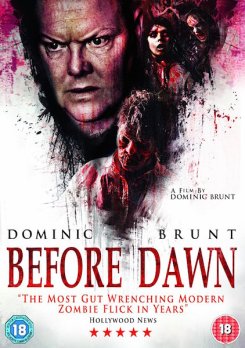
Directed by Emmerdale actor and zombie aficionado Dominic Brunt (who also stars), from a screenplay by Emmerdale writer Mark Illis based on a story by Brunt’s wife, Joanne Mitchell (who also co-stars), Before Dawn is a mash-up between remote-farmhouse zombie horror and kitchen-sink relationship drama.
The story sees struggling couple Alex (Brunt) and Meg (Mitchell) leaving their kids with her mother and heading off to the aforementioned remote farmhouse for a reconciliatory weekend. As they clash and argue, we see the signs around them that All Is Not Right… until suddenly they’re being chased by the undead.
Unfortunately, Brunt and Illis aren’t quite up to pulling off the film’s original concept. The relationship drama is lightweight, with nothing strikingly new or engaging about it, just rote “couple argue but maybe love each other really”-type shenanigans. It also takes way too long to get going. The scene saying goodbye to the kids is interminable, with nothing to add to the narrative or characters. I guess it’s trying to establish a rapport between the parents and their kids, designed to pay off later, but it offers nothing you wouldn’t get from literally showing that they have kids. If you want us to have an emotional investment, give us some emotion, not just instructions about bedtime and requests for hugs. Then there’s the wannabe-artsy shots of driving, and… just get a wriggle on, yeah?
Amateurish production values often let the side down. I don’t think Brunt’s direction would be too bad were it not for the cheap camerawork, although the action scenes are overrun with ShakyCam. There are some very good bits late on: the developments that come as a result of a stranger’s arrival; a phone call with the kids; perhaps even the very end, which is a bold climax.
Incidentally, no part of the plot has anything to do with something occurring “before dawn”, so I presume the title is a riff on Before Sunrise (relationship two-hander) and Dawn of the Dead (zombie movie) — in which case, the title goes from being oddly meaningless to quite neat. In that respect, it might be the best thing about the film.
The inherent idea of cross-pollinating these two genres isn’t without merit, so it’s a shame it’s come to pass in this fairly weak film. Maybe someone else will try it again someday.
2015 #96
Marjane Satrapi | 104 mins | Blu-ray | 2.35:1 | USA & Germany / English | 15 / R
Jerry (Ryan Reynolds) is a nice guy living in the small town of Milton, working in shipping at Milton Fixtures and Fawcetts, where he fancies the English girl in accounts, Fiona (Gemma Arterton), and doesn’t notice how much another girl in accounts, Lisa (Anna Kendrick), likes him. He also talks to his dog, Bosco, and cat, Mr Whiskers, and they talk back. That’s why his psychiatrist (Jacki Weaver) encourages him to take his medication, but he doesn’t. When he accidentally murders Fiona (as you do), it’s Mr Whiskers that encourages him to cover up the crime.
The Voices isn’t your usual kind of film — obviously. In the special features, everyone’s very keen to talk about how it exists outside of genre, and they’re right. From some of the premise (his pets talk!) and marketing, you’d be forgiven for thinking it was just a comedy. It is a comedy, but a very black one. A very, very black one. A total-absence-of-light black one. The laughs do not come thick and fast, though there are some, and there’s a left-of-centre worldview that is comedy-quirky — if you tried to play this entirely straight, it wouldn’t work.
However, it is also something of a psychological crime thriller. Jerry is clearly a very messed up individual, and so we’re always wondering what he will do next, what happened in his past to make him this way (flashbacks and hints are scattered, leading to an eventual reveal), and how will it all end for him? We’re conflicted here, because he’s a nice guy who we like, but he’s also a murderer, in horrific fashion, and so surely justice is due. Screenwriter Michael R. Perry and director Marjane Satrapi (of Persepolis fame) tread a fine line here: they do want us to like Jerry, but are certainly aware that can be an uphill struggle given what he’s done.
They’re aided in no small part by Ryan Reynolds’ first-class performance. Reynolds has coasted along in minor, generic, average-to-below-average action-thrillers (Smokin’ Aces, Safe House), rom-coms (Just Friends, The Proposal), and, mainly, comic book movies (Blade: Trinity, X-Men Origins: Wolverine, Green Lantern, R.I.P.D.), but a couple of more recent performances seem to have shown his range. Firstly, Buried (which I’ve still not seen), where he carries the film trapped alone in a box, and now this. And last weekend’s Comic-Con trailer for Deadpool, which looks like it might be awesome. Here, he essays a multitude of characters: working on the theory that the voices are all in Jerry’s head, Reynolds voices Bosco, Mr Whiskers, and a couple of other animals to boot. This isn’t just an affectation: he gives different performances as each, offering a kinda-dim but good-hearted Southern gent as Bosco the dog, and an evil bloodthirsty Scot as Mr Whiskers the cat. The dog is good and the cat is evil? Sounds about right. That’s not to undersell his main performance, in person as Jerry, a socially awkward guy who really does want to do the right thing, but can’t help being led astray.
Able support comes in the form of three women in Jerry’s life. Gemma Arterton has a ball, first as a bit of a bitch, then as a ludicrously-chipper super-English talking head. Anna Kendrick, meanwhile, is sweet and likeable, and while we may be on Jerry’ side when he accidentally slides his knife into Fiona, we’re keen for him not to make the same mistake with Lisa. Whether he does or not is where the real battle for his sanity lies. The third is Jacki Weaver’s psychiatrist, who is central to the climax but also has the least to do of all three, really. Never mind.
Satrapi delivers a film of mixed tones, which clearly doesn’t work for every viewer, but I thought handled the shifting styles well. There’s a kind of kooky comedy to it all, but also horror movie-level disgust at points, and the complex psychology underpinning Jerry’s actions. I thought all three were mixed well, though I can see why it’s not to everyone’s taste to have such apparently-disparate genres co-existing; certainly, the darkness of the humour will be beyond some. DP Maxime Alexandre nails the visuals for all this, though. Off his drugs and in his delusions, Jerry’s world is perfect and sunny, but the cleverness here is that it isn’t beyond the realms of reality, it’s just a bright, sunny, polished, happy reality. When he takes his meds, the dark, grey, grim, hoardersome, blood-soaked, shit-stained reality of his life comes in — and his two best friends look really miserable and stop talking to him. No wonder he’s tempted to the dark side. Alexandre has form in horror movies (The Hills Have Eyes, The Crazies, Silent Hill: Revelation), so no wonder he can do the latter, but the majority of the film is on the shiny side, and he’s got that down pat too.
The Voices is the kind of film you say is “not for everyone”, which are often the best kind if they are for you. For me, it wasn’t quite funny enough — I’d’ve liked more of the dog and cat, who get the lion’s share of the best material. I also felt that Jerry’s backstory, the reasons for why he is how he is and does what he does, weren’t explored quite enough. The Blu-ray’s deleted scenes hint at more of this, particularly with an alternate climax, which was perhaps cut because there was too little material specifically building up to it. Rather than losing that ending, it would’ve been better to keep it and find more scenes that contributed to it.
And talking of the ending, I haven’t even mentioned the finale! The more out of the blue it comes the better, I think, so I shall say no more. As a capper on everything, though, it’s darn near perfect.
The Voices is not an unqualified success, then, but it’s one of the more unusual films I’ve seen in a while, with a good few appreciable qualities, and I enjoy that. Recommended with caution.
2015 #73
Martin Scorsese | 138 mins | Blu-ray | 2.35:1 | USA / English | 15 / R
Adapted from a novel by Dennis Lehane (whose work also inspired Mystic River and Gone Baby Gone), the fourth collaboration between Martin Scorsese and Leonardo DiCaprio stars the latter as US Marshal Edward Daniels, who in 1954 is dispatched with this new partner (Mark Ruffalo) to the Ashecliffe facility on the titular island, a prison/hospital for violent, mentally ill criminals run by Dr Cawley (Ben Kingsley) and Dr Naehring (Max von Sydow), where one of the patients has disappeared from her locked room. Her presumed escape seems to be impossible, the staff are remarkably unhelpful, and Daniels has a theory about something much darker and more sinister being conducted on the island… Naturally there’s an almighty twist, which will either keep you guessing or you’ll spot early on so you can brag about how you thought it was very predictable in order to make yourself look big and clever on online comment sections (because that works).
In fairness, the twist — or, at least, key elements of it — are fairly guessable if you’re playing that game. Equally, the film leaves enough doors of possibility open that if you set your heart on one answer (even the right one) then you’re perhaps being a bit blinkered and not indulging in the fun of being strung along by a well-built mystery. And as I always say, most twists are only “predictable” if you predicted the right thing. The mystery certainly kept me engrossed and guessing. I did suspect certain things that turned out to be correct, but there were enough other possibilities floating around that I wasn’t twiddling my thumbs waiting for the reveal.
Besides, the film has other delights beyond being an elaborate guessing game. One of the things Lehane set out to do in his novel was write “a gothic”, and Scorsese and co have taken that ball and run with it. It’s overflowing with a fantastic atmosphere: unsettling, creepy, chilling, horror-movie scary when needed (some sequences are properly hair-raising); truly gothic-feeling. Every aspect of filmmaking — the direction, the photography, the editing, the sets and locations, the music — work in harmony to create a coherent mood.
To single out two, it’s gorgeously shot by Robert Richardson. There are a couple of dream sequences that are a show-off for that kind of thing, but it’s true more widely, the storm-bedevilled island presenting a rewardingly overcast palette. There are instances of what one might call dodgy green screen… but, combined with the continuity-troubled editing, I sense it may’ve been a conscious choice to enhance the disquieting sensation (the editing is certainly deliberate — that some commenters seem to believe Scorsese and Thelma Schoonmaker could make so many basic errors is bizarre).
The second is the music, put together by Robbie Robertson. Scorsese and Robertson decided against a traditional score, instead choosing to compile fragments of other works (many of them anachronistic) and chop them up in different ways. It’s probably to Robertson’s credit that it doesn’t feel like a jukebox soundtrack; indeed, I assumed it did have a fully composed score, and really rather liked parts of it.
And then, after Scorsese and co have done their best to shred your nerves, in the final half-hour the pathos is immense. Quite without realising it had brought me to that point, I had a tear in my eye. This is in part thanks to some great performances, though you do need to reach the twist to fully appreciate them. Everyone reveals more levels once you know it, and indeed it’s clear a great amount of effort went into ensuring re-watchability — that if you view it again knowing the answers, you can spot things; not clues, per se, but elements in the performance, the design, the staging, that tie in to the reveal.
DiCaprio has the showiest performance, though he never goes too far with it — it’s resolutely plausible at all times. Ruffalo may give the best turn of them all, in retrospect — if you watch it a second time (or, for a quick fix, check out the clip-laden making-of documentaries where they discuss the acting), you can really see what he’s doing. Kingsley, too, who without changing his performance is both threatening and kindly.
Incidentally, reviews criticise the brevity of the documentaries on the Blu-ray, but with over half-an-hour of content they could be considerably worse, and they’re quite focused — I learnt a lot from them. No, you’re not getting a scene-by-scene breakdown like you would in an audio commentary, and there’s minimal detail on the usual moviemaking details, but there’s a solid overview of the film’s themes and how they were translated to the screen.
I think the more you let Shutter Island percolate after it’s over, the better it becomes. Solving the mystery and guessing at the twists occupies so much of your time on a first viewing that you almost miss the details in the characters and the world, but they build up nonetheless. There’s layers and depth here, and a plausibly realistic depiction (even according to an expert) of something that’s incredibly hard to depict in fiction. You can view Shutter Island as just an atmospheric gothic mystery chiller, and as that it’s a quality piece of work, but it’s the extra depth that mark it out as, actually, a great movie.
The UK network TV premiere of Shutter Island is on Channel 4 tonight at 9pm.
Shutter Island placed 16th on my list of The 20 Best Films I Saw For the First Time in 2015, which can be read in full here.

 Sometimes, I swear off consciously watching any more likely-to-be-bad movies. And sometimes, I just feel like attempting something like One-Eyed Monster. And this is why: it’s actually pretty fun.
 hide it behind an age barrier in the euphemistically-titled “adult” section of their website. Anyone looking for those kind of kicks is going to be disappointed, although there’s still plenty of vulgar and crude dialogue to justify its 18 certificate. In actuality, it’s mostly above using “we said a rude word!” as a ‘joke’, which is one positive it has over many more mainstream ‘comedies’.
 I’m not a big one for Halloween, but I’ve acknowledged the horrific holiday on a couple of occasions now. For 2015, I decided to review one of the most notorious supernatural films of recent times. A movie so horrific, it sent critics cowering behind their sofas. A film so evil, it’s perverted the minds of children — and some adults — the world over. A movie so renowned, it strikes fear into the hearts of even hardened movie lovers.
 Edward is an odd, creepy stalker — turning up in Bella’s bedroom and staring at her while she sleeps, that kind of thing — who she then finds out is a century-old man (bit of an age gap) and, literally, a predator… but she instantly unconditionally loves him. What the merry fuck? She’s given no reason to even like the guy, and plenty of reasons to run away scared of him, but no, she falls in love. What message is this sending to young girls? That the guy who follows you around everywhere just staring at you and then confesses he’s having trouble controlling his impulse to murder you (yes, he says that) is the perfect soulmate? Not to mention that he’s 100-and-something years old and dating a 17-year-old. He shouldn’t be pre-teen girls’ idol, he should be Hugh Hefner’s!
 in particular its treatment of female characters. Yet she also wrote this. Even if you allow for her being hamstrung by the novel in story terms, the dialogue is appalling, in every respect. Characters bluntly state their own and each other’s emotions at each other. We’re always being told stuff instead of shown it. Scenes heavy with exposition are shot with frenetic camerawork and underscored with driving music as if that somehow makes it filmic and exciting.
 a little light ogling of someone around my own age pales in comparison.)
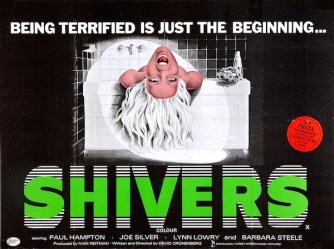 The first commercial (i.e. non-student) feature by horror maestro-to-be David Cronenberg, Shivers depicts the sexually-charged chaos that erupts after the spread of a man-made sexually-transmitted parasite in an isolated hyper-modern tower block.
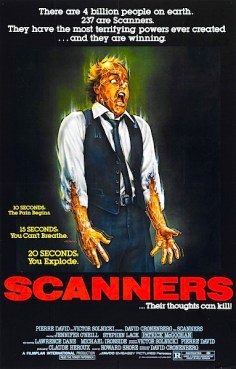 If you’re versed in sci-fi/fantasy cinema, you’ve heard of Scanners even if you haven’t seen it: it’s the one with the (in)famous exploding head. That moment is distinctly less shocking for those of us coming to the film as a new viewer at this point: gore perpetuates genre cinema nowadays, so it’s less striking,
 emotional journey or something is the core of the film. As if to make up for it, McGoohan is of course excellent, acting everyone else off the screen, while Ironside makes for an excellent villain, naturally. Some say that the final psychic battle, between Lack and Ironside, is underwhelming, but I thought it was excellently realised, a tense and effective struggle. Such brilliant effects and sequences are scattered throughout the film.
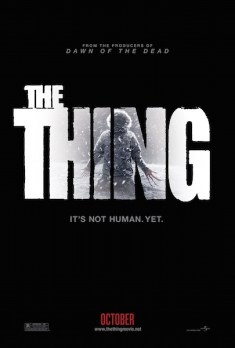 At some point during the process of remaking John Carpenter’s seminal 1982 sci-fi/horror
  Of course, it isn’t as good. There are many reasons for this, one of which is the fact that, because they haven’t just remade the other film, every homage/rip-off they come up with is inferior. So the blood testing scene from the ’82 film is replaced by shining a torch in someone’s mouth to see if they have fillings. God help you if you’ve taken care of your dental hygiene. The climax is typically overblown — this isn’t a spoiler, I’m preparing you if you’ve not seen it: the survivors venture into the alien’s spacecraft to stop it taking off. Some people get a kick out of getting to see inside the ship, and I suppose you could say that at least the remake-makers are trying to offer something new. Unfortunately, new is exactly what it’s not. The Thing is a bizarre creature, growing and morphing and warping in disgusting ways — what strange kind of spaceship would it call home? A bog-standard metal-corridors kind of one, apparently. The lack of imagination is staggering.
 The other element the making-of material is keen to underline is just how much effort was put in to make sure this ties back to its predecessor. Essentially, they looked at what was revealed about the Norwegian base in Carpenter’s film and used that to reverse engineer the events that had to occur in this film. However, the final result could’ve made some of these connections more explicit. For example, we don’t see when the guy who slit his throat performs that act. The moment is actually included among the disc’s deleted scenes, but why did they cut it?! The movie’s final scene, which directly links the two films, is intercut with the end credits — why?! It comes across as apologetic, like they’d rather it wasn’t there but feel it has to be. Either put the scene in the film proper, or put it as an after-credits easter egg for die hard fans; the halfway-house used in the final cut is just messy. If someone’s argument was, “casual viewers will find those linking scenes meaningless”, then watch your own movie! The helicopter being away for refuelling is referenced earlier in the film; Joel Edgerton’s character says they didn’t kill Lars but never says what they did do with him; and the last time we see Colin he’s alive (until a single shot of his frozen corpse, that is). To put it another way: they’ve done a bang-up job of making those things matter within the film itself, as well as in the context of linking up to the ’82 film, so why were they deleted or included only as an embarrassed afterthought?
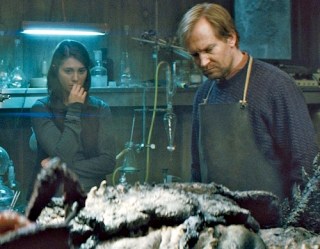 Or maybe they wouldn’t, because The Thing 2011 is a lesser film than the original. It does still offer some suitably gross effects work, albeit lessened by it being obvious CGI rather than gruesomely physical constructions, but there are still some resultantly tense sequences. Heck, it’s the first film in I-don’t-know-how-long that actually made me jump, once. Some viewers complain that there’s no “who might be an alien?”-type tension because the characters aren’t well-drawn enough, but I had that problem with Carpenter’s film too.
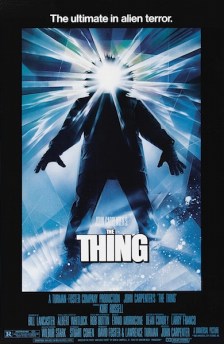 It’s just an ordinary day at the US Antarctic research base staffed by helicopter pilot MacReady (Kurt Russell) and his compatriots, until a helicopter buzzes overhead dropping grenades on a dog it’s pursued across the ice fields. The dog finds sanctuary in the US base; the helicopter and its crew are less fortunate. Realising it’s from a Norwegian facility an hour’s flight away, MacReady and the doctor brave inclement conditions to investigate. They find numerous corpses and the base burnt to ruins. What horrors befell the Norwegian base? And have they inadvertently brought them into their own…?
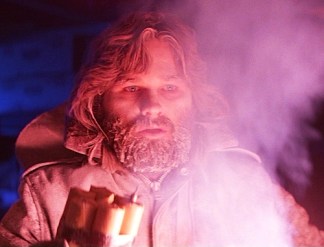 Even if you don’t want to get deep about it, The Thing has the “who’s human?” thrills to keep you engaged on that level. Accusations of boredom no doubt stem from the fact it’s a bit of a slow burn, the early acts building suspicion and unease as MacReady and co investigate. Even after the true nature of the threat is revealed, Carpenter paces himself, though the frequency of incidents begins to mount inexorably as we head towards the climax. Well, that’s just good structure.
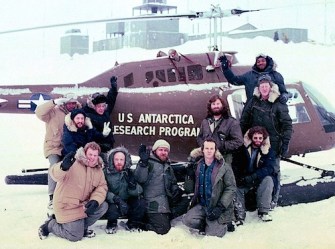 For me, it’s the psychological quandaries that are gripping and exciting, rather than any enjoyed disgust at the emetic special effects. However, knowing the characters a little better — thus caring if they’d been replaced or not, and also perhaps allowing us a chance to try to guess for ourselves — would have just made it that bit superior.
 James Woods is the owner of a trash TV station who’ll do pretty much anything for ratings. His hunt for the next ‘big’ thing leads him to come across the signal for a channel that shows just one bizarre, disturbing programme. Obsessed with finding out the truth behind it, he gets suckered in to a conspiracy that blurs the line between reality and imagination.
 I guess for some people the “ew”-inducing effects are the primary delight of the film. These are the kind of people who complain about the UK version being cut. In truth, this is actually the originally-released R-rated version; the so-called Director’s Cut adds just over a minute. Having read about
  Directed by
 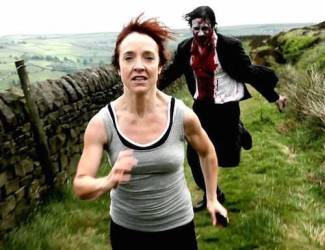 Amateurish production values often let the side down. I don’t think Brunt’s direction would be too bad were it not for the cheap camerawork, although the action scenes are overrun with ShakyCam. There are some very good bits late on: the developments that come as a result of a stranger’s arrival; a phone call with the kids; perhaps even the very end, which is a bold climax.
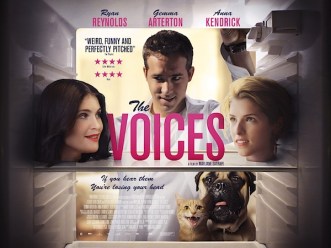 Jerry (Ryan Reynolds) is a nice guy living in the small town of Milton, working in shipping at Milton Fixtures and Fawcetts, where he fancies the English girl in accounts, Fiona (Gemma Arterton), and doesn’t notice how much another girl in accounts, Lisa (Anna Kendrick), likes him. He also talks to his dog, Bosco, and cat, Mr Whiskers, and they talk back. That’s why his psychiatrist (Jacki Weaver) encourages him to take his medication, but he doesn’t. When he accidentally murders Fiona (as you do), it’s Mr Whiskers that encourages him to cover up the crime.
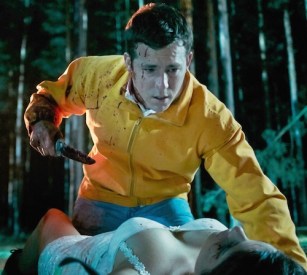 what happened in his past to make him this way (flashbacks and hints are scattered, leading to an eventual reveal), and how will it all end for him? We’re conflicted here, because he’s a nice guy who we like, but he’s also a murderer, in horrific fashion, and so surely justice is due. Screenwriter Michael R. Perry and director Marjane Satrapi (of
 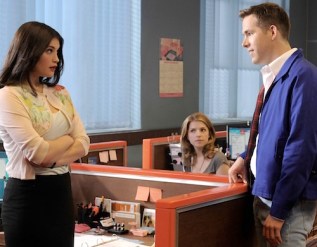 Able support comes in the form of three women in Jerry’s life. Gemma Arterton has a ball, first as a bit of a bitch, then as a ludicrously-chipper super-English talking head. Anna Kendrick, meanwhile, is sweet and likeable, and while we may be on Jerry’ side when he accidentally slides his knife into Fiona, we’re keen for him not to make the same mistake with Lisa. Whether he does or not is where the real battle for his sanity lies. The third is Jacki Weaver’s psychiatrist, who is central to the climax but also has the least to do of all three, really. Never mind.
 The Voices is the kind of film you say is “not for everyone”, which are often the best kind if they are for you. For me, it wasn’t quite funny enough — I’d’ve liked more of the dog and cat, who get the lion’s share of the best material. I also felt that Jerry’s backstory, the reasons for why he is how he is and does what he does, weren’t explored quite enough. The Blu-ray’s deleted scenes hint at more of this, particularly with an alternate climax, which was perhaps cut because there was too little material specifically building up to it. Rather than losing that ending, it would’ve been better to keep it and find more scenes that contributed to it.
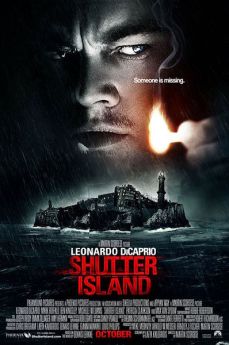 Adapted from a novel by Dennis Lehane (whose work also inspired
 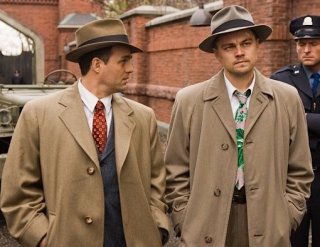 Besides, the film has other delights beyond being an elaborate guessing game. One of the things Lehane set out to do in his novel was write “a gothic”, and Scorsese and co have taken that ball and run with it. It’s overflowing with a fantastic atmosphere: unsettling, creepy, chilling, horror-movie scary when needed (some sequences are properly hair-raising); truly gothic-feeling. Every aspect of filmmaking — the direction, the photography, the editing, the sets and locations, the music — work in harmony to create a coherent mood.
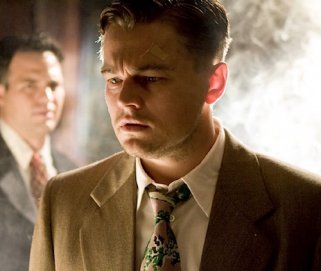 And then, after Scorsese and co have done their best to shred your nerves, in the final half-hour the pathos is immense. Quite without realising it had brought me to that point, I had a tear in my eye. This is in part thanks to some great performances, though you do need to reach the twist to fully appreciate them. Everyone reveals more levels once you know it, and indeed it’s clear a great amount of effort went into ensuring re-watchability — that if you view it again knowing the answers, you can spot things; not clues, per se, but elements in the performance, the design, the staging, that tie in to the reveal.
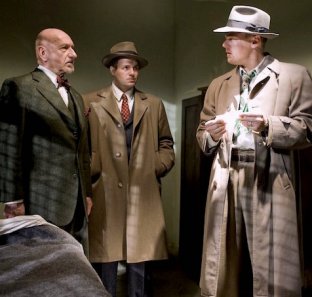 I think the more you let Shutter Island percolate after it’s over, the better it becomes. Solving the mystery and guessing at the twists occupies so much of your time on a first viewing that you almost miss the details in the characters and the world, but they build up nonetheless. There’s layers and depth here, and a plausibly realistic depiction (even according to an expert) of something that’s incredibly hard to depict in fiction. You can view Shutter Island as just an atmospheric gothic mystery chiller, and as that it’s a quality piece of work, but it’s the extra depth that mark it out as, actually, a great movie.
 100Films.co.uk