2013 #50
Tom Hooper | 158 mins | Blu-ray | 1.85:1 | UK & USA / English | 12 / PG-13
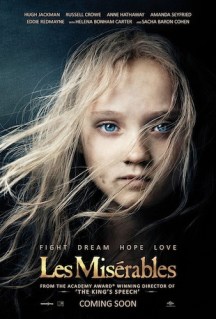 27 years after its West End debut, the long-running smash-hit musical finally makes the leap to the big screen. Such a beloved work paired with a recently Oscar-winning director and an all-star cast was pretty much a dead cert for big-name awards nominations, and so it was to be; but critical reaction was more mixed: I’ve seen people who love the film unreservedly, and others who despise it with a passion.
Let’s begin with the obvious: Les Mis* is a two-hour-forty-minute musical — some people are never going to be on board with that. “Why are they siiingiiiiing?!”, etc. Such complaints must be ignored. After that, more valid complaints do arise: the quality of said singing; the necessity of such length; whether said Oscar winning director is overrated and should he have won the Oscar in the first place; and so forth.
Les Mis is an epic tale: it spans decades, albeit in three distinct chunks. It begins when Jean Valjean (Hugh Jackman), freed from years of hard labour as punishment for stealing a loaf of bread, breaks his parole and disappears. Years later, we find him a wealthy man, manager of his own company and the mayor or something to boot. But his former prison guard, Javert (Russell Crowe), finds him too — oh no! Indebted to a young woman he wronged (Anne Hathaway), Valjean takes her child for a better life in Paris, where, more years later, they end up embroiled in one of the capital’s failed revolutions.
 Despite its running time, Les Mis is quite brisk for much of that plot (which, sorry if you’ve never seen it, I have described a fair old chunk of). There’s no interval in the film, but on stage it doesn’t come until well into the Paris section of the tale. Such a break must help the pacing, because while I remember enjoying it all on stage (where, I might add, it’s even longer), on screen I felt the middle portion began to drag. So yes, an epic running time for an epic, but it actually moves quickly through the parts that make it an epic before slowing for a bit of a forced romance and that kind of palaver.
I noted that it’s longer on stage, which is because here some songs have been trimmed. That’s partly for time, partly for re-staging (is it “hot as hell” in a spray-drenched dock pulling in wrecked galleons? No, apparently not), and partly to squeeze in a new song so it could get an Oscar nod. That’s Suddenly, which did get its awards nom but of course lost to Skyfall. It doesn’t fit too badly into the film, as it turns out, but in and of itself is a bit insipid. How much other trims bother you will depend on whether you’re a fan or not, of course. Some of the very best numbers are left to play in full, while tonally-awkward reprises (a comedy song after the climactic massacre) are cut back to literally a couple of lines.
 Much talk around Les Mis focused on the performances, with three in particular attracting discussion. As honourable wronged-man Valjean, Jackman is the star of the show, and brings his musical theatre background to bear on a clearly-sung but emotive performance. He was unlucky to be in the same awards year as Daniel Day-Lewis’ all-conquering turn in Lincoln, because otherwise those gongs might well have been his. Opposite him in the film’s central rivalry is driven letter-of-the-law lawman Javert, divisively sung by Crowe. I think the best criticism I read was that his vocal style seems at odds with the rest of the cast — whereas they’re musical theatre, he’s got a gruffer, perhaps rockier, tone. I didn’t think he was all that bad, a few moments aside, which I suppose is the advantage of hearing so much negativity in advance.
And then there’s Anne Hathaway, as much of a sure thing during awards season as Day-Lewis. To be honest, I think Jackman comes out of the film better. I can never quite escape Hathaway’s earnestness; a sense of, “look, I’m singing! And isn’t this role important and meaningful!” Her delivery of I Dreamed a Dream, so over-used in the film’s trailers, is pretty flawless, realised (if I remember rightly, which I might not) in a single shot, a soul-crushing close-up on her face. Otherwise, while she’s good really, I felt she’d stolen some of the attention that should be on Jackman.
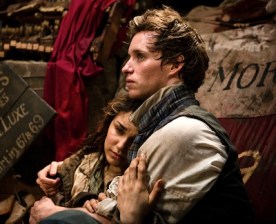 The rest of the cast is an assortment from the can-sing (Eddie Redmayne, Amanda Seyfried) to the comedic-so-it-doesn’t-matter (Sacha Baron Cohen, Helena Bonham Carter). The best voice of the lot belongs to Samantha Barks as Eponine. No surprise, really, as she was poached from the West End… where she’d found herself via one of Andrew Lloyd Webber’s BBC talent shows, so I imagine he feels thoroughly vindicated now (as if he didn’t before).
Famously, they’re all singing live. As a viewer, this is more appreciable as a technical accomplishment than something that makes any difference to what we see on screen. It brings some extra emotion (read: odd breathing points and half-achieved notes) at times, and a knowledge of authenticity always has a way of adding authenticity, but otherwise…
There was much surprise when Tom Hooper wasn’t rewarded with a Best Director nomination at the Oscars — much of it originating from within the Les Mis camp, I felt, whereas no one else was particularly fussed. Hooper has improved a bit as a director (finally, close-ups are framed properly!) but, to be honest, I don’t particularly rate him on the whole. For every good decision (going for a grimy real-world style rather than something typically musical-y) there’s an awkward one (the decision to represent Paris almost entirely with one slightly-stagey set). For every well-staged song (realising Lovely Ladies as a montage to show Fantine’s fall over time) there’s one that’s lacking (we don’t see any empty chairs at empty tables until the song’s half over).  Hooper does an above-average job on the whole, but the lack of awards nods shouldn’t be so surprising.
After so long on the stage, a film adaptation can feel redundant or insufferably inferior. Despite the negative reaction from some quarters, I think it’s fair to say the team behind Les Mis have managed to render something that is neither of those, even if I had a nagging feeling it could’ve been even better still.
* Why Americans insist on using a ‘zee’ there I don’t know — do they think it says “miss”? How do they say the word “miss”? “Misssss”? Anyway: ^

 Sean Bean and his ragtag band of knights investigate an unaffected village during Ye plague-adled Olden Days in this folk horror from the director of Creep, Severance and Triangle.
 The director of
  which is what you should expect from the director of all those films I listed above but quite blatantly doesn’t sit right. And it’s over two hours long too, so it keeps going… and going…
 Moonfleet is probably what you’d call a curio. It’s a colour CinemaScope Hollywood adventure movie from a director best known for epic German silents or dark film noirs; it’s not been passed by the BBFC since its original release in the ’50s, meaning it’s never been released here on DVD or (presumably) even VHS; I believe it’s also unavailable in the US; yet despite this dearth of attention in both the country that made it and the country in which it’s set, a
 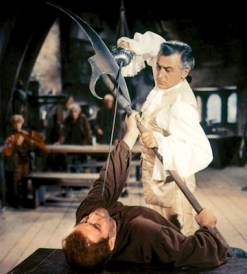 fights and chases of various kinds, a dramatic shoot-out on a beach, midnight escapes, and so on.
 16 years after they
 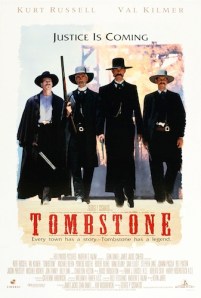 The story of the OK Corral is one I know by name only; I haven’t even seen the
  That may be down to historical accuracy. There’s a distinct feeling of veracity to proceedings, and as I understand it a concerted effort was made in that regard. The Movies perhaps shouldn’t worry about sticking too closely to fact (if you want an accurate lesson, read a textbook), but when they can manage to be both factually accurate and entertaining, it’s all the better. Cosmatos & co appear to balance this well.
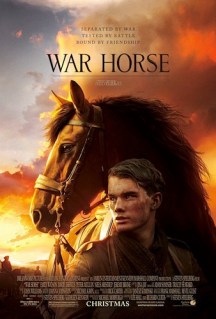 After decades telling tales from the Second World War, Spielberg moves back a conflict. That said, the BD’s special features make sure to point out this “is not his First World War movie” — it’s just a good tale about a boy and his horse.
 It can’t be denied that there’s factual inaccuracy here (the climax takes place at the Somme in the lead up to Armistice Day in 1918, but that battle was actually fought in 1916), or the occasional heavy dose of sentimentality (it’s directed by Spielberg and co-penned by Richard Curtis — what did you expect?), but I think it carries through these with a scale and heart that is, primarily, entertaining. It is based on a children’s novel and I think aims to be a family film (it should by rights be a PG; my twitter rant on that subject is
  Aiding the sense of the epic is Janusz Kaminski’s cinematography, which is regularly stunning and definitely one of the film’s standout achievements. The beauty of some shots is immediately obvious — he lenses the countryside idyll of Dartmoor in a sweeping fashion, bathed in summer sunlight — but there are striking compositions to be found throughout, be they in close-ups, cavalry charges, horse auctions, battlefield hospitals… There’s often a lovely texture to things too, from the likes of drifting snow or chaff, or the way light streaks across a room. The final scene, fully tinted orange, calls to mind the likes of
 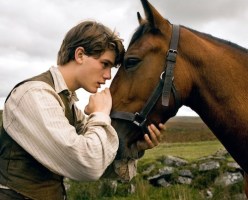 one that isn’t afraid to depict some of the nastier realities of the world, but in a way that makes them relatable for a younger audience. I think that’s important; but this isn’t a Worthy Film for that, it’s just something it does well. I think it also nails sensations of adventure and, yes, sentimentality.
 There are a few Oscar nominees from the ’00s that inspire little desire in me to bother seeing them (I’m certain that’s completely true of every era, but I’ve seen most of the ’00s nominees so I tend to focus on them more often), meaning it’s taking me a very long time to get round to them (maybe I never will). Master and Commander isn’t really one of those — it’s no
 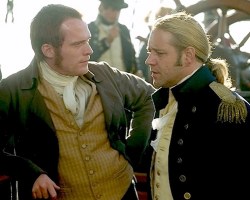 he’s not a naval man and doesn’t always understand their traditions. He’s not a crass audience-cipher in the way such parts often can be, but it does make him identifiable.
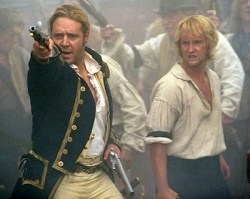 (that makes for a strangely bizarre array of company logos at the start). Despite the fact it’s based on a series of 20 (completed) books, and various people involved have mentioned the possibility down the years, a sequel is so unlikely it seems silly calling it just “unlikely”. And that’s a shame, because this is an entertaining action-drama with likeable characters and an engrossing atmosphere. A little to my surprise, I loved it.
 This year’s 52nd film is, in many ways, thanks to DC’s The New 52 (the comic book initiative/publicity stunt that saw DC relaunch their entire universe across a series of 52 new #1 issues, for those who don’t do comics): it got me back into reading regular comics, and featured in multiple titles for several months was a cool-looking advert for the US release of Detective Dee, complete with the attractive review quote, “
 To take Time’s opinion as a starting point, I have to wonder if they would rank Detective Dee so highly if it had been an American-produced film with actors speaking English. I don’t mean if the film was Americanised, but exactly the same, just an American production. In that instance, I think it would very much be viewed as a summer blockbuster, because that’s definitely what it strikes me as. It’s one with lots of talky bits and an over-complicated story, certainly, but then it’s not unheard of for US blockbusters to confuddle the viewer with an under-written over-developed plot (less so these days, I grant you).
 not in awe of the performer’s abilities or entertained. One of them features the hero fighting a gaggle of cheap CGI deer. Yes, deer. Why?
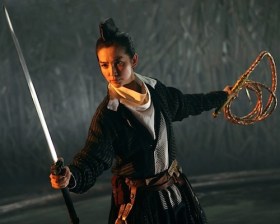 and they happily take its advice (see second paragraph)), a fighter whose arms fly off and turn into… something else (choppy editing means I’m not sure), facial transfiguration (imagine
 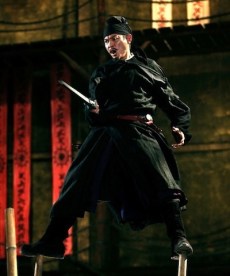 you could enjoy the characters, or the political machinations, but only if you take time to study them slowly and work out what was going on for yourself, because the film’s in too much of a rush to explain it to you. There’s something to be said for entertainment not spelling everything out — it’s often a highly-praised element of anything that achieves it — but Dee doesn’t do that, it rushes headlong past things that could do with more clarity. (One thing I should do is listen to Bey Logan’s commentary — there’s a fair chance he’ll have insights that illuminate me. But in a moment you’ll see why I haven’t done that before posting this.)
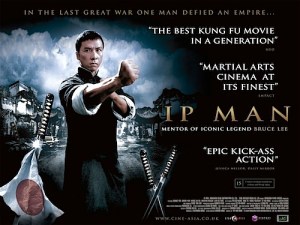 I liked Ip Man, but as we know from experience there are times when I find myself with little to say about a film, or I fail to make any notes, and this was an example of both. So I’ve decided to try something a little different.
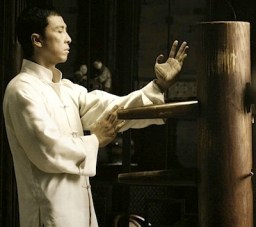 Though that’s an amusing thought, the film’s not quite that simplistic: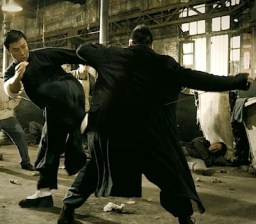
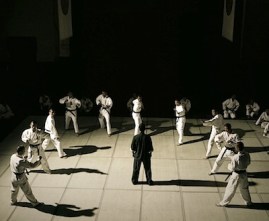 Indeed, fighting is still what the film does best:
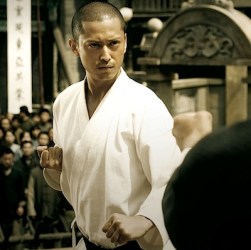 On the other hand, as that “sinister Japanese general”:
 100Films.co.uk