2012 #50
manlly Wilder | 101 mins | Blu-ray | 1.37:1 | USA / English | PG
 Directed by the inestimable Billy Wilder, winner of the Grand Prix (forerunner to the Palme d’Or) at the first Cannes, winner of the Best Picture Oscar in 1946, and also Best Actor, Director, and Screenplay, it’s a wonder that The Lost Weekend isn’t better known. I don’t think I’d even heard of it until Masters of Cinema announced their Blu-ray release back in January 2012, and comments I’ve seen around the internet express a similar experience of prior unawareness. Thank goodness for MoC, then, because this isn’t a film that deserves to be forgotten.
Adapted from the novel by Charles R. Jackson, the entire film takes place across one particularly eventful weekend (well, that plus flashbacks), in which should-be-recovering alcoholic Don Birnam (Ray Milland) tries desperately to fall back off the wagon.
The plot may smack of a worthy social drama (perhaps why it’s been forgotten), but most every sequence is loaded with more tension than a thriller. This is Wilder’s skill as both co-writer and director: he gets us on Birnam’s side early on, so that we follow him through the almost-self-induced hell that follows; and he keeps us on the edge of our seat, as desperate for it to work out as Birnam himself is. But, right from the very first scene, hardly a one of his plans does work out; 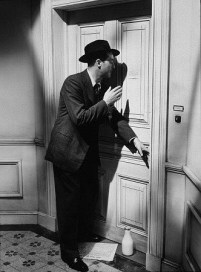 all of them thwarted at the last possible moment, when victory seems assured. The film isn’t preachy, but if it does teach us a lesson then this is how it does it.
Wilder’s direction is excellent throughout, with innumerable striking compositions, perfectly paced scenes, and the aforementioned tension ratcheted up to maximum. There are other very good directors who would’ve made a hash of a film like this — made one that screams “meaningful movie about An Issue” — but the way Wilder handles affairs means it’s more than that. It explores its issue, it exposes us to the facets of it so that we might learn something, but it does so under the auspices of a drama about a man we come to care about. It’s not an “alcohol is bad” sermon, it’s a “can this man survive it?” thriller.
Equally, the flashback structure could scupper the film, but instead it raises it, with two of the best sequences coming here. There’s the exceptional La Traviata scene — it’s very obviously a bit of Good Direction, but while you could call it showy, it works — and the scene where Wick tries to cover for his brother to his new girl, which lends weight and backstory to the opening scene where he seems ready to (and, indeed, does) callously abandon him.
 Milland is astounding. The film rides on him and he really carries it. It’s easy to play a comic drunk, but Milland doesn’t sink to that. Indeed he doesn’t do one type of drunk at all, swaying back and forth across various levels of inebriation as required. I often find films of this era contain performances we assess as great, but if you put them in a film today no one would buy it; they’d find it stagey and fake. Milland’s transcends that — it fits the era, but I wouldn’t be surprised to find it would play just as potently today. I think it’s fair to say that Milland is not widely known today, but with every film of his I become more convinced that history has been unkind.
Also worthy of praise is Frank Faylen as Bim. In his featurette on the MoC release, Alex Cox says he’s the second best character in the film, and he’s probably right. Cox notes that at least one review at the time really laid in to Bim, painting him as an evil sadist. Today, I don’t think we have that perspective at all. Bim tells Birnam the truth, painting his illness like it really is. Whereas his other friends and relations all try to do their best for him, but wind up enabling his addiction to continue, Bim’s experience and detachedness means he can be blunt and truthful. Birnam may not realise the good it’s done him, but good it does ultimately do.
 There’s also able support from Howard Da Silva as barman Nat and Doris Dowling as Gloria (is she a whore of some kind? Just an escort? A bar-crawler? Did I miss something?), whose slang is oddly infectious. No offence to Jane Wyman, but her lovelorn-but-strong girlfriend character only seems to really come alive in the closing minutes, when she considers abandoning Birnam to his fate.
The Oscar-nominated score by Miklós Rózsa at first seems highly unusual, a warbling horror movie score, but it quickly comes to fit very well, and not just the nightmarish daydream sequence near the film’s climax. The movie was also nominated for John F. Seitz’s cinematography and Doane Harrison’s editing. They lost to The Picture of Dorian Gray and National Velvet respectively, neither of which I’ve seen, but they must have something special to outclass the work on show here.
I think the same can be said of the whole film. Issue-focused movies from the past are often badly dated, even if we can still admire the filmmaking techniques involved. That’s not their fault — it’s the cultural climate of the time, or the shifts in understanding that have come since. I’ll admit I know next to nothing about alcoholism so can’t comment definitively on the film’s enduring accuracy, 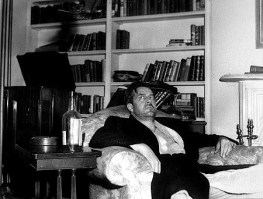 but from what I do know of other conditions of addiction and mental health, this feels as if it’s still thoroughly relevant.
Even if you don’t care about The Issue, there’s an engrossing, thrilling drama for everyone to enjoy. If The Lost Weekend is indeed forgotten, then it merits widespread rediscovery.
That concludes my reviews from 2012.

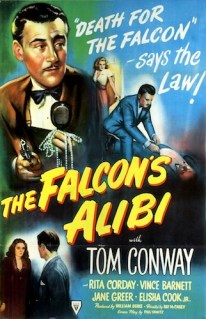 Once again smitten by a pretty lady, the Falcon finds himself co-opted into guarding a wealthy woman’s jewellery. But when said jewels are promptly stolen, and murders ensue, our charming hero is implicated. Who would do such a dastardly thing? And what’s going on with the DJ in the roof of the hotel?
 Among the rest of the cast, Vince Barnett becomes the fourth actor to play the Falcon’s sidekick, Goldie; and Jean Brooks and Rita Corday each appear in their fifth Falcon films! Brooks was previously in Strikes Back, in Danger, the Co-eds and in Hollywood, while Corday was in Strikes Back, the Co-eds, in Hollywood and in San Francisco (making this three in a row). Can you imagine anyone doing that today? (And Brooks is in literally one shot, I think. Considering she was a leading lady in at least two previous Falcons, that’s a tad weird to boot.)
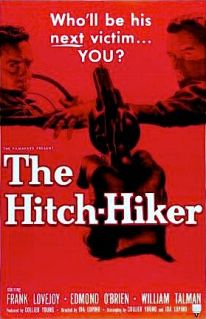 Based on a true story, this film noir sees two chums on the way home from a fishing trip pick up a hitchhiker. As you can tell from the title, he turns out to be rather significant: he’s a murderer on the run, and pulls a gun on the men so they’ll do his bidding, which is take him to Mexico so he can escape justice. Oh dear.
 But does her gender add any different perspective? I think perhaps it does. If you read
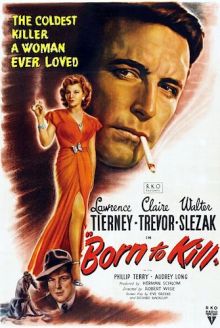 Director Robert Wise certainly had an eclectic career. Depending on your genre predilections, you may feel he’s best known for
  Even today, it’s quite a nasty little work, although tastes have evolved to the point where “discriminating people” are likely to be attracted to it — though not purely for the violence. You’d imagine that would pale by today’s standards, but even now the opening double homicide — presented pretty much in full on screen — is quite shocking, especially because it seems so horrendously plausible. Much movie violence is heightened, involving gangsters or spies or whatever, but here it’s a lover in a jealous rage killing two people in the kitchen of a regular house. Grim.
 sometimes develop a cult following.
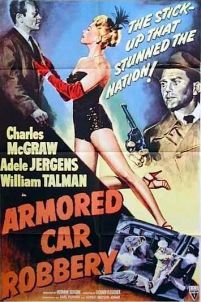 A B-picture from the middle of the classic film noir era, Armored Car Robbery is perhaps most notable today for being one of the first films directed by Richard Fleischer, who would later call the shots on
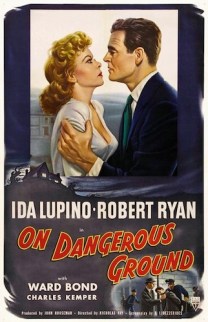 Helmed by acclaimed director Nicholas Ray (
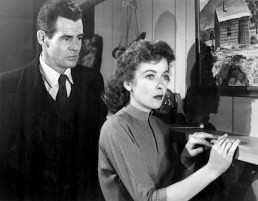 On the plus side, Bernard Herrmann’s score is unequivocally excellent, particularly the pulsating opening theme and the insistent action climax.

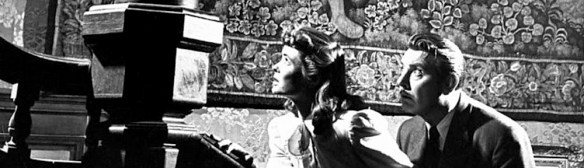

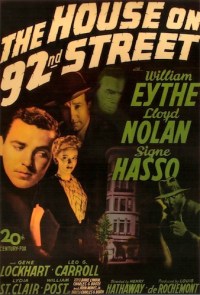 Here’s an unusual one from the pantheon of film noir. These days we’d probably call it a docu-drama, though thankfully there are no talking heads, but there is a factual voiceover narration. The story, we’re told, comes from the FBI’s files and is based on a real case —
  how they really work and investigate a case. At the time I imagine this was a fascinating procedural; now, we’re all a bit more familiar with how such things go, but it still works as an historical document.
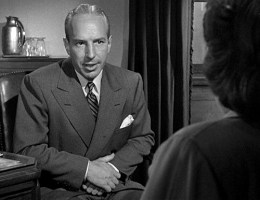 Might be because no one ever knew they were making a film noir, eh? How can you expect something to conform to a set of rules that were only defined after the fact? Hathaway and co didn’t fail at making a noir, they just made a film that doesn’t fit the later-defined template as well as the films used to define said template. I know, four words from some other online critic hardly merit a whole paragraph, but it does bug me when people write daft things like that.
 If The Locket is known for anything, it’s for a plot structure that places flashbacks within flashbacks within flashbacks. There’s always the potential for good fun in that kind of structure, though it’s usually the kind of thing that sounds more complicated than it is — the straightforward ‘concentric circle’ arrangement here makes them a doddle to follow; so straightforward, in fact, that it would be easy to miss how it was so structured.
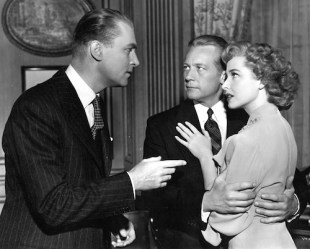 It might have been more interesting if the doctor had been making it all up; or if it had been left open ended, with Nancy set to ruin someone else’s life. That could well have worked, leaving the audience to come to its own conclusions, etc. Considering the film’s age, however, I’m sure there were demands we see this thief and murderess brought to justice.
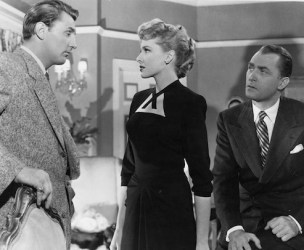 manipulative criminal it seemed all along, but instead a damaged individual doing these things involuntarily. This isn’t the wholly nonsensical part of the film — her apparently-accidental marriage to the son of the house she grew up in would be that bit — but I preferred it when she was just a villain. Psychologically it holds relevance, but at the same time she’s rather taken it to extremes. Or maybe I was just fed up by then.
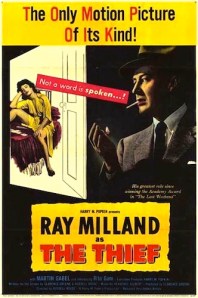 Ray Milland stars as Dr. Allan Fields, a nuclear physicist working at the United States Atomic Energy Commission, who is photographing secret files and passing them to The Other Side, until something goes wrong and the authorities are on his tail. But that’s almost beside the point, because if The Thief is known for anything it’s for its dialogue — as the poster proclaims, “not a word is spoken…!”
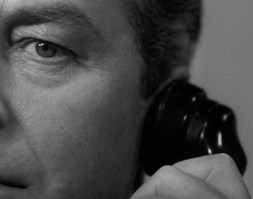 Obviously we can look back to the silent cinema for that kind of thing, but while that era could probably still teach many filmmakers something about visual storytelling, it’s hard to deny that the advent of synchronised sound adds a helluva lot to the ability of film — if it didn’t, it wouldn’t have taken over so fast and remained virtually 100% dominant for the last 80+ years.
 Perhaps this is why the villains are never explicitly named. But they’re definitely not American! Tsk tsk. More crucially, it’s a bit slow at times — it seems to take longer to explain things when stuck doing them through visuals alone. That said, it could probably have survived a speedier approach even doing what it does — perhaps, then, Rouse is playing for time: the film only runs 87 minutes in spite of its pace.
 100Films.co.uk