Red Riding: 1980 (2009)

aka Red Riding: In the Year of Our Lord 1980

2009 #51
James Marsh | 93 mins | TV (HD) | 15

This review contains major spoilers.

Red Riding: 1980The second instalment of the Red Riding Trilogy sets out its stall with a stunning opening montage, covering six years of the Yorkshire Ripper case in as many minutes through news footage and faux news footage. In one fell swoop this establishes its own storyline, fills in some of what’s happened since 1974, and sets itself apart from its predecessor: this one’s based on fact. Well, a bit.

Unfortunately, a factual grounding hasn’t helped the story one jot. Where the first idled, this meanders, flitting between the Yorkshire Ripper, the investigation into the Karachi Club shooting (which closed 1974), and the private life of lead character Peter Hunter. It’s the cover up surrounding the middle of these that’s the most interesting, but that’s also the bit with the least time devoted to it. Most is spent on Hunter’s investigation into the investigation of the Ripper case, though by the end it becomes apparent this exists to cover the ‘real’ story — which is, of course, the Karachi Club cover up. Consequently neither are covered with the appropriate depth: the Ripper investigation is never a serious thread, the team we follow uncovering nothing significant and the Ripper himself captured by chance, off-screen, by a previously-unseen regular constable; and the incidents at the Karachi Club, and their lasting impact, are just about clarified but given no serious weight before a last-minute explanation.

If that sounds complicated, it isn’t. As in 1974, it’s all too straightforward: the people you suspect did it actually did, as it turns out, and there’s no serious attempt to conceal that. In fairness, it just about manages one surprise, right at the end, and the moment after this — where Hunter’s murderer shows remorse with one brief, subtle facial expression — is by far the best bit of the film. Worse than the lack of suspense, 1980 seems to forget its own plot all too often. Hunter is employed by the Home Office, for example, and told to report directly to them and them alone. But then we never see those characters again, not even when he’s later dismissed by lower-ranked officers — why not return to the men he was, supposedly, actually employed by? Other plot points are pushed aside too soon, forgotten about or just abandoned.

Characters and locations resurface from the first film — an unsurprising continuity, but pleasingly almost all appear in a context that’s actually relevant to the plot, rather than a mere catch-up on a previously-known person. Some of them have great import now, their role in the trilogy apparently fulfilled, while others remain little more than cameos with no bearing on the story, suggesting an even bigger part still to play. This works quite well, creating a real world where characters come and go rather than one that is obsessively — and unrealistically — interconnected.

The same can be said of the cinematography. Marsh frequently finds a beautiful or unusual shot, enlivening proceedings considerably. The 35mm glossiness doesn’t evoke the feel of a grimy past quite so thoroughly as Jarrold’s hazy 16mm, but as this is now the ’80s perhaps that’s the point. Nonetheless, the setting conveyed is still a drab, dreary — and constantly damp — North.

Underscored by a plot that doesn’t really come together, and largely bears little relation to the other two films, 1980 is the weakest entry in the trilogy.

3 out of 5

Red Riding: 1974 (2009)

aka Red Riding: In the Year of Our Lord 1974

2009 #50
Julian Jarrold | 102 mins | TV (HD*) | 18

Red Riding: 1974The Red Riding Trilogy covers nine years of police corruption and child kidnap/murder in Yorkshire, amongst one or two other things, and begins here with a very film noir tale, courtesy of author David Peace and screenwriter Tony Grisoni, slathered in neo-noir stylings, courtesy of director Julian Jarrold.

Jarrold is most recently responsible for Kinky Boots, Becoming Jane and Brideshead Revisited, all of which stand in a sharp juxtaposition to the style and content of Red Riding. But turning from his lovely English-as-they-come costume dramas to something altogether nastier should come as no great surprise, for Jarrold is merely returning to his TV roots: in the mid ’90s he directed episodes of Cracker, Silent Witness and Touching Evil.

He certainly seems to know his territory, but perhaps he knows it too well — though this is also the fault of Grisoni and, perhaps, Peace — as the plot that he unfolds is not only familiar but told as if he’s all too aware we know what’s coming. The feeling one gets is of a British James Ellroy, albeit a low-rent, less complex version. (The same is true of 1980, though for me 1983 manages to escape such comparisons.) The story idles along, not exactly slow so much as in no hurry, full of near-clichéd plot points and an unrelentingly standard structure. These things aren’t necessarily a problem, but when you’ve got as big and bold a reality claim as the Red Riding Trilogy they feel out of place.

Another recent point of comparison would be David Fincher’s Zodiac — young newspaperman on the hunt for a serial killer in an inspired-by-fact ’70s setting — though this does 1974 no favours. It may be grittier than Fincher’s film, but it lacks the polish, the originality, and manages to feel slower, despite being a whole 50 minutes shorter. However much arty photography, disjointed storytelling, relatively dense accents and ‘gritty reality’ is plastered over the barebones of the tale, the familiarity of it — to both viewers and the makers, who don’t even seem to be trying — means there’s not an ounce of suspense or surprise to be had.

The cast is made up of established names, familiar faces and rising stars, many of them unfortunately stuck in familiar roles or otherwise left stranded by the unrewarding material. If they’re not quite stereotypes it’s because they’re too bland, lacking enough discernible character traits to reach such lofty heights. Occasionally this is because, with two films to come, some minor parts here have a major role later, but this can’t be said of them all. As the lead, Andrew Garfield’s journalist is as much of a stock character as the plot he finds himself in: a young reporter type, idealistic among journalists who no longer care (if they ever did), hunting to expose The Truth. Again, it could work, but is belied by the insistence — in both promotion and filmmaking style — that Red Riding is something more than Another Murder Mystery. Only Rebecca Hall, as a mother whose young daughter went missing years earlier, is granted the material to give an outstanding performance — which she does, easily justifying her recent BAFTA Rising Star nomination.

Besides Hall, the best thing about 1974 is its dull, desaturated photographing of grimy, desolate locations, where any colour that isn’t beige desperately wants to be. It suits the story and era perfectly, and the choice of 16mm seems to add a level of haziness that is equally appropriate. It’s perhaps indicative of everything this is aiming for that the most beautiful imagery is of an incinerated gypsy camp. Rendered almost black and white by the soot and desaturisation, ash floats through the air like snowflakes as Garfield stumbles through it, the whole picture a vision of Hell. It’s a kind of perverse beauty, true, but that’s also entirely in keeping with Red Riding.

1974 is a stock noir tale, dressed up with fancy filmmaking techniques and claims of realism to look like something more truthful, more real, more Important. And it makes me a little bit angry because of it. Maybe the violence is more realistically depicted than your average genre entry, maybe the police corruption is a little more plausible — then again, maybe it isn’t — but the real story here is so familiar they haven’t even bothered to hide the plot beats and twists properly, no doubt assuming a “gritty” veneer plastered over the top would do the job for them. It doesn’t. Maybe 1974’s grimy setting, brutal violence and unbeatable police corruption are all true to life, but the familiar and predictable plot leaves the realism feeling like no more than a pretence.

I was enjoying 1974 a lot more by the time the unexpectedly satisfying conclusion came around, but the sense that it had tried to pull the wool over my eyes throughout — and not in the good way a thriller should — just leaves a bitter taste.

3 out of 5

* Though I watched Red Riding: 1974 on 4HD, it’s my understanding that it was upscaled. ^

Alien³ (1992)

2009 #15
David Fincher | 110 mins | DVD | 18 / R

3 times the stupid taglines.We’re used to seeing big studio’s logos transformed at the start of films — Universal perhaps do it most often, having a handy globe, though others are far from immune — but I think Alien³ is the first instance I’ve seen where the logo is left untouched but the music is altered. Right from the disconcerting modification of the famous Fox fanfare you can tell this is going to be something a bit different and a bit edgy. Unfortunately, it’s also a bit rubbish.
At the very least the Alien franchise has to be applauded for giving each film a very different feel and tone. Even if in some ways 3 combines the first two — single Alien, claustrophobia, unarmed heroes; but there are lots of them, most with experience of killing — it adds enough variety, especially stylistically, to mark it out. This can probably be attributed to first-time feature director David Fincher, who, despite severe studio interference, still manages to quickly make the film his own. Though the story picks up directly from the previous film (as Aliens did from Alien), it soon turns dark, dirty and decrepit, abandoning both the military sheen of Aliens and the old tanker grime of Alien.

The sets and costumes have a Gothic feel, devoid of most of the franchise’s sci-fi trappings, and though the cinematography is glossier than either preceding entry (Aliens looks distinctly ’80s, whilst this has a distinctly ’90s look — I’m not well enough versed in technical details to know why this is) it manages to feel grungier. From style to story, the whole film is bleak and uncompromising, particularly with its brutal plot — from the start, only Ripley survives the crash, and soon after there’s a horrid autopsy performed on Aliens‘ lovable little Newt, who Ripley previously fought so hard to save.

Alien³ is very dark and very nasty — and these are by far the best things about it.

Put simply, the story — or the way the story is handled — lets everything down. It all goes well for the first 40 minutes or so, but then it begins to get scrappy, and gets steadily worse as the running time rolls on. Leaps in story and logic abound, either creating plot holes or doing nothing to hide them. Much of the middle is the worst, where the convicts’ plans are muddled and quickly discarded. That said, this is also true of the climax — something to do with running around corridors and a giant piston and… I have no idea. It’s a shame because someone clearly had plenty of fantastic ideas, plot twists and action sequences, but they’re all squandered either by weak editing or, even worse, simply by being in this film.

As for the Alien, it sadly has no real menace — it just turns up as and when it (or, rather, the plot) fancies, and goes away for the rest of the time. In the first film it could be anywhere, in the second they were constantly advancing, but this time it’s just around, somewhere, sometimes. It’s not helped by poor realisation, spending too much time either in the light or in clear shots, both of which show the shortcomings of the special effects in a way the previous two films fought to hide.

The total lack of weapons or monster-fighting skill on the part of the supporting cast exacerbate these problems, meaning that, even when the Alien does turn up, the result is always a foregone conclusion. Even worse, any characters we really care about — or can even identify, to be honest — are killed early on, leaving a bunch of faceless potential victims who weren’t invested with any character and so who we’re not invested in. This is worsened by using a fantastic, recognisable British cast, none of whom are given anything much to do. For all these reasons, almost the entire film is devoid of any genuine tension.

Alien³ isn’t irredeemable — it’s packed with good ideas and good direction — but that’s also why it hurts. Lumbered with a hatchet job on the plot, characters and editing, it feels like some very talented people made a good film before someone else hacked it up a bit. The result is quite bad but, even worse, it’s disappointing.

3 out of 5

Tomorrow, Alien Resurrection.

My review of the Alien³ Special Edition can now be read here.

Insomnia (2002)

2009 #33
Christopher Nolan | 113 mins | DVD | 15 / R

This review contains minor spoilers.

The Dark KnightBetween becoming a Geek God with Batman Begins and The Dark Knight and coming to everyone’s attention with a stunning more-or-less-debut that managed to elbow itself right up into the IMDb Top 10 (that’d be Memento — obviously, it’s slipped since), Christopher Nolan directed this: an American remake of a Norwegian police thriller, and the only one of Nolan’s five major films not to be on that be-all of film quality, the IMDb Top 250 (the fifth is of course The Prestige, while Begins is the lowest at #106.) So is Insomnia a forgotten classic robbed of a spot, or just a footnote to the rest of Nolan’s superb career?

These days, there’s a murder mystery/thriller on the TV most weeks — heck, most days thanks to the abundance of repeat-laden digital channels — and so a film attempting one can’t just settle for the usual array of clues, suspects, interviews and twists. Insomnia looks like it’s heading down this road early on — an interview with the victim’s boyfriend in particular could easily slot into any episode of Midsomer Murders or what have you — but soon does what’s required of any film entering this territory these days: it provides more. Most obviously, despite the early plot and stylistic conventions, this is not a “whodunnit”: the killer’s identity is revealed around the halfway mark (assuming you haven’t already guessed it from the opening credits) and from then on the film gradually moves into murky moral territory, quickly leaving behind those early trappings for a set of more complex noir-ish moral conundrums.

Al Pacino’s detective, for example, is a man under pressure — not just from the case, nor the usual clichés of a messy divorce or alcoholism, but from a pending Internal Affairs investigation that may or may not be justified, and an incurable bout of insomnia brought on by the Alaskan summer’s lack of night. The pressure mounts, he makes bad decisions (which I won’t spoil here), and even if the use of these plot points was merely that they occurred it would have offered something above the norm. Hillary Seitz’s screenplay pushes it further however, digging far deeper than usual for the genre into debates about the morals of police work, what seems acceptable and what is acceptable, and perhaps even what should be acceptable. The ending may seem to offer a Hollywoodised “everything’s set right then” denouement, but while it’s true that the plot is neatly resolved the considerations raised are not so easily ignored.

Cast-wise Insomnia fares pretty well. When it was released, around the same time as the excellent One Hour Photo, everyone was amazed at Robin Williams turning in a pair of non-comedic performances. The quality of them both makes it seem only natural now however, leaving that amazement as a distant memory. His turn as novelist Walter Finch here may owe something to Kevin Spacey’s John Doe in Se7en — indeed, Nolan seems to explicitly reference that film in locations such as the corridor of Finch’s apartment building — but isn’t as lowly as an impersonation. Hilary Swank offers able support as wide-eyed young cop Ellie Burr, while Pacino does a good job portraying the confusion induced by lack of sleep, aided by some effective camerawork, editing and sound design.

In the end, the main damage done to Insomnia is inadvertently by its director: while it is undoubtedly above average for a murder mystery/thriller, its relative straightforwardness pales in comparison to the work Nolan’s done before and since. However, as with every Nolan film so far, I found my perceived enjoyment increase the more I’ve thought about it since. It may not be objectionable that Insomnia hasn’t made it onto that IMDb list then, but if it is a footnote to Nolan’s career it’s a significant and enjoyable one.

4 out of 5

BBC One are showing Insomnia tonight at 10:45pm.

In Bruges (2008)

2009 #22
Martin McDonagh | 102 mins | TV | 18 / R

This review contains minor spoilers.

In BrugesIn Bruges has gathered quite a bit of indie-level praise and acclaim, culminating in wider recognition at the Oscars and other awards ceremonies at the start of this year. For those like me, finally getting round to seeing it in the wake of all this, it comes with quite a burden of expectation on its shoulders. Can it possibly be the modern classic many make it out to be? I mean, it is set in, y’know, Bruges…
First and (perhaps) foremost, In Bruges is hilariously funny, much more so than most by-the-numbers ‘comedy’ films can manage. The easily-offended might disagree, and some jokes are a tad too obvious (Americans are fat! Fat people can’t climb tight stairs!), but it’s nice to genuinely laugh at a film rather than force the odd smirk so as to at least get something from an otherwise wasted 90 minutes. It’s also dark and occasionally tragic though, and in this respect it’s unsurprising that writer/director McDonagh started out as an acclaimed and award-winning playwright, as stage plays mix humour and darkness more frequently (and with wider extremes) than films ever dare to. His theatrical roots also go some way to explaining the amount and ferocity of the swearing (again, something plays are more prepared to indulge in), but so too the brilliance of the dialogue. That it takes a playwright to craft such a good film is perhaps an irony, but not a troubling one.

Good dialogue is wasted without a good cast however, and thankfully everyone here gives a fantastic performance. The standout is Colin Farrell as hitman Ray. He initially seems a confident, cocky, experienced young hitman, and therefore verges dangerously close to stereotype, but we soon realise he’s actually twitchy, nervous, insecure, and genuinely sorry for the sole act of violence he committed. It might look like a Black Comedy With Nasty Violence to some — certainly, there are reviews that suggest some viewers are incapable of seeing anything beyond that — but there’s a lot more depth in the characters than the surface would suggest. Brendan Gleeson and Ralph Fiennes give consummate supporting performances, like Farrell chipping away at the stereotyped facades to find the hidden facets that the script is kind enough to reveal.

The quality of McDonagh’s writing (and direction) doesn’t stop with character and dialogue. The story is thematically considered, with a variety of paintings and associated imagery to occupy those who might be interested. Events are beautifully tied together and, best of all, none of the early scenes feel oddly inserted or have that nagging sense that they’re merely an excuse for something to be there later — everything works first time, and then has a seamless payoff too. Some viewers have criticised the ending, but I suspect they’re largely more used to mainstream fare and viewers who have ever enjoyed an indie film won’t bat an eyelid. All in, it’s easy to see why the screenplay has become the film’s prime awards nominee and winner.

Nominations, wins and buzz weigh heavy, but In Bruges has shoulders broad enough to carry such expectation with ease. “There’s never been a classic movie made in Bruges,” one character truthfully espouses, “until now.” It seems she couldn’t’ve been more right.

5 out of 5

In Bruges placed 2nd on my list of The Ten Best Films I Saw For the First Time in 2009, which can be read in full here.

The Dark Knight: The IMAX Experience (2008)

2008 #48a
Christopher Nolan | 152 mins | IMAX | 12A / PG-13

The Dark Knight: The IMAX ExperienceOne of the joys of spending five weeks of this summer in New York is that I have the opportunity to see anything that’s out in the US before the UK early. I haven’t entirely used this to my advantage (no trip to Hellboy II, for example, which has almost left theatres here but is still a few weeks off at home), but I have been to the much-anticipated new Batman movie, The Dark Knight… twice. Unlike in the UK, I have relatively easy access to an IMAX here, and, as any good Bat-fan will know, this means I was not only able to see TDK one week early, but also on the screen it (or, at least, parts of it) were specially shot for. Of course, despite the film virtually being on loop at Manhattan’s sole IMAX screen, the high demand for tickets means I had to wait til the second Saturday to see it writ so large — and even then I was fairly lucky, as some showings sold out inside of two hours.
As I’ve reviewed the film before, and my feelings on it have barely changed with a second viewing just one week later, it seems sensible to focus on the IMAX aspect. For those who somehow missed the news, The Dark Knight is the first Hollywood blockbuster to be specially shot for IMAX — not all of it, but six key sequences… or so they say. From what I could tell, while some whole sequences were indeed shot on IMAX film, often it was used just for bits of scenes, or now and then for the more dramatic establishing shots. For example, every aerial shot in the film — and, as those who’ve seen it will know, there are a fair few — appears to have been shot with IMAX cameras. The choice of sequences to shoot on IMAX is also intriguing. Some reviewers asserted it was “obvious” scenes were IMAXed even on a 35mm print, but I think they might be in for a surprise. Yes, the bank robbery opening, the car chase, and elements of the climax all receive the IMAX treatment, but elsewhere smaller scale action sequences and even some dramatic scenes are awarded the vision-filling honour.

It all looks stunning, of course: the resolution is visibly increased whenever the IMAX film kicks in (the rest of the film, blown-up from 35mm, is blurry and grainy by comparison but still doesn’t come out too badly) and the added size and scope of the format serve to underline the scenes for which it’s employed. While most of them are worthy, if sometimes unexpected, there are times when one wonders if scenes were picked just to make up the numbers with something not especially challenging. That said, it’s always nice to see, so one can’t complain too much. I didn’t find IMAX to be an especially viewer-friendly format for a two-and-a-half-hour feature though — it’s designed to fill your vision, an aim it achieves admirably, but when trying to watch a regular movie it entails an unusual amount of head turning, as well as trying very hard to notice everything right into the depths of your peripheral vision. It was certainly an experience, as the advertising subtitle suggests, but it won’t be for everyone and I’m not sure I’d bother again without some notable incentive (such as the one Dark Knight offers — none of these new-fangled 3D films have been interesting enough to tempt me yet). In some respects, what interests me most is what debates and opinions the use of IMAX will provoke about the film’s correct aspect ratio when it comes to DVD/Blu-ray time. I don’t care to predict what people will say, but I suspect it will be amusing to observe.

One final note: watching this just one week after I first saw it in a normal cinema (one week & one hour, to be exact!), it seemed to me that the odd shot was trimmed slightly or actually missing. Quite why this would be I don’t know, and it may just be my memory playing tricks, especially as the running time listed on the BBFC is actually slightly longer for the IMAX version (as seems to be standard, from a quick look at a few other IMAXed films — I’m sure someone knows why). The differences — if indeed there are any — are minor, but I felt I should mention it.

There’s no questioning The Dark Knight‘s brilliance in its own right, in my mind — it may be questionable whether it’s the Best Film Ever (surprisingly, it still sits at #1 on the IMDb Top 250), but at the same time I genuinely enjoyed this more than any other film I’ve seen from that top ten (and probably beyond). Whatever size screen you see it on, this film is an amazing experience — but some of it was shot especially for IMAX and those bits do look spectacular on the extra-huge screen. If you have the chance, this is really how Dark Knight should be seen — especially as it’s always possible that you won’t have the chance again.

5 out of 5

As if two reviews wasn’t enough, I shared more of my thoughts on The Dark Knight (this time when considered next to Batman Begins) here.

On the off chance anyone’s wondering what happened to #48, it’s WALL-E and the review’s on its way. But I’ve been sat on this one for a week (and not got round to the WALL-E one for over a week!), so I thought I’d just get on and post this, sequence be damned.

The Dark Knight (2008)

2008 #47
Christopher Nolan | 152 mins | cinema | 12A / PG-13

The Dark KnightThe Dark Knight — the sixth film in the modern Batman series (though not connected to the first four) — comes with a heavy weight of expectation on its back. It’s the sequel to the last film, Batman Begins, which relaunched the flailing series in style and is one of the best comic book movies ever — so Nolan and co had to top that. There was Heath Ledger’s death, a sad accident that has heaped extra focus on his penultimate performance here (his final one, in The Imaginarium of Doctor Parnassus, is currently in post-production with no release date) — especially as some sources cited his appropriation of the Joker’s mindset as related to his death. And then there were the trailers too, which caused ridiculous levels of excitement among some — personally, I found them a tad lacking. But I was fairly confident that, a bit like Begins, The Dark Knight would turn out to be the sort of film that doesn’t necessarily trail all that well but is excellent when seen.
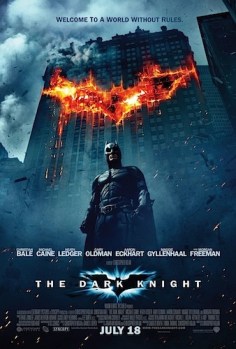
And I was right. In this respect, it’s because the action sequences aren’t the point of the film. They occur when required by the story, while still being well-spaced and appropriately exciting, rather than serving as check-boxes for a plot designed primarily to link them together — the latter being what most blockbusters seem to settle for these days. Many are pleasantly old-school in style, the stunts performed largely for real, and at least one major example is even left without music. On the odd occasion when effects must have been used, they’re seamlessly achieved. The most obvious use of CGI — which I won’t describe for the sake of spoilers, though many will already know about — is incredibly well done. All of this helps ground the film in a perhaps-surprising (for some) degree of reality, one that goes far beyond what other ‘realistic’ superhero movies have strived for.

In fact, this realism is probably The Dark Knight‘s main strength. Obviously there’s never going to be a real city where a billionaire dressed in bat-inspired armour protects the populace from a deranged man in clown make-up, but if there were then this is how it would be. Where Burton’s two Bat-films were “dark”, and Schumacher’s were “gaudy” (or “crap”), Nolan’s pair are “real”. It’s an excellent thriller as well as everything else. The focus of the plot — at least at first — is on the mob and their control over Gotham, and it’s from their criminal desires — plus the very existence of Batman — that the Joker grows. Ledger’s performance is as outstanding as you’ll have heard said elsewhere, and while it still feels like a supporting role it receives more attention than the psychology of Bruce Wayne/Batman — which, considering that’s what Batman Begins focused on, seems fair enough. Every other performance is equally as flawless (I’ll name names in a moment), but it’s Ledger’s disturbing, engrossing turn that will stay with you. He is the Joker, in a way Jack Nicholson certainly never was, and — among obviously more upsetting effects of his premature death — the fact we’ll never see him in a rematch is a huge shame.

As Harvey Dent, Aaron Eckhart’s role is much larger than I was expecting. The floating-head posters that seemed to divide the film between him, the Joker and Batman are spot on — they’re the three central characters, everything revolves around them, their actions, choices, and emotions. While Ledger may dominate with his (appropriate) theatricality, Eckhart is more the heart of the film, with a genuinely tragic story. Viewed in this light, the order of the film’s final scenes — which I think some may see as incorrectly balanced, perhaps even anticlimactic — make all the more sense. However, I don’t mean to undersell the rest of the cast by highlighting Ledger and Eckhart — in their supporting parts, Michael Caine, Maggie Gyllenhaal, and especially Gary Oldman and Morgan Freeman, all do brilliant work. The talented Christian Bale manages to hold his own as the ambiguously heroic crimefighter, even against the more obviously attention-grabbing performances of Ledger and Eckhart.

As with other superior superhero sequels like X2 or Spider-Man 2, The Dark Knight uses the groundwork of its successful predecessor to craft an experience that’s even greater. In fact, there’s an awful lot more that could be said about the qualities of The Dark Knight. At two-and-a-half hours, it’s a packed epic of a movie — which makes Nolan’s confident juggling of plot threads, character development, several large performances, action sequences, and more, all the more impressive. I certainly enjoyed seeing it with a large, American (importantly), opening-weekend crowd — several moments produced whoops and sustained applause from the audience, as well as a good number of well-deserved laughs.

The Dark Knight is great entertainment, with a good deal of meat on its bones too — the performances and emotional stories are as engrossing as the thriller-ish plot and impressive action. When all is considered, it’s possibly as perfect a thriller/blockbuster as they come. In fact, as I publish this, The Dark Knight sits at #1 — the best film of all time ever — on IMDb. It will drop, of course, because that’s opening-weekend fan-led gut reaction for you… but, even when time’s passed, I’m certain it deserves to remain high on the list.

5 out of 5

Sadly (though not surprisingly) the Manhattan IMAX was booked solid all through opening weekend (and most of next week, at least). As soon as I manage to see it on the extra-big screen, I’ll share my thoughts here. You can also read even more of my thoughts on the film (this time when considered next to Batman Begins) here.

The Dark Knight placed 1st on my list of The Ten Best Films I Saw For the First Time in 2008, which can be read in full here.

L.A. Confidential (1997)

2008 #26
Curtis Hanson | 132 mins | DVD | 18 / R

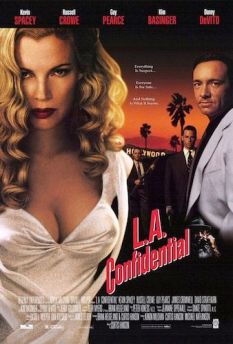
L.A. ConfidentialOnce again I’m watching an adaptation shortly after plowing through the source novel, a situation that has so far proved awkward for giving films a fair assessment. L.A. Confidential is an especially tricky one: how does a 480-page, densely written, intricately plotted crime novel, spanning seven years and “no fewer than four and perhaps as many as a dozen major crimes”, translate into a two-and-a-quarter-hour film? With more than a few surprises, as it turns out, because the apparently minor changes near the film’s start turn out to be the proverbial pebble in a pond: their ripples spread so far that, by the second half, not even a reader who can remember the many details of the novel’s complex plot will know for sure what’s coming.

This isn’t necessarily a bad thing. If screenwriters Hanson and Brian Helgeland had tried to squeeze in everything the movie would have been rushed even at three hours. Instead they’ve excised several unnecessary subplots and trimmed others to the bare minimum. Most impressively, they’ve picked apart several of the multitudinous plot threads and completely restructured them. It’s an incredible feat of adaptation. The downside is that some great strands are lost. Ed Exley’s father plays a huge role in the novel but is completely absent here; Inez Soto, the victim of a brutal gang rape, is reduced from a key supporting character to a couple of lines. Another connected loss is some characterisation. Jack Vincennes and Exley lose the most, though Bud White’s development is tied too closely to the main storyline. That said, the characters are still mostly there, painted quickly and precisely; they may lack some of the depth and complexity the novel can offer, but that’s an almost unavoidable difference between a film and a long, well-written novel. To make a good film such sacrifices are necessary — even though it’s been simplified, the novel’s complex plot is still a long way from becoming straightforward.

What impressed me most about L.A. Confidential is that, despite spending huge chunks of the film pondering what they’d cut and changed, I still enjoyed it immensely. Even while distracted with thoughts of the novel, its differences and its relative merits, I could still enjoy the fantastic filmmaking. The casting is perfect, especially Spacey, Pearce and Crowe (perhaps the last most of all, considering his penchant for real life violence). For once it really is as if the roles were written for them, making it easy to forget that Pearce and Crowe were virtually unknown at the time. They’re supported by a cracking screenplay (which I think I’ve praised plenty already) and beautiful direction, which manages to evoke the period without being shot like a period film — Hanson has stated that he aimed to make it period-accurate but shoot it like a modern thriller, and he’s succeeded. There may be one or two imperfections (the music felt a little repetitive to me, for example), but they’re slight and it seems churlish to pick on them in any depth.

I look forward to watching L.A. Confidential again without the novel hanging over my head. I’ve made my comparisons now, and my memory’s weak enough that, by the time I get round to watching it again (perhaps when the long-rumoured special edition re-release turns up), I’ll have forgotten enough of the novel’s specifics to not be bothered by them. I expect I’ll enjoy it even more then. It’s an excellent achievement, both as an adaptation and a film in its own right. You can’t say fairer than that.

5 out of 5

Dark City (1998)

2008 #2
Alex Proyas | 97 mins | DVD | 15 / R

Reposted today in memory of the great Roger Ebert, this was a film he championed and, as you’ll soon see, I adored.

Dark CityA little while ago I wrote about not falling in love with new films any more. Well, put bluntly, here’s one.

Dark City is probably the most underrated film I’ve ever seen. It is, to my mind, absolutely brilliant. It’s an intelligent and engaging neo-noir thriller with wonderful sci-fi twists. The imagery is fantastic — the film is beautifully designed and shot in a wonderfully stylised and highly effective manner. The sets and effects are breathtaking — not showy like so many blockbusters, but utterly effective and impressive. The script and story are complex (though never too much) and interesting, allowing you to piece together the mystery of just what is going on. To my mind, it’s much more effective than the whole “what is the real world” thing of The Matrix.

Incidentally, on that subject, if you’ve seen all of that particular trilogy you may find some bits of Dark City eerily familiar — to say which would spoil things, but many are so obvious you don’t have to be a film buff to spot them. Either both universes are based on similar philosophical ideas, or the Wachowskis just ripped this off (in case you hadn’t noticed, it predates The Matrix by a year, and many of the most recognisable elements are in the sequels anyway). Considering there hasn’t been a lawsuit (to my knowledge), I’ll guess it’s the former. But Dark City does it all better: there are no rambling, incomprehensible speeches and it doesn’t batter you around the head with philosophical claptrap when all you want is the story to move forward.

The film’s single major flaw is the studio-imposed opening narration, which gives away far too many plot twists — honest to God, if you ever watch this, mute it during the New Line logo and don’t turn the sound back on til the first close-up of Kiefer Sutherland’s fob watch. If you don’t, you’ll find most of the mystery of the plot ruined, as this narration shockingly gives away most of the answers. (There are rumours of a director’s cut, 15 minutes longer and without that narration, slated for release back in 2006. Maybe this year it’ll turn up as a “10th Anniversary Edition”.)

I could witter on for pages about how much I’ve fallen for Dark City. It’s a superb movie, massively underrated, that I hope I haven’t over-hyped for any reader who wants to seek it out. But please, if you do, heed my warning about muting the opening narration — it really is worth it.

5 out of 5

Dark City placed 3rd on my list of The Ten Best Films I Saw For the First Time in 2008, which can be read in full here.

Mean Streets (1973)

2007 #126
Martin Scorsese | 107 mins | DVD | 18 / R

Mean StreetsSemi-autobiographical New York gangster movie, guaranteed a place in history as the first collaboration between Scorsese and De Niro — what a place to end my little season!

As with Goodfellas, it’s someone else who’s the main character; and, as with Goodfellas, De Niro’s supporting character is a disturbing presence even when off screen. The similarities don’t end there, but I’m not going to go into them in detail. Suffice to say, Mean Streets feels a bit like a less epic, oddly less focused, grittier, and perhaps more realistic, prototype for Goodfellas. But even then it’s only that in some ways — the two are notably different enough to make each worthwhile.

4 out of 5