Review Roundup: 15-Rated Comedies

You don’t have to be an adult to like today’s reviewed movies, but… you do have to be a teenager. Still being a teenager would probably help you enjoy them, too.

In today’s roundup:

  • Airplane II: The Sequel (1982)
  • Hot Tub Time Machine (2010)
  • Sausage Party (2016)


    Airplane II: The Sequel
    (1982)

    2018 #17
    Ken Finkleman | 81 mins | DVD | 16:9 | USA / English | 15* / PG

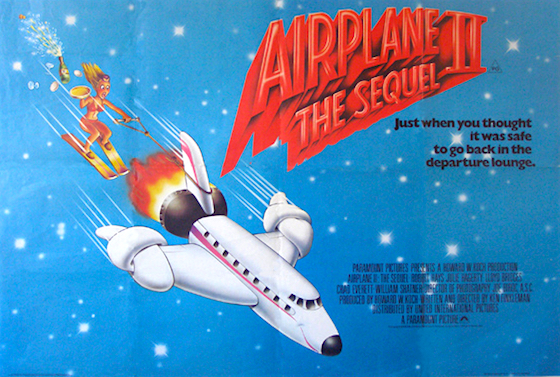
    Airplane II: The Sequel

    Comedy sequels are a funny business. Generally the first film’s been a big enough hit that people want to cash in, but can lightning strike twice? Well, the number of comedy trilogies (or more) suggests the answer is “yes”… or at least that enough people liked the first one enough that they went to see the second one and, regardless of what they actually thought of it, that persuaded people there should be a third.

    Airplane is widely regarded as one of the best comedies of all time. There is no Airplane III. Those two facts might suggest something about Airplane II — though it’s a film which even included a gag in its title, so it’s off to a good start.

    Watched now, over 35 years after its release, Airplane II has a certain vein of humour that hasn’t aged well. Ha ha, those two men kissed like they were a couple! Ha ha, that priest was looking at Altar Boy magazine like it was Playboy! Ha ha, everyone has to slap an hysterical woman! At least one of those gags would probably get you fired from a directing job at Disney nowadays… But to focus on those is to pick on the film’s weak points. Another would be that it has a few too many rehashes of jokes from the first one. Well, what comedy sequel doesn’t? That aside, much of the rest is pretty darn funny.

    3 out of 5

    * This was rated PG on its original theatrical release, but that was cut. The uncut version has consistently been rated 15 on video. ^

    Hot Tub Time Machine
    (2010)

    2018 #51
    Steve Pink | 97 mins | streaming (HD) | 1.85:1 | USA / English | 15*

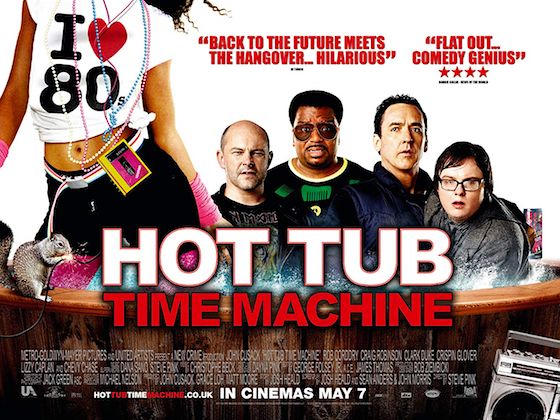
    Hot Tub Time Machine

    I don’t know why I felt the need to watch Hot Tub Time Machine. Maybe just because it found its way onto my 50 Unseen list back in 2010 (I guess people talked about it at the time. Has it lasted? I don’t think so). Maybe because it’s got “time machine” in the title and so the sci-fi implication draws me in, especially as a Doctor Who fan. I don’t know. Whatever, it’s been vaguely on my radar for the past eight years and, when I wanted something undemanding one Friday night, its time finally came.

    As the title implies, it’s about a hot tub… that’s a time machine. Four dudes get in it and find themselves in the bodies of their ’80s selves. Except for one who wasn’t born at the time, who just finds himself in the past. Yeah, the logic of it is really shaky.

    Nonetheless, it actually has a couple of solid thematic and plot ideas buried away, to do with fate and second chances and stuff, but those are mired in execution that’s both derivative (of both Back to the Future and stuff like The Hangover — and, I swear, I hadn’t seen the quote on the above poster when I wrote that) and often unfunny (unless you really like that lowest-common-denominator gross-out stuff). There are some genuine laughs, but they’re infrequent enough that they might just’ve been accidents. Another part of the problem is that for the eventual pay-offs to work you need to be invested in the characters. The film makes half an attempt to give us reasons to care about the guys, but they didn’t connect for me. Maybe if that worked better, the later stuff would land too.

    I didn’t hate Hot Tub Time Machine — it was passably amusing for a time-filler — but it wasn’t great either. My score errs on the harsh side, because I definitely liked it less than other movies I’ve recently given 3 stars.

    2 out of 5

    * I watched the extended “unrated” version, hence no MPAA certificate. It’s less than two minutes longer (comparison here), with no material that would challenge an R rating. ^

    Sausage Party
    (2016)

    2018 #37
    Greg Tiernan & Conrad Vernon | 85 mins | streaming (HD) | 1.85:1 | USA & Canada / English | 15 / R
    Sausage Party

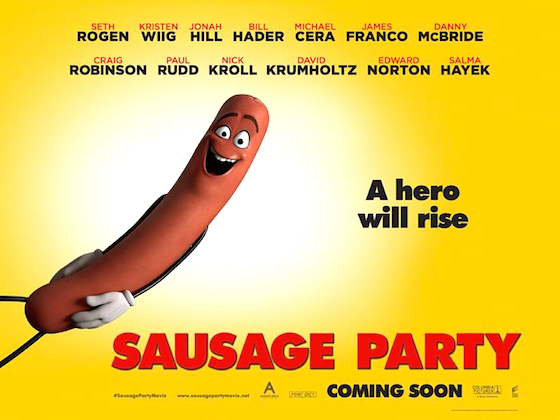
    A movie about sentient food that parodies the inherent stupidity of religion — I mean, what’s not to like? Well, it’s from the minds of Seth Rogen, Evan Goldberg, and co (Jonah Hill as a story co-credit), so if you don’t like their kind of humour…

    Certainly, it’s incredibly rude and crude — even more so than they’d necessarily intended: they were so certain they’d get an NC-17 rating from the MPAA that the version they submitted included some extra extreme material, the hope being that would act as a distraction so that what they actually wanted in the film would pass as an R. However, the MPAA only insisted on one relatively minor change. I imagine that was to the massive, long, graphic orgy scene. There are no words for it. And yet, it only got a 15 over here — you really have to be very extreme to get an 18 these days, huh? Or maybe it’s just because it just involved food…

    For all the eye-watering content, at least the film has the good grace to also be quite witty and clever at times. I guess some of the ‘satire’ is a bit on the nose, but it works for what it is. I mean, no one comes to a film like this expecting subtle social commentary, do they? And if the analogies for religious belief are a bit on the nose, well, maybe that’s what it takes to get through to those people…

    4 out of 5

  • The Navigator: A Medieval Odyssey (1988)

    2018 #162
    Vincent Ward | 92 mins | Blu-ray | 1.85:1 | Australia & New Zealand / English | 12* / PG

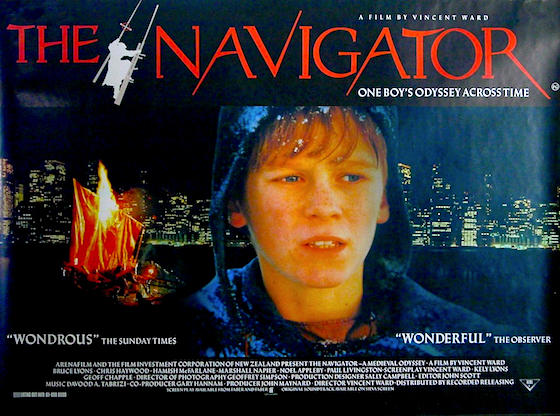
    The Navigator: A Medieval Odyssey

    1348: the Black Death is sweeping across Europe. A remote mining village in Cumbria is yet to be afflicted, but they fear the disease is close at hand. When young Griffin (Hamish McFarlane) reveals he’s been having visions of a quest to a great cathedral, they decide this is their best hope for salvation: a band of brave men will follow Griffin’s vision and make an offering to God so he will protect the village. The journey begins by travelling down a pit so deep it’s rumoured to lead to the other side of the world. As they emerge, they’ve unwittingly travelled not only across the world, but also forward in time some 640 years, to New Zealand, 1988.

    If that sounds like an adventure movie but also a bit, well, weird, then you’ve probably got a handle on The Navigator already. It’s a men-on-a-mission time travel adventure quest filtered through an arthouse sensibility — writer-director Vincent Ward trained at a school of fine art, intending to become a sculptor and painter, before getting sidetracked into moviemaking; and he’d previously helmed the first New Zealand film to screen in competition at Cannes, Vigil. (I didn’t realise until after viewing that he’d gone on to direct What Dreams May Come and also did a lot of development on Alien³ (the “wooden planet populated by monks” version), but once you know that, the aesthetic similarities seem obvious.) The Navigator has thus been likened to the work of Werner Herzog and Terrence Malick, but also Terry Gilliam.

    So, on the one hand, it can play as a straightforward heroic quest, but the sometimes slow pace and occasional presence of symbolism suggest, on the other, a film with greater depths. Primarily, I think, this is the way the villagers’ fear of the plague is reflected by our modern-day fears — or, as the film’s press book rather nicely puts it, in the present day the adventurers are “surrounded by echoes of the fear which haunted medieval England”. So, for example, their journey is disrupted by the rise of a monolithic submarine, presumably a nuclear one; the issue of nuclear deterrence is also brought up on a TV broadcast; and that’s followed by a famous Australian AIDS commercial, perhaps the most obvious mirror of the plague there could be for an ’80s movie.

    Plagued by the, er, plague

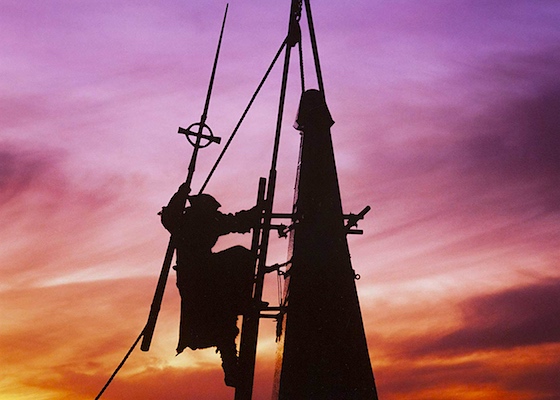
    It’s also a somewhat spiritual film, though not in a heavy-handed, pro-religion kind of way. After all, the men are on a quest to seek protection from God, and the climax revolves around placing a spire atop a church. Naturally, the reliance of medieval folk on their belief in God is counterposed with the modern world’s disregard for such values — though, again, the comparison isn’t made in too forceful a manner. For example, when they first arrive in the present they look out over the city to find the cathedral, because a church is always the tallest building, but, to their confusion, they can’t see it because of all the skyscrapers. The point is subtly put: we worship different gods today.

    But aside from all these nods to philosophising, the film does work as an adventure movie, with certain sequences relying on the gang overcoming obstacles rather than musing on the state of the world. Standout set pieces include crossing a four-lane motorway (it was Ward trying to do exactly that in Germany that first gave him the idea for the film!), and the climax atop the church, which — between John Scott’s superb editing and Griffin’s premonition that one of them will die there — is as suspenseful a finale as you could ask for. Scott’s editing also shines in the sequences depicting Griffin’s visions, which become cleverly sprinkled in so that at times you’re wrong-footed about whether what you’re seeing is happening or another premonition. Although the film never chooses to play this for a big twist, it keeps things dynamic.

    The real star from the crew, however, is probably cinematographer Geoff Simpson. The entire movie is gorgeously shot in a couple of styles: the medieval stuff is presented in high-contrast black & white, which combines with the snowbound setting to create a stark, gritty beauty; then the present day stuff is in colour, mostly lit in rich oranges and blues so that it feels almost opulent, with the choice of colours drawing inspiration from medieval art. Ward’s reasoning for this delineation was to emphasise how striking the modern world would feel to someone coming from the grimness of the plague years, and it works. A word too for composer Davood A. Tabrizi, an Iranian émigré here charged with writing Celtic-esque music. Inspiration was taken from genuine ethnic music that was specially researched in Britain, Italy, New Zealand, and Australia, and the score was performed entirely with traditional instruments. The resulting folksy sound is wholly fitting and very atmospheric.

    Steeple chase

    The film doesn’t devote much time to fleshing out the characters of its band of heroes, but they’re succinctly delineated nonetheless. Standouts include Bruce Lyons as Connor, Griffin’s admired older brother, an experienced adventurer, but that also leaves him prone to thinking he knows best; and Marshall Napier as Searle, a likeable but pragmatic and sceptical man, with a tragic backstory. Young Hamish McFarlane also acquits himself well as Griffin, a young lad whose unexplained gift leaves him with the weight of the world on his shoulders, but a determination to live up to what’s needed of him. (Incidentally, although he did act a couple more times, during filming of The Navigator McFarlane apparently became fascinated by the process of filmmaking, and he’s gone on to have a career behind the scenes — his most recent credits as first AD include episodes of Ash vs Evil Dead, Supergirl, and forthcoming giant shark movie The Meg).

    All of the above mixes together to create a film that both has familiar elements, but also feels strangely unique. It’s at once a straightforward heroic quest, with sequences of adventure, tension, and humour, and also a thoughtful, spiritual, philosophical musing on communal fears, how we deal with them, and how they resurface. Or, you know, something. It’s a marvellously idiosyncratic film in that regard, and while I wouldn’t say I loved it, it’s an experience I’d definitely take again.

    4 out of 5

    The Navigator is released on Blu-ray this week by Arrow Video in both the UK and US.

    * It used to be rated PG in the UK too, until Arrow had it reclassified for the Blu-ray. The higher certificate is due to a man stuck on a speeding train, a boy climbing a church spire, and the “unsettling” psychic visions. Frankly, it strikes me as needlessly excessive — the PG was fine. ^

    The Great Wall (2016)

    2017 #158
    Zhang Yimou | 103 mins | download (HD+3D) | 2.39:1 | USA, China, Hong Kong, Australia & Canada / English, Mandarin & Spanish | 12 / PG-13

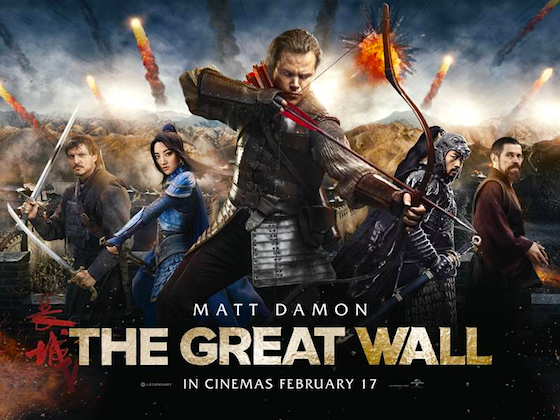
    The Great Wall

    This movie was on a hiding to nothing from the moment people got wind of the fact it was a China-set action movie starring white American Matt Damon. Increased representation is all well and good, but you still need a big-name star in order to get funding for your movie if it’s a $150 million production aimed at a global audience, and the stars who can sell movies that big around the world are almost exclusively white. It’ll be a positive thing when that changes, but it’s the way it is right now. Should we write off entire movies just because they have to think about budget more than political correctness?

    There are pros and cons within the film itself. Damon plays a mercenary who stumbles upon China’s national secret: that the Great Wall was built to keep out monstrous beasts, and when they attack it has to be defended. An outsider character works as a good way into this story, though of course there are “white saviour” issues with it being someone who looks like Matt Damon. If you want to object to the movie entirely for those reasons, that’s your prerogative. There were other criticisms of it as a piece of entertainment, but I hold even less stock in those, because I thought it was highly entertaining.

    The best bit is the first 25 minutes. This opening salvo is phenomenal: a huge, well-made battle sequence with tonnes of cool moments. It’s so epic, it feels like the climax. That leaves you wondering where the film possibly has left to go for the next hour-and-change — can it possibly have something up its sleeve to top that? Unsurprisingly, it heads away from huge battles and into skirmish territory. Fortunately, inventive ideas keep these sequences from feeling like lesser fodder than the epic opening act. In the end, it never does top the opener, but hey-ho.

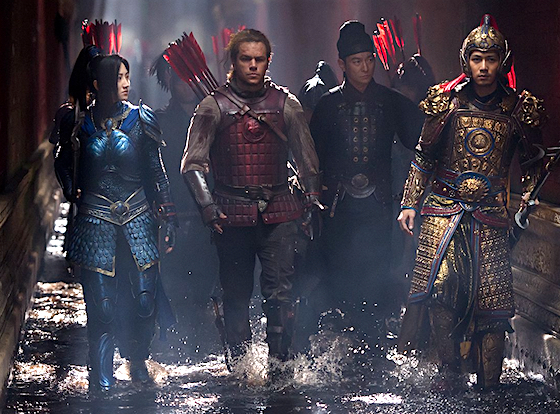
    Colourful diversity

    As for the plot, well, it is what it is. There are some obvious holes and contrivances (most obviously: why do they hold back some weapons and tactics to only use in later battles?), but nothing I found too bothering for the type of entertainment the film seeks to provide. Character work is also about what you’d expect from an action-adventure blockbuster, though Damon and Pedro Pascal have a buddy relationship that’s a lot of fun. Despite the presence in key roles of Damon, Pascal, and Willem Dafoe, most of the cast are actually Asian, with the standout being Jing Tian as a strong female co-lead.

    As you might expect from the director of Hero, the film is a visual feast. There’s vibrant design work, emphasised by cinematography from DPs Stuart Dryburgh and Zhao Xiaoding that makes things like the colour-coded soldiers really pop. And the 3D is spectacular. Although it’s a post-conversion, the film definitely seems to have been shot with it in mind. The massive scale of the wall allows for both deep scenery shots and extreme height, especially when we follow the class of warriors who dive off the wall to fight while abseiling down it. Then there are the arrows, throwing axes, leaping monsters, exploding monsters… Of course the rest of the film has visual depth too — facial details in close-ups, the scale of a large banquet hall, and so on — but the action scenes are a riot.

    That’s why I enjoyed The Great Wall, despite its daft plot. The action is a lot of fun, and the whole thing looks spectacular in 3D. From an action-adventure blockbuster, that’ll do me nicely.

    4 out of 5

    Despicable Me 2 (2013)

    2018 #155
    Pierre Coffin & Chris Renaud | 98 mins | download (HD+3D) | 1.85:1 | USA, France & Japan / English | U / PG

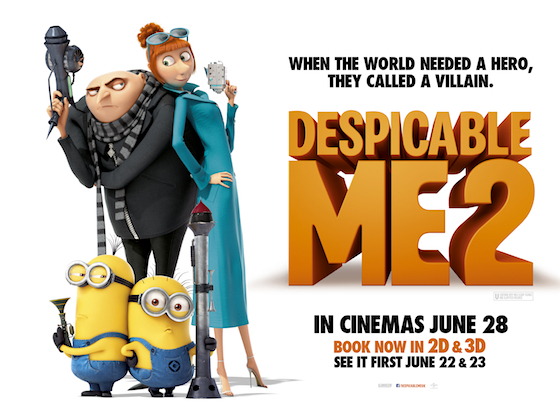
    Despicable Me 2

    In this sequel to the popular animated comedy (which I wasn’t that fond of, personally), supervillain turned adoptive dad Gru (Steve Carell) is dragged back into his old world when the Anti-Villain League recruit him in order to track down the villain who stole a dangerous serum. Meanwhile, Gru’s daughters think he needs a girlfriend, and the AVL agent assigned as his partner, Lucy Wilde (Kristen Wiig), seems the perfect fit. Also, his yellow Minions are still around, getting up to all sorts of ker-azy antics.

    That’s the concise version, anyhow. This is a film that rambles around a lot in the telling, presumably out of fear that it might ever become boring to hyperactive youngsters. Unfortunately, it almost had the opposite effect on me. The main plot just felt like a shape on which to hang the romantic and Minion subplots, but those subplots just felt like a constant distraction from the main plot. The end result is a film that’s narratively unsatisfying on all fronts.

    So. Many. Minions.

    Instead, entertainment value comes from individual scenes or moments. Personal preference will dictate just how entertaining those are, however. I didn’t feel there was much consistency, with the humour able to spin on a dime from being pretty amusing to falling flat. It doesn’t help that it feels way too long, overloaded with subplots that don’t go anywhere meaningful and the Minions’ sketch-like shenanigans. And there’s a lot of the Minions, clearly the breakout stars of the first movie (and hence why the series’ next film was entirely centred around them). While they amuse me on occasions, I mostly find them annoying, and am slightly baffled that anyone over the age of about six can find them significantly amusing.

    But it looks pretty great in 3D, at least — turns out Gru’s long pointy nose was made for the format — and it’s quite funny and imaginative in places. Still, a good trim would’ve benefitted it enormously. Unless you do really enjoy the Minions, I guess.

    3 out of 5

    The UK network TV premiere of spin-off Minions is on ITV today at 6:15pm.

    Paddington 2 (2017)

    2018 #58
    Paul King | 103 mins | streaming (UHD) | 2.35:1 | UK & France / English | PG / PG

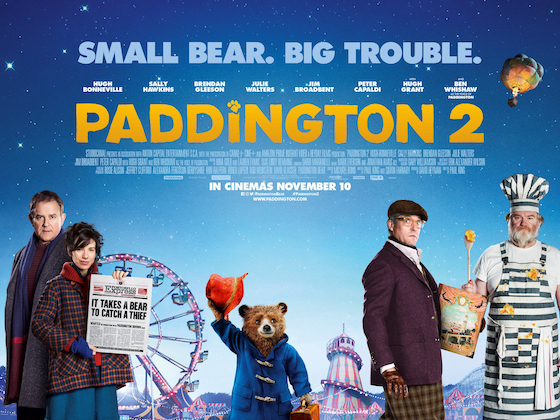
    Paddington 2

    Famous for its untarnished 100% Rotten Tomatoes score after almost 200 reviews (the best critical record of any film ever), Paddington 2 consequently comes with an awful lot of hype attached — perhaps too much for a movie that is, at heart, just a kind-hearted bit of fun about a marmalade-loving bear. But then, in our current climate, such a film is less barely necessary (unlike many sequels) and more a bear necessity.

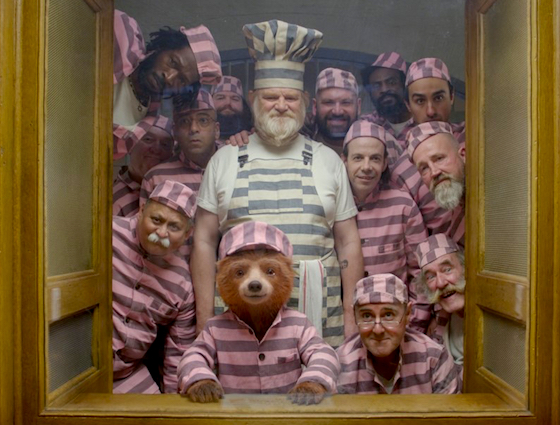
    Said bear (voiced by Ben Whishaw) wants to buy a unique, and consequently expensive, pop-up book for his Aunt Lucy’s 100th birthday. When the book is stolen by failed actor Phoenix Buchanan (Hugh Grant), he manages to frame Paddington, who is consequently sent to prison. His adoptive family (Hugh Bonneville, Sally Hawkins, et al) set out to prove his innocence, while Paddington makes the most of his jail time by making friends and livening the place up.

    The film’s joy lies less in the facts of the storyline and more in the emotions it inspires. The whole thing has clearly been crafted with a lot of love, inventiveness, generosity, and a good-hearted outlook on life, which comes across from all the characters and their actions, making for a resolutely charming and feel-good film that’s beautifully made. Of course, the first one had a lot of those elements too, but they’ve managed that rare thing of striking gold twice. One thing the first movie didn’t have is Hugh Grant, who proves he’s more than just a stuttering romcom lead with a superbly witty turn as the film’s villain. HIs BAFTA nomination wasn’t as silly as it perhaps sounded.

    Friendly criminals

    But while there’s nothing bad about Paddington 2, and an awful lot to like, I feel like my expectations for its absolute perfectness were set too high. I feel like I should be giving it 5 stars just because of how lovely everyone else said it was — and it was lovely, but 5 stars lovely? I’m not sure. I did like it a lot — it’s funny, clever, sweet, and good-natured — but I wasn’t bowled over in the way I’d been led to believe I would be. Maybe I would’ve been if I’d seen it before all the hype? That element of almost-disappointment means I can’t give it full marks, but it’s still a film I’d definitely recommend, especially if you’re after something thoroughly nice, or that’s both suitable for and entertaining to the entire family. I look forward to watching it again sometime and refining my opinion. Maybe in a double-bill with the first film, which I’m currently tempted to say was slightly better.

    4 out of 5

    Paddington 2 is available to stream on Amazon Prime Video UK as of yesterday.

    “Christmas in July” Review Roundup

    Being someone who lives in the northern hemisphere, and up towards the top of it too, we celebrate Christmas at, y’know, Christmas. But for people who live in places where 25th December falls in summery weather, all the trappings of the festival don’t feel so appropriate. Hence at some point someone conceived of “Christmas in July”.* I don’t know when — a long time ago, probably — but I first encountered the concept a year or two back.

    Anyway, I don’t think it’s celebrated on a specific date (it’s just a thing some people do some places), but it turns out there is a “Christmas in July” in London — a great big marketing event, self-described as “the ‘London Fashion Week’ of Christmas press launches.” Well, what could be more Christmassy than massive commercialisation? That’s occurring today and tomorrow, and seemed as good a point as any to post this selection of leftover reviews from the festive viewing I enjoyed seven months ago.

    In today’s roundup:

  • Elf (2003)
  • Scrooged (1988)
  • It’s a Wonderful Life (1946)


    Elf
    (2003)

    2017 #173
    Jon Favreau | 93 mins | streaming (HD) | 16:9 | USA / English | PG / PG

    Elf

    Regarded by some as a modern Christmas classic (though it’s 15 years old now, so I’m not sure if “modern” still applies), Elf is about a human raised as one of Santa’s elves (Will Ferrell) who travels to New York to find his real dad (James Caan), in the process spreading Christmas joy with his charmingly innocent view of the holiday.

    An early starring role for Ferrell, the film is more concerned with letting him get up to funny antics than it is with, say, building fully rounded character arcs — Caan goes through his inevitable redemption in the space of one cut. It’s less character development, more character transplant. Heck, transplants take time to perform — it’s character transmogrification. By taking such short cuts it fails to earn the changes of heart for its characters, leaving it to feel kind of empty and unsatisfying on an emotional level. Nonetheless, the focus on comedy and an innocent’s eye-view of Christmas means it makes for a fairly entertaining, pleasantly festive time-killer.

    3 out of 5

    Scrooged
    (1988)

    2017 #174
    Richard Donner | 101 mins | streaming (HD) | 16:9 | USA / English | PG / PG-13

    Scrooged

    Director Richard Donner transplants the most famous of all Christmas stories (that doesn’t star a divine baby, anyhow), Charles Dickens’ A Christmas Carol, to the corporate ’80s in this fantasy comedy. (Most Christmas movies are “fantasy comedies”, aren’t they? Even the ones that aren’t (like, say, Home Alone) kind of are. But I digress.)

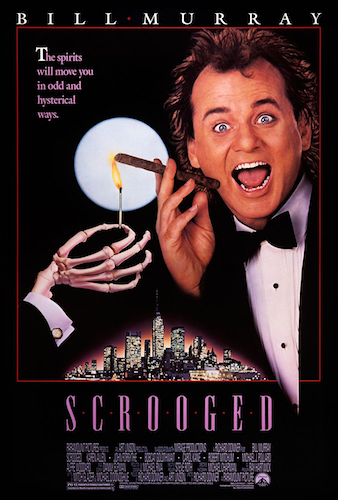
    Bill Murray stars in “his first comedy since Ghostbusters”, as the UK poster boasts (“Bill Murray is back among the ghosts. Only this time, there’s no one to call.”). He’s the Scrooge figure, Frank Cross, a miserly TV executive visited by three ghosts who expose his negative effect on the world, and in turn on himself. Obviously, therefore, the film retains the broad shape of Dickens’ original story, but it goes a little further than that, taking all the salient details and adapting them to its own variation. It’s a good modernisation: true to the original, but without being slavishly beholden to translating the story word for word.

    It does feel like it could’ve been tightened up a bit, though according to Murray they “shot a big, long sloppy movie, so there’s a great deal of material that didn’t even end up in the film,” which I guess means this is already the improved version. Nonetheless, this is a Christmas tale with just enough ’80s cynicism and gentle horror to stop it being too twee, while retaining an appropriately goodhearted festiveness.

    4 out of 5

    It’s a Wonderful Life
    (1946)

    2017 #171
    Frank Capra | 130 mins | streaming (HD) | 1.33:1 | USA / English | U / PG

    It's a Wonderful Life

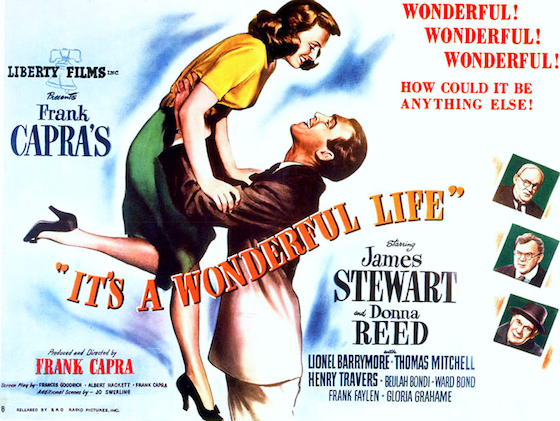
    I’m a little late to the party here: It’s a Wonderful Life is a Christmastime TV staple that most people have been enjoying for decades, many since childhood. Frankly, that’s the main reason I watched it — almost out of a sense of duty, owing to it being an iconic Christmas film, and also well rated on polls like the IMDb Top 250.

    So I set out merely to rectify my oversight, expecting to find it a bit saccharine and twee, and probably overrated. But no, it’s not that at all: it’s a beautiful, brilliantly made, genuinely moving film — I even got something in my eye during the conclusion, even if its heartwarmingness was objectively inevitable. Now, my only regret is I didn’t watch it sooner, so that I could’ve been re-experiencing it all my life.

    It’s not often you get a film with a reputation like this that manages to live up to it, but It’s a Wonderful Life is that rare exception. Indeed, it’s so good I’d even say it exceeded its reputation. Wonderful indeed.

    5 out of 5

    It’s a Wonderful Life placed 6th on my list of The 17 Best Films I Saw For the First Time in 2017, which can be read in full here.

    * If you happened to think this had something to do with the football — you know, like, “if England get through to the final it’ll be like Christmas in July for the fans” — then, um, no. Sorry. ^

  • Dudes & Dragons (2015)

    aka Dragon Warriors

    2018 #145
    Maclain Nelson & Stephen Shimek | 113 mins | Blu-ray | 16:9 | USA / English | 12

    Dragon Warriors

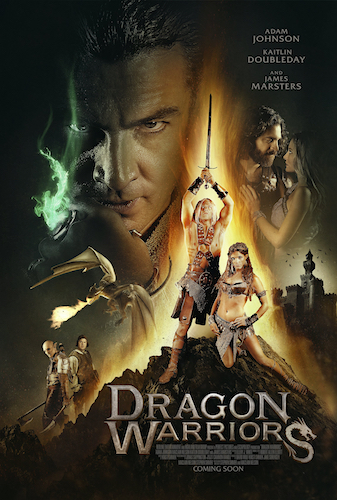
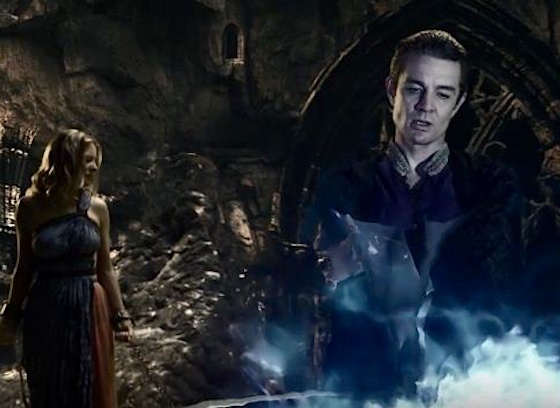
    Back in 2014, when it felt like I was contributing to Kickstarters for film projects left, right and centre (including a variety of short films I still haven’t got round to watching and several projects which never amounted to anything, which is why I’ve largely stopped), I helped fund a fantasy comedy called Dragon Warriors. To cut to the quick, it was eventually released as Dudes & Dragons, the title changed presumably to better indicate its comedic tone, and apparently at the end of last week it popped up on Prime Video UK — so, naturally, that made me finally get round to watching my Blu-ray copy.

    In a Dungeons & Dragons-y world, no one can show signs of love lest they be torched by the fearsome dragon Dolvarnög (the pronunciation of which is one of the film’s better recurring jokes). In fact, the dragon is commanded by evil sorcerer Lord Tensley (James Marsters, of Buffy and Angel fame), whose personal experiences with love have left him bitter. The dragon is just one threat to the relationship between human Camilan (Maclain Nelson) and elf Larec (Clare Niederpruem), and so he teams up with his mercenary brother Ramicus (Adam Johnson) — plus Camilan’s stable boy, Samton (Jake Van Wagoner), and Ramicus’ lodger, orc Shokdor (Erik Denton) — to save the world, etc.

    Comedy!

    As I said, and as the title surely implies, Dudes & Dragons is ostensibly a comedy — though not the kind of comedy the re-titling implies, I don’t think. I guess the lead characters are “dudes”, but they’re not, like, “dude” dudes… if you know what I mean. Setting that aside, potential hilarity is undercut by the film being overburdened with plot. My summary didn’t even mention the object of Tensley’s affections, his cousin Ennogard (Kaitlin Doubleday), who summons our heroes on their mission; or that Camilan’s parents forbid his marriage to Larec because of some stuff to do with laws of succession or something — this is meant to be a comedy, fellas! Who wrote it, Phantom Menace-era George Lucas? This necessitates rather too many scenes of exposition, especially early on, meaning it’s a while before the gags really begin to flow.

    Well, “flow” is a generous descriptor — the gag rate is alarmingly low. The exposition scenes are balanced on a knife edge where you can’t tell if the actors are playing it tongue-in-cheek because it’s supposed to be humorous, or if it’s because they’re reaching for a florid style that they think is correct for a serious High Fantasy movie. (“High” fantasy is probably what you expect from a movie called Dudes & Dragons, actually, isn’t it?) Put another way: take those joke-less scenes out of context and you might think they were just am-dram Fantasy. James Marsters is probably best equipped to navigate this, giving a sterling go at being both villainous and comic, though the uneven tone means he’s never allowed to be properly menacing nor properly hilarious, a balance we know he can strike thanks to the aforementioned Whedon series. The rest of the cast actually aren’t bad — when the script gives them some decent material, there are laughs to be had. The weakest link is a cameo from Luke Perry, who’s worse than most of the non-famous cast.

    Buffy flashbacks

    Production-wise, this is a very low-budget effort and it shows, but if you give it the benefit of bearing those cheap-and-cheerful roots in mind, it doesn’t look half bad. Well, mostly. I mean, some of the costumes are a bit cosplay, but the creature prosthetics are pretty good; and the CGI monsters are alright considering the next-to-no-budget; and it’s decently shot, especially some sequences that spoof the oeuvre of Zack Snyder, though it’s sometimes distracting that it was all done on green screen — were there no real forests nearby they could’ve popped down to?

    There’s some enjoyment to be had in Dudes & Dragons for the more forgiving viewer. It would’ve been helped immeasurably by a more streamlined plot, a higher preponderance of genuine gags, and probably by being a good 20 or 30 minutes shorter, too. As it is, most people after some fantasy-based laughs are going to want to look elsewhere.

    2 out of 5

    Journey to the Center of the Earth 3D (2008)

    2017 #139
    Eric Brevig | 93 mins | download (HD) | 1.78:1 | USA / English | PG / PG

    Journey to the Center of the Earth 3D

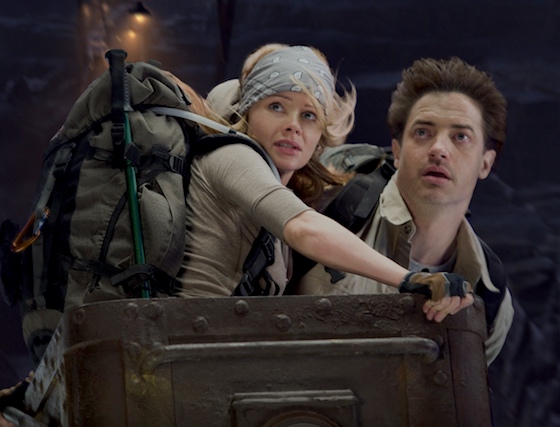
    Journey to the Center of the Earth 3D (as it’s actually titled on screen, a rarity for 3D movies) is a very loose (very, very loose) adaptation of Jules Verne’s classic fantasy novel — indeed, you could say it’s more of a sequel, as the characters’ adventure is inspired by the belief that Verne’s novel is actually an account of real events. It turns out they’re right, of course, because otherwise this would just be a movie about a man and his nephew trekking up a mountain to find nothing — which sounds like a film someone would make, but not an effects-driven summer blockbuster.

    I remember Journey 3D (as the title card indecisively morphs into before finally moving on) going down quite poorly on its release a decade ago, but, looking up sources to cite for that now, I’m not wholly correct: it has 61% on Rotten Tomatoes, which isn’t great but is still considered ‘fresh’, and grossed a respectable $242 million (off a budget of just $60 million). Nonetheless, I expected little of it (I watched it mainly because it’s on my 50 Unseen from 2008, a notoriously under-completed list) but wound up pleasantly surprised… in some respects, anyway.

    They're all right

    The key to my enjoyment was watching it in 3D, in which it plays more like a theme park attraction than a movie: from the very beginning it has loads of those “sticking stuff out into the audience” hijinks that no one bothers with anymore (indeed, after watching a dozen other 3D movies on my TV, I don’t think I’ve seen anything poke out before). Gimmicky and in your face (literally) though it may be, the effect works, it’s uncomplicatedly fun, and it makes the movie better just because it’s trying. Relatedly, this was the first film released in 4DX, the South Korean-developed theatrical format which features “tilting seats to convey motion, wind, sprays of water and sharp air, probe lights to mimic lightning, fog, scents, and other theatrical special effects”. I imagine all that palaver suits the film really well — as I said, it’s more like a theme park attraction than a regular movie anyhow.

    However, that’s just one of the reasons why I imagine it would be nearly unwatchable in 2D. All the stuff that’s kinda fun in 3D would seem pointless in 2D, and the at-the-camera things would be horrendously blatant (I mean, they are in 3D, of course, but at least their purpose is retained). And as for the rest of the movie, the direction feels very TV-ish; or, again, like a theme park attraction — it’s a bit basic, basically. Some moments push towards achieving wonder. I’m not sure they quite get there, but I’ve seen worse. (Director Eric Brevig is a visual effects guy by trade, with credits ranging from The Abyss and Total Recall up through Men in Black and The Day After Tomorrow to John Carter and The Maze Runner, and many more besides. His second film as director was the Yogi Bear movie (you know, the one with that poster), which is probably why he’s not directed anything since.)

    Remember when Hollywood thought Brendan Fraser was Harrison Ford?

    Let’s not just reserve our criticism for the direction, though: the dialogue is terrible too, including what may be the single worst (or best — it’s so bad it’s good) exchange in the entire history of movies:

    Trevor: Max was right. He was right! [shouting] Max! Was! Right! Ha ha! [to Sean] Your dad was right. He was right.
    Sean: Hannah, your dad was right too.
    Trevor: They both believed in something that everyone told them was impossible. He was right! [echoing:] He was right!

    But hey, at least it makes an effort to do that screenwriting thing of eventually paying off every single thing we learnt about earlier… except for a yo-yo, the thing with the most “this is setup for later” introduction. Maybe the scene where they needed to do some hunting got cut… There’s added incidental amusement watching it a decade on thanks to the surprisingly old-fashioned technology on display: computer monitors are still CRTs; cool kids’ mobiles are still flip phones; being able to Google while on a plane is a wonder… It’s like the film is self consciously showing off how much technology has changed in the last decade — which it isn’t, obviously, because it couldn’t’ve known. And hey, if you don’t laugh at it you’ll cry because it’ll make you feel old.

    Really, Journey 3D is cheesy, tacky, and kinda terrible… but I also enjoyed myself. Yes, a big part of that was the 3D. I’d never claim it was a good film, and I don’t think that I’d even recommend it, but I wouldn’t write off watching it again someday.

    2 out of 5

    Almost Oscar-Worthy Review Roundup

    Each of these films was nominated for multiple Oscars… but failed to win a single one.

    In today’s roundup:

  • Big (1988) — nominated for Best Actor (Tom Hanks) and Best Original Screenplay.
  • Frost/Nixon (2008) — nominated for Best Picture, Best Actor (Frank Langella), Best Director, Best Adapted Screenplay, and Best Editing.
  • Lion (2016) — nominated for Best Picture, Best Supporting Actor (Dev Patel), Best Supporting Actress (Nicole Kidman), Best Adapted Screenplay, Best Cinematography, and Best Original Score.


    Big
    (1988)

    2017 #91
    Penny Marshall | 100 mins | TV (HD) | 1.85:1 | USA / English | PG* / PG

    Big

    Big is one of those strange gaps in my viewing — the kind of film I feel I should’ve seen when I was a kid in the early ’90s but didn’t.

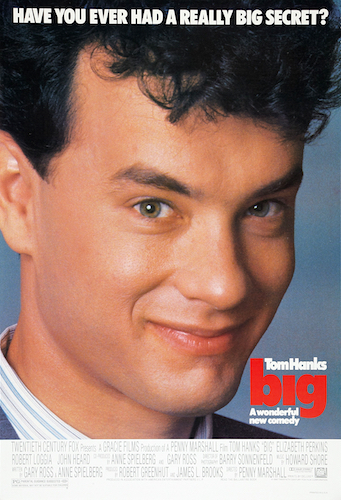
    Anyway, in case you’ve forgotten, it’s the one where a 12-year-old boy makes a wish and ends up as an adult, played by Tom Hanks. Rather than solve this problem in a day or two, he ends up moving to the city, getting a job, an apartment, a relationship, and all that grown-up stuff. Maybe it’s just me, but I didn’t expect that level of scale from a movie like this. Generally there’s some hijinks around “kid in an adult’s body” and it’s all solved in a day or two, but the length of time the kid’s predicament rolls on for allows the movie to tap into more than that. I mean, it’s still a funny movie, but it’s got a message about how it’s important to remember the childlike spirit, but also that it’s OK to be at whatever stage in life you’re at — don’t rush it.

    Plus the whole thing has a kind of sweet innocence that you rarely see in movies nowadays. We’re all too cynical, too concerned with realism (even in fantasy movies). If you made it today, it’d ether have to be sexed/toughened up for a PG-13, or kiddified (and likely animated) for a G. That said, that the 12-year-old boy in a man’s body is happy to sleep with the hot woman, apparently without it bothering his conscience one iota, is by far the most realistic thing about this movie.

    4 out of 5

    * The UK PG version is cut by two seconds to remove an F word. The cut is really obvious, too — was there not a TV version with an ADR’d non-swear? Anyway, it was classified uncut as a 12 in 2008, though that’s not the version they show on TV, clearly. ^

    Frost/Nixon
    (2008)

    2017 #136
    Ron Howard | 117 mins | DVD | 2.35:1 | USA, UK & France / English | 15 / R

    Frost/Nixon

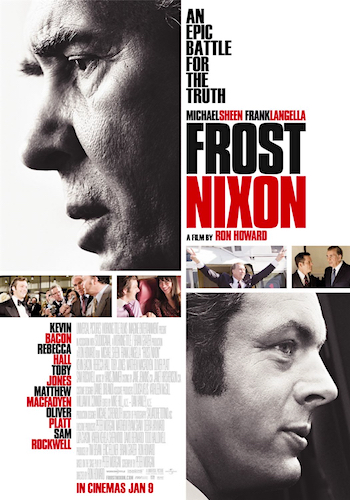
    Peter Morgan’s acclaimed play about the famous interviews between David Frost and President Richard Nixon (the ones where he said “when the President does it, that means it’s not illegal”) transfers to the big screen with its two lead cast members intact (Michael Sheen as Frost and Frank Langella as Nixon) and Ron Howard at the helm.

    As a film, it almost embodies every pro and con that’s ever been aimed at Howard’s directing: it’s classy and thoughtful, in the way you’d expect from a director who’s helmed eleven Oscar-nominated movies* and won two himself; but it also, for example, employs an odd framing device of having the supporting cast be interviewed as if for a documentary, which exists solely as an on-the-nose way of integrating direct-to-audience narration from the original play — my point being, it’s a bit straightforward and workmanlike.

    Still, when you’ve got actors of the calibre of Sheen and Langella giving first-rate performances (the latter got an Oscar nomination, the former didn’t, I reckon only because Americans aren’t as familiar with David Frost as us Brits are — his embodiment of the man is spot-on), and doing so in a story that’s inherently compelling (even if somewhat embellished from reality — but hey, that’s the movies!), what more do you need?

    4 out of 5

    * Many of those only in technical categories, but hey, an Oscar nom is an Oscar nom. ^

    Lion
    (2016)

    2017 #103
    Garth Davis | 119 mins | streaming (HD) | 2.35:1 | UK, Australia & USA / English, Hindi & Bengali | PG / PG-13

    Lion

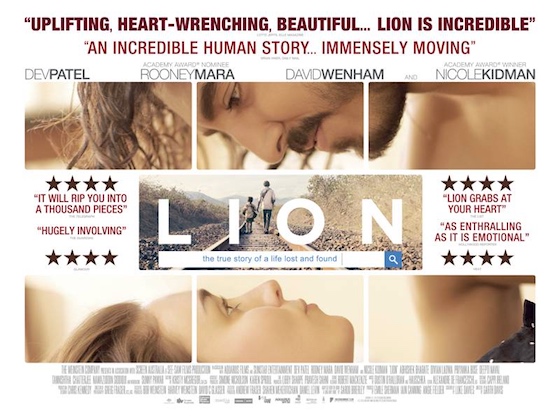
    Slumdog Millionaire meets Google product placement in this film, which is remarkably based on a true story — or based on a remarkable true story, if you want to be kinder. It’s the story of Saroo Brierley, a young Indian boy (played by newcomer Sunny Pawar) who is separated from his family, ends up in an orphanage, and is adopted by Australian parents. As an adult (played by Dev Patel), he resolves to find his birthplace and family — using Google Earth.

    If it was fiction then it’d be too fantastic to believe, but because it’s true it packs a strong emotional weight, not least Saroo’s relationship with is adoptive parents, played by Nicole Kidman and David Wenham. The star of the show, however, is Dev Patel. You may remember there was controversy about him being put up for Supporting Actor awards, deemed “category fraud” by some because Saroo is the lead role. Conversely, he shares it with young Sunny Pawar, and Patel doesn’t appear until almost halfway through the film. Well, the “category fraud” people are more on the money, and it’s testament to Patel’s performance that it doesn’t feel like he’s only in half the film. Pawar is great — both plausible and sweetly likeable — but while watching I didn’t realise the movie had a near 50/50 split between young and adult Saroo. Maybe this means the first half is pacier, but its not that the second part feels slow, more that Patel has to carry greater emotional weight.

    Mother and son

    Rooney Mara is also in the film, as adult Saroo’s girlfriend. Her character is in fact based on multiple real-life girlfriends, but it makes sense to consolidate them into one character for the sake of an emotional throughline. However, her storyline ultimately goes nowhere — it ends with Saroo asking her to “wait for me”. Did she? Did he go back to her? It’s not the point of the film — that’s about him finding his family, and after that emotional climax you don’t really want an epilogue about whether he gets back with his girlfriend or not — but it still feels like it’s left hanging. I suppose it isn’t — I guess we’re meant to presume she does wait for him and they get together when he returns and live happily ever after — but it doesn’t feel resolved. It shouldn’t matter — as I say, it’s not the point — but, because of that, it does.

    So it’s not a perfect movie, but it packs enough of an emotional punch to make up for it.

    4 out of 5

  • Babe: Pig in the City (1998)

    2017 #42
    George Miller | 92 mins | streaming (HD) | 1.85:1 | Australia / English | U / G

    Babe: Pig in the City

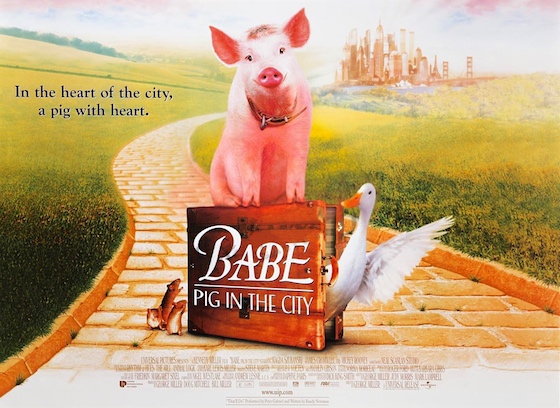
    Between making the first Mad Max trilogy and winning an Oscar with kids’ animation Happy Feet, George Miller produced beloved family flick Babe, which was such a success he took the directing reins for this follow-up. I remember it going down very poorly at the time — Rotten Tomatoes doesn’t quite support that, but a quick scan reveals many of the reviews to be retrospective. Some were wise to it from the off, however: Roger Ebert gave it full marks and his presenting partner Gene Siskel chose it as the best movie of the year! Not everyone’s got on that bandwagon (it still has a low rating on IMDb), but it’s definitely developed a cult following. Sign me up, because I too thought it was rather brilliant.

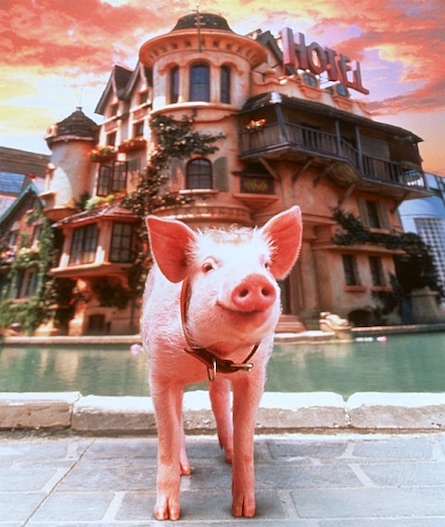
    Set immediately after the events of the first film, it sees everyone’s favourite sheep-pig travelling to the big city to raise money to save his farm. There, he ends up staying at a kind of hotel for animals, and winds up in all kinds of hijinks. There’s no point trying to describing it — the movie is barking. Also oinking, and quacking, and… yeah, you get the joke.

    In some ways it feels like a kids’ movie made for adults. Sure, it’s about cute talking animals, but a lot of the jokes are squarely aimed at knowing grown-ups, as is some of the emotional stuff, such as a scene where the Jack Russell is clearly running off to Heaven, which probably (hopefully, even) goes over younger children’s heads. As that may suggest, it’s also a very dark movie. Most of the darkness is eventually undercut, subverted, or rescued, but not always immediately — the situations are allowed to get bleak first.

    Pig in a hotel

    There’s an above-the-call-of-duty quality to the filmmaking, too. It’s lovelily designed, in a hyper-real cartoon-strip way, and beautifully shot, by Andrew “Lord of the Rings” Lesnie no less. Plus there’s a credits song written by Randy Newman and performed by, of all people, Peter Gabriel. And that’s not some kind of “they used a song by them” coincidence — its lyrics are based around the famous “that’ll do, Pig” catchphrase. Barmy.

    Pig in the City made me really made me want to rewatch the original — I enjoyed it as a kid, but as an adult would I see all sorts of extra stuff that I missed before? Or was it the success of the “cute talking pig movie” original that gave Miller & co the freedom to cut loose in the sequel? Comments I’ve read suggest the latter. Well, even if Babe doesn’t merit revisiting as an adult, this sequel certainly does. I’m not sure I’ve ever seen anything else quite like it.

    4 out of 5