Hellboy II: The Golden Army (2008)

2008 #93
Guillermo del Toro | 115 mins | DVD | 12 / PG-13

This review contains minor spoilers.

Hellboy II The Golden ArmyDespite enjoying the first live action Hellboy movie last year, I didn’t make it to the cinema for this sequel. Unfortunately neither did a lot of others, choosing to see The Dark Knight again and again instead. Of course these days the DVD release is almost as important… except Hellboy’s was on the same day as Dark Knight’s. I don’t have sales figures, but I expect it was thoroughly overshadowed again — which is a shame, because Hellboy II is actually a very different beast.

Despite shared roots in the pages of comic books, Hellboy II sits comfortably apart from last Summer’s other two big comic book adaptations, The Dark Knight and Iron Man. While the former was aiming for a real-world crime-epic feel and the latter a more humour-littered sci-fi, they both still dealt with billionaires investing in identity-hiding suits to fight crime of one kind or another. Hellboy exists in a completely different place. Of course there are still wise-cracking heroes (with requisite Issues) and scheming villains, action sequences and a liberal use of CGI (mixed with “we did it for real!” bits, thankfully the ‘in thing’ right now) — but it’s not Sci-Fi, it’s Fantasy.

Del Toro uses this to his advantage, allowing his incredibly fertile imagination to run riot over every frame. There are more creatures than the first Hellboy and Pan’s Labyrinth combined — in the Troll Market sequence, there’s probably more in each shot — and, in the vicious Tooth Fairies, a wonderfully gruesome twist on a familiar concept. Though couple these with certain other inventions, such as a baby-like talking tumor, and one might begin to wonder how this got passed as a 12 / PG-13; and you’d think a giant red demon getting a human girl pregnant might be enough to raise the classification. (I jest, of course — giant red demons are entitled to all the same rights as the rest of us.)

Imagination isn’t limited to creature design either. An attractively animated prologue manages to both bring back the ever-excellent John Hurt and find a way to convey the huge back story without making it tediously dull (it also has a Christmassy feel that was perfect for when I watched it). The action sequences have all the requisite coolness too, especially the closing duel on giant moving cogs. In fact, del Toro’s creation seems to overflow — the laying of plot threads for a further film is even more overt than it was in the first film — which makes it even more unfortunate that the director’s long term commitment to The Hobbit and its sequel, plus about half a dozen projects after that, makes a proposed trilogy-closer seem increasingly unlikely. This isn’t a major problem with the film, however, just an annoyance that we may never get a third entry.

One of the most amusingly idiotic criticisms I’ve encountered of Hellboy II was that it was “comic-book-ish” — not only does that make one think, “well, duh”, but also, “and why not?” When the other big comic book movies are aiming for real-world seriousness, it’s nice to have a more fantastical alternative. Hellboy II is more than up to the task.

4 out of 5

Hellboy II: The Golden Army placed 8th on my list of The Ten Best Films I Saw For the First Time in 2008, which can be read in full here. The brief comment there is probably more eloquent than this review, so please check that out too.
Russian Ark (2002)

aka Russkiy Kovcheg

2008 #98
Alexander Sokurov | 96 mins | DVD | U

Russian ArkRussian Ark has received boundless praise from some quarters, and not just for being shot in a recording-smashing single take — to cite one review in particular, “anyone with an eye for beauty, a yearning for the past or a passion for pure cinema is going to be spellbound.”

Apparently some sort of artistic documentary on the history of Russia, told via a fantastical time-travelling-ish tour of a Russian museum, Russian Ark is certainly ‘artistic’. Unfortunately, it doesn’t teach you much and is at no point clear about what it’s covering. Perhaps a more detailed knowledge of Russian history would lend some meaning to the tableaus that are half-glimpsed as the Steadicam drifts by, though it spends as much time meandering down empty corridors in search of something to film as it does actually showing anything. When it does alight on something, the staging is occasionally spectacular, especially considering the self-imposed technical restrictions, but I gained little from this alone.

I freely admit this may say more about me than the film itself, but the most interesting parts were when the character whose point-of-view we inhabit and the French historian he encounters begin to discuss something that almost (almost) resembles a plot — how did they get there, how can the Frenchman speak Russian, can others see them, and so on. Sokurov merrily raises all these questions, in the process throwing a sci-fi dimension into his artistic-documentary-fantasy, but are there any answers offered? No, of course not — that’s not the point. Which does rather make you wonder why they’re vocalised at all…

Watching Russian Ark is a little like doing what the nominal lead characters do: wander aimlessly around an unfamiliar museum without any guide to what they see. Undoubtedly impressive, and worth seeing for the audacity of the single take, but I, unlike others, was far from spellbound.

2 out of 5

(Originally posted on 30th January 2009.)

The Green Mile (1999)

2008 #78
Frank Darabont | 181 mins | DVD | 18 / R

This review contains major spoilers.

The Worst Movie Poster of All TimeFive years after making The Shawshank Redemption — somewhat ignored at the time, but now incredibly popular and constantly bidding for acknowledgement as The Best Film Ever — writer-director Frank Darabont returned to the Stephen King Non-Horror Well (quite a shallow one, I should think) to film this tale of a man on death row in the ’30s. Darabont writing & directing a three-hour adaptation of a Stephen King story set in a prison in early 20th Century America? But Shawshank 2 this is not; in fact, I would argue that, due to one key difference amid those similarities, it’s actually the anti-Shawshank.

The key difference, I should rush to point out, is not the presence of the supernatural. While obviously a major element of the film, the level of realism dedicated to it, plus the overall tone of the piece, means that it still doesn’t feel too far removed from its predecessor. Nonetheless, where Shawshank was very much a real-world story, The Green Mile gradually draws the viewer into believing that miracles may be possible. It’s a whole hour before Michael Clarke Duncan’s near-silent John Coffey (“like the drink, only not spelled the same”) does his healing thing, at which point what was apparently a straightforward period prison drama gains a new dimension.

The fact that this occurs so late, after a lot of effort has been spent establishing the normal real-world setting, means it is firmly grounded in reality. Where most supernatural-focused films ask the viewer to accept, “in this world, this is real”, The Green Mile forces us to ask, “in the real world, what is this power? where does it come from?” Perhaps this seems a subtle distinction, but it isn’t; and the film pulls it off with impressive ease thanks to Darabont’s writing and direction, plus the well-judged performances of Duncan, Tom Hanks as lead warden Paul Edgecomb, and the rest of the cast.

Up to this point, the film feels like a collection of subplots. It takes a slow and careful, but never dull, approach to storytelling, slowly unfurling details of the characters, their relationships, and the technicalities of prison life; but it’s not until Coffey’s power emerges that these really begin to come together. Within this process, Darabont’s writing cleverly structures the release of information to the viewer. We never learn any details of some of the inmates’ crimes, for example, allowing us to sympathise with them; indeed, a lot of subtle effort is put into making Michael Jeter’s Del likeable, serving the double purpose of making his death infinitely more shocking (that we don’t know his crimes largely removes the danger of a “well he deserved it” reaction from certain viewers) and, by his association with Coffey, helping the viewer to like the apparent child murderer. All sorts of details slip by almost as scene setting, only to have horrendous significance later on, and both the reveals and later revelations are played out perfectly.

The film’s ending successfully brings together a wide variety of these seeded elements, neatly melding the remaining subplots without pushing into the realm of unsatisfactory coincidence. But the conclusion is also unapologetically downbeat, and it’s this which affirms that anti-Shawshank status: where Shawshank ends with escape and hope, The Green Mile ends with injustice and imprisonment — the execution of an innocent, miraculous man, and Paul’s ‘imprisonment’ in an unknowably long (potentially, endless) life, suffering the constant loss of those he loves and the guilt of what he did.

If The Green Mile is not quite Shawshank then that’s because it’s not trying to be. It’s a superb film in its own right, but the lack of an uplifting ending is the reason it isn’t — and never will be — as popular as its apparent twin.

5 out of 5

(Originally posted on 28th January 2009.)

Enchanted (2007)

2008 #80
Kevin Lima | 103 mins | DVD | PG / PG

EnchantedYou’ve probably heard about Enchanted: it’s the one that starts out as a traditionally animated Disney film, before The Normal Girl Who Will Marry A Prince is thrown into a Magic Portal by The Evil Stepmother and finds herself in present-day New York. It’s one of those concepts so good it just makes you think, “why haven’t they thought of that before?”
Thankfully, they pull it off. It’s very funny, riffing on many recognisable elements from Disney’s considerable library of classics, and manages to produce a number of catchy songs of its own. Amy Adams is brilliant in the lead role, managing to be infectiously sweet rather than sickeningly sugary, while Susan Sarandon has a whale of a time in her boundlessly camp (though disappointingly small) role. The rest of the cast are good too, especially a wonderfully vacant James Marsden as The Prince.

The plot is ultimately predictable, but no more than you’d expect considering the target audience — certainly, kids will likely go through all the requisite emotions, and it would probably be more disappointing if they did try anything truly shocking. Still, it’s crammed with more than enough fun invention and new ideas to make up for any unsurprising plot beats.

Quite simply, Enchanted is a fantastic concept, beautifully executed. A veritable success.

4 out of 5

Ultimate Avengers II (2006)

aka Ultimate Avengers 2: Rise of the Panther

2008 #83
Will Meugniot & Richard Sebast | 70 mins | DVD | 12 / PG-13

Ultimate Avengers IISome things in life baffle me. Form dictates I now list a couple of humorous examples, but we’ll skip that and get to the point: why would you make a direct-to-DVD movie that has a subtitle on the box but not on the film itself? I can understand why titles get tweaked on cinema-release posters and/or subsequent DVD releases — for marketing purposes, say; or clarity — but why, when your title is going direct to the DVD stage, do the titles not match? And why does the box add the subtitle rather than remove it for on-shelf simplicity? I have no answers — it baffles me, remember — but this is the sort of thing I sometimes muse about. The sort of thing that most other people don’t even notice, never mind care about.
Insignificant title issues aside, the fact that (as of writing) 2,365 people have bothered to rate the first Ultimate Avengers on IMDb, while only 1,325 have bothered to rate this second, suggests many were so disappointed by the initial film they didn’t bother with the sequel. Which is something of a shame, because it’s a lot better. Problematically, it’s heavily grounded in the first, picking up several threads that were left hanging — enough so as to make that weak franchise opener required viewing, sadly.

Why’s it better? We’ll get the obvious out of the way: yes, it’s a modern genre sequel, so yes, it’s ‘darker’. In this case that means “more adult”, touching on issues you might not expect in superhero animation with such a low certificate — marital problems, survivor’s guilt, political isolationism, even vague allusions to alcoholism. None are dealt with in any great depth I should add, but it will likely please adult fans wishing for something more “grown-up”. There’s also a greater amount of violence, though much of it is implied, or just off screen, or against bug-like aliens. The animation still isn’t great, though at times seems improved. Equally, while both script and story are better — there’s no pace issue this time — there’s still plenty of clanging dialogue, and the adult subplots aren’t exactly subtly executed.

The climax also has its share of flaws. While most of the story is nicely balanced, it’s over-efficient in wrapping up, in the way that only animation seems allowed to be — for whatever reason, this exact story would comfortably fill a two-hour live-action version. The worst effect of this is that some points aren’t treated with their deserved weight — the death of a major character is so hasty and glossed over that I didn’t even realise it had happened until a brief shot of a memorial in the closing scene. On a less pressing note, the giant alien robots of the final battle leave the film just one leg (per robot) away from becoming a total War of the Worlds rip-off. But this tale is of American origin, so the aliens are defeated not by a clever plot twist, but by brute force.

Despite my attention to the film’s weak points there’s actually plenty to enjoy here, provided animated superhero movies are your thing. There’s more action than the first instalment, a more interesting story, more character development… Even if it’s done at quite a basic level it’s still adequately entertaining, enough that you might wish there was a third. An improvement then, if still flawed, but — ultimately — enjoyable.

4 out of 5

For my review of the first Ultimate Avengers, please look here. Live-action sequel Avengers: Age of Ultron is in UK cinemas from this Thursday, 23rd April 2015.

Ultimate Avengers (2006)

2008 #82
Curt Geda & Steven E. Gordon | 68 mins | DVD | PG / PG-13

Ultimate AvengersWith the big-screen live-action Avengers movie on its way in just two-and-a-half years — once we’ve had a variety of tie-ins to lead into it, of course — now seemed as good a time as any to check out this direct-to-DVD animated version (and its sequel).

I won’t say too much about the plot because, if the rumours are true, the live action film may follow it fairly closely — indeed, the first 15 minutes of Ultimate Avengers presents a roll call of elements already introduced in this summer’s Iron Man and The Incredible Hulk: the Avengers Initiative, a super solider serum, a black Nick Fury, Captain America frozen in ice (OK, so that was only in a deleted scene…) But to follow this story wouldn’t necessarily be a bad thing… as long as there were some tweaks.

The primary problem is balance. Ultimate Avengers spends the entire first half assembling the team, the story crawling along at a snail’s pace; consequently, there’s nothing like enough time to do the remaining plot justice, leaving much of it to feel rushed. However, the tale itself retains an appropriately comic-book feel — no surprise considering it’s adapted from a specific storyline — while still containing just about enough information to keep newcomers covered. Were it properly paced, and bolstered by the main characters being introduced in their own films, there’s no real reason this wouldn’t suffice in live action.

On the other hand, in its current incarnation it’s very much Captain America’s story — possibly a problem for the 2011 version, as it will follow Cap’s debut feature by just two months. If his solo outing isn’t a success — particularly if whoever plays him is no good — it would likely sink an Avengers movie that was as focused on him as this. Not encumbered with such problems here it works fine, though it’s disappointing how little we see of other major players — Tony Stark/Iron Man barely features and there’s even less of Thor. That said, Bruce Banner/Hulk gets a key subplot which could be even better if fully developed.

Dodging further predictive comparisons for a moment, the animation quality is variable. Some is very good — mainly the opening World War II-set action sequence — but most is no better than you’d expect from a kid’s TV cartoon (unless they’ve got even worse recently). It does the job adequately, but there’s little exemplary. If there’s a theme emerging it’s this: promise is shown, but not fully realised. That’s not the fault of the medium of course, but rather the brief running time and unbalanced structure.

When the live-action Avengers reaches our screens, I suspect this animated outing will be of greater interest — an intriguing point of comparison between a direct-to-DVD fan-aimed version and a Summer Blockbuster mass audience version of (possibly) the same story. Of course, by that point, Ultimate Avengers will be half a decade old and no longer such a contemporary — or memorable — example.

3 out of 5

Ultimate Avengers II will be reviewed tomorrow, Tuesday 21st April 2015. Live-action sequel Avengers: Age of Ultron is in UK cinemas from Thursday 23rd.

Cube Zero (2004)

2008 #85
Ernie Barbarash | 93 mins | DVD | 15 / R

Cube ZeroI presume, from the title, that Cube Zero is meant to be one of them prequel things, going back before the original film to reveal more of the backstory and answer questions that probably didn’t need answering. It does some of this — there are unwelcome answers and an ending that explicitly links back round to the first film — but undermines it by apparently being set in some fantasy-future retro-industrial universe that doesn’t gel with the everydayness of the preceding entries. This design work is almost nice, reminiscent of films such as Brazil, The City of Lost Children, and even Blade Runner; but it’s all on a direct-to-DVD scale that feels oddly familiar from things I’m sure I haven’t seen. Derivative? Yes indeed.

One thing it isn’t especially derivative of — initially, anyway — is its two prequels. After the requisite gory opening, the camera pulls back to reveal an entirely different setup: the people who observe the cube! Except they’re still a small group (just two), confined to one room, with no idea about the people behind all this. They are, very literally, only one step removed… until one of them goes inside, and then we’re right back in familiar territory, except with an added outside perspective that sinks to new depths so low I don’t even want to explain them.

In the cube itself, we have the most gory deaths yet. Barbarash — here adding “director” to his list of crimes after producing and co-writing Cube² — lingers on the gruesome details, seeming to make the series bridge the gap between relatively old-style horror films and the new trend for sickening weirdness that Saw would kick off the same year. I’m sure gore-hounds will love it but, for me, Cube was never about how vile the deaths could be.

You have to admire them (albeit begrudgingly) for trying to do something different with the concept and give it some fresh spins. But, as ever, the series didn’t need those additions, and consequently it doesn’t need this sequel. It answers too many questions, which might be acceptable if the answers were remotely original or satisfying, but, of course, they aren’t: they’re derivative and, worst of all, quite irritating.

And that goes for the film too.

2 out of 5

For a brief overview of the Cube trilogy, please look here.

Cube Zero featured on my list of The Five Worst Films I Saw in 2008, which can be read in full here.

The Wizard of Oz (1939)

2008 #60
Victor Fleming | 98 mins | DVD | U / G

The Wizard of OzThe Wizard of Oz is one of those films whose reputation unavoidably precedes it. Considering it’s nearly 70 years old now, that’s a reputation long in the making.
The biggest problem with this is that, coming to it for the first time as an adult, one knows just about everything that’s going to happen. There are still some gaps to fill for the uninitiated — it takes a surprisingly long time to get to Oz, and a surprisingly quick time from there to the Wizard — but it mostly feels oddly disconcerting: it’s such a well-known tale, even to those of us who hadn’t seen it, that having it played out in full, complete with bits one didn’t know about, is strange. That’s not really anything to do with the film, of course, just my personal impression.

My other observations amount to little more than “the second half is surprisingly light on musical numbers” and “the transition from sepia to full colour is still highly effective and glorious to watch” — as the (very interesting) restoration featurette on the DVD details, it literally looks better now than it ever has before. Beyond that, I had the sense that the film would exert a greater sense of wonder over the very young. That’s appropriate enough, but it means that, coming to it a tad later in life, it’s not a film I’m ever likely to really love.

4 out of 5

Stardust (2007)

2008 #55
Matthew Vaughn | 122 mins | DVD | PG / PG-13

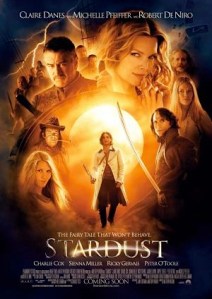
StardustPerhaps the simplest way to describe Stardust — to a film aficionado, at any rate — is as “the British Princess Bride”. That may do it a disservice however, as this tale of a boy entering a magical realm to find a fallen star is sufficiently its own beast to stand apart from such (admittedly lofty) comparisons, and be much more than a simple rehash with different accents.

Stardust succeeds in numerous ways. The plot is a good mix of fantasy archetypes, fairytale morality, a slight-but-knowing modern filter (thanks primarily to top-and-tail narration from Ian McKellen), humour and action. It rattles along, occasionally running the risk of becoming episodic, but thankfully avoiding it by linking and returning to various episodes. For a British film the effects work is perhaps surprisingly good, with impressive sequences that neither suggest restraint or budget limitations, nor smack of ambitious overreaching by the filmmakers (unlike, for example, the recent Tin Man miniseries).

This sort of fantasy adventure film is a somewhat unexpected choice for co-writer/director Vaughn, who previously produced Lock Stock, Snatch and Mean Machine, and directed Layer Cake, but his direction is neither over-grounded in reality (as you might expect from his background), nor over-done to the point of distraction (as if he were compensating). Instead, he demonstrates an entirely appropriate flair and skill, which promises much for future work.

If you watch a lot of British TV the cast seems star-studded, though even if not there’s the likes of Robert De Niro and Michelle Pfeiffer in major roles. Both are clearly having a whale of a time — as is everyone else, to be fair. De Niro’s role is especially surprising and fun, though to say any more would ruin it. It stands out as one of the best and most memorable elements in a film loaded with them. Charlie Cox is a likeable lead, while Claire Danes’ fallen star is pleasing subversive — you’d expect her to be sweetness and light (literally), but she is in fact amusingly stroppy — and Mark Strong is a perfectly villainous villain. They’re just three further standouts from an almost uniformly excellent ensemble. “Almost” because, sadly, the film’s weakest links are also among the cast. Ricky Gervais plays himself, as ever, almost shattering the well-constructed universe in the process; and Sienna Miller is too bitchy — and, to be frank, too wooden — for us to believe our hero could ever really want her.

But these are minor, easily ignored flaws in what is otherwise a fantastically entertaining fantasy. In fact, in recalling it for this review, it’s just magicked itself an extra star. How very appropriate.

5 out of 5

Stardust placed 4th on my list of The Ten Best Films I Saw For the First Time in 2008, which can be read in full here.

The Golden Compass (2007)

2008 #51
Chris Weitz | 113 mins | Blu-ray | PG / PG-13

The Golden CompassThis adaptation of the first novel in Philip Pullman’s His Dark Materals trilogy (known as Northern Lights in the UK, but adopting the US title for the film — unlike Sorcerer’s Stone, it’s actually more appropriate) received quite the critical drubbing on its cinematic release, and wasn’t a huge success at the US box office either, which has cast doubt on the prospects of the following two instalments ever being produced. Which is a shame, because this is actually a fine family fantasy film.

The requisite elements are present and correct: a well-realised alternate world, engaging heroes, slightly camp villains, mysterious items, mysterious backstories, a globe-trotting quest, talking non-human characters, a couple of action sequences and casual doses of spectacle. The latter was something that worried me going into the film, in fact, as the CGI looked dreadful in the trailer. When it won the Oscar I really couldn’t understand how, but now having seen the film — and in high definition to boot — it was, to my surprise, mostly exemplary. There are weak patches, of course (Mrs Coulter’s monkey being the main one), but the majority is either appropriately realistic or in a suitable style enough that it didn’t matter. “Don’t judge a book by it’s cover,” as they say; or indeed a film by its trailer.

Another key sticking point for me was the discarding of the books’ religious elements, which is far too atheistical for most Americans (not that I’ve actually read the books yet, but I always enjoy a good bit of Christian baiting). The filmmakers have found an appropriate way around this however: there’s a subtext, blatant to the intelligent viewer, which carries such views. It will like whoosh over the heads of those who would’ve been offended by it, which is surely the point. Nonetheless, the lack of commercial success suggests that the stir it had already caused served to cement it as “the anti-Christian film” in too many people’s minds. Or perhaps it was merely that too few had heard of the books? Or there’s always those variable reviews…

Leading the cast as Lyra, Dakota Blue Richard’s accent seems forced and occasionally grates, but really speaking she’s pretty good (pun retrospectively intended). The rest of the cast make a good account of themselves, though the likes of Daniel Craig, Derek Jacobi and Christopher Lee were clearly cast in readiness for the intended sequels. Ian McKellen is as good value as ever and the rest of the voice-only actors offer able support. Nicole Kidman never really gets the chance to unleash her full evil potential however.

In fact, therein lies probably the film’s primary weakness. While Golden Compass does work in its own right, it’s as much Part One of a trilogy as Fellowship of the Ring: at the end you feel curiously fulfilled, even though there’s clearly a lot of tale left to tell. I can only hope that the muted success it achieved is enough to get the continuing and concluding parts made, though that seems increasingly, disappointingly, unlikely.

4 out of 5