
Phil Lord & Chris Miller | 90 mins | Blu-ray | 2.35:1 | USA / English | U / PG
 The island town of Swallow Falls exists for one purpose: sardines; the fishing, packing, and distribution thereof. But when the world suddenly realises that sardines are gross, the town’s economy is left in tatters and the only foodstuff the islanders have is sardines. (While we’re on the glum bit, the location of Swallow Falls is identical to the real-world location of Bermuda, except in this reality almost every inhabitant is Caucasian and the island is indisputably part of the US. This is why you don’t scrutinise the geopolitics of kids’ movies, especially American ones.)
However, genius young inventor Flint Lockwood (Bill Hader) invents a machine that can turn water into any food you ask for. When he accidentally fires it off into the atmosphere, it begins to rain burgers, and it looks like the town’s fortunes will face a massive change. But is that all for the best, etc etc etc.
Cloudy with a Chance of Meatballs has a silly title, a silly premise, and I thought it looked kinda silly too, which is why I didn’t bother with it before. A bit like How to Train Your Dragon, really, because then I began to hear good things about it, and when I found myself with the offer of a free Blu-ray (for reasons too dull to go into) I picked this on a whim (and because the other choices were pathetic — I mean, I could pick two, and the other I got was Resident Evil 4 just because I have the first three on DVD. I’ve not even watched the first two sequels, and I only thought the original film was OK. But I digress…)
And, again much like Dragon, Cloudy subverts first impressions by actually being really good. And I mean that as in “good for adults”, not just “good for kids” — 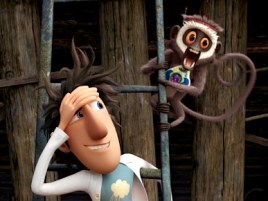 not an unworthy aim, and something Cloudy also achieves, but not a main consideration in my personal assessment of things. The main selling point is that it’s very funny. Of course there’s the slapstick cartoon humour, which is well done, but there’s also a lot of great one-liners, random asides, and the like. Not ‘adult jokes’ by any means, but I think it makes the film fun for grown-ups too.
There’s also subplots that deal with why it’s OK to be a nerd/geek/whatever the term is this week, and why that’s better in the long-run (perfect for school-aged kids, I guess); and another about female empowerment, which is probably the kind of thing that ought to be in kids’ movies more often. Not that they don’t have their share of strong or equal female leads, but… well, maybe they do. That’s a Big Discussion for another time, but it’s something I think Cloudy handles notably well. Sure, it’s framed partly in a fairly traditional romance narrative, but I don’t think that’s necessarily a problem.
I suppose themes of acceptance by society and/or your family, of finding your place in the world, and of proving your worth, are all regular topics of kids’ movies — the “I feel different but I want to fit in” thing seems to be pretty universal. But Cloudy succeeds in making many of these feel fresh, and surrounds it with such fun that even if it didn’t you probably wouldn’t care.
This is buoyed by an array of memorable characters, voiced by a moderately starry cast all giving quality performances. Bruce Campbell is particularly noticeable as the mayor, though Neil Patrick Harris is slightly wasted as Steve the monkey. 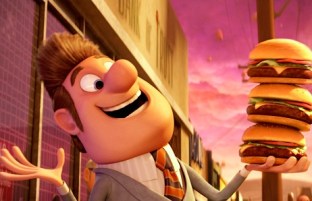 He’s a very funny character, but that’s in the writing, directing and animation — the voice work is spectacularly minimal. Apparently Harris was offered the lead but turned it down for the “more interesting” part of Steve. Nothing against Hader, but if I were the directors I’d have tried to persuade him to do both.
One final thing I particularly liked was the pace. It seems silly to criticise some 90-minute movies for not getting on with things, but almost inevitably you know scenes or moments, or even whole plot threads, will turn up to slow things down, even in otherwise entertaining films. Not so here. It moves like the clappers through the main plot, the sequences devoted to subplots aren’t tedious (even the romance one), and — perhaps indicative of the speed it’s moving at — the climax starts halfway through the film! That’s not an exaggeration: the events that form the film’s final-act grand-finale begin around the 42-minute mark. You’d think that would unbalance the film, toppling it under the weight of the entire second half being what most films deal with in the final quarter, but no, because it’s still moving at such a rate that you don’t notice. Well, clearly I did notice — but, most importantly, I didn’t mind.
In fact, the only criticism I have is the end credits song. It’s by some Disney pop-brat, it’s called Raining Sunshine, and it’s exactly as dreadful as that sounds. But the actual music in the film is good, particularly the action-movie-esque theme that plays on the Blu-ray menu, so there’s that.
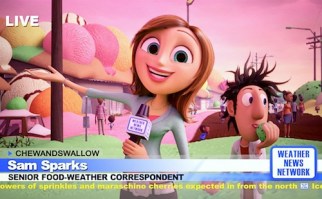 I should probably learn to stop writing off non-Pixar animated movies so readily (and, based on what I’ve heard and seen of their last few efforts, maybe slacken off on the Pixar love. I say that as if it’s news — plenty of people already have; and I’ve never been wholly on that bandwagon anyway. But I digress…) Big, bold, colourful, funny and exciting, Cloudy with a Chance of Meatballs is the kind of film I imagine a lot of kids love and watch on loop. In the process they may even be learning some Important Moral Lessons, which, crucially, aren’t too heavy-handed. Many of these aspects work for adults too. I don’t know if you’d want to watch it on loop, but you may certainly want to watch it again.

The UK free-TV premiere of Cloudy with a Chance of Meatballs is at 4:20pm this Sunday, 18th October, on Channel 5.
Previews of Cloudy with a Chance of Meatballs 2 are in UK cinemas this weekend, with the film on wide release from next Friday, 25th October.
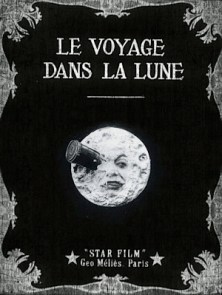 Of all the defining images of cinema — certainly of the silent era — the face on the Moon with a rocket in its eye must be one of the most recognised, though you have to wonder how many have actually seen Méliès’ full vision. More than it could have been, though, because A Trip to the Moon was so popular that, in the copyright-lax world of early cinema, it was widely copied and ripped-off; the kind of thing that destroyed Méliès’ career and, along with it, much of his work.
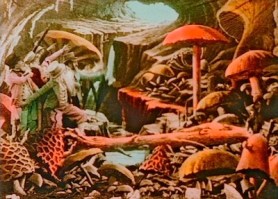 But Méliès wasn’t making a documentary, he was making an entertainment. Indeed, the analogy to a blockbuster is a good one, because this is essentially the turn-of-the-century equivalent. The fantastical sets, costumes and story are all designed to wow the viewer — and remember, we’re only a few years on from people diving out of the way of film of a train arriving in a station.
 Whatever it is, it’s certainly not period-authentic.
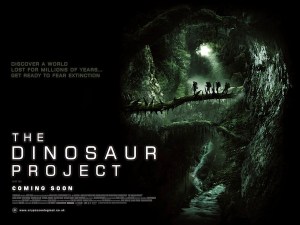 Found footage movies, eh? You either love them or hate them. Well, plenty of people hate them. I don’t mind them — it’s fast becoming an unoriginal idea (“existing genre + found footage = exciting new idea” is a sum that stopped working a couple of years ago), but if it’s done well, of course it still works.
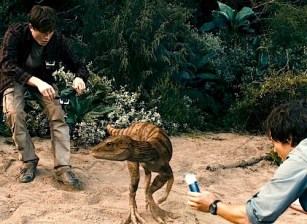 Essentially, then, it’s a cut-price
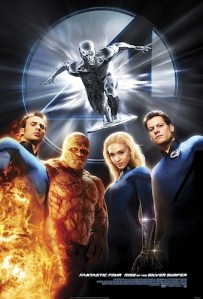 The Fantastic Four are the kind of superhero team that people in comics think are a big deal but the wider world aren’t so fussed about, as proven by the lack of success of their two film outings versus the likes of
  It’s also the kind of film where the US military have jurisdiction Everywhere In The World, which is again the kind of thing that used to just slide but doesn’t seem appropriate any more. Apparently the General character was originally meant to be Nick Fury — if it had been S.H.I.E.L.D., rather than the US military, at least that part might’ve made sense.
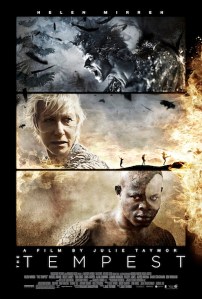 Film and theatre director Julie Taymor (infamous now for Spider-Man: Turn Off the Dark) here brings us a radical-seeming interpretation of Shakespeare’s final play. The main character’s changed gender! There’s CGI being tossed about everywhere! It’s got Russell Brand in it! If that sounds superficial, it is. Taymor’s film is still set in the Elizabethan period, in Elizabethan dress (broadly speaking), with a cast of mostly classical actors, enacted on an island that is admittedly a stunning setting but is nonetheless where the original play is set. If it’s a “modern retelling of William Shakespeare” (per the blurb), it perhaps missed what Baz Luhrmann
 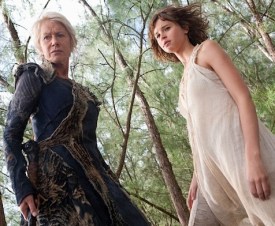 It goes on in the middle, a mess of scenes of characters traipsing about the island for no apparent reason. (This reminded me of
 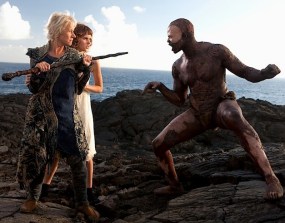 Another key role sees Djimon Hounsou as the slave Caliban, immediately suggesting a colonialist reading that isn’t exactly a huge reach anyway. And Russell Brand makes Shakespeare sound like Russell Brand talking, which at some points I’m not convinced he isn’t (I’ve no idea if Taymor allowed him to stray from the text or not). Love interest is provided by Reeve Carney. I’ve never heard of him, but he’s young and quite pretty and has a music video on the Blu-ray, so I guess he’s from that kind of arena. He speaks with an English accent, but so does everyone else (bar Caliban and the boatswain), so he may still be sourced from the other side of the pond’s teenybopper scene.
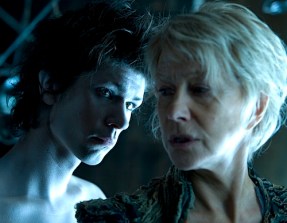 Ariel as a truly spiritual spirit, half invisible and jetting off into the sky on a regular basis. I found his realisation a mixed bag: it’s nice to take advantage of the medium to render the spirit in a way that’s impossible on stage, but sometimes it goes a bit far and looks a bit cheap. They’ve also tried to make him androgynous, but done it a bit weirdly: he’s always naked, occasionally making it clear he has no penis, sometimes has small breasts, but always has a moderately deep, clearly manly voice. Show it to a class of teenagers studying the play and you may illicit some confused feelings… That aside, the make-up effects are brilliant. Caliban’s patchwork skin is the best piece of work, but Ariel’s rendering as a giant crow is a fearsome sight as well. For all I know the latter may count as costume design, which is what earnt the film an Oscar nomination. But, hey, the clothes are nice too.
 It would be nice to say the magic and fantasy could convert new fans to Shakespeare, much as Leo DiCaprio and swishy editing did for teens nearly two decades ago, but there’s nothing beyond that trailer-friendly neat-looking stuff to convince them it was worth their time. Meanwhile, Shakespeare traditionalists may find it all a bit much. If that leaves it stranded on an ill-located isle of terrible beauty, then at least it’s an apt fate.
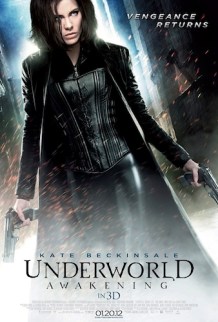 Just when you think the Underworld series is dead, it suddenly lurches back to life with a new instalment. Fitting for a series all about vampires & that, I suppose.
 By taking such a bold move with the plot, meanwhile, the story pushes the series’ mythology in new and relatively interesting ways. It’s becoming a bit dense and fan-only (unless you let it wash over you and just enjoy the punching), but at least they’re not regurgitating the same old stuff. It manages a few twists along the way too, which is always nice. The plot seems to have been half worked around Speedman’s non-involvement, leading me to wonder why — he’s not too busy, surely? Perhaps he’d just had enough? But no, apparently it was genuinely just written this way. I guess he couldn’t be bothered to turn up for some cameo shots, because the stand-in is really obvious.
 means the next one will probably turn up out of the blue with little hype, much as Awakening did last year. Plus, though this is the most expensive film to date (double the budget of the preceding one!), it’s also the most financially successful: $160.1 million worldwide, beating number two’s $111.3 million. Assuming Beckinsale still feels up for it, I imagine 2015 will bring us a continuation — and, hopefully, a conclusion.
 Also worthy of commendation: new-style ‘evolved’ Lycans; a small role for Charles Dance (always worth seeing); the evocative near-future setting; good quality action sequences; some nice steel-blue cinematography/grading. Some of it was shot at 120fps on brand-new pre-alpha never-used RED cameras — take that Peter Jackson, eh. Plus it’s only a little over 1 hour and 18 minutes long without credits. Some would bemoan such brevity, but it has its positives.
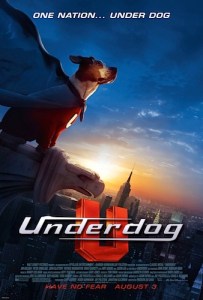 In this big screen live-action version of some old US cartoon, a dog gets superpowers and, naturally, becomes a superhero. That’s pretty much it.
 Remember
 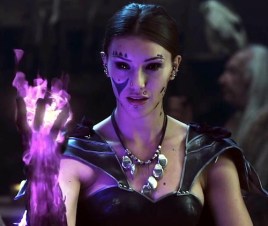 Director Gerry Lively helmed the preceding D&D movie and some stuff you’ve never heard of, as well as serving as DoP on such auspicious-sounding films as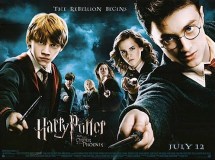
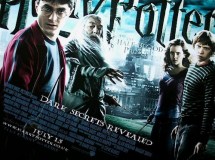


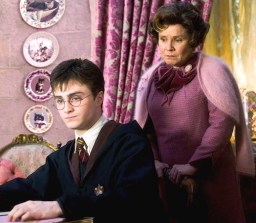 Their main weapon is Dolores Umbridge, perhaps the series’ most despicable villain, because she is so horrendously plausible. She seems to be all sweetness and light, but it masks a dangerous streak that sees her eliminate any fun from the school and, in one of the most sadistic sequences in either the novels or the films, she has Harry write lines with a magic quill that cuts each one into the skin of his left hand. The Potter series actually has its share of nuanced villains, but Umbridge is thoroughly unlikeable. Though she’s defeated and carted off at the end of Phoenix, she resurfaces in
 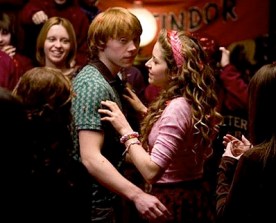 But not so. Yates approached his follow-up with a stated aim of introducing more comedy, believing the three leads to be talented in that area but not having had a chance to show it in his dour first film. So here we get a whole subplot given over to Ron’s attempts to join the Quidditch team, as well as much focus on the trio’s romantic entanglements — teenage love always being a good topic for humour. The film is not without its dark side, but peppered liberally throughout are those comedic subplots and scenes that are liable to see the viewer laugh perhaps more than in any other Potter film. It’s easy to miss this element — the main plot is, as always, getting darker and more serious — but once it’s been highlighted (as the makers do in the film’s special features) I think it becomes very noticeable.
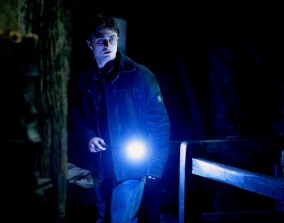 grading the film in perfectly-calibrated conditions so they can really push it to extremes, not considering how most end-users will view it; and, much like fast-cut action scenes, an over-familiarity with the material that means the director/editor/grader can see what’s going on because they’ve watched it dozens (or hundreds) of times, which doesn’t work for a first-time viewer in the middle of the film. As you may be able to guess, I’m not a fan.
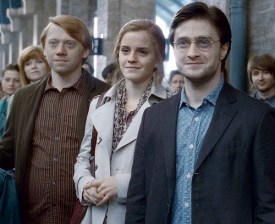 not a sudden smash-cut to a few decades on where we see how some characters’ lives have developed. I know some people complain about
 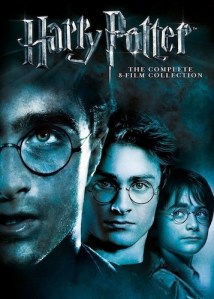 It’s hard to offer a final summary of the Harry Potter series. Some people see them as mediocre and overblown; for others, they are their life. Personally, I think they develop from sometimes-uncertain roots in the early films, to a flourishing series of epic fantasy movies. There are often niggles of one kind or another, be it acting (I forgot to discuss Emma Watson’s eyebrows!), or cartoonish designs, or too-faithful adaptation, or abbreviated adaptation, or what have you — but none of these are ever-present. More importantly, every film offers something to enjoy, and the growing maturity — of not only the cast, but also the filmmaking — means their impact only increases when viewed as an entire eight-film saga.
 After
After  100Films.co.uk