aka Beauty and the Beast
2014 #104
Jean Cocteau | 94 mins | Blu-ray | 1.33:1 | France / French | PG
“When it comes to “fairy-tale movies” — if such a genre exists as something other than a profit center for the Disney corporation — there is Cocteau’s Beauty and the Beast and then there is everything else.”
 So states Geoffrey O’Brien in his essay “Dark Magic” (included in the booklet for Criterion’s Blu-ray release of La Belle et la Bête, and available online here). Despite the varied list of titles people have selected to cover for the Fairy Tale Blogathon, I feel it’s a pretty accurate statement — ask most people to name a film based on a fairy tale and they’re going to come out with a Disney; ask a cinephile and I suspect, as a rule, Cocteau’s acclaimed film would come to mind ahead of most others. After all, it’s on a variety of well-regarded best-ever lists, including both the cineastic (TSPDT, Sight & Sound, Cahiers du cinéma) and the mainstream (the Empire 500, IMDb Top 50s for Fantasy and 1940s). It’s a film considered almost without peer in its now-animation-dominated sub-genre.
I imagine you know the story — it’s a tale as old as time, after all — but let’s recap anyway: in lieu of her father, Belle (Josette Day) goes to be the ‘guest’ of the animal-like Beast (Jean Marais) in his castle. Initially repulsed by him, Belle comes to realise there’s something there that wasn’t there before as she grows attracted to her captor. Meanwhile, Belle’s would-be suitor (Marais again) resolves to kill the Beast…
As if I haven’t made it explicit enough with my shoehorning of song titles and lyrics, the elephant in the room when discussing La Belle et la Bête today is Disney’s 1991 adaptation of the same story. It may have come 45 years later and I’m sure is less kindly looked upon by cineastes, but there’s no doubting its popularity — and acclaim, in fact, notably being the first animated movie to be nominated for a Best Picture Oscar. Simply put, Cocteau’s film is less accessible than the Disney version. That might sound like it goes without saying, but even allowing for the differences in production style (slick colourful animation with catchy Broadway-style tunes vs. black-and-white French poetic realism), 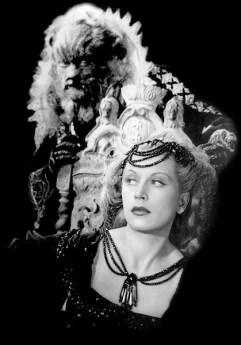 here the characters’ relationships are more complex and ambiguous, particularly at the climax. It isn’t a simple “see the true beauty behind the ugly exterior” moral fable; indeed, if anything, Marais’ Beast is more beautiful than the man he becomes.
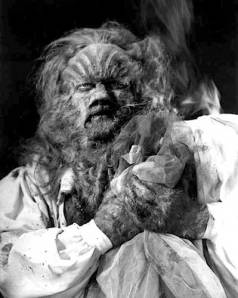
There are several reasons for that. One is the visual: Marcel Escoffier’s resplendent costuming, Henri Alekan’s gorgeous cinematography (more on that later), and, primarily, Hagop Arakelian’s make-up. Taking five hours to apply every day, the look of the Beast is in no way a dated ’40s special effect, but a marvellous, expressive, essential part of the character. Nonetheless, as O’Brien notes,
[The Beast says,] “You mustn’t look into my eyes.” It is, of course, his eyes that we look at, glistening from within the multilayered makeup… makeup so expressive that Marais’ real face seems a blank by comparison.
As is alluded to there, it’s not just the stuck-on fur that makes the man a Beast, but Marais’ performance. The eyes may indeed be the window to the soul, for it’s through them that we can see he’s a man underneath the beastly visage. But even in that sphere the character is a man transformed — his manner, his voice, and the steely look that often lies behind those eyes. In her essay named after the film in the BFI’s Gothic – The Dark Heart of Film compendium, Marina Warner summarises the cumulative effect of the numerous filmmaking disciplines that created the character:
[Cocteau] imagined a beast who has no rival for hideous fascination among fairytale beasts before or since: Jean Marais’s growling, slowed, incantatory delivery, his sweeping, elaborately princely magnificence of apparel, his thick pelt curling out exuberantly from his lace collar and fine linen as he springs and lopes, and, above all, his staring pale eyes in the great leonine and brindled mask of his face with the two sharp incisors defining his mouth, has never been matched for erotic power. He captures a perfect and irresistible synthesis of repulsiveness and attractiveness.
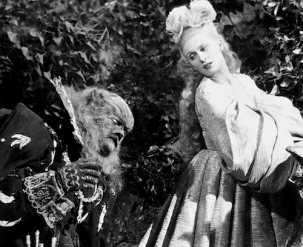 That final idea, of the erotic or sexual in the film, seems a favourite theme for critics: O’Brien reckons “the magic is sexual throughout — a fantastic… sex magic”, and I think we’ll skip Warner’s lengthy discussion of the feelings the film elicits in her. How prevalent such undercurrents are is surely in the eye of the beholder — O’Brien notes that “it is so chaste that no censor could have ever assailed it”, and I suspect many a viewer would feel the same. That said, the soft-lensed scene in which the Beast gently laps water from Belle’s delicately cupped hands may make viewers with a particularly-disposed mind think of certain other acts.
A more defining feature of the film’s depiction of magic, I think, is its groundedness. O’Brien sums it up most succinctly when he says that “if this is magic, it is a shaggy, palpable sort of magic… we sense at each moment that we are caught up in a process governed by laws”. We rarely know what these laws are, in fact, but there’s a sense that there’s some governing order to what occurs, that some things are possible and others not — there’s clearly no love potion to solve the Beast’s problem, for instance. Many uses of magic in the film come with associated “how to use it” guides from one character or another; not presented in some kind of deconstructionist technical-manual style, but neither are they a hand-wavy “it’ll do whatever we need it to when we need it to”. To quote O’Brien again:
Cocteau was able to realize the fantastic not as an escape from the real but as an extension of it… He approaches the paraphernalia of the fairy tale — those enchanted mirrors, keys, gloves — with a technician’s dispassion, no more taken aback by their existence than by the existence of trees or streams or horses or rose gardens.
 Cocteau was trying to move away from a wishy-washy kind of fantasy — indeed, he says as much in the press book for the film’s US premiere (a piece entitled “Once Upon a Time” and also included in Criterion’s booklet): “To fairyland, as people usually see it, I would bring a kind of realism to banish the vague and misty nonsense now so completely outworn.” In these respects you could probably draw a line from Cocteau to something like Peter Jackson’s films of the Lord of the Rings trilogy, where a not-real world with magical qualities is rendered with the precision of historical drama, and even Game of Thrones, which you could certainly mistake for a real-life medieval epic (until the dragons turn up). Cocteau’s vision feels a little more storybook than either of those, but everything’s a step on a journey.
Plus, unlike either of those examples, Cocteau’s film needs to draw a line between the everyday world and the fantastical one. Much as with the Beast, this is achieved with a synthesis of production elements. The farmhouse of Belle’s family is shot on location, providing inescapable realism, and with relatively straightforward photography from Alekan. It’s not that these section are unimaginative, just that they present a world that is ‘normal’. The Beast’s castle, on the other hand, is heightened and expressionistic. Christian Bérard’s production design offers sets with lots of black emptiness in place of floors and walls, with decorations and dressings that shine, gleam and glow in Alekan’s lighting — not to mention the candelabras with self-lighting candles, held by moving arms; or the faces set in the fireplace, whose roving eyes follow the action; or the hand protruding bizarrely from the tabletop, there purely to pour the wine.
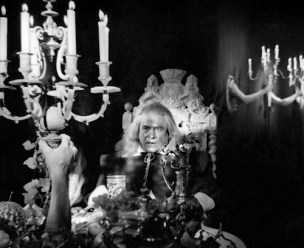 It’s in the Beast’s castle that the most enduring images of the film are played out, most famous among them being Belle’s father’s arrival, with the candles igniting themselves and the hands pointing the way, and Belle’s own arrival, a slow-motion run with billowing dress and curtains — if you haven’t seen the original, you’ve surely seen an advert inspired by it. For all the groundedness Cocteau and co may be bringing to the fantastical, it’s still a strange realm; one rendered with loving beauty in its design and photography, but with an unsettling effect. Right on the money, then.
And if we’re talking about “unsettling beauty”, we’ve surely come back round to the Beast himself, and in particular his role in the ending. You know how that turns out: having been able to see the true goodness beneath the ugly exterior, Belle is rewarded when the Beast is transformed back into a handsome prince. Hurrah — she gets a hubby who is both nice and pretty! But is it such a victory after all? Not if Cocteau gets his way:
My story would concern itself mainly with the unconscious obstinacy with which women pursue the same type of man, and expose the naïveté of the old fairy tales that would have us believe that this type reaches its ideal in conventional good looks. My aim would be to make the Beast so human, so sympathetic, so superior to men that his transformation into Prince Charming would come as a terrible blow to Beauty, condemning her to a humdrum marriage.
 Good moral message, but isn’t the “superior” Beast the same fella as Prince Charming? The way a felled Avenant is transformed into the Beast at the same time as Charming is unveiled as a more-perfect duplicate of Avenant (it’s Marais in all three roles, of course) suggests some kind of parallel should be drawn. Warner wonders, “Has the Beast taken on [Avenant’s] appearance because [Belle] admitted to him that she was fond of Avenant?” Could be, but isn’t that a bit simple? She has another theory: “does Cocteau want to suggest that a ne’er-do-well like Avenant can also be transformed by love?” Could it be Avenant is about to get a lesson in how to be a better person, as Charming has already endured?
These are all attempts to find a positive reading of the ending, I think — one where love conquers all, and what it hasn’t conquered is a mission for the future. O’Brien is a bit more pessimistic, concluding the film is “a story more full of suffering than of wish fulfillment”. Oh dear. He believes that “even as Belle and her prince (the Beast transformed into the double of the unreliable Avenant) soar in the sky, she seems already to realize that this is not exactly what she wanted.” It’s certainly true that every character in the film goes through some misery, be it small (Belle’s sisters being snubbed from social engagements) or big (the family’s destitution), and by the end very few of these are resolved. If Belle thought she was getting an honourable Beast and instead has to suffer a preened Avenant for her foreseeable future, then she’s lost out too. Indeed, the only one who got what he wanted was the Beast: transformed back into a man, and with a lovely new wife to boot.
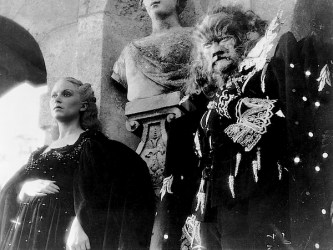 There’s a cheery message to end on. But then, this is “a fairytale for grownups” — a quote from Warner, but, to an extent, it would seem Cocteau agreed (by implication, with his statement at the start of the film urging the audience to embrace child-like acceptance of the story they are about to see) — and the resolutions of grownup stories are rarely “happy ever after”.
This review is part of the Fairy Tale Blogathon. Be sure to check out the many other fascinating articles collated at Movies Silently, including my review of fairytale-inspired miniseries The 10th Kingdom.

 An unnamed woman (Martina Gedeck) goes to stay with some friends at their lodge in the Alps. The friends pop into town, leaving their dog behind with the woman. When she wakes up the next morning, they’ve not returned, and she finds an invisible wall surrounding the mountain. Exploring its boundaries, she sees people outside, paused mid-life, as if frozen. As hours turn into days turn into weeks, she begins to realise the need to fend for herself, farming the land and caring for her animals, which come to also include a cow and a cat. As weeks turn into years, she comes to accept her new life, from which it seems there may be no end…
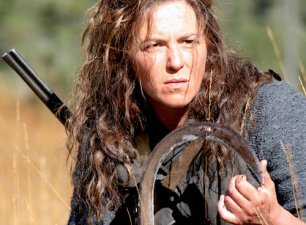 The Wall starts out with a compelling mysterious premise, but seems to have no interest in exploring it or answering the many questions it raises. In some respects that’s better than the kinds of rote explanation offered by lesser films — you know, “Aliens did it. Why? Because.” — but it’s a bit like a joke without a punchline. Taking the setup as a mere excuse for an exploration of the human condition, I don’t know that it’s that illuminating. Either way, it makes for a sporadically interesting but ultimately unsatisfying experience.
 Released the same year as
  Even with the undercurrents of grief and the difficulties of moving on, this is fundamentally a light, amiable romance.
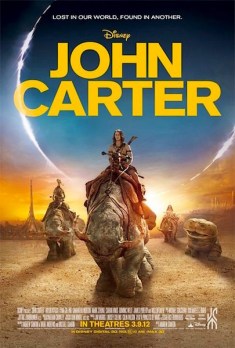 A box office flop (it made a once-astonishing $284 million worldwide, but that was off a $250 million production budget and a ginormous bungled marketing campaign), John Carter has gained something of a following among those who did enjoy it or caught it later — see
  not because it’s so famous (among Normal People, I don’t think it is), but because its influence means its imagery and concepts have already been plundered (
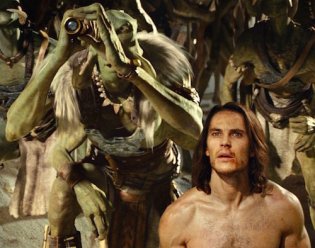 It doesn’t help that the film is structurally muddled at the offset. It begins on Mars, a voiceover detailing the conflict — an instant bombardment of names and concepts. I don’t mind things that challenge you to keep up, but it still feels a bit much. Then we jump to New York in the 1880s, where Carter is running away from someone in the streets. Then to his house, where his nephew has just turned up to be told he’s dead. You what? We just saw him in the telegraph office! And then we jump back to the 1860s, where he’s searching for gold and getting arrested (or something) by Bryan Cranston in a wig as some form of army officer. Then it gets a bit more straightforward. If being transported to Mars and meeting four-armed CG aliens who speak in subtitles is what you call “straightforward”, anyway.
 It feels a bit facile to criticise the quality of CGI these days, but that doesn’t stop John Carter from being over-ambitious in this regard. In fact, it’s not really the sometimes-half-assed green screen or occasional plastic-ness that’s the problem, but the design: those four-armed aliens are just a little too cartoony. Perhaps it’s a hangover from Stanton’s Pixar days, perhaps something just went a little awry during the process, but their design doesn’t look quite ‘real’ enough; a little like someone’s taken a real-life creature and then lightly caricatured it. I think it’s the eyes, which are perhaps a little too big and round and ‘cute’, but there’s something else indefinable there, or not there. These aliens aren’t just set dressing but proper motion-captured characters, played by the likes of Samantha Morton, Willem Dafoe, Thomas Haden Church and Polly Walker, so the lack of connection is regrettable.
 I was expecting, or perhaps hoping, to like it; to find a misunderstood old-style adventure full of entertainment value. It may be an old-style adventure, but that’s beside the point, because whatever it is, I just felt it wasn’t particularly well made: poorly constructed, weakly performed, lazily (and wrongly) assumptive of the audience’s familiarity with the material. Disappointing.
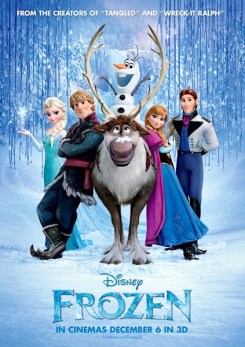 Frozen is a grim single-location thriller about three college kids trapped on a ski-lift overnight, battling hypothermia and worse over a hundred-foot drop. Or at least it was until last year, when Disney went and released its all-consuming mega-musical.
  Unlike the best Disneys, however, I think its appeal resides firmly with little girls — you don’t actually have to go very far on the internet to find people baffled by its success. Plenty of people think the music is bland, the characters underdeveloped, the moral and emotional arcs not fully thought-through, the visual style a rip-off from
 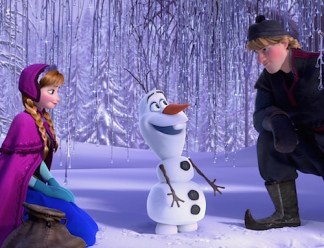 The lack of villain’s song is attributable to the fact that, for nearly the entire film, there are no nasty characters. A villain emerges right at the end to give us a climax, but for once that works — a genuine twist! It’s almost a shame it has to resort to that, but how else do you end a Hollywood movie other than a big dramatic confrontation? Plus, aforementioned snowman Olaf confounded my expectations, pulling off the quite remarkable feat of not being the most irritating CGI character since Jar Jar Binks. (I don’t know who is the most irritating CGI character since Jar Jar Binks, but Olaf is alright.)
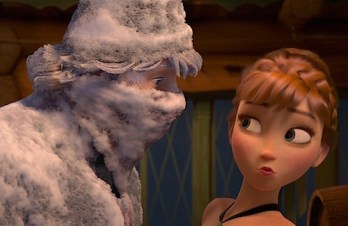 It’s not bad — it’s adequately cartoony — and actually the ice and snow effects are very, very good. It’s the character animation that I felt let it down, especially some of the more minor roles — there were points where their style and movement looked little better than you’d find in a video game cut scene.
 Frozen is by no means a bad Disney movie, and it does have a lot of favourable aspects. Whether the internet’s right and it’s not as good as Tangled, I wouldn’t care to say (I enjoyed Tangled, but at this point have largely forgotten it); conversely, the sometimes-rabid fan base are perhaps being a little over-enthusiastic. There’s nothing wrong with a kids’ movie being beloved by kids, though; and with all the dreadful things the media churns out for little girls to obsess over and centre their life values around, this is undoubtedly one of the most positive.
 Comic book creator Frank Miller brings what he learnt co-directing
 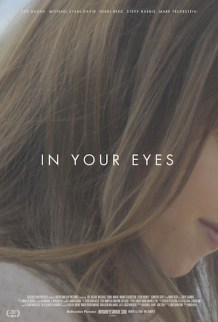 Perhaps most discussed for the way it was released — at the same time as the film’s festival premiere, writer-producer Joss Whedon made it available to rent online — In Your Eyes is worthy of note on its own merits as a movie, too.
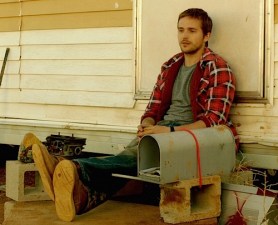 Secondly, their emotional connection means they begin to spend a lot of time in each other’s heads, distancing themselves from the world and, when they begin to be overheard talking to each other — or, as everyone else sees it, talking to themselves — people begin to get suspicious. And when you’ve got a controlling doctor for a husband, who knows about your history of mental health issues… well…
 A character-driven romance that will likely bore some, In Your Eyes weaved a spell on me. It’s beautifully, simply directed by Brin Hill, the focus lying heavily on the characters and performances of Stahl-David and Kazan. If you warm to them — and I think many will — then they’re a pleasure to spend time with, and you become invested in where events will take them. More magical realist than hard fantasy, this isn’t one for serious genre fans. Romantics, however, may fall in love.
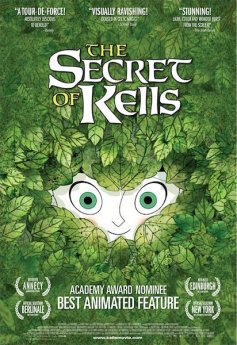 You can lament the quality of Oscar voters’ choices all you want, but if it wasn’t for their 2010 Best Animated Feature nominations I’m not sure many would have heard of this Celtic gem.
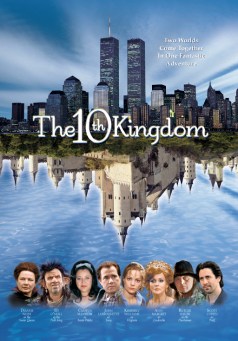 Created by British screenwriter Simon Moore (writer of
 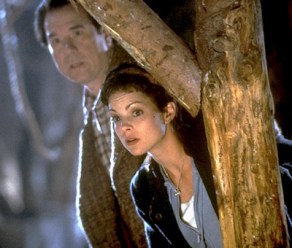 Anyway, the Nine Kingdoms is the place all our fairytales come from — the part of the narrative set there takes place “almost 200 years” after the “Golden Age”, when the events we know from stories actually happened. We’re led into this world by Virginia (Kimberly Williams) and her dad, Tony (John Larroquette), after indolent monarch-to-be Prince Wendell (Daniel Lapaine) flees to our world while escaping the Evil Queen (Dianne Wiest) and winds up taking the two New Yorkers back to his world. Along with Wolf (Scott Cohen), a chap with animalistic tendencies, the quartet try to stop the Evil Queen’s evil machinations.
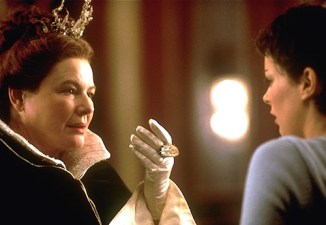 It also means the way it’s been edited into one long movie on DVD feels quite natural: it’s one long story with arbitrary breaks, not a series of finite episodes. (If you’re thinking, “of course it’s one story, it’s a miniseries”, plenty of single-narrative series and miniseries still function as discrete episodes that build to a whole.)
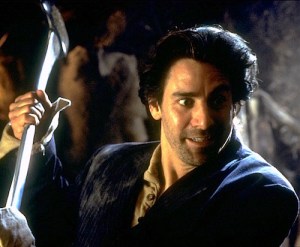 This gives the whole thing a heightened comedy tone, emphasised by many of the performances. A gaggle of troll siblings are irritatingly over-played, but Cohen’s meat-obsessed Wolf is a hammy delight (pun very much intended). The entertainment value means we quickly warm to the characters, so that when more perilous aspects of their quest do come into play later on, we care what happens. Plus, like most of the original fairytales (as opposed to Disney-style sanitised re-tellings), there’s the odd darker undercurrent. For instance, you may think the story of Snow White ends with a kiss and “happily ever after”, but here we’re told how the stepmother who poisoned Snow White was made to wear fire-heated iron shoes and ‘dance’ at the wedding until her feet were burnt raw, before being thrown out into the snow. Very dark and grim (and possibly from the original tale, for all I know).
 Little details in this vein abound: an apple tree has grown by Snow White’s cottage (don’t eat those apples!); the site of her glass coffin is now a tourist attraction; if you break a mirror, you genuinely get seven years’ bad luck… There’s also a pair of golden shoes that can turn you invisible, but the more you wear them the more you desire to use them all the time — what a precious idea (wink wink nudge nudge). These subversions also manifest in a strain of pleasant practicality; for instance, the abundant magic mirrors aren’t “just there”, but instead have been manufactured by dwarves. It lends the feel of a fully-conceived and rule-bound world, rather than an “anything can happen”, “just because” environment.
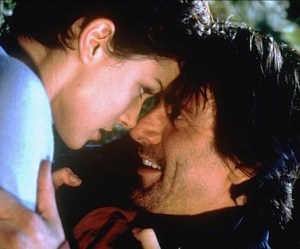 a world away from being locked in a castle until you change your mind. If this sounds like criticism, it isn’t. I’m not arguing the love story element of the series is unsuccessful — I’m sure it engages plenty of fans as the series’ primary attraction, even — but, on reflection, I’m not sure reading it as a Beauty and the Beast variation is actually that illuminating.
 Based on the cult novel by Cracked.com editor David Wong, John Dies at the End is a bizarre horror-fantasy that defies easy explanation or summary.
 100Films.co.uk