100 Films’ 100 Favourites #55

The Journey Ends.

Country: New Zealand & USA
Language: English & Sindarin
Runtime: 253 minutes (extended edition)* | 201 minutes (theatrical version)
BBFC: 12A
MPAA: PG-13
* 263 minutes with the interminable fan club credits.
Original Release: 17th December 2003 (UK, USA & others)
First Seen: cinema, December 2003
Stars
Liv Tyler (Armageddon, The Incredible Hulk)
Miranda Otto (Love Serenade, War of the Worlds)
Cate Blanchett (Elizabeth, Blue Jasmine)
John Noble (The Monkey’s Mask, Risen)
Ian Holm (Alien, Hamlet)
Director
Peter Jackson (The Frighteners, The Hobbit: An Unexpected Journey)
Screenwriters
Fran Walsh (Heavenly Creatures, King Kong)
Philippa Boyens (The Lovely Bones, The Hobbit: The Battle of the Five Armies)
Peter Jackson (Braindead, The Hobbit: The Desolation of Smaug)
Based on
The Lord of the Rings, a trilogy of novels by J.R.R. Tolkien.
The Story
The Ring’s evil influence over Frodo intensifies as he and Sam allow Gollum to lead them on a difficult path into Mordor. Meanwhile, Aragorn and Gandalf try to unite the world of men against Sauron’s forces, hoping to at least buy Frodo and Sam the time they need…
Our Heroes
It’s an ensemble cast so there are heroes aplenty, but this is the film where Sam really comes to the fore. Although wronged by Frodo, whose Ring-induced confusion allows him to be convinced by the machinations of Gollum, Sam repeatedly comes through to rescue his friend. “I can’t carry it for you… but I can carry you!”
Our Villains
With Saruman out of the picture, the focus falls back on the Big Bad big eye, Sauron. In the extended cut we’re also treated to his rather disgusting Mouth. Special mention also for the Witch-King of Angmar, who reckons he can be killed by no man. Of course, despite Tolkien’s reputation, not every character is a man…
Best Supporting Character
Women get short shrift in Tolkien’s world on the whole, but Miranda Otto’s Éowyn gets a relatively strong role through Two Towers and Return of the King, here riding into battle (in disguise) and (spoiler alert!) avenging the murder of her uncle, the king.
Memorable Quote
“My friends, you bow to no one.” — Aragorn, to the Hobbits.
Quote Most Likely To Be Used in Everyday Conversation
“Fool of a Took!” — Gandalf
Memorable Scene
With the Ring destroyed and Sauron defeated, the film takes the necessary time to walk us through the ultimate fates of the surviving characters. For the conclusion of an eleven-hour story, The Return of the King has a proportionally appropriate number of endings. Stop bloody whinging.
Memorable Music
Howard Shore completes his fantastic score. This time, memorable moments include The Realm of Gondor (in Ascension), heard best as Gandalf rides into and up the city of Minas Tirith; and The Edge of Night, sung by Pippin (Billy Boyd) as Faramir leads a futile charge on Osgiliath (another strong contender for Memorable Scene, that).
Technical Wizardry
The Fellowship of the Ring was one of the films that pioneered digital grading, a process which pretty quickly became standard (and now is fundamentally unavoidable, what with digital photography being the primary movie production format). Return of the King demonstrates the full power of the form, however: After the final battle, Pippin finds Merry on the battlefield. In the theatrical cut, the scene takes place during the day; in the extended cut, new and rearranged scenes means it takes place at night. It’s the same footage, graded differently, and it works seamlessly in either cut.
Truly Special Effect
Creating the trilogy’s many epic battle sequences required the ability to computer generate hundreds of thousands of soldiers fighting, a gargantuan task and a problem that hadn’t had to be solved in filmmaking before. This is what led to the creation of MASSIVE — short for Multiple Agent Simulation System In Virtual Environment — a computer program which creates thousands of characters who are capable of acting as individuals, responding to their surroundings through the use of pre-programmed actions and animations. The kit has been used in many sci-fi/fantasy films since, including Avatar.
Letting the Side Down
I’ve never really bought all the stuff with the ghost army, and apparently Peter Jackson agrees. Although he hated it because it was so unbelievable, he kept it in so as not to disappoint fans of the novel.
Making of
Although most of the trilogy was filmed as part of one massive shoot before the first film was even released, pick-ups and additional filming were later done for both parts two and three. Ultimately, the final day of filming for the trilogy (to get one additional shot for the extended edition of Return of the King) actually occurred not only after the final film had already been released, but after it had swept the board at the 2004 Academy Awards, too. Apparently it amused Peter Jackson to be shooting footage for a movie that had already won the Best Picture Oscar.
Previously on…
The story began in The Fellowship of the Ring and continued in The Two Towers, of course.
Next time…
Jackson and co returned to Middle-earth to adapt prequel tale The Hobbit in three parts, which has a framing device that places it… before Fellowship. So this remains the chronological end of the line.
Awards
11 Oscars (Picture, Director, Adapted Screenplay, Editing, Art Direction-Set Decoration, Costume Design, Makeup, Score, Song, Sound Mixing, Visual Effects)
5 BAFTAs (Film, Adapted Screenplay, Cinematography, Visual Effects, Audience Award)
8 BAFTA nominations (Supporting Actor, Director, Music, Editing, Production Design, Costume Design, Sound, Make Up/Hair)
9 Saturn Awards (Fantasy Film, Actor (Elijah Wood), Supporting Actor (Sean Astin), Director, Writing, Music, Make Up, Special Effects, DVD Special Edition Release (for the extended cut))
5 Saturn nominations (Actor (Viggo Mortensen), Supporting Actor (both Ian McKellen and Andy Serkis), Supporting Actress (Miranda Otto), Costumes)
7 Teen Choice Award nominations (including Choice Movie Liar and Choice Movie Sleazebag (both for Gollum))
Won the Hugo for Best Dramatic Presentation Long Form
What the Critics Said
“the invisible wizard Peter Jackson makes use of every scene to show us the meaning of magnificence. Never has a filmmaker aimed higher, or achieved more. The third and last installment of the screen epic based on J.R.R. Tolkien’s literary classic redefines — steeply upward — the very notion of a major motion picture. […] To write about this culminating chapter of The Lord of the Rings is to risk gushing in a public place. Still, I’ve never seen a movie like it, or been so struck by a filmmaker’s generosity and the prodigality of what he has done. Yes, the running time is long, and yes, those many endings in a slow, dreamy coda left me feeling spent — better spent than I can ever remember.” — Joe Morgenstern, The Wall Street Journal
What the Public Say
“When I talk about any of the Middle Earth films, I’m referring to the extended edition because, despite Jackson’s dissembling, they’re the movies he always intended to release and are uniformly better than the theatrical cuts. Nowhere is this more true than with The Return of the King which, despite winning Best Picture, was made infinitely better by its extended cut, which does clock in at a whopping four and a half hours. It’s a wonderful end to one of the most epic tales in all of fiction (and if I hear anything about the “five million endings” I’ll reach through your screen and slap you unless you can tell me how you would have ended an 11 hour film better).” — David Yaeger, Killing Time
Verdict
Return of the King is widely regarded as the best Lord of the Rings film, which is an opinion I can’t agree with. At its simplest: there’s nothing I’d change about Fellowship to improve it, whereas RotK could stand to lose the Army of the Dead and (were it not for the fact it comes from Tolkien) no one would mind. Still, that element aside, this is a fantastic conclusion to Tolkien/Jackson’s epic saga, bringing numerous plots and characters to their conclusion, and rounding out one of the most impressive feats of filmmaking we will likely ever see. There are very few things I could imagine watching for 12 hours straight (without it feeling like a chore, anyway), but The Lord of the Rings is certainly foremost among them.
#56 will be… ロストイントランスレーション。

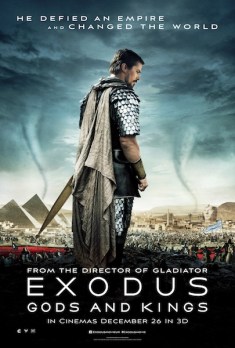 For his most recent historical epic, Ridley Scott tackles the story of Moses. It’s easy to nitpick, depending on your proclivities: whitewashed cast; lack of adherence to the Bible; Ridley’s typically flexible attitude to historiography; it was even banned in Egypt for the negative depiction of both rulers and slaves.
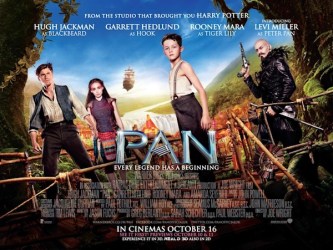 12-year-old Peter (Levi Miller) lives in an orphanage in World War 2 London… until the night pirates bungee in through the ceiling and kidnap a bunch of boys onto their flying galleon. Yes, really. From there it’s second star to the right and straight on ’til morning as the pirates take their new charges to Neverland, where they’re forced into the
  As said boy, Levi Miller manages to make Peter not intensely irritating, which is an achievement compared to other adaptations. Some of that is surely inherited from the writing and directing, but Miller gives a strong performance too. Hugh Jackman hams it up magnificently as Blackbeard, clearly having a riot. Rooney Mara may be miscast due to the colour of her skin (for all the complaints about whitewashing, her tribe is shown to be mixed race… which doesn’t necessarily excuse it), but her actual performance is very good. I felt like Garrett Hedlund was doing an impersonation of someone but I never quite got a handle on who (the character’s definitely written to be Han Solo, but the actor’s not copying Harrison Ford). Adele Akhtar brings comedy as Hook’s chum, Sam ‘Smee’ Smiegel, there are cameos of varying purpose from Amanda Seyfried and Kathy Burke, and Nonso Anozie is always a welcome presence, here playing Blackbeard’s henchman. Cara Delevingne doesn’t act so much as provide a human reference for the CGI.
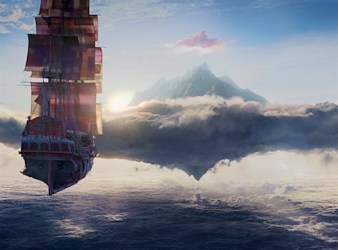 Having found Pan to be a very likeable fantasy adventure, I confess to being slightly confused by the response that saw it soundly trounced by most critics and viewers. The
  or Disney’s, aside from my aforementioned aversion to the eponymous hero), so I was perhaps more open to this Epic Fantasy reimagining. (In that last respect, it definitely falls into the same bracket as
 The director of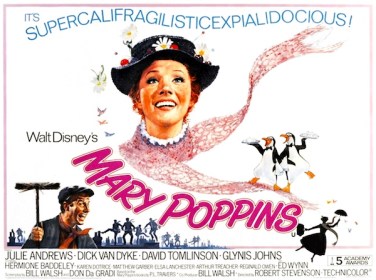
 Score:



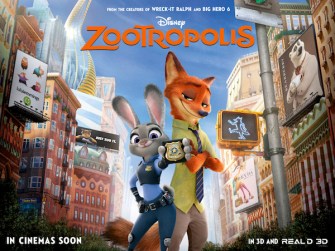 Disney’s 55th Animated Classic is their second highest-grossing ever, the 25th film to take over $1 billion at the worldwide box office, which makes it a hit of
  I think Zootropolis may be the first time they’ve attempted a neo-noir crime thriller, though. And I bet no one ever thought they’d see a Disney film with a sequence set at a nudist resort. Or in a drugs lab, for that matter. Or one with a substantial parody of
  However, that’s not to say kids can’t get enjoyment out of it: there are plenty of colourful characters and locations, relatable situations, cross generational humour, and a moral lesson young’uns will understand. There’s the DMV sequence, for instance, which is grounded in an adult experience but so funny it must cross over. Considering all the praise I’ve heard for that one scene, it’s also a feat it lives up to the hype. It’s gorgeously animated throughout, bolstered by a world that has been magnificently realised, with all the different themed districts of the city. (After all the Disney movies that have had contrived TV series spin-offs, this is a film that actually feels like it deserves one. The setup is obvious — a police procedural — and the world the film suggests is big enough to warrant it. Heck, it practically demands it — there’s so much more of this world, you want to see it explored.) Michael Giacchino’s score is different too: memorable and fun, in part thanks to using a cornucopia of unusual instruments to provide a ‘world music’ sound that’s in-keeping with the movie.
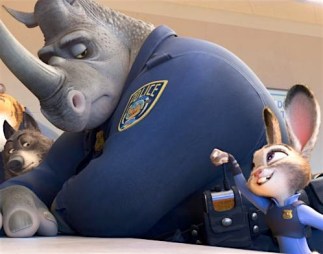 too, but that doesn’t mean the journey getting there is any less fun.
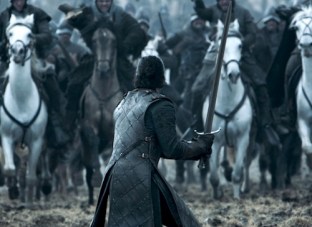 GoT produced two of its greatest-ever episodes to conclude this season. Actually, that’s arguably an understatement: based on IMDb votes, if nothing else, Thrones produced two of the best episodes of TV ever made. But what do IMDb voters know? Well, more than some people give them credit for. Obviously everyone has different tastes, but for the genres Thrones operates in — and, in some instances, even transcending those — these are incredible hours of TV. Episode 9, Battle of the Bastards, is surely one of the most thoroughly-realised medieval-style battles ever depicted on screen: the scale is epic, the strategy is clear, the feeling of what it’s like to be in the thick of that environment is palpable. How it turns out may have been predictable, but something being predictable is not the same as it being bad — not everything needs to be a twist.
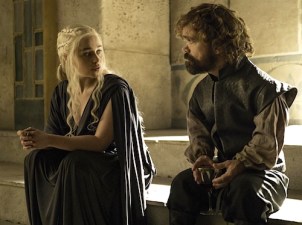 As for the forthcoming seventh season, it’s pretty clear we’re now entering the show’s endgame — though we’re going to have to wait even longer for it, with the next season set to have a later-than-normal premiere and the final end not coming until the season after that. It’s going to be an excruciating wait, but if they can maintain the form displayed throughout season six, it’ll be worth it.
 This is done and dusted Stateside now, but goodness knows when Channel 5 will choose to ‘officially’ air it over here, so I’m just getting on with it. I used to despise most of PoI’s arc plots and often wished it would stick to being just a pretty cool vigilante procedural; but at this point, it’s so invested in the epic Super-AI vs. Super-AI sci-fi storyline that any attempts at case-of-the-week episodes feel like a waste of time — especially when this truncated season is fast approaching the show’s final end. I really hope it comes to a proper conclusion, because there’s too much going on here to let it end forever on a cliffhanger. (Obviously that answer’s now out there, but naturally I’m avoiding spoilers.)
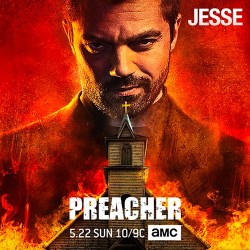 I’m a bit behind on this at the minute (the latest episode was the eighth), but, as of the halfway point, it’s definitely settled into its own skin — or maybe it was always settled there, but it’s taken time for viewers (or this viewer) to get past the expectations brought as a reader of the comic books. It’s still far from being a literally faithful adaptation, carving out its own path from some of the comic’s building blocks, which makes it an odd and hard-to-judge work if you have read any of the original. Still, it’s an entertaining series, and people involved keep talking about this season being something of a prequel to what we saw in the comic, so maybe the already-commissioned season two will feel more recognisable.
 This month, I have mostly been missing stuff I don’t even know I’m missing. By which I mean, I haven’t been paying enough attention to the TV schedules to know what I’ve missed. The BBC’s supernatural drama The Living and the Dead sounds kind of interesting; I know Mr Robot is back, not that I ever got round to season one; plus The Musketeers continues (though I hear it’s gone off the rails this season); and I keep hearing vaguely good things about Netflix’s new series, Stranger Things, like that it’s a cross between Steven Spielberg and Stephen King, or The Goonies mixed with The X Files… which just reminds me that I need to get round to seeing The Goonies someday.
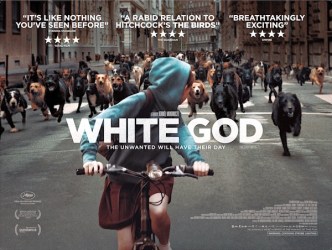 Thirteen-year-old Lili (Zsófia Psotta) and her dog Hagen are forced to temporarily live with her father, Dániel (Sándor Zsótér), because her mother is going on holiday with her new partner. Dániel doesn’t like Hagen anyway, but when the dog’s behaviour causes problems for him, he sets Hagen loose on the streets. Already angry with her father and his attitude, a devastated Lili sets out to find her beloved dog, who is busy discovering the darker side of mankind and our treatment of animals.
 For all the toughness of the journey, where it leads is triumphant; not entirely so, I must add, but enough. The film’s third act can pithily be described as Rise of the Planet of the Dogs: having seen the abuses of humans, an impounded Hagen leads a canine uprising that seeks to… well, they don’t speak (they’re dogs, remember, and this isn’t Disney), so who knows what their precise aims are? “Revenge” would be too cruel, but they definitely seeking some retribution. The film’s sadness doesn’t disappear (hence why not entirely triumphant), but some wrongs are righted.
 Some will find the middle of the film a slog, I suspect, both emotionally and with its occasionally lagging pace. However, the bookends seek to justify it. There’s catharsis in the finale, as described, but even better is the film’s opening. It has to be seen to be properly understood, but it’s operatically scored, shot, and edited, and involves hundreds (literally) of trained dogs en masse. It’s spectacular, unforgettable moviemaking; perhaps even one of the best openings to a film ever. And I don’t say that just as a “dog person”.


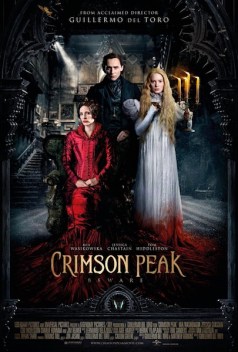 Mia Wasikowska stars opposite a British thesp best known for playing a comic book villain and a red-headed repeat-Oscar-nominee, in a Gothic drama-thriller from an acclaimed non-Anglo director? That’s a description of
  The story actually concerns Edith Cushing (Wasikowska), a well-to-do businessman’s daughter in upstate New York who is occasionally haunted by ghosts. She falls for visiting English gent Sir Thomas Sharpe (Hiddleston) and, long story short, moves with him and his haughty sister Lucille (Chastain) back to their crumbling — literally — pile in the English countryside. The house hides many secrets, and ghosts, too. Having said it’s not a horror movie, it would be unfair to class Crimson Peak as simply a tame drama — as you’d expect from writer-director Guillermo del Toro, those ghosts can be bleedin’ scary, and there are certainly a smattering of good old fashioned jumps to boot.
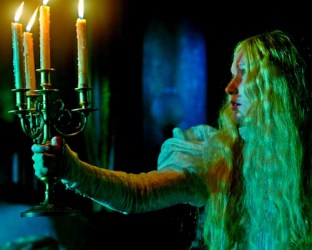
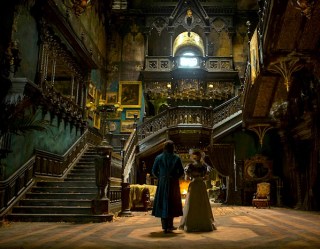 Whatever one’s thoughts on the story and tone of the film, it can’t be denied that its technical merits are extraordinary. Every inch of the design work is gloriously imagined, and the cinematography — the lighting in particular — is spectacular. And that gigantic house set…! And the climactic ‘limbo’ set, too — incredible work. (That’s not a spoiler, incidentally: it was the set’s nickname, not its literal location.) The ghost effects are excellent too — original, creepy, and executed in a way that blurs the lines between make-up, animatronics, and CGI. It’s a shame the film as a whole wasn’t better received, because I imagine that’s all that held it back from numerous awards-season nods.
 100Films.co.uk