
David Fincher | 158 mins | Blu-ray | 2.40:1 | USA, Sweden & Norway / English | 18 / R
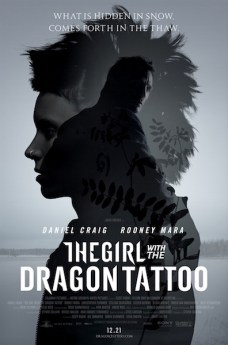 Stieg Larsson’s much-hyped novel comes to the screen for the second time in David Fincher’s much-hyped English-language re-adaptation. Somewhere between the pre-release build-up (do you remember the fuss over the trailer’s release? And all those magazine covers and articles?) and now, something clearly went awry: its UK TV premiere back in March was buried mid-week on ITV2.
If you’ve read or seen a previous version then you know the story, which hasn’t succumbed to a massive reworking for the American remake — it’s still set in Sweden, even. If you don’t, it sees disgraced journalist Mikael Blomkvist (Daniel Craig) being invited by the patriarch of the rich Vanger family (Christopher Plummer) to investigate the murder of his beloved niece, which happened 40 years earlier. At the same time, we follow the trials and tribulations of Lisbeth Salander (Rooney Mara), a troubled twenty-something hacker who must contend with abusive guardians, before eventually teaming up with Mikael to close his investigation. The novel’s original title translates as Men Who Hate Women, and that’s a pretty succinct summary of the grim, violent, nasty places the stories take us.
After an aside into magical character drama and big-business thriller, Fincher has moved back towards more familiar stomping ground here: a boundary-pushing thriller with themes so dark many wouldn’t want to touch it. It also followed hot on the heels of the well-received Swedish screen adaptations of the novels, another reason to stay hands-off; doubly so given that this sticks equally closely to the source novel. The merits of the various versions can be debated ad infinitum, naturally. I’ve not read the novel so can’t compare, but reportedly the Swedish film’s characters are more like those in the book and the plot is even more closely adapted. That said, to a casual viewer, the two films feel very similar in terms of story and character. 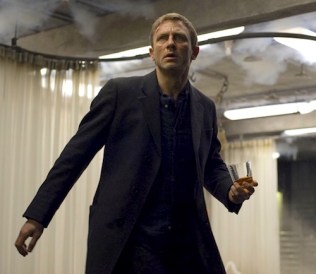 There are certainly changes, but nothing especially major. For example, the ending has been tweaked — not “completely changed”, as some reports had it, but just streamlined slightly. Some will struggle to even remember the difference if their experience of a previous version was long enough ago. Die hard fans, however, seem to regard it as a massive re-visioning of events. It isn’t.
I could go on with this comparison, but there are plenty enough articles to do that already, and I don’t really want to. Yet it’s quite a hard thing to avoid, purely because the two films materialised so close together. Even distant remakes invite comparison, but when they come out virtually back-to-back it just emphasises the point. So too the fact that the Swedish films were widely and readily available, and that they were acclaimed by both critics and audiences, not cheapo idiomatic versions before the big-budget American one came along. Indeed, though I called it boundary-pushing earlier, few boundaries feel pushed because it’s so close to the Swedish version. Of course, in and of itself — and if you’ve not seen the foreign-language film — there’s a lot of shocking, extreme stuff here. Even for the director who gave us Se7en, this is at times pitch-black material.
And that there is another comparison that dogs the film: Fincher’s previous work. However much of his own touch the director brings to proceedings — and he has produced an incredibly well-made film;  in particular, it’s beautifully shot, and there’s a vein of interest to be mined in discussing the fact it was consciously made using a five-act (as opposed to the usual three-act) structure (but not here today, sorry) — it feels unable to innovate or hone the genre in quite the way Se7en or Zodiac did. This is not a movie that will be remembered among the very top-level of his work.
Well, I say that — who knows? Enough films have been reevaluated with time in the history of film that you can’t ever quite be certain. At the moment, the context of comparing it to the Swedish film holds it back, but where that has Noomi Rapace’s performance as Lisbeth in its favour, this has the skill of David Fincher, not to mention a not-half-bad (indeed, Oscar nominated) Lisbeth from Rooney Mara, as well as a quality supporting cast. And the best use of Enya since at least Fellowship of the Ring. Then, from a personal perspective, Se7en and Zodiac are among my most-favourite films, so in that comparison battle Dragon Tattoo almost has a hand tied behind its back. Historical context hasn’t improved since, either, with Fincher’s follow-up being another morally-dark bestselling thriller adaptation, pigeonholing them (for some commentators) as a pair of Fincher-by-numbers placeholders until he comes up with something original again — if he ever does (as naysayers would proclaim).
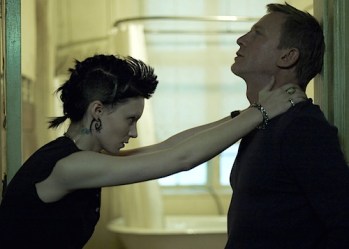 So my rating may come as a bit of a surprise given the focus of this review, which is primarily my fault for finding it so tough to shrug off all those contexts and comparisons. But hey, that’s something the film itself struggles with in many people’s eyes, too. If the viewer can divorce it from those ties, however, I think it’s still an exceptionally good thriller.

The Girl with the Dragon Tattoo is on ITV2 tonight at 11:10pm.
 Director Steven Soderbergh takes the methodology he used to depict the drug trade in
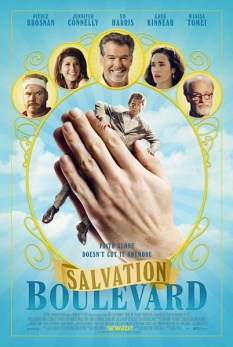 Reuniting Pierce Brosnan and Greg Kinnear, stars of comedy-thriller
  This is not the Salvation Boulevard that has ended up on film. I tried to hunt down an explanation for why co-writer/director George Ratliff had deviated so, but the best I could unearth was
  I shouldn’t have expected much given the poor reviews, but I like the cast (which also includes Ciarán Hinds and Marisa Tomei), I really enjoyed The Matador, and the trailer was suitably promising, all of which encouraged me to seek it out. I wouldn’t say Salvation Boulevard was an entire waste of time, but I couldn’t help but feel there was potential for a funnier, more cutting movie hidden in the material. Shame.
 Ten years after the events of
  Let’s start with some other reviewers’ problems. An oft-cited one is the initial moral repugnance of the characters, but is it a valid criticism to say a movie about a bunch of macho dicks presents its characters as macho dicks? Because let’s not be kidding ourselves, the American military is not full of Guardian-reading lefties; it’s full of vulgar, unreconstructed young Blokes… like these fellas. Now, I’m sure I’m generalising — I’m sure they can’t all be like this — but I can believe plenty of them are. No doubt elements of their behaviour are more “macho fantasy” than reality (a hookers and coke party the night before shipping out?), but the fundamentals of their attitude are plausible.
 And just as it looks like we’re about to get a truthful, if obvious, moment where the characters admit that, no, this war is utterly pointless and has absolutely nothing to do with America or keeping Americans safe, the first guy answers, “yes, I do.” Really? Really?! At that moment it just feels queasily like right-wing propaganda, especially as the two characters in question have been positioned as our de facto heroes.
 Later, in the war zone, there are more horrific situations and imagery that will certainly test your perspective. For example, the guys come across a school bus that was caught in an attack on some monsters. The bus is full of dead children, but our guys need to search it for water nonetheless. Is this unflinching in its realism of the brutality of war, or a step too far and just sick? Perhaps the sci-fi context again undermines the movie, because you can’t apply the “this is really happening” argument when there are giant monsters involved. But if the giant monsters are a MacGuffin to reflect real, current conflicts, then does this become something that is happening? Perhaps it’s a circular argument.
 Dark Continent is the debut feature of director (and, here, co-writer) Tom Green, who previously helmed half-a-dozen episodes of E4’s excellent “superheroes with ASBOs” drama
  I do think Dark Continent is better than most reviews give it credit for, but it’s not exactly a movie of the greatest or most original insight, and — their added visual interest aside — it didn’t need to be a Monsters movie. Indeed, if it had just been a straight Middle East war movie, perhaps some critics would’ve been kinder, because at least they would’ve known what they were getting. If you liked the first film then there’s absolutely no guarantee you’ll enjoy this — it’s not the same kind of film at all — but the worst sequel of the decade? Not even close.
 Paul Thomas Anderson — the fêted writer-director of
  Anderson chooses to realise the movie mostly in long, unbroken takes, which not only lets the photography shine, but also allows his cast free rein to construct their own performances. I’m not sure how much that pays off, but it’s certainly not a hindrance. Turns from the likes of Josh Brolin and Martin Short border on the memorable, though your mileage will vary on if anyone truly achieves it, with the possible exception of Katherine Waterston, who surely deserves more — and more prominent — roles. Other recognisable faces (Jena Malone, Eric Roberts, Reese Witherspoon) are wasted in one- or two-scene appearances, which I suppose we could kindly call cameos.
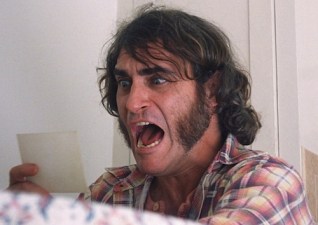 I am in neither of those groups, however. The aforementioned fleeting aspects of quality weren’t enough to swing it for me either. Sadly, I’ll be chalking this up alongside
 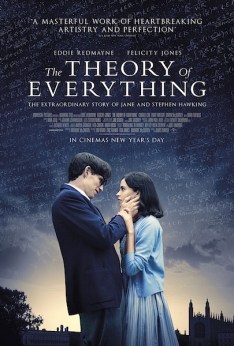 Biopic of genius cosmologist Stephen Hawking and his wife/caregiver Jane, on whose memoir the film is based.
 Nine months on from its theatrical debut, I’ve managed to remain remarkably spoiler-free about Interstellar, the ninth feature from director Christopher Nolan. “Matthew McConaughey lives on a farm and somehow ends up in space with Anne Hathaway,” is about all I knew going in. That and the somewhat divisive critical reception it had received, leaving what many had assumed could be an Oscar favourite with a disappointing tally of nominations (and its studio to have backed the wrong horse, resulting in
  More plot happens. Interstellar is the kind of film where you could get an awful long way through the story just trying to explain the setup. That’s a certain style of storytelling, and in its own way a positive one — a plot that is constantly moving and updating, rather than one that presents a basic setup, runs on the spot with it for a while, then wraps it up. The latter is how most narratives unfold, which is why reviews can so often summarise said setup and that’s fine. Nonetheless, Interstellar’s first act goes on too long, and could do with a good trim. (For an alternative view on why the first act is in some respects the best part of the film and needed more development, read
  Based on a skim through online reaction, some viewers would indeed love even more, while others would despise it. One thing I find interesting about this apparently diverse reaction is that you can find an abundance of negative/semi-negative comments and reviews by people who write such things, but nonetheless the average user scores on the likes of
 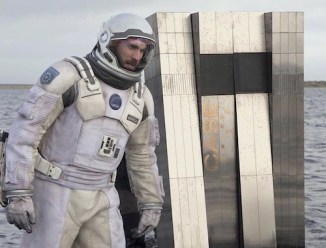 From a filmmaking perspective, there is surely nothing to fault. The visuals are incredible. As you’d expect, the IMAX footage looks absolutely stunning. Every time the Blu-ray reverted back to 2.40:1 I was a little disappointed. A sneaky part of me thinks Warner deliberately make these sequences look less good to ramp up the quality of the IMAX footage (I felt the same about
 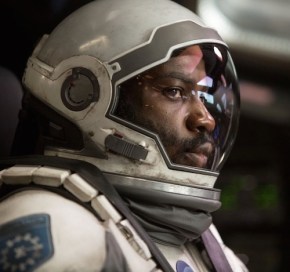 Anne Hathaway is largely understated, but slivers of emotion seep through when appropriate; and Michael Caine actually gets to do a bit of Acting in a Nolan film for a change, rather than just turning up as a wise old dispenser of exposition — though don’t worry, he does that too. One of the stand-outs for me was David Gyasi, getting a role that was subtly stronger and more thought-provoking than several of his more famous colleagues, and executing it with aplomb too. Similarly, the voices of semi-sentient robots TARS and CASE — Bill Irwin and Josh “he’ll always be ‘that guy from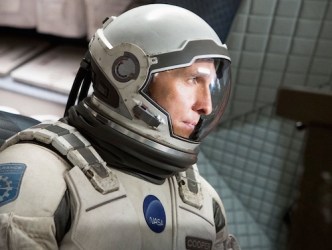
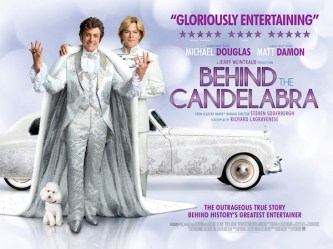 Steven Soderbergh’s supposed last-ever film (or, if you’re American, Steven Soderbergh’s first project after he supposedly quit film) is the story of Scott Thorson (Matt Damon), a young bisexual man in the ’70s who encounters famed flamboyant pianist Liberace (Michael Douglas) and ends up becoming his lover, which is just the start of a strange, tempestuous relationship.
 It looks great, too. The film, that is, not Rob Lowe’s face. The design teams have realised an excellent recreation of the period, which is then lensed with spot-on glossy cinematography by DP
  2013 Academy Awards
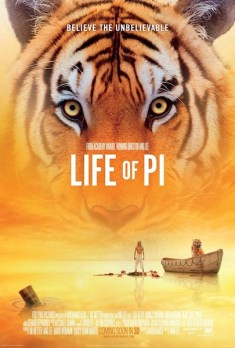 “Unfilmable” — now there’s an adjective you don’t hear tossed about so much these days. For a long time it seemed like it was all the rage to label novels “unfilmable”, but at this point too many ‘unfilmable’ novels have been filmed, and the wonders of CGI have put paid to anything ever again being unfilmable for practical or visual reasons. It may still be an apposite descriptor for works that feature very literary storytelling, though if you can render something like the subjective and unreliable narrator of
  but because of almost-indefinable features of each shot’s crispness, its depth of field, even the compositions. It absolutely works in 2D, and it didn’t leave me longing for 3D in quite the same way as something like the swooping aerial sequences of
 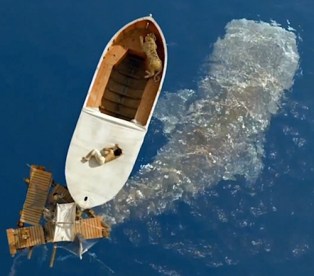 Later, the 4:3 “book cover” shot is just pure indulgence. There’s no reason not to just have empty sea to the left and right of frame, and the “it’s emulating the book cover!” reason/excuse doesn’t come close to passing muster simply because book covers aren’t 4:3. In both cases, then, what was intended to be striking or clever or innovative or in some way effective, I guess, comes across as pointless and distracting and pretentious.
 Reading around a little online, it seems that some people have interpreted the film’s message as being a defence of/justification for/persuasion towards religious faith, and hate it for that. This interests me, because I — coming, I suspect, from a similar perspective on religion — read it as a subtle condemnation of religious stories. Actually, not a condemnation, but a tacit acceptance of the fact that such stories are a nice fairytale, but not the truth. To put it another way, I took the message to be (more or less) that religion is an obvious fiction which people choose to believe because it’s a nicer story than the more plausible alternative, neither of which are provable. I think some focus on the point that the journalist hearing Pi’s story is told it will make him believe in God, and, at the end, the journalist seems to accept that it does. I don’t think that’s the film’s contention, though; I think the film is, in a way, explaining why people believe in God. Or maybe there are just no easy answers.
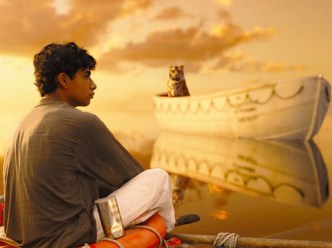 I found Life of Pi to be a little bit of a mixed bag, on the whole, where moments of transcendent wonder-of-cinema beauty rub up against instances of thumb-twiddling; where insightful or emotional revelations rub shoulders with pretentious longueurs. There is much to admire, but there are also parts to endure. The balance of reception lies in its favour, but while some love it unequivocally, a fair number seem to despise it with near-equal fervour. Either way, it’s definitely a film worth watching, and in the best possible quality you can manage, too. It also made me want to read the book, which for a movie I wasn’t even sure how much I liked is certainly an unusual, but positive, accomplishment.
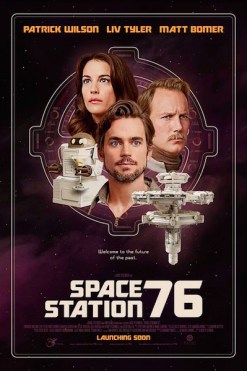 Liv Tyler is the new first officer on a space station commanded by Patrick Wilson in this retro-future-styled film, which is both a spoof of/riff on ’70s genre movies, and a character drama about people’s relationships. No, really.
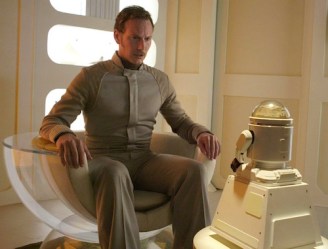 used to feed into the humour, that’s simply what makes it, a) a period movie (just a period movie set in the future), and b) a comedy-drama (as opposed to a drama). I think this is the real reason for its lowly regard on sites like IMDb: those expecting Anchorman in Space are going to be disappointed; but you can’t blame anyone for such expectations when that’s more-or-less how it’s trailed.
 The characters and their relations are well enough drawn to make it passably engrossing, even if not a stand-out contribution to any such genre, while the comedy pays off handsomely at times.
 100Films.co.uk