2015 #141
Carol Morley | 102 mins | streaming (HD) | 1.85:1 | UK / English | 15
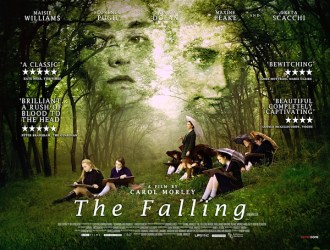 Inspired by real events, The Falling stars Game of Thrones’s Maisie Williams as Lydia, a 1960s teen with an awkward home life who is a student at a repressive girls’ school. She’s best friends with the popular and charismatic Abbie (newcomer Florence Pugh, next to be seen as the lead in Lady Macbeth (which seems to have bugger all to do with Shakespeare)). When Lydia starts fainting for no apparent reason, it leads to a fainting epidemic at the school that no one can explain. Is it caused by illness? Fakery? Something psychological? Or possibly even some kind of dark magic?
On Amazon Instant Video (where it’s available free to Prime subscribers from today), The Falling is billed as “a mesmerising psychological drama”, which isn’t too wide of the mark. However, presumably because of the prominent pentagram on the cover image there, all of the “customers also watched” recommendations are called things like The Exorcism of Molly Hartley, The Houses of Halloween, Haunt, Demonic, and Sinister House, or are other obviously-cheap-trashy-horror-looking films with less blatant names (like The Canal, Awaiting, and Robert (chilling!)). No wonder it has a low user rating if it’s a “psychological drama” being mainly watched by people who choose to pay to watch that kind of low-rent horror crap!
The Falling is certainly not low-rent horror crap. Is it a horror movie? Not really — there are no monsters, no jump scares, none of the obvious tropes; but it does have a distinctly unnerving air a lot of the time, and there are definite references to and hints about some kind of mysticism playing a role. It’s often incredibly atmospheric, with some beautiful cinematography courtesy of DP Agnès Godard and effective editing by Chris Wyatt.  Writer-director Carol Morley has kept the pace and tone slow, in an enchanting rather than ponderous fashion, but it’s a “not for everyone” pace nonetheless. For me, it only really lost its way as it moved into its final stages. Without wanting to spoil where it goes, in my opinion too much was explained, but at the same time it explained nothing.
Indeed, I feel it might’ve fared better overall if it had stuck with the magical-realist / folk horror / olde-worlde magik styles it veers towards early on. But then Lydia says she’s a rationalist, and I suspect Morley is too, and so they well know that such things as spells and lay lines have no bearing on the real world. If one wants to present the possibility of a real-world explanation for the film’s events — and, as they were inspired by actual events, I presume Morley does — leaving things at “because magik” isn’t going to cut it.
The immediately obvious explanation — certainly as far as the school’s teaching staff are concerned — is that the girls are faking for attention. One comment-review on a website asserts that “one of the central questions of the film is whether or not the girls were faking their illness,” before going on to outline how this could’ve been improved to make the film into an “entertaining thriller”. I think this is a prime example of reviewing what the reviewer expected or wanted rather than what they were given, because it didn’t seem to me that the issue of fakery was the “central question” here. Of course, that’s only my interpretation of the filmmaker’s intent, so no more or less valid than this other commenter’s; but I really don’t understand how you can watch The Falling and think it was anyone’s goal for this film to be considered an “entertaining thriller”. It’s simply not that kind of movie.
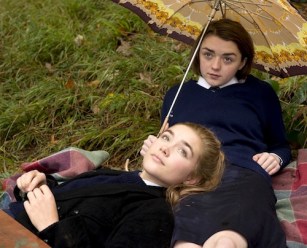 An element I do think was at the forefront of consideration is sensuality and sexuality, which plays a large and significant part in the film. Pretty much any movie bar “bawdy high school comedies starring obvious twentysomethings” seems to veer away from schoolgirl sexuality these days, wary of inevitable “OMG u a pedo” reactions, I guess. Sexuality does not equal pornography, though; and, as I alluded, here it’s played out as much through a heightened, tactile sensuality. It does probably ‘help’ that it’s a film written and directed by a woman — it would carry a very different, more Lolita-ish air if it had been written or directed by a man. What exactly it’s saying with all this is arguably as mysterious as the cause of the fainting epidemic, but then it’s all tied together: teenage years are a period of sexual awakening, of course, and if you’re in an environment where nearly everyone is of the same gender, and where such things are massively repressed… well, how is it going to manifest itself? If “sex” is somehow the cause of the fainting, it’s not because sex is bad, it’s because there’s no other appropriate outlet for it.
Or maybe that’s got nothing to do with it at all.
A lot of this has to be carried on the shoulders of a relatively young cast, but all are capable. Maisie Williams is by far the best known of the girls, though viewers of Ripper Street will recognise Anna Burnett. She was good in the Victorian detective series, but she’s even better here. Williams gives a strong performance too, afforded the ability to show some range and variety from Arya Stark (unlike her appearance in the currently-airing Doctor Who two-parter-that-isn’t, for instance). There’s also a quality adult supporting cast, including the likes of Maxine Peake (in an initially quiet but ultimately key role), Greta Scacchi, and Monica Dolan, while Peaky Blinders’ Joe Cole acquits himself well in the subtly complex role of Lydia’s brother.  Best of the lot, however, is Florence Pugh. Reportedly discovered when The Falling’s casting directors visited her school, you can see why she’s quickly been snapped up for a leading role. I wouldn’t be surprised if Hollywood come knocking looking to make her the next Kate Winslet/Keira Knightley/Gemma Arterton/etc “English rose”-type lead in some blockbuster or other.
The Falling is an odd film, really; though in many respects that shouldn’t come as a surprise. Some will love it; many will despise it. Personally, I felt a lot worked very, very well, but the bits that didn’t, well, didn’t. For what it’s worth, I ranked it 3.5, aka 7, on sites that have half-stars or are out of ten. It would’ve been a solid 4 if not for those niggles, but equally they’re not so bad to drag it down to a 3. Some viewers seem to put the niggles aside entirely and push it up into the 4.5 or even 5 margin; for others it doesn’t work at all, dragging it down much lower. Everyone’s reaction to any film is completely subjective and personal, obviously, but this is the kind of film where it’s more true than others — you can’t pigeonhole it like you can a superhero actioner, or a rom-com, or, well, most movies, to be honest. It’s part high school coming-of-age drama, part supernatural thriller, part kitchen sink drama, part arthouse tone poem. How well that uncommon mix works is entirely down to the individual viewer’s personal predilections.
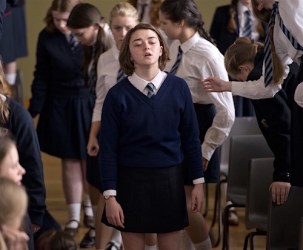 For me, it’s the kind of film that, with time and subconscious reflection, I may come to remember more fondly and be keen to see again, or all but forget. It’s the kind of film I could, without even re-watching it, re-evaluate and want on my year-end top ten, or could see on my top ten contenders long-list come January 1st and wonder, “dear God, what was I thinking?!” It’s the kind of film I’m not sure I wholly liked, but I’m glad I’ve seen.
As mentioned, The Falling is available on Amazon Prime Instant Video from today.

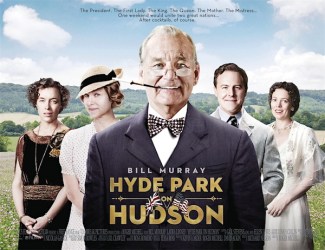 Wannabe-prestige picture Hyde Park on Hudson is like two films playing at once: the dramatic/romantic story of President FDR’s (Bill Murray) burgeoning affair with his distant cousin Daisy (Laura Linney), and the comedy-drama of his meeting with King George VI (aka “the one Colin Firth played in The King’s Speech”; here, Samuel West) and Queen Elizabeth 1.5 (Olivia Colman) in the build up to World War 2, at a time when America really didn’t want to get involved.
 For what it’s worth, the film was born of the discovery of Daisy’s letters and diaries, which told of the relationship. Apparently the screenwriter was one of the people who found these, so I guess that’s where his interest lies. The film is a UK production from Film4, however, and made in the wake of the global success of The King’s Speech, so perhaps that explains the root of the royal involvement. While both stories have some potential, they aren’t made to gel, switching back and forth as if in some kind of narrative relay that enables the film to run a theatrical distance.
 with vibrant colours evoking a place of sunny happiness, but anything set at night is graded with a terribly extreme, not to mention awfully rote, case of teal-and-orange.

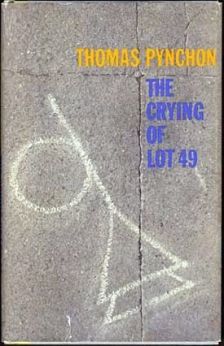 After watching
  It’s probably not fair to judge The Crying of Lot 49 by normal moviemaking standards. As a high school project to summarise a novel in a few minutes of video (which it may or may not be), it’s probably alright. Otherwise, though, it’s not worth the seven minutes; not even for die-hard fans of the author and/or novel. It is, you might say, a W.A.S.T.E. of time. #injoke
 Screened at the London Film Festival earlier this month, then made available on MUBI in the UK (where you can, if you want,
  That’s the whole movie, more or less. I haven’t spoiled it for you because you’re not going to watch it because why would you? There is no discernible story or meaning; there is no characterisation; there is nothing but imagery and snippets of moments that signify nothing. It is a movie that has deliberately left out any explanations. Apparently the director has said it’s all a criticism of global capitalism, or something. Even with that extra-filmic information, it’s still difficult to ascertain much meaning. This isn’t realism — this isn’t avoiding “hello, person who is my brother” dialogue — this is obtuseness for obtuseness’ sake.
 Screenwriter Peter Morgan (of
 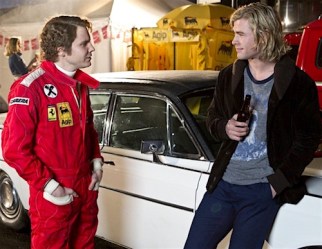 I presume the point of engaging with their personal lives away from the track was to add depth; to make sure it was a two-hander, rather than just about one or other of the drivers, and to ensure Hunt wasn’t just two-dimensional. However, without any growth on his part, or even some kind of active change, he’s just as flat, only now the star of some pointless scenes.
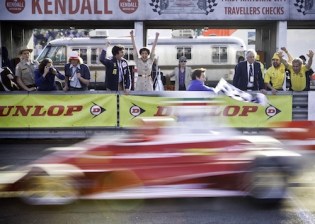 If that narrative fits snuggly into familiar plot beats, what are you meant to do? Change the truth to make it less like fiction? That’d be a first. Saying that, I’m taking it on faith (based on comments in the making-of) that the true story was so perfect you wouldn’t believe it if it had been fiction. Maybe they did streamline it. But assuming it’s real… well, it’s not the filmmakers’ fault if life imitates art.
 All in all, I’m a little surprised how well-liked Rush is. I mean, as of posting it’s at #162 on
 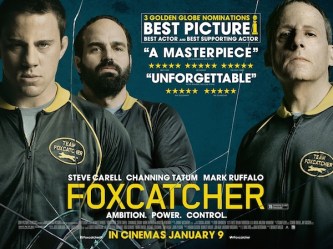 The director of
 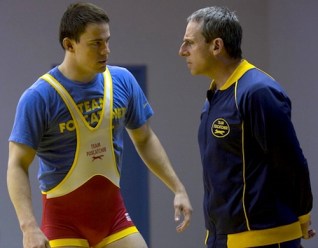 Fortunately, it has three leads who are up to carrying a narrative of that nature. In a rare dramatic role, and lumbered with a hefty prosthetic noise, Carrell’s John Du Pont almost feels like a caricature rather than a plausible human being… but apparently the film has actually toned down how odd the man was, so what are you gonna do? It’s a memorable performance none the less. Tatum is an understated lead, demonstrating he’s a better actor than you might expect as he displays emotional complexities in a man who doesn’t seem especially emotionally complex. Showing a character struggling with feelings he probably doesn’t quite understand is quite a feat, especially when it’s not explicitly conveyed in dialogue, so applause for Tatum there. Ruffalo, meanwhile, provides typically strong support, embodying a wrestler — right down to a very specific, unusual way of carrying himself — from the guy who plays Bruce Banner rather than the Hulk.
 making one wonder if anything the film may suggest is consequently wide of the mark.
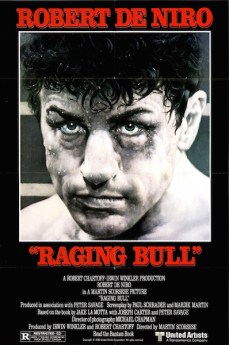 It would be boring if we all liked the same stuff, wouldn’t it? I’m sure there’s at least one ‘universally’-loved classic that we each dislike. Heck, tends to be every ‘universally’-loved classic has at least one Proper Critic that dislikes it. The flip side of this is that, in my opinion, if you don’t like something that everyone else does, there’s a fair chance it’s you who’s missing something. That’s a rule I apply to others, naturally, but I also try to bear it in mind myself (and, at the risk of sounding terribly arrogant, I think a few more people could do with thinking the same).
 The aforementioned fights, on the other hand, are full-on Cinema, and glorious for it. The make-up is also very good. Relatedly, De Niro’s physical transformation, from lithe boxer to washed-up fatso, is remarkable. Decades before the likes of Christian Bale and his
 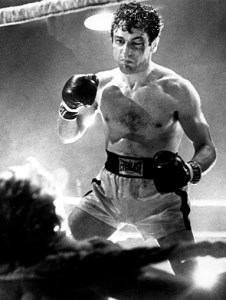 Based on where we find him at the end, I guess LaMotta would appreciate a Shakespeare quotation. For all the film’s “greatest of all time” acclaimedness, this is the one that came to my mind:
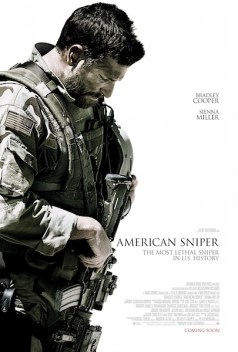 Politics aside, American Sniper is an adequately-made film. Eastwood’s direction is at best workmanlike, at worst laughably clichéd. Jason Hall’s screenplay rehashes better movies’ insights into the mental effects of war on combatants. Neither elicit much excitement from a half-arsed sniper-vs-sniper storyline. The film belongs to a bulked-up Bradley Cooper, who
  On the day marshal Will Kane (Gary Cooper) marries his young bride Amy (Grace Kelly), hands in his badge and plans to leave town, word reaches Hadleyville that a criminal he arrested, Frank Miller (presumably Will read
 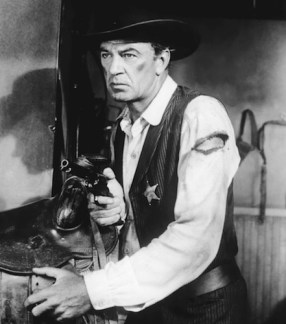 Some would contend it’s impossible to engage with High Noon and ignore that political allegory; others, like Mike at
 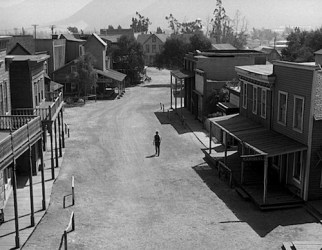 To top it all off, the film takes place in near-as-damn-it real time. Regular readers will know this is a plus for me, for reasons I still can’t quite fathom. In a narrative such as this, however, it only adds to the tension: you know it isn’t going to jump from 11:30 to the titular time, for instance — you’re going to live every one of those minutes with the characters; that’s exactly how much, or little, time Will has left to get ready.
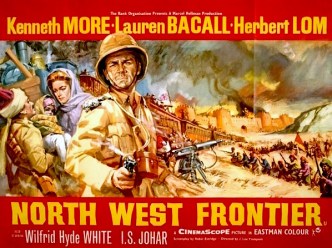 British Army Captain Scott (Kenneth More) is charged with getting an Indian child prince and his American governess (Lauren Bacall) to safety as rebels attempt to murder him. With the palace under siege, their only hope is a barely-ready rust-bucket train engine, a single passenger carriage, and a long journey through enemy territory joined by a motley group of diplomats and hangers-on who’ve bargained their way on to this last train.
 on the train by her governor husband, and Eugene Deckers is an arms dealer, who consequently no one likes but who remains unashamed of his trade. Through this prism there’s some discussion of the merits or otherwise of the British Empire and Indian independence, which some will judge to be extolling old-fashioned values, and others will take as little more than a (probably unnecessary) hat-tip in the direction of real politics.
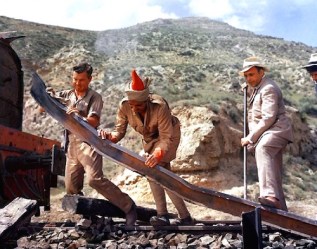 North West Frontier, on the other hand, sounds like a Western — which was perhaps the intention: the film’s structure and story style is fundamentally a fit for that genre, albeit British-made and geographically relocated. The storyline immediately brings to mind John Ford’s
  100Films.co.uk