The Grandmaster (2013)

aka Yi dai zong shi

2015 #160
Wong Kar Wai | 109 mins | streaming (HD) | 2.35:1 | Hong Kong & China / Mandarin & Cantonese | 15 / PG-13
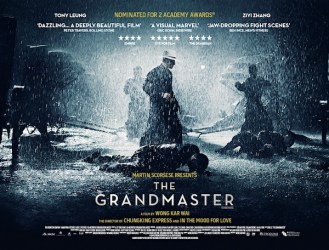
As a Western viewer, if you know anything about Ip Man beyond “he’s the chap who trained Bruce Lee”, it’s probably thanks to the pair of eponymous biopics starring Donnie Yen (soon to become a trilogy). Heck, if you know that much there’s a fair chance it’s due to those films. This take on the man, directed and co-written by Wong Kar Wai and starring Tony Leung as Ip, is tonally very different.

Some of the facts remain the same, naturally: Ip is a master of Wing Chung in Foshan, China, until the Japanese occupation ruins everyone’s lives. Post-war, he moves to Hong Kong and sets up a school there. Concurrently, there’s something about being the grandmaster of martial arts in all of China, or somesuch. When the previous incumbent is murdered by his disciple, the old man’s daughter, Gong Er (Ziyi Zhang), has revenge in mind.

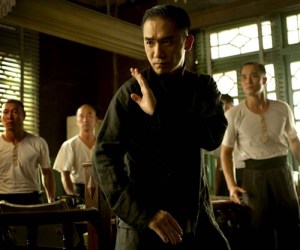
The Grandmaster is very much more an arthouse version of the story than the Ip Mans’ accessible action-movie stylistics, with elliptical storytelling and a carefully-measured pace, even in the action sequences. I’ve seen at least one review criticise Wong for leaning too heavily into ‘genre’ pictures — I guess that critic doesn’t actually watch too many genre pictures, because a good number of genre fans criticise this for being too arty. It is more “arty” than “genre”, even given its inclusion of numerous fantastic fight scenes. The duels are stunning, though pure adrenaline-junkie viewers seem to find even those a disappointment. Well, they’re wrong.

It helps that it’s gorgeously shot. Ultra-crisp blue-black rain-soaked night time duels; rich golden hues in pre-occupation Foshan; cold bright-white snowy landscapes; a train platform fight that’s almost sepia-like. Between the photography and the ever-excellent action choreography of Yuen Woo-ping (The Matrix, Crouching Tiger, Kill Bill, et al), the film is immensely satisfying on a visual level.

One factor that may — or, as we will see, may not — have an effect on how the film fares beyond the purely visual is that there are at least three different cuts: a 130-minute original cut, a 122-minute international cut, and the 108-minute version released in the US by the Weinsten Company. “Ah,” you might think, “yet another Weinstein hack job.” Well, Wong himself says otherwise:

As a filmmaker, let me say that the luxury of creating a new cut for U.S. audiences was the opportunity to reshape it into something different than what I began with — a chance one doesn’t always get as a director and an undertaking much more meaningful than simply making something shorter or longer. The original version of The Grandmaster is about 2 hours, 10 minutes. Why not 2 hours, 9 minutes or 2 hours, 11 minutes? To me, the structure of a movie is like a clock or a prized watch — it’s about precision and perfect balance.

We always knew that we wanted to have a U.S. version that was a bit tighter and that helped clarify the complex historical context of this particular era in Chinese history, focusing further on the journeys of Ip Man and Gong Er. While the previous version was more chronological, adding narration and captions to explain certain plot points gave us the freedom to bring more life to moments in the characters’ stories. I also aimed to enhance the audience’s understanding of the challenges faced between North and South, especially during the Japanese invasion.

Well, the narration and explanatory title cards are at times useful, but at others feel heavy-handed. I guess that’s the result of them being added retroactively as an explanatory device — if Wong had felt that information needed to be in the film throughout production, I’m sure it could’ve been better integrated into the storytelling.
However you look at it, the other Ip Man films are undoubtedly more palatable to a mainstream audience. Does that mean they’re worse? No. Better? Not necessarily. But I don’t think The Grandmaster is all it could’ve been. It seems to run out of story and lose its way as it gets towards the end. The focus shifts entirely to Gong Er, and it feels less clear what it’s meant to about as a whole film. It becomes a movie of great moments, and maybe even scenes, but an unsatisfying whole. But oh, the images…

4 out of 5

This review is part of the 100 Films Advent Calendar 2015. Read more here.

The Fifth Estate (2013)

2015 #144
Bill Condon | 128 mins | streaming (HD) | 2.35:1 | UK & Belgium / English | 15 / R

It’s The Julian Assange Movie, in which Benedict Cumberbatch dons a lanky white wig and an Australian accent to portray one of the most significant figures of our times, whether you like it or not.

The story is told from the perspective of Daniel Berg, played by Daniel Brühl, who first encounters Assange in Germany and is somewhat captivated by him. Daniel helps Assange to really launch WikiLeaks, and is by his side through their early fame-garnering exposés. He functions a little as Assange’s moral compass, too, especially when they receive some stolen US military files relating to their controversial Middle Eastern exploits…

Cumberbatch’s performance is the showstopper here, and it’s been justly praised. It can seem a little over the top and affected, but then people who actually knew Assange say it’s bang on, so I think we have to take it that’s what he’s like rather than it being Cumberbatch overplaying. I largely rate him as an actor anyway, so he earns the benefit of the doubt. Brühl excels in the less showy role, however — much like he did in Rush, in fact, though even that role had its share of affectations to work with, which this part does not.

Daniel is torn between ‘saving the world’ and a love interest, played by Alicia Vikander, who is everywhere right now but I think this is the first time I’ve actually seen her in something. There’s nothing remarkable about her part, so I can’t really judge her. The same goes for the rest of the cast, where a wide array of starry and/or acclaimed names (Peter Capaldi, Laura Linney, Anthony Mackie, Alexander Siddig, Dan Stevens, David Thewlis, Stanley Tucci, Carice van Houten (who’s big in Belgium, it would seem)) don’t falter, but nonetheless struggle to make a mark when none are awarded anything meaty to do.

The rest of the film is unfortunately hit or miss. It begins with an absolutely fantastic two-and-a-half-minute title sequence that covers the whole history of human mass communication, from hieroglyphs to the internet and everything in between. It’s succinct, thorough, and excellent, probably the best thing about the entire movie. Elsewise, Bill Condon’s direction is a little rote. At times he seems to want to be clever and cutting edge, with on-screen tech and the visual representation of WikiLeak’s virtual office space, but it’s inconsistent, a grab-bag of tricks without a guiding principle. The rest of the movie is shot plainly. Not badly, just plainly; normally; almost old-fashioned-ly. Its directorial style doesn’t match the material. For contrast, look to David Fincher’s The Social Network, which also told the story of cutting-edge ever-so-now tech developments, but did so with filmmaking that could be described in similar terms.

Every once in a while the film interjects a US-set subplot that seems to go nowhere. The posters and trailers imply these American officials were people hunting Assange; instead, they’re relatively minor cogs in the political wheel who get caught out by what he does. They don’t seem to have any particular significance in themselves — they’re not famous, nor more wronged than anyone else — so maybe they’re just meant to be emblematic? As in, Laura Linney’s character is there to be representative of Assange’s effect, not the only person it happened to. Or was she the only person fired, and that’s the point? The film doesn’t make it clear.

In terms of understanding, it’s also very much a movie of Now. It assumes you know an awful lot of real-world context — essentially, the history of the last decade or two. Before too long, it’ll be a tough film for new viewers to follow or engage with without some kind of degree. Not everything should be made with an eye to its longevity, but one wonders how successful The Fifth Estate is in and of itself. It’s almost fiction-filmmaking as journalism: it’s about something that just happened — in some respects, is still happening — rather than an attempt to look back and explain those happenings in a historical context.

Indeed, one wonders how enlightening the film is in any respect. Assange is clearly a difficult person to get to know, by turns crusading hero and egotistical wannabe. That’s how the film depicts him, and if that’s accurate to life, well, that’s not the film’s fault — what’s wrong with having a primary character who isn’t a hero? Anyway, that’s the role Daniel is there to fulfil — he’s the honourable one; the one who’s actually invested in the site’s supposed values. But then the film is partly based on his book, so he would be the good guy.
In the end, this is an immensely complex story, with many different and contradictory sides to tell, and the film isn’t up to the task of covering them all. Great performances, though.

3 out of 5

This review is part of the 100 Films Advent Calendar 2015. Read more here.

End of Watch (2012)

2015 #111
David Ayer | 104 mins | streaming (HD) | 1.85:1 | USA / English | 15 / R

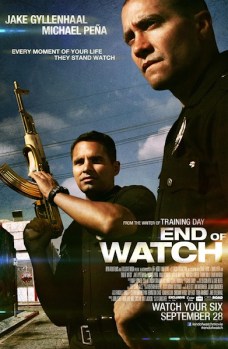
I don’t think anyone paid writer-turned-writer/director David Ayer much heed when he was one of a pack of people penning historically-inaccurate submarine thriller U-571, inadvertent franchise-launcher The Fast and the Furious, or TV-adaptation actioner S.W.A.T.; nor when he first turned his hand to directing with L.A. crime thrillers Harsh Times and Street Kings. He did have the claim-to-fame of having penned Training Day, though. But then there was this: a found-footage cop thriller starring a shaven-headed Jake Gyllenhaal, which found its way onto a variety of best-of-year lists back in 2012. At the same time, however, it has more than a few detractors. So which is it?

The film follows a pair of South Central beat cops (Gyllenhaal and Michael Peña) who accidentally get caught up in some kind of cartel drug war. That overarching element is so subtly fed in that many a viewer seems to have missed it entirely, instead just seeing the film as a series of episodic vignettes about the life of cops. That’s usually then levelled at the film as a criticism, but I think I’d like it more if that’s all it was. The huge scale of the villainy our leads unwittingly find themselves facing means they encounter increasingly grand crimes, at odds with the “everyday policing” feel of the documentary-esque camerawork and tone. It ultimately leads to an overblown and unrealistic climax that would feel more at home in a Die Hard sequel than a found-footage cop thriller.

Ah, found footage. Some despise it. I’m not sure anyone loves it. I don’t mind it, so long as it’s used appropriately. Here, the found footage aspect is abandoned literally as soon as it’s introduced, rendering it absolutely pointless. If Ayer had just shot the film handheld and up-close, it would wash as a stylistic choice; because he attempts a diegetic explanation for why it’s shot this way, but then breaks the rules of that explanation instantly (and continues to do so, with increasing frequency), it turns a valid stylistic choice into an irritating, ill-thought-out distraction. Plus: you want to be innovative and shoot an L.A. cop movie on digital video? Too late! Michael Mann already got there… in 2006.

Ayer at least sees fit to include a rather cool soundtrack. It’s location-appropriate, so not my kind of music generally, but it works… with the possible exception of Public Enemy’s Harder Than You Think, which for some British viewers is most familiar as the theme music to the Paralympics and topical comedy series The Last Leg. On the other hand, bonus points for including a snippet of Golden Earring’s Twilight Zone, thereby bringing to mind The Americans season two finale and its incredible use there. (Not enough people watch The Americans. If you don’t watch The Americans, you should watch The Americans.)

Also on the bright side, there are several excellent performances. The scenes of Gyllenhaal and Peña just driving around chatting are infinitely more enjoyable than the somewhat clichéd, under-explored crimes they have to deal with. As the cops’ romantic partners, Natalie Martinez and Anna Kendrick are very good when they’re allowed to be, but are too briefly on screen. That’s because the home-life side of things is just a subplot, but I think the film would’ve been more enjoyable if it had been 100 minutes just hanging around with the two officers and their families, all the crime palaver be damned.

Although there are things to commend End of Watch — in particular the performances, and even a couple of tense sequences when the filming style actually pays off — I can’t get on board with it being a best-of-year-type movie. Even if it could’ve been more — and, in spite of that varied CV, isn’t the best thing Ayer’s done (I very much liked his next movie, Brad Pitt WW2 tank movie Fury) — this isn’t a bad effort.

3 out of 5

This review is part of the 100 Films Advent Calendar 2015. Read more here.

Europa Report (2013)

2015 #158
Sebastián Cordero | 90 mins | streaming (HD) | 1.78:1 | USA / English | 12 / PG-13

Astronauts head to a Saturnian moon to examine its water in this scientifically-accurate drama.

The voluminous “special thanks” to space-related organisations shows how seriously the filmmakers took that accuracy, and it pays off in the exploration of some neat ideas. A faux-documentary style lends verisimilitude, as well as an effective “unreliable narrator”-style twist.

However, story construction is frustrating, jumping around in time merely to create mysteries out of thin air, a technique so forced it becomes irritating. It also fails to disguise that Sharlto Copley’s entire storyline is just padding.

Still, worth a look for fans of realistic near-future sci-fi.

3 out of 5

This drabble review is part of the 100 Films Advent Calendar 2015. Read more here.

The Swimmer (1968)

2015 #122
Frank Perry | 95 mins | streaming (HD) | 1.85:1 | USA / English | PG / PG

Magnificently strange film about a man (Burt Lancaster) who decides to ‘swim’ home through his friends’ pools. It becomes clear they know something he’s forgotten…

A strange air means this quickly begins to feel like a Twilight Zone-esque mystery, but it’s actually something else entirely… though to reveal too many secrets would spoil it. Lancaster is fantastic as an ultimately complex character, there are good supporting turns, and Frank Perry’s direction is evocative, though Sydney Pollack helmed one vital scene.

Now obscure and consequently tricky to see, The Swimmer is a forgotten gem that’s worth unearthing if the opportunity arises.

4 out of 5

I only know of The Swimmer thanks to the ghost of 82. His appreciation is very much worth a read.

This drabble review is part of the 100 Films Advent Calendar 2015. Read more here.

L’Atalante (1934)

2015 #138
Jean Vigo | 85 mins | DVD | 1.33:1 | France / French | PG

The only feature-length work of director Jean Vigo (though Zéro de conduite just qualifies for AMPAS’s definition of feature-length, being 41 minutes) before he died tragically young at 29, L’Atalante has been acclaimed as one of the greatest films ever made.

It wasn’t always thus. It was not well received at first, leading to a tumultuous release history. Previews were so poor that the distributor cut 20 minutes and released it as Le chaland qui passe, the title of a popular song at the time, which was of course added to the soundtrack. It translates as The Passing Barge, which is a very apt moniker, at least. Nonetheless, it was still a commercial failure. In 1940 it was partially restored, and after World War 2 its reputation began to be rehabilitated by critics, including becoming a favourite of the French New Wave directors. It was more thoroughly restored in 1990, and then again in 2001, bringing the film as close to its original form as possible.

Personally, my view hews closer to the original reception. Reportedly a French distributor called it “a confused, incoherent, wilfully absurd, long, dull, commercially worthless film,” while critics called it “amateurish, self-indulgent and morbid.” OK, maybe it’s not that bad, but there are nuggets of truth in there.

It boils down to a relationship drama, about a couple so in love that they married in haste and now must learn how to live together and reaffirm their love in a new context. That story is told with some asides to barge life that seem (at least to me, on a first viewing) wholly unrelated, but in themselves are frequently more entertaining, thanks primarily to the performance of Michel Simon as the barge’s older first mate.

The romance is told in a way many describe as “poetic”, which seems to me to be something of a euphemism for “obliquely”. There are certainly poetic shots or sequences, like Jean’s dive where he sees a vision of Juliette, but the actual narrative is more social realist — low-key, and not spelt out or expounded upon for our benefit.
At one time, L’Atalante must have been visionary, groundbreaking, and revelatory to both critics and other filmmakers. Over eight decades on, however, whatever was then new has been subsumed by filmmaking in general; it has become familiar, or been better employed by filmmakers who were finessing rather than experimenting. L’Atalante may well be a significant work in the history of film, and for that reason may once have been considered one of the greats (and still is by some), but for me, now, it doesn’t have enough merit as a work in its own right.

3 out of 5

L’Atalante was viewed as part of my What Do You Mean You Haven’t Seen…? 2015 project, which you can read more about here.

This review is part of the 100 Films Advent Calendar 2015. Read more here.

Force Majeure (2014)

aka Turist

2015 #174
Ruben Östlund | 120 mins | streaming (HD) | 2.35:1 | Sweden, France, Norway & Denmark / Swedish, English, French & Norwegian | 15 / R

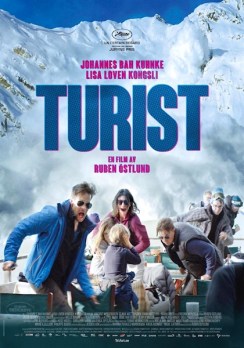
During a near-miss on a skiing holiday, a dad abandons his wife and kids. Cue days of passive-aggressive familial angst.

At its best, writer-director Ruben Östlund’s YouTube-inspired film (seriously — look at IMDb’s trivia) is a droll dark comedy. Told in wisely-deployed long takes that benefit the cast, there’s also gorgeous photography and a dramatic score courtesy of Vivaldi’s Summer.

Other times, it’s too languorous and arthouse-y for my taste. Compare Rotten Tomatoes to viewer opinions elsewhere and you see a fissure in opinion Maybe removing some longueurs would’ve made it something regular viewers could enjoy as much as critics.

4 out of 5

Force Majeure is available on Netflix UK as of last Sunday.

This drabble review is part of the 100 Films Advent Calendar 2015. Read more here.

Birdman (2014)

aka Birdman: or (The Unexpected Virtue of Ignorance)

2015 #164
Alejandro G. Iñárritu | 119 mins | streaming (HD) | 1.85:1 | USA / English | 15 / R

Oscar statue2015 Academy Awards
9 nominations — 4 wins

Winner: Best Picture, Best Director, Best Original Screenplay, Best Cinematography.
Nominated: Best Actor, Best Supporting Actor, Best Supporting Actress, Best Sound Mixing, Best Sound Editing.


I started the week by reviewing the first Best Picture winner, and now end it with a review of the most recent — which just so happens to be coming to Sky Movies and Now TV from today (couldn’t’ve planned that much better if I’d tried!)

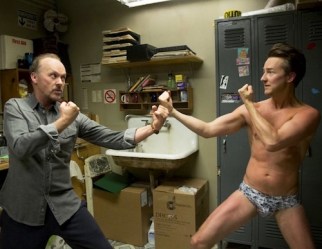
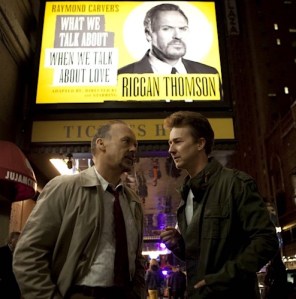
Birdman isn’t a superhero movie, though if the title sounds like one then that’s no accident: Michael Keaton is an actor who once played a superhero in the late ’80s and early ’90s. Well, to clarify, Michael Keaton plays an actor, Riggan Thomson, who once played a superhero in the late ’80s and early ’90s — the Birdman of the title. Decades later, he’s trying to be taken seriously by starring in a play on Broadway… which he’s also written… and is directing… and has sunk his personal finances into. So it’s probably not a good thing that one of his cast can’t act, his personal life is all over the place, the critics hate him before the play’s even opened, and he’s hallucinating superpowers.

Birdman is a comedy. “How the heck did a comedy win Best Picture at the Oscars?” you might well wonder, because that never happens anymore. Well, it’s a comedy-drama — it’s certainly funny, but drily so, and with lots of Personal Character Drama and a few Issues along the way. As it goes on, and gets a bit weird and kinda arthouse-y (as if it wasn’t to start with), you may forget that’s where it began. Nonetheless, I found it more consistently amusing than other recent acclaimed comedic Best Picture nominees, like the disappointing American Hustle.

In part this is thanks to Keaton, who gives quite an immersive performance as the numbed, self-deluded star. Some people were very much behind him for the Best Actor gong, but I think it found its rightful home: Eddie Redmayne’s performance as Stephen Hawking was transformative to the point you forgot you were watching an actor; Keaton is just rather good. Anyway, for me the more enjoyable performance came in a supporting turn from Edward Norton. Norton is a notoriously difficult-to-work-with actor… sorry, Norton plays a notoriously difficult-to-work-with actor, who joins Riggan’s production and begins to wreak all kinds of havoc.
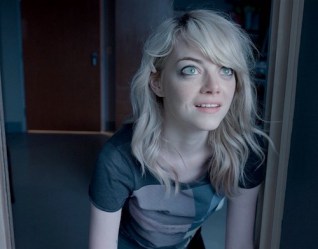
The rest of the cast are dealt very mixed hands. Emma Stone is good, but was there enough meat on the role’s bones to justify Best Supporting Actress, other than one awards-clip-baiting shouty monologue? I’m not sure. The most memorable thing about her performance is how extraordinarily large her eyes are. Andrea Riseborough is thrown a bone or two; Zach Galifianakis doesn’t showboat like I’d’ve expected a comedian with his background to; Lindsay Duncan appears for one scene, but it’s a pretty good one (sometimes it really benefits American movies that there are swathes of fantastic British actors who are capable of first-rate leading performances, but so low down the food chain that they can be drafted in for single-scene roles); and Naomi Watts is utterly wasted. (At one point Riseborough and Watts kiss, which is apparently a spoiler for Mulholland Drive because she kisses a woman in that too. Oh IMDb trivia section, you will let any old rubbish in.)

Famously, almost the entire film takes place in a single take. A fake one, of course. Well, I say of course — Russian Ark did a feature-length single take for real. I’d assumed this meant the film took place in real time, because that seems the obvious thing to use an unbroken shot for — to show us everything that occurred in the time it occurred. But no. Iñárritu uses that and the fact it’s faked quite cleverly at times, to pull off impossible changes of location. For example, at one point the camera leaves Norton in the theatre’s gods and drifts down towards the stage, where we can see him mid-performance.
The most curious aspect of the single take is: what did it need two editors for?! Everything had to be meticulously planned in advance — apparently, longer was spent on the screenplay than is normal, because once it was shot nothing could be cut — so surely all someone had to do was stick it together at the joins? Some of those joins are actually fairly obvious (your familiarity with filmmaking techniques and where joins might be hidden will dictate exactly how many), but a decent number remain hidden, I think. Well, I presume — I didn’t see them. Anyway, it’s more a feat of logistics and cinematography, the latter of which Emmanuel ‘Chivo’ Lubezki did win an award for. How deserved that was, I’m not sure. It’s very impressive to work out how to shoot a movie in a single take, even a pretend one, but surely cinematography awards are for the quality of the images, not the logistics of moving your camera around? Birdman is by no means an ugly film, but the best-looking of the year? I’m not so sure.

Birdman is an entertaining film, both funny enough to keep the spirits up and dramatic enough to feel there’s some depth there. It’s also a mightily impressive feat of technical moviemaking, but then I do love a long single take (even a fake one). Is it the Best Picture of 2014? Well, from the nominees, it’s not the funniest (The Grand Budapest Hotel), nor does it have the most impactful performances (The Theory of Everything), nor is it the must gripping or thought-provoking (Whiplash), and it doesn’t feel the most significant (Boyhood). There is an interesting element of having its cake and eating it about Birdman, though, as it berates The Movies for their current superhero obsession while telling the story of a Hollywood actor who sets out to prove those snooty New York theatre critics wrong. Hm, however did this win Best Picture from an organisation whose main voting bloc is Hollywood actors?

4 out of 5

Birdman debuts on Sky Movies Premiere today at 1:45pm and 10:10pm.

Stoker (2013)

2015 #162
Park Chan-wook | 99 mins | streaming (HD) | 2.35:1 | UK & USA / English | 18 / R

Director Chan-wook “Oldboy” Park makes his English-language debut with this modern-Gothic thriller from the pen of Wentworth “yes, the guy from Prison Break” Miller.

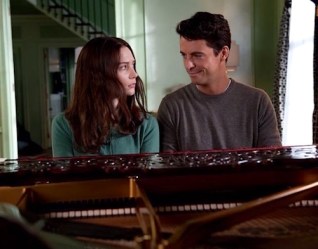
When well-to-do architect Richard Stoker dies on his daughter’s 18th birthday, he leaves said insular daughter India (Mia “Tim Burton’s Alice in Wonderland” Wasikowska) stuck in their Tennessee mansion with her unbeloved mother (Nicole “the face behind the nose” Kidman). At the wake, both are surprised by the arrival of Charlie (Matthew “Ozymandias” Goode), Richard’s brother who Evelyn has never met and India has never even heard of. Nonetheless, he’s all charm and good manners, though when he moves into their home he begins to build up a slightly creepy relationship with Evelyn, and essentially stalks India. The Stokers’ housekeeper clearly knowns something about him, but then she disappears; and Richard and Charles’ Aunt Gwendolyn turns up wanting a word with Evelyn. Just what is going on with Uncle Charlie that everyone apart from India seems to know about?

And I’ve already said too much, maybe. Stoker isn’t all about its mystery and its twists — it’s at least as much about its carefully constructed Gothic mood; but part of that is the mystery, so, y’know. Indeed, it’s so moody and atmospheric that it seems to turn some viewers off. It’s certainly not thrill-a-minute, and it has a very particular pace and tone. I’m going to keep coming back to the word Gothic, because that really is the best word for it; whether that should be “modern Gothic” or “neo-Gothic” or “Southern Gothic” or what, I don’t know, but it’s definitely Gothic — with little more than cosmetic changes, I’m sure the story could be shunted back to a crumbling pile in 19th Century England. So precise is the mood of this secluded household, it’s kind of weird when, a little while in, we get to see India’s place of education: a typical US high school. In another film I might call this sudden change of locale a misstep, a breaker of tone, but in the world Park has created it just feels like a point of contrast.

Visually, Stoker is peerless. It doesn’t scream “beauty” at you, but the shot composition, Chung-hoon Chung’s photography, and Nicolas De Toth’s editing are all exceptional. The sound design is incredible too, with judicious use of ultra-heightened effects to imitate India’s skill for hearing small things others maybe miss. Finally, the music is perfection. A piano duet composed by Philip Glass is one of the film’s most memorable sequences, but Clint Mansell offers a doom-laden score, of a piece with his work on Requiem for a Dream and The Fountain (both of which I think I’ve written of my admiration for sometime previously), and there are some choice songs too: I’d never heard Summer Wine by Nancy Sinatra & Lee Hazlewood before, but it fits the film like a glove, as well as being fantastic in its own right; and Emily Wells’ Becomes the Color slugs in with a kind of perfect dissonance to the musical style to that point. A comment on iCheckMovies used the word “sumptuous” for all of this, and that seems apt.

I have a feeling “not for everyone” may be one of the most overused phrases on this blog, but, if so, I think that’s for good reason: some of the best movies are “not for everyone”. We may not agree on what those movies are, but that’s kind of the point: they fit our own individual tastes, not “everyone’s”. Stoker undoubtedly doesn’t have easy mass appeal — it’s got a 6.9 on IMDb — and even some people open to its charms deem it to only be style over substance. I don’t think it’s wholly lacking in the latter, though if you’re looking for some Significance then I don’t know if you’ll find it — it’s an artistically-made Gothic thriller, not a soul-bearing artistic portrait of humanity. And as for the style… well, I’ve already talked about that. Whether you can have “style” for style’s sake, or whether it needs to be in aid of something, is a debate for another day. Here, it is in aid of something: amping up the Gothicism of the inherently Gothic story, which in other hands could have just became any-old present-day-set family thriller.
Describing something as “an acquired taste” might well be another phase I’ve used often, especially as it’s essentially a synonym for “not for everyone”. Nonetheless, that’s what I’ll go for here. Stoker will most decidedly not appeal to all palates, but for the right viewer, it’s a dark, moody, sensuous, Gothic delight.

5 out of 5

The UK TV premiere of Stoker is on Film4 tomorrow, Friday 30th, at 9pm.

It placed 7th on my list of The Ten Best Films I Saw For the First Time in 2015, which can be read in full here.

Wings (1927)

2015 #153
William A. Wellman | 144 mins | Blu-ray | 1.33:1 | USA / silent (English) | PG / PG-13

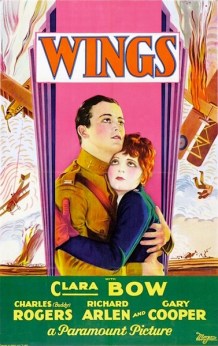
Students of the Oscars well know that, technically speaking, there wasn’t a single “Best Picture” award at the inaugural Academy Awards ceremony in 1929. Instead, there were two awards that covered that ground, seen (at the time) as being of equal significance. One was for “Unique and Artistic Production” — which I’d argue is more or less what most people think Best Picture represents today. That was given to F.W. Murnau’s Sunrise. The other was more generically titled “Outstanding Picture”. Presumably because of the more obvious similarity in its name, that’s the one the Academy have retrospectively decided was the first Best Picture award; and that’s why Wings is, officially speaking, the first Best Picture winner.

In small-town America in 1917, middle-class Jack (Charles ‘Buddy’ Rogers) and rich David (Richard Arlen) are rivals for the affections of city girl Sylvia (Jobyna Ralston). She’s actually only interested in David, though Jack’s too naïve to see it. He also doesn’t see that his neighbour, Mary (“It girl” Clara Bow), is infatuated with him. When both lads sign up for the air service, they find themselves in training together, where they eventually bond by having a punch-up. Boys, eh? Before you know it they’re on the front line of the First World War — via a brief encounter with Cadet White (a pre-fame Gary Cooper) — holding their own in dogfights against ace German pilots. Meanwhile, Mary has also joined the war effort, arriving in France as an ambulance driver. What are the chances she’ll run into Jack and their potential romance will have an opportunity to progress, I wonder?

So Wings is part rom-com, part war-action movie. On the ground, Jack and David’s interactions with Mary and Sylvia (the latter of whom barely features) are based around misunderstandings and almost-slapstick drunkenness. In the air, the picture comes alive in thrilling battle scenes, performed by fearless stuntmen and shot by bold cameramen. Well, most of the time: famously, Rogers and Arlen had to pilot themselves (in Rogers’ case, he learnt to fly just for the film), and, mid-flight, had to film their own close-ups by switching on battery-operated cameras mounted in front of them. You wouldn’t know it from watching the film itself, though: even today, the action sequences carry a palpable air of excitement, aided (perhaps even created) by the knowledge that it was all done for real — including the crashes.
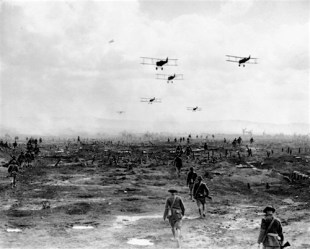
At the time of production, director William A. Wellman was pretty much unproven, having mainly directed B-level Westerns. Conversely, Wings was a risky proposition, with a remarkably high $2 million budget — not the most expensive silent film (that was Ben-Hur, at $4 million), but in the very top tier (according to this Wikipedia article, the average cost of an MGM feature at the time was $160,000). However, Wellman got the nod because he was an experienced combat pilot, having flown in World War One himself. This knowledge paid dividends for the film’s eventual quality, though caused some friction during production, as Wellman spent weeks on location not shooting as he waited for the right clouds. Sounds ridiculous, but the movie was shot in clear-skied Texas, and with no clouds there would be no sense of depth or speed for the planes.

Why Texas? It’s where the country’s largest military base was, with up to 10,000 troops stationed there. The military committed resources to aid a picture that was seen to cast them in a positive light, reportedly providing the production with $15 million worth of men and equipment. Yes, not 1.5 — fifteen. In today’s money, that contribution comes to around $200 million, which alone would put Wings among the top 50 most expensive films ever made. It was a remarkable undertaking. This included occupying a five-acre site where they “built France”, including an entire village and a trench-crisscrossed bomb-pockmarked battlefield. Those bomb craters were, in fact, genuine: the military spent a few days before filming using the location for target practice. The climactic battle that occurred on this site was filmed with up to 19 cameras at once, including some mounted on four towers, the highest of which reached 100ft. I know this is a review, not a catalogue of production numbers, but it’s quite incredible.
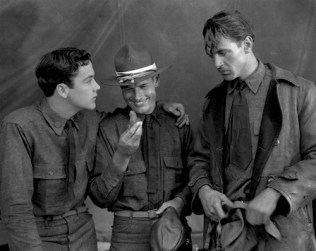
As is the movie it produced. Whatever Wellman’s status before and during production, the end result proves his skill as an action director. Unsurprisingly these sequences don’t have the adrenaline-fuelled fast-cutting of today’s action scenes, but they have a mind-boggling scale that armies of CGI will never replicate, and an accompanying sense of awe to match. It’s not exactly thrilling, because Wellman takes time to find asides that show the cost of combat — this isn’t just a Boy’s Own gad about in the jolly old First World War. Tragedy strikes, and Wellman makes it suitably affecting.

If the same can’t be said of the romantic storylines then, well, it could be worse. A mid-film sequence in Paris, where Jack gets plastered and starts imagining bubbles floating out of everything, wins bonus amusement points for actually showing those bubbles, though loses some for going on too long. It also doesn’t help matters that Jack’s actually a bit of a dick in the way he treats other people throughout the movie. He undermines and borderline bullies David thanks to their shared affection for Sylvia, while we know David’s being kind enough to not tell Jack that Sylvia’s actually in love with him. Even after they’ve made up, the same situation rears its head late in the film, when David tears up a photo of Sylvia to stop Jack seeing the love note jotted on it. That’s before we even get on to how completely ignorant he is of Mary’s affections.

How much these factors affect the film’s quality seems to be very much a personal matter. Wings set the stall for many a Best Picture winner to follow by being not that well regarded by critics; indeed, more time and praise is given to its top-award compatriot, Sunrise. For the most part, I found the personal dramas passable enough, with a few outstanding scenes — David’s farewell to his stoical parents; Cooper’s scene; the bubbles (at first). However, the combat sequences, and in particular the aerial photography, are stunning; so impressive as to easily offset whatever doubts the other elements may engender.
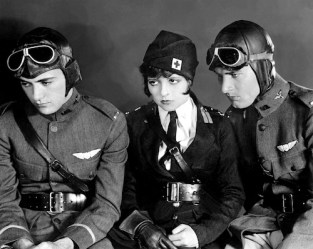
At a time when silent movies are still routinely overlooked by the studios (and the best most labels outside the US seem to release is the canon of accepted greats (plus a few random outliers)), I think it’s safe to say Wings has only received extensive restoration and re-release thanks to its position as the official first Best Picture winner. Would it receive such royal treatment from Paramount without that accolade? I think we can be pretty certain that — even though it was both an extraordinarily expensive and extraordinarily successful film — it would not. On the bright side, it’s deserving of such attention for its inherent qualities, even if it remains a shame that other equally (or, arguably, even more) deserving silent pictures not only don’t receive the same love and attention from their rights holders, but don’t receive any attention whatsoever.

But I digress. Wings is a film that deserves to be remembered as more than a mere footnote. It’s not just a trivia answer to “what was the first Best Picture?”, but a worthy winner of that prize; a movie that, almost 90 years after it was produced, still has the power to elicit excitement and awe. Wellman’s picture may not have been deemed unique or artistic, even though it’s definitely the former and possibly the latter, but it was deemed outstanding, and it’s definitely that.

5 out of 5

This review is part of The Silent Cinema Blogathon. Be sure to check out the many other fantastic contributions collated by host In the Good Old Days of Classic Hollywood.