
Stevan Riley | 98 mins | download (HD) | 1.78:1 | UK / English | 12
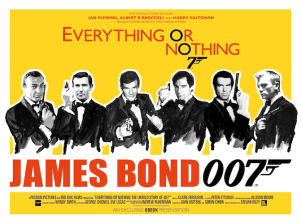 To mark the 50th anniversary of the James Bond film series last year, the producers commissioned this special documentary looking back at the entire phenomenon. If you missed it when it was shown exclusively at Odeon cinemas (in the UK; it was on TV in the US), it’s been out on DVD for a few weeks (in the UK; nothing in the US) and comes to Sky Movies Premiere from tomorrow (at 12:15pm and 10:30pm; continues twice a day thereafter). It’s sometimes called Everything or Nothing: The Untold Story of 007, not that you’ll see that title on screen or on the DVD cover; and not that it’s very accurate, actually, because many (perhaps all) of these stories have been told before. But I’ll come to that.
Overall, experienced documentary-maker Stevan Riley has put together an engaging work. Eschewing intrusive, dogmatic voiceover narration, Riley instead tells the story through interviews (both new talking-head pieces and archive-drawn audio), illustrative clips, behind-the-scenes photos and film snippets, and music. The latter elements are taken almost exclusively from the Bond franchise itself — one of the film’s early contentions is that the Bond novels were a mixture of autobiography and fantasy for creator Ian Fleming, so (as Riley has said in interviews) clips from the films seemed an appropriate way to cover his back story.
 Although ostensibly a history of the film series, Riley begins the story with Fleming’s wartime career and the birth of the Bond novels, then covers early attempts to get Bond on screen. Depth here means it actually takes quite a while to get to the entry of ‘Cubby’ Broccoli and Harry Saltzman, the producers who finally brought Bond to the big screen in the still-running series this documentary is meant to be about! Some have accused the film of being “the producers’ story”, as if that were a bad thing. It’s a behind-the-scenes tale, and with only a handful of people steering the series during its lifetime, naturally the throughline falls to them. Besides, cataloguing the changing roster of leading men is a story that’s readily and widely available, what with the on-screen action being (as it were) the ‘public face’ of the series.
With just over an hour-and-a-half to cover 60 years of history, the film’s biggest problem is length. There’s little time for nuance, instead offering a whistle-stop overview of the main events, highlighting key aspects here and there. Inevitably a lot of important things get short shrift — there’s hardly any detail on the birth of the iconic title sequences, for instance, or the series’ distinctive musical style. It’s both a blessing and a curse that detailed featurettes on elements such as these can be found on the series’ DVD and Blu-ray releases. A blessing, because the casual fan wishing to know more can look there for the detail they seek; a curse, because many fans will already have seen all of those featurettes (and they are numerous, including at least one dedicated thirty-minute-plus making-of per film) and find little new in Riley’s effort.
But there was never going to be time in a single feature to cover that much fine detail, so we must allow Riley some leeway. It’s also not his fault that Sean Connery refused to be interviewed, or that other key players are no longer with us and so can only be represented by occasionally familiar archive interviews,  plus second-hand recollections (sometimes, third-hand) of friends and relations. This is, perhaps, most keenly felt in the film’s discussion of Kevin McClory, the man who claimed he had some rights to make competing Bond films (Broccoli and Saltzman brought him in to the fold to make Thunderball, which he did own rights to and so being where his claims stemmed from; he was the man who later made Never Say Never Again, and continued to fight for filmmaking rights up until his death). Here he’s very much painted as the villain, not only as a constant thorn in the side of the series’ guardian-angel producers, but also it all but says he conned Fleming, and quite heavily implies the first Thunderball court cases contributed significantly (or even wholly) to Fleming’s death. Is that true? It might be. McClory isn’t here to defend himself, but then his friends and relatives who do pop up don’t seem to try too hard to justify him either.
The one section I would call a major disappointment is the coverage given to the Brosnan era. Dalton and Craig are equally brushed past, but the key tenants — why Dalton’s films floundered and how Craig, despite initial doubts, led a glorious rebirth — are covered. There’s surely much more to say about Brosnan, however. DVD was emerging as a dominant format around the time his Bond incumbency happened, meaning the special features on his films were put together as the movies came out. That’s great for on-the-ground as-it-happened making-of material, but naturally offers zero retrospective opinion, something all the previous films’ discs benefit from. Unfortunately, the Brosnan section here does little to redress the balance. You get the feeling there’s an awful lot going unsaid, particularly about Die Another Day and the way Brosnan was unceremoniously dropped in its wake. The fact the former leading man can’t even remember which way round Tomorrow Never Dies and The World is Not Enough happened suggests something too… but I’m not sure what, because it’s never explored.
 As a dyed-in-the-wool Bond fan, I was left wanting a bit more from Everything or Nothing; especially as someone who grew up during the Brosnan era, I feel there’s more to be told about that time. But for newer or casual fans, or those seeking a nostalgia-tinged flick through the highs (and the odd low) of the most enduring series in film history, it succeeds admirably. It’s just a shame they didn’t include it in the Bond 50 Blu-ray set — it would’ve been most welcome on the otherwise-pathetic bonus disc. But that’s a quibble for another day.

Everything or Nothing comes to Sky Movies Premiere from tomorrow, Friday 15th February, and plays twice daily until Thursday 21st February.
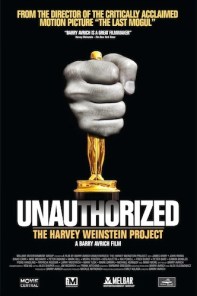 The documentary that Weinstein reportedly tried to stop existing, including discouraging people from participating in interviews. Either he needn’t have worried or really is a complete megalomaniac, because while there is a certain warts-and-all aspect to Avrich’s cinematic biography, it can’t help but admire all that Weinstein has achieved.
 Even for those who were following film culture through this era, and in spite of Harvey’s apparent efforts, there are numerous interviewees who were there — former Miramax employees, for instance — to offer insight. Thanks to archive footage we get even more opinions, including a fair few comments from Harvey himself. How much of this was available at the time, I obviously don’t know. Even if it is mostly recap, it’s a concise and well-constructed one.
 Bill Cunningham is 80. He lives in a small rent-controlled apartment in New York City that is filled with filing cabinets. His bed is little more than a mattress on some boxes. Each day, he dresses in the same distinctively simple blue smock and sets out on his bicycle. He eats at the same places each day; simple cheap food, cheap coffee. He doesn’t have a partner or kids; he may never have had a romantic relationship. He doesn’t watch TV or listen to music. It sounds like some kind of life of poverty or religious devotion. It’s neither, although you could make an argument for the latter, because all Bill does all day is photograph what people wear.
 Bill is, technically, a fashion and society photographer. His real passion, however, is clothes. Real clothes. The clothes people actually wear and how they wear them. His newspaper column — a collection of photos from the streets — is essential reading as far up the chain as Anna Wintour. He doesn’t set trends, he observes them. Exposes them, you might say, because in the past he’s used his work to call fashion designers on where they’ve copied (consciously or not) the work of another from years before, and that has sparked arguments.
 What he actually is, more than a “fashion photographer”, is a documentarian, recording how people choose to present themselves to the world, both as individuals and how that translates en masse. Fashion may seem like a meaningless, arbitrary, frivolous thing to afford such time to, and I’d have no argument against Fashion being called exactly that. But fashion — the actual clothes we wear in our actual lives — is something a good many people spend a good amount of time obsessing over; it’s how they choose to represent themselves in the world, how they indicate what they’re like as a person, how they show which groups or types of people they align with. We all do it, even if it’s not a conscious choice. Surely that’s worth recording?
 But that’s all an aside, probably because it’s so well done. What might be worth picking up on is that there’s no specific story. There are stories in there — like how Carnegie Hall is kicking out its handful of 80- and 90-something resident artists to make way for more office space — but the film doesn’t have an overarching tale. It’s a portrait; one of a fascinating, unusual, but likeable, and certainly unique, individual.
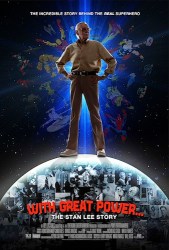 Stan “The Man” Lee is indeed The Man when it comes to the world of comic books. In the 1960s he revolutionised the medium in the US, introducing complex and realistic characters to a world that had previously focused on perfect super-humans like Superman, Batman and Captain America. In a period of just two years he co-created the Fantastic Four, Hulk, Spider-Man, Thor, Iron Man and the X-Men, and after that rejuvenated Captain America (cancelled a decade earlier) for a modern audience. If there’s anyone in the comic world deserving of a dedicated feature-length documentary, it’s Stan Lee.
 both in his Marvel heyday in the ’60s as well as before and since. It also really digs in to his personal life at time, getting very emotional. That Lee and his family appear and tell these tales mean it doesn’t feel intrusive.
 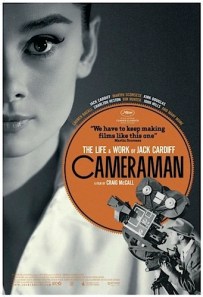 Documentary telling the story of the career of cinematographer and director Jack Cardiff.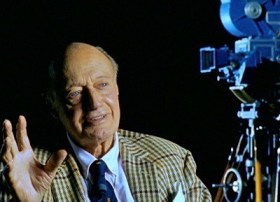
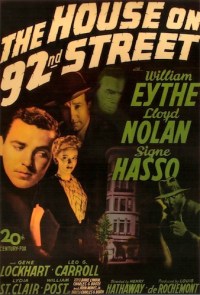 Here’s an unusual one from the pantheon of film noir. These days we’d probably call it a docu-drama, though thankfully there are no talking heads, but there is a factual voiceover narration. The story, we’re told, comes from the FBI’s files and is based on a real case —
  how they really work and investigate a case. At the time I imagine this was a fascinating procedural; now, we’re all a bit more familiar with how such things go, but it still works as an historical document.
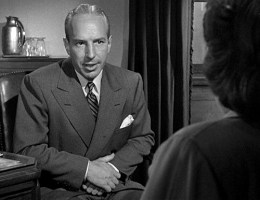 Might be because no one ever knew they were making a film noir, eh? How can you expect something to conform to a set of rules that were only defined after the fact? Hathaway and co didn’t fail at making a noir, they just made a film that doesn’t fit the later-defined template as well as the films used to define said template. I know, four words from some other online critic hardly merit a whole paragraph, but it does bug me when people write daft things like that.
 Catfish is a documentary (probably — we’ll come to that) in which 20-something Nev falls in love with a girl somewhere else in America over the internet. He and his friends become suspicious that she’s not who she claims and set off to find out The Truth.
 Before I get spoilersome, then, let me say this: you will probably guess where it’s going. Even if you’ve not had it in some way revealed (however little of it) before you watch, early scenes will lead to the obvious conclusion: why am I being shown this if it doesn’t go somewhere? And what’s the obvious place it’s going to go? I think most viewers must guess. But I think many — probably even most — will not guess precisely where it ends up; the exact nature of the truth it finds. So this is not as much of a Thriller as it’s been sold in some quarters. It has suspense, certainly, and it has mysteries that have answers… but there’s not some dark secret at the heart of it all; instead, there’s a painful emotional situation. Already I’m saying too much.
 and/or satire, I still think most people fundamentally believe what they see in a documentary (or they read in a newspaper) to be the truth.
 The allegation that it can’t be real because they happened to film everything that happened is nonsense.
 (it’s still on track as the best film I’ve seen in 2011), Catfish probably has more to say about the actual impact of Facebook on our lives than Fincher/Sorkin’s biopic does.
 Alternate histories are always fun, and nothing seems to have provoked more than the Second World War. Which, as a defining event in modern history for a good chunk of the world, is understandable. It Happened Here is perhaps one of the earliest examples, depicting a 1940s Britain under Nazi occupation.
 namely, the quiet but methodical enacting of The Final Solution in an occupied territory. The whole film builds to this point, gradually showing the darker and deeper levels of cooperation — which starts out almost harmless and ends with organised mass murder — meaning it never feels like Brownlow and Mollo are pushing an agenda too hard, but still confront us with the reality: that we’d probably succumb too, and this is where we’d end up.
 Another controversy arose over the villains being British collaborators — few German Nazis are seen — and the ease with which many agreed. But this is based in the facts of what occurred in other occupied territories; maybe Britain’s plucky spirit would’ve shown through, as many like to believe, or maybe many would have caved for the easier life — or, indeed, life at all. The film is examining several perspectives of occupation, and using the fictional context to good effect: this could have happened, the film says, however much we like to believe we wouldn’t have collaborated like (and/or resisted better than), say, the French.
 Nonetheless, It Happened Here is more anti-Nazi than pro-Nazi propaganda, in my opinion, though it’s easy to see why any material critical of the Allies could have outweighed the overall bias when the film was first released, just 20 years after victory in Europe. Generally, and viewed from a much more removed perspective, Brownlow and Mollo do a good job of offering conflicting perspectives with minimal comment, allowing the viewer to decide how ridiculous certain newsreels or opinions are, or how weak or misguided characters may or may not be — on both sides.
 100Films.co.uk