Meat Loaf: In Search of Paradise (2007)

Bruce David Klein | 88 mins | DVD | 16:9 | USA / English

Meat Loaf: In Search of Paradise

The singer Meat Loaf was very protective of his creative process, and apparently this documentary was the first time he’d allowed cameras behind the scenes to document it. Certainly, he’s frequently uncomfortable with or begrudging of their presence, although he seems to get used to them over time, allowing us some rare insights.

The film follows Meat and his band as they prepare for and commence a mammoth 18-month world tour following the release of Bat Out of Hell III. Despite the lengthy schedule, a DVD recording of the concert is scheduled for just a few gigs in. It’s never mentioned who was responsible for booking that, but it clearly causes added stress for everyone: rather than allowing the show to become refined and polished over a long series of gigs, it’s got to be good enough to be documented almost as soon as it starts. No one here is ever pretentious enough to refer to the recording as an “historical record”, but that’s what it will be. This is the first tour in which Meat will perform songs from the entire Bat Out of Hell trilogy, and the gig that’s recorded for DVD is the one that will endure as the record of this tour. It’s got to be right.

Perhaps the biggest obstacle is the fact that Meat Loaf is never satisfied. At one point, Meat’s mate Dennis Quaid is in town and pops by to watch that evening’s gig. Afterwards, he describes it as “an incredible show”. “It wasn’t one of my favourites, but thank you,” replies Meat. So Dennis asks, “how many times are they your favourite?” “Never,” Meat answers, “I hate ’em all… I’m waiting for the perfect show.” Of course, the perfect show never comes, and so Meat never feels it’s gone as well as it could have; he’s always apologising to fans that it won’t live up to expectations. But it’s not that the tour is genuinely coming up short — the band are happy; the crowds are certainly entertained — it’s just something in Meat Loaf’s character. He pushes himself so hard — too hard, given how exhausted it makes him, to the point he physically collapses after most shows. Whether you like his music or not, this film leaves you in no doubt about his dedication to his craft; to trying to give his fans exactly what they want.

Looks like paradise to me

That desire comes to a particular head in one of the film’s major subplots: the show is generally well reviewed in the press, but every critic takes issue with the staging of Paradise by the Dashboard Light, a number about teenage sex in which 59-year-old Meat duets with 28-year-old Aspen Miller — who looks a lot younger, especially in her skimpy cheerleader outfit. Frankly, I reckon the critics were at least partly jealous that Aspen Miller wasn’t writhing all over them, but maybe that’s just giving away something about me… Anyway, the number should be one of the highlights (as guitarist Kasim Sulton says, he’s been touring with Meat for decades and they’ve never done a show without it), but the criticisms are a cause of irritation backstage. Importantly, Miller doesn’t share the critics’ concerns; indeed, she seems to find it frustrating that they’re dismissive of her part in the performance, writing her off as a victim of it, when she’s an adult involved in the planning of what is a fully-choreographed routine. But the criticisms get to Meat even more — it’s not meant to be a song about a handsy old man attempting to assault a young girl, after all — and so various fixes are attempted to improve the song’s reception. It’s like a case study in revising a work while it’s already in performance, and shows that these tours don’t go out on the road locked and unchangeable — or, at least, they don’t when Meat Loaf is involved.

The film’s final line is given to Meat Loaf himself. As he walks away after that all-important gig filmed for the DVD, he repeats several times: “I tried.” That’s his attitude in summation: he never thought it was good enough, but he always gave it his all.

4 out of 5

Meat Loaf: In Search of Paradise is the 10th film in my 100 Films in a Year Challenge 2022.

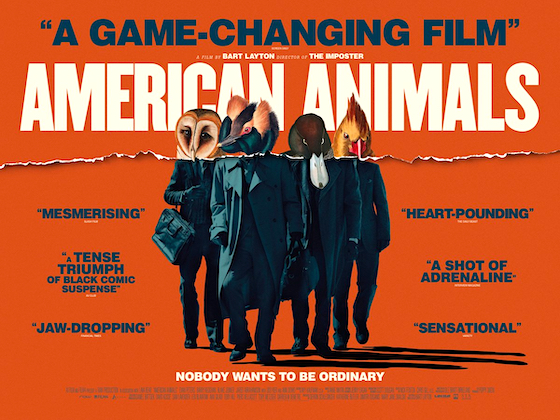
American Animals (2018)

Bart Layton | 117 mins | digital (HD) | 2.39:1 | UK & USA / English | 15 / R

American Animals

I don’t want this to turn into a rant about IMDb — there’s a time and a place for those, certainly, but what’s meant to be a short review of one film is not one of them — but the way they’ve devalued the documentary in recent years is not also depressing but also inaccurate. Because anything that has the genre Documentary is now marked as “(documentary)” on someone’s filmography, and therefore IMDb, and/or its contributors, are reluctant to use it about anything that isn’t 100% a documentary. Something like, say, American Animals.

To be clear: American Animals is unquestionably a documentary. It tells a true story, about some students who plan to rob a library of its rare books. It features interviews with the real people involved, both the students and others. But it’s mostly told via reenactments starring actors, several of them fairly recognisable faces. The real people appear as talking heads scattered throughout, particularly at key moments. So, it’s also unquestionably a hybrid of documentary and fiction. On the surface, it can look a lot like any fictionalised adaptation of a true story; but it’s hidebound to be more accurate than those often are, because it’s also got all these interviews. IMDb isn’t built for nuance such as this.

Prior planning prevents piss-poor performance... possibly

The film’s director, Bart Layton, previously made widely-praised definitely-a-documentary The Imposter. In my review of that, I described his style as “flashy” and “over-eager”, wondering if “perhaps he better belongs in fiction filmmaking? Perhaps that’s where he wants to go in future”. Here, I guess he’s moving to bridge that divide; but the blurred line means that, when the film says “here’s the real [person X]”, you kind of question it. Especially as, if a crime was committed, how come they’re interviewing the criminals?

That latter thought contributes to a genuine tension and suspense throughout the film. How far will this plot go? Do they even actually attempt it? One of the guys keeps saying, “I expected there to be something to stop us”, and you think maybe something will stop them… but the fact this film exists, and there’s all the chat about how the boys let their parents down and whatever, shows something happened. (No spoilers!) Yet it’s also surprisingly funny, like a bit where we’re shown the “Ocean’s Eleven version” of the robbery, complete with Elvis song on the soundtrack.

Some have criticised these kinds of flights of fancy, or the whole hybrid form, for inviting us to sympathise with these guys rather than condemn their actions. I think there’s room for both. The film seeks to explore what led these pretty normal guys to do such a thing, and (to an extent) how it has affected them since. I think you can both disapprove of what they did and seek to sympathise with them — to understand how it happened is not to condone it.

4 out of 5

American Animals was #107 in my 100 Films in a Year Challenge 2020.
It is streaming on All 4 until 10th February.

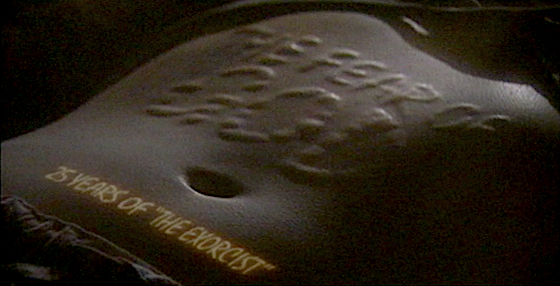
The Fear of God: 25 Years of “The Exorcist” (1998)

2019 #134
Nick Freand Jones | 81 mins | digital (SD) | 16:9 | UK / English | 15

The Fear of God: 25 Years of The Exorcist

There have been some great made-for-TV documentaries down the years, but that status as “TV programmes” means it’s kind potluck if they’re still readily available to us years later. Mark Cousins’s The Story of Film: An Odyssey? So acclaimed it got a DVD release and, recently, a Blu-ray upgrade. Mark Gatiss’s horror series? Too full of clips to be licensable. The Complete Citizen Kane? I don’t think this was available anywhere besides bootlegs, but will soon be included on Criterion’s 4K release of the film.

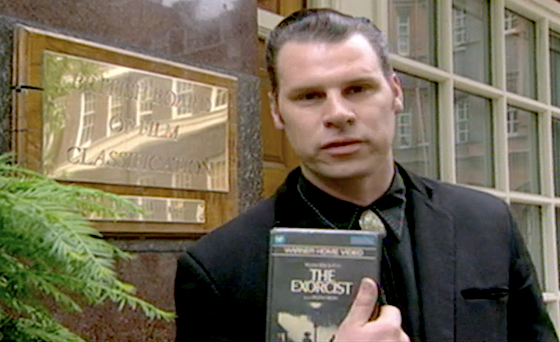
I could go on, but let’s stick to the one at hand. This feature-length Mark Kermode-fronted doc was screened at festivals in 1998 before being shown on the BBC in an edited form. Down the years it’s been available on some of the film’s DVD and Blu-ray releases, but only in that shortened version. Finally, 20 years after its first release, the unedited original cut popped onto the BBC iPlayer for Halloween 2019, and tonight it will be broadcast for the first time ever, on BBC Four at 11:55pm.

For those unfamiliar with him, Kermode is sort of the UK’s answer to Roger Ebert: a long-standing, widely-respected film critic across print, TV, and radio. The Exorcist is his favourite film, and (as he explains in a recently-shot introduction to this documentary) he’d written a book on it that its makers had liked, which led to him making The Fear of God.

Mark Kermode and The Exorcist

As with almost any documentary about a specific film, your interest in it is likely to depend on your interest in the original film. So, assuming you care to know the behind-the-scenes story of The Exorcist, this is definitely a good film. I get the impression it’s the original source for a lot of interviews and stories that have been repeated around the place; ones that I’ve personally picked up through osmosis down the years. Despite that, I still learnt new stuff, and there are some nice moments to witness, like when novelist and screenwriter William Peter Blatty suddenly realises, on camera, how he should’ve written a scene all along.

If you’ve seen The Fear of God before (say, on one of The Exorcist’s physical media releases), how much this so-called “festival cut” is worth your time is a matter for your personal level of interest. Some DVD releases cut as much as 25 minutes out of the documentary, so if you’ve only seen that version then obviously there’s a lot of new material here. If you’re watching this version, you can be assured you’re seeing everything Kermode wanted to include as well as everything producer Nick Freand Jones wanted in. For example, there’s an interview with the woman who voiced the demon, who insisted her contribution was only in the BBC broadcast. Well, I guess this still conforms to that wish.

4 out of 5

The Fear of God: 25 Years of “The Exorcist” is on BBC Four tonight at 11:55pm, or on iPlayer now.

The 100-Week Roundup XXX

Bow-chicka-wow-wow!

Oh, er, no, sorry — it’s not that kind of XXX. It’s Roman numerals: this is the 30th 100-Week Roundup. (But if it is the other kind of XXX that you’re looking for, check out Roundup XX.)

Still here? Lovely. So, for the uninitiated, the 100-Week Roundup covers films I still haven’t reviewed 100 weeks after watching them. Sometimes these are short ‘proper’ reviews; sometimes they’re only quick thoughts, or even just the notes I made while viewing.

That said, as with Roundup XXIX, this week has run into some reviews that I feel would be better suited placed elsewhere; mainly, franchise entries that it would be neater to pair with their sequels. Consequently, sitting out this first roundup of May 2019 viewing are The Secret Life of Pets, Jaws 2, Ice Age: The Meltdown, and Zombieland. I’m going to have to get a wriggle on with these series roundups, though, otherwise that subsection of my backlog will get out of control…

So, actually being reviewed here are…

  • Eyes Wide Shut (199)
  • The Eyes of Orson Welles (2018)
  • Everybody Wants Some!! (2016)


    Eyes Wide Shut
    (1999)

    2019 #72
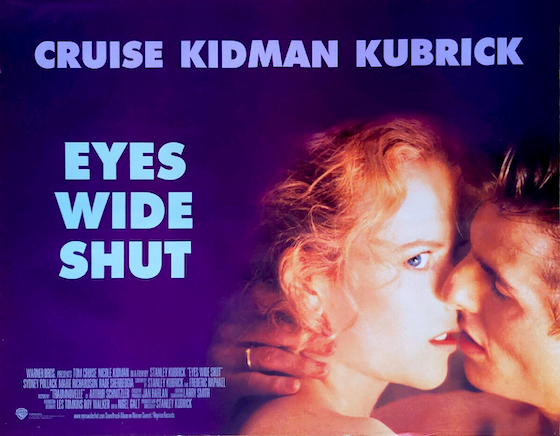
    Stanley Kubrick | 159 mins | Blu-ray | 16:9 | UK & USA / English | 18 / R

    Eyes Wide Shut

    I seem to remember Eyes Wide Shut being received poorly on its release back in 1999, but then I would’ve only been 13 at the time so perhaps I missed something. Either way, it seems to have been accepted as a great movie in the two decades since (as is the case with almost every Kubrick movie — read something into that if you like).

    Numerous lengthy, analytical pieces have been written about its brilliance. This will not be one of them — my notes only include basic, ‘witty’ observations like: one minute you’re watching a “men are from Mars, woman are from Venus” kinda relationship drama, the next Tom Cruise has taken a $74.50 cab ride from Greenwich Village to an estate in the English countryside and you’re in a Hammer horror by way of David Lynch. “A Hammer horror by way of David Lynch” is a nice description, though. That sounds like my kind of film.

    And Eyes Wide Shut almost is. It’s certainly a striking, intriguing, even intoxicating film, but I didn’t find the resolution to the mystery that satisfying — I wanted something more. Perhaps I should have invested more time reading those lengthy analyses — maybe then I would be giving it a full five stars. Definitely one to revisit.

    4 out of 5

    Eyes Wide Shut was viewed as part of What Do You Mean You Haven’t Seen…? 2019.

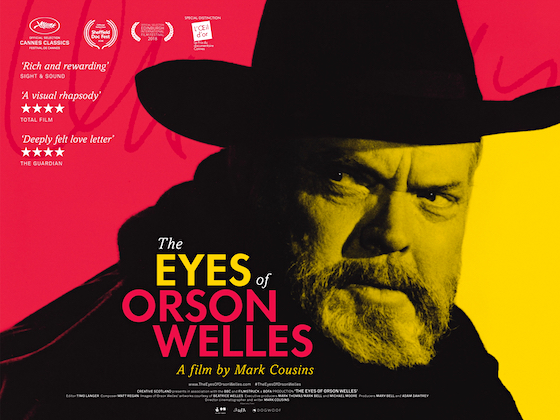
    The Eyes of Orson Welles
    (2018)

    2019 #74
    Mark Cousins | 100 mins | TV (HD) | 16:9 | UK / English | 12

    The Eyes of Orson Welles

    Mark Cousins, the film writer and documentarian behind the magnificent Story of Film: An Odyssey, here turns his attention to the career of one revered filmmaker: Orson Welles (obv.)

    Narrated by Cousins himself, the voiceover takes the form of a letter written to Welles, which then proceeds to tell him (so it can tell us, of course) about where he went and when; about what he saw and how he interpreted it. A lot of the time it feels like it’s patronising Welles with rhetorical questions; as if Cousins is speaking to a dementia suffer who needs help to recall their own life — “Do you remember this, Orson? This is what you thought of it, isn’t it, Orson?” It makes the film quite an uneasy experience, to me; a mix of awkward and laughable.

    Cousins also regularly makes pronouncements like, “you know where this is going, I’m sure,” which makes it seem like he’s constantly second-guessing himself. Perhaps it’s intended as an acknowledgement of his subject’s — his idol’s — cleverness. But it’s also presumptive: that this analysis is so obvious — so correct — that of course Welles would know where it’s going. His imagined response might be, “of course I knew where you were going, because you clearly have figured me out; you know me at least as well as I know myself.” It leaves little or no room for Welles to respond, “I disagree with that reading,” or, “I have no idea what you’re on about.” Of course, Welles can’t actually respond… but that doesn’t stop the film: near the end, Cousins has the gall to end to imagine a response from Welles, literally putting his own ideas into the man’s mouth in an act of presumptive self-validation.

    I can’t deny that I learnt stuff about Orson Welles and his life from this film, but then I’ve never seen or read another comprehensive biography of the man, so that was somewhat inevitable. It’s why I give this film a passing grade, even though I found almost all of quite uncomfortable to watch.

    3 out of 5

    Everybody Wants Some!!
    (2016)

    2019 #79
    Richard Linklater | 112 mins | TV (HD) | 1.85:1 | USA / English | 15 / R

    Everybody Wants Some!!

    Everybody Wants Some Exclamation Mark Exclamation Mark (that’s how we should pronounce it, right?) is writer-director Richard Linklater’s “spiritual sequel” to his 1993 breakthrough movie, Dazed and Confused. That film has many fans (it’s even in the Criterion Collection), but I didn’t particularly care for it — I once referred to it as High Schoolers Are Dicks: The Movie. So while a lot of people were enthused for this followup’s existence, the comparison led me to put off watching it. A literal sequel might’ve shown some development with the characters ageing, but a “spiritual sequel”? That just sounds like code for “more of the same”.

    And yes, in a way, this is High Schoolers Are Dicks 2: College Guys Are Also Dicks. It’s funny to me when people say movies like this are nostalgic and whatnot, because usually they just make me glad not to have to bother with all that college-age shit anymore. That said, in some respects the worst parts of the film are actually when it tries to get smart — when the characters start trying to psychoanalyse the behaviour of the group. Do I really believe college-age jocks ruminate on their own need for competitiveness, or the underlying motivations for their constant teasing and joking? No, I do not.

    Still, while most of the characters are no less unlikeable than those in Dazed and Confused, I found the film itself marginally more enjoyable. These aren’t people I’d actually want to hang out with, and that’s a problem when the movie is just about hanging out with them; but, in spite of that, they are occasionally amusing, and we do occasionally get to laugh at (rather than with) them, so it’s not a total washout.

    3 out of 5

  • The 100-Week Roundup XXVI

    The 100-Week Roundup covers films I still haven’t reviewed 100 weeks after watching them. Sometimes these are short ‘proper’ reviews; sometimes they’re only quick thoughts, or even just the notes I made while viewing.

    This week’s selection, the final two films from March 2019, includes a pair of awards-worthy short animations — the first won an Oscar, the second was nominated for one. I was going to include more films in this week’s roundup (effectively bundle two weeks into one), but it felt like a disservice to this pair.

  • Paperman (2012)
  • Waltz with Bashir (2008)


    Paperman
    (2012)

    2019 #48a
    John Kahrs | 7 mins | Blu-ray (3D) | 1.85:1 | USA / silent | U / G

    Paperman

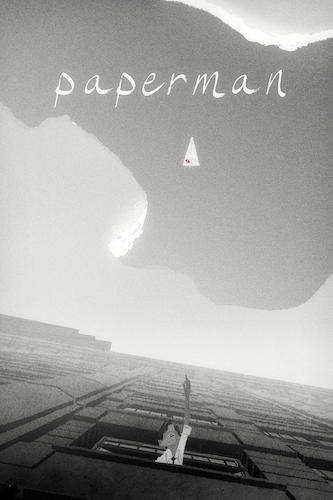
    This Disney short was originally released alongside Wreck-It Ralph (and can now be found on that film’s Blu-ray; as well as on Disney+, I presume) and, as I recall, attracted a lot of praise at the time, primarily for its visual style. That was an innovation in creating 2D-looking animation via a 3D system — so it seems a bit daft that I watched it in 3D. I have to wonder if the added visual dimension highlights the underlying 3D animation, because it’s quite obviously been created in 3D with a 2D style over the top.

    That said, it look gorgeous, however you cut it. There’s an inherent beauty in how it’s executed, while the chosen black-and-white style emphasises the apparent setting (’40s New York) and also gives it a timeless quality. The 2D/3D combination works well, giving it the fluidity and dynamism of CG animation, but with a certain roughness — a hand-made-ness — that comes from 2D cel animation. Of course, that’s artificial, injected via design choices (like scruffy outlines on the characters), but it feels authentic.

    As for the actual story, it’s a charming little romantic number involving paper aeroplanes… until those sheets of folded paper become sentient and omniscient, at which point it lost me with its silliness. But as an exercise in style: lovely.

    4 out of 5

    Waltz with Bashir
    (2008)

    aka Vals Im Bashir

    2019 #49
    Ari Folman | 87 mins | TV | 16:9 | Israel, France, Germany, USA, Finland, Switzerland, Belgium & Australia / Hebrew, Arabic, German & English | 18 / R

    Waltz with Bashir

    One night at a bar, an old friend tells director Ari Folman about a recurring nightmare in which he is chased by vicious dogs. They conclude that there’s a connection to their Israeli Army service in the first Lebanon War of 1982. Ari can’t remember that period of his life, so he meets and interviews old friends and veterans, hoping to discover the truth about that time and reconstruct his own memories of the conflict. — adapted from IMDb

    This search for the truth has led Waltz with Bashir to be labelled an “animated documentary”, which sounds like an odd idea, almost oxymoronic — you can tell a true story with animation, of course, but can you document something? Well, yes. Rather than talking heads, what animation allows is the visualisation of the narrators’ memories and dreams alike, and means we can flow between them, too. On a practical level, it allows the film to stage scenes that would be impossible in live-action without a huge budget, meaning it doesn’t have to compromise on the stories it tells. More thematically, having a shared style between ‘reality’ and ‘dream’, plus the distancing effect of it being drawn, not ‘real’ — of being unequivocally created, not just filmed — helps to underscore larger points about the reliability (or otherwise) of memory. The dreams are connected to the memories; are the memories a kind of dream?

    Given the time period being remembered, of course the film is about war and how that affects the mind of its participants, but it’s also memory in general, I think. You’d think such extreme, unique experiences would be unforgettable, and yet the workings of the mind and memory aren’t that straightforward. One strand I found particularly fascinating was the way people are haunted by the suffering of animals in the conflict, perhaps more so than by the human-related atrocities they saw. Is this just a coincidence of the people Folman spoken to? Is it a particular interest of Folman himself? Or is it a genuine phenomenon? I don’t know the answer, but (outside of, say, War Horse) I don’t remember it being such a clear thread in a war-related film or documentary before.

    I’ve seen people say they couldn’t connect with Waltz with Bashir because they didn’t know the history of the period well enough. Conversely, I felt that was part of why the film was so effective: not really knowing what was going on or what was being referred to, I was discovering it as the character did. Some parts along the way could perhaps have used further clarity or explanation for those of us entirely unfamiliar with the conflict, but there’s enough information disclosed to be going on with. I found the film’s ending to be powerful beyond words, and part of what makes it so shocking and impactful is not knowing about it, of learning about it for the first time with the characters.

    5 out of 5

  • The 100-Week Roundup XV

    I’ve fallen terribly behind with these 100-Week Roundups — I should be on to films from 2019 by now (because 100 weeks is c.23 months), but I still have 17 reviews from 2018 to go. I considered trying to cram more into each roundup, but that just takes longer to compile, so my aim is to post a more-than-average number of roundups in the next fortnight with the goal of at least completing 2018 before 2020 ends. We’ll see how that goes.

    For now, we’re in November 2018 and looking at…

  • The Other Side of the Wind (2018)
  • Batman & Mr. Freeze: SubZero (1998)
  • Paper Moon (1973)
  • Hitchcock/Truffaut (2015)


    The Other Side of the Wind
    (2018)

    2018 #226
    Orson Welles | 122 mins | digital (UHD) | 1.37:1 + 1.85:1 | France, Iran & USA / English | 15 / R

    The Other Side of the Wind

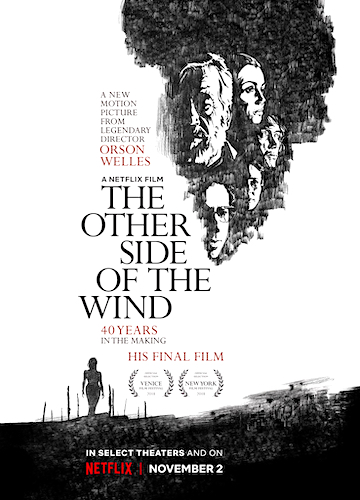
    One of my draft intros for The Other Side of the Wind was to talk about how it feels like “a 2018 film” because it’s different; innovative; unique — modern. But then to note that, of course, it was all shot in the 1970s, but never completed for financial and legal reasons. That’s only partially true, though, because while it does feel modern in some ways, it still looks and feels very ’70s; and while it’s no doubt experimental and avant-garde, it’s in a very ’70s way. And the look of the film stock is very ’70s. It’s a strange, undoubtedly compromised movie — but so are many of the films Orson Welles managed to complete while he was alive, thanks to studio interference, so it’s hardly a sore thumb in that regard.

    The film tells the story of the final days of Jake Hannaford (John Huston), a film director working on his comeback movie (you’ve gotta think there’s some autobiography in here, then, right?) It’s a portrait of the man’s final hours, supposedly assembled from dozens of sources that were shooting him at the time — Welles prefiguring the ‘found footage’ genre by a decade or two. But this isn’t a horror movie… well, not in the traditional sense: in my notes I described it as “a frantically-cut display of pompous self-declared intellectuals pontificating about something and nothing in a battle of pretentiousness. That perhaps explains why, at a time when Netflix movies routinely ‘break out’, the flash of interest the film’s release provoked has not resulted in any kind of sustained wide admiration.

    Whatever your thoughts on the final film (and it’s clearly one for cineastes and completists rather than general audiences), it seems remarkable that it took so long for anyone to be willing to fund the completion of a film by The Great Orson Welles. But that’s actually a story unto itself, told in the accompanying documentary A Final Cut for Orson: 40 Years in the Making (which is hidden in the film’s “Trailers & More” section, but is definitely worth seeking out if you’re interested). Among the revelations there are that Welles shot almost 100 hours of footage, spread across 1,083 film elements, all of which had to be fully inventoried. Matching it up was a problem that would have been insurmountable even ten years ago; it’s only possible now thanks to digital techniques and algorithms — and, of course, a big chunk of change from Netflix. Welles had only cut together about 45 minutes, with the rest completed based on the style of those parts, his notes and letters, and recordings of some of his direction that was retained on the sound reels.

    Was the effort worth it? It’s certainly a fascinating project to see brought to some kind of fruition. In the end, I’m not sure what it all signified. The story is pretty straightforward, but it’s jumbled in amongst a lot of hyperactive editing, as well as a bizarre film-within-a-film. There are things here which still feel ahead of their time even now, and things that were certainly ahead of their time when shot in the early ’70s (even if other people have done them since), which is always exciting. Combine that with Welles’s status and this is unquestionably a fascinating, must-see movie for cinephiles.

    3 out of 5

    Batman & Mr. Freeze: SubZero
    (1998)

    2018 #227
    Boyd Kirkland | 67 mins | Blu-ray | 1.33:1 | USA / English | PG

    Batman & Mr. Freeze: SubZero

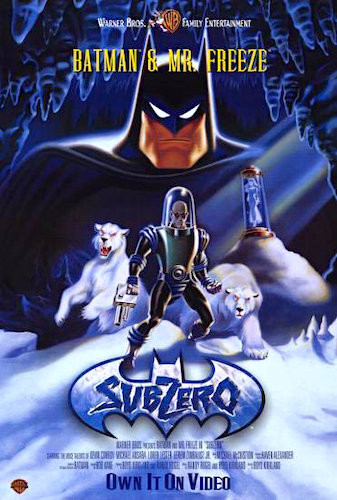
    It’s now so ingrained in Bat-canon that it’s easy to forget, but Batman: The Animated Series actually invented Mr Freeze’s backstory about his dead wife, etc. It was so successful that the episode (Heart of Ice) won an Emmy, the character was brought back to life in the comics (complete with this new backstory), and just a few years later it was used in Batman & Robin (which, considering how much that film was happy to ignore about other characters, e.g. Bane, just goes to show… something).

    So, with The Animated Series responsible for such a major revival of the character, it kinda makes sense they’d choose him to star in their second animated feature — although another version of events is he was chosen to tie-in with Batman & Robin, but then SubZero was pushed back after the live-action film was a critical flop. That makes sense, because while Heart of Ice is fantastic and influential, none of Freeze’s other Animated Series appearances have a great deal to offer. TV episode Deep Freeze is sci-fi B-movie gubbins featuring Freeze as a cog in the plot rather than its driving force; and, after all the effort to humanise him, in Cold Comfort he’s just a villain doing villainous things with incredibly thin motivation.

    SubZero is, at least, a step above those. It doesn’t withstand comparison to its predecessor movie, the genuine classic Mask of the Phantasm — that had entertainment value for kids, but was also a thoughtful, mature story about what drives Bruce Wayne to be Batman. SubZero, on the other hand, is just an action-adventure ride. It’s not bad for what it is (there’s a pretty great car chase halfway through, and the explosive climax aboard an abandoned oil derrick going up in flames is rather good), but no more than that. At least it finally provides a neat end to Freeze’s story… even if it is kinda hurried in a last-minute news report.

    3 out of 5

    Paper Moon
    (1973)

    2018 #235
    Peter Bogdanovich | 98 mins | TV (HD) | 1.85:1 | USA / English | PG / PG

    Paper Moon

    I do try to avoid this situation arising in a ‘review’, but I watched Paper Moon over two years ago and didn’t make any significant notes on it, so I’m afraid I can’t say much of my own opinion. What I can tell you is that I happened to spot it in the TV schedule and decided to watch it primarily to tick it off the IMDb Top 250, thinking it was a bit of an also-ran on that list (based on iCheckMovies, it’s not very widely regarded outside of IMDb; indeed, it’s not even on the Top 250 anymore). But that was serendipitous, because I wound up really enjoying it.

    Sticking with IMDb, here are some interesting points of trivia:

    “At 1 hour, 6 minutes, 58 seconds, Tatum O’Neal’s performance is the longest to ever win an Academy Award in a supporting acting category.” I guess category fraud isn’t a recent phenomena: O’Neal’s a lead — the lead, even — but I bet that supporting award was an easier win, especially as she was a child. Which also ties to this item: “some Hollywood insiders suspected that O’Neal’s performance was ‘manufactured’ by director Peter Bogdanovich. It was revealed that the director had gone to great lengths, sometimes requiring as many as 50 takes, to capture the ‘effortless’ natural quality for which Tatum was critically praised.” But I’ll add a big “hmm” to that point, because I think it’s very much a point of view thing. Every performance in a movie is “manufactured”, in the sense that multiple takes are done and the director and editor later make selections — is requiring 50 takes for a child actor to nail it any different than Kubrick or Fincher putting adult actors through 100 or more takes until they get what they want?

    On a more positive note, “Orson Welles, a close friend of Bogdanovich, did some uncredited consulting on the cinematography. It was Welles who suggested shooting black and white photography through a red filter, adding higher contrast to the images.” Good idea, Orson, because the film does look rather gorgeous.

    5 out of 5

    Hitchcock/Truffaut
    (2015)

    2018 #236
    Kent Jones | 77 mins | TV | 16:9 | France & USA / English, French & Japanese | 12 / PG-13

    Hitchcock/Truffaut

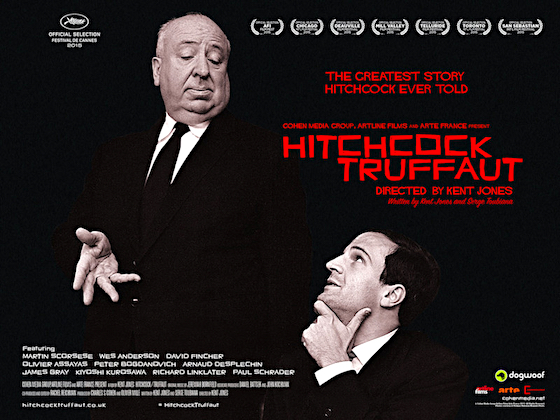
    In 1962, film directors Alfred Hitchcock and François Truffaut locked themselves away in Hollywood for a week to excavate the secrets behind the mise-en-scène in cinema. Based on the original recordings of this meeting — used to produce the mythical book Hitchcock/Truffaut — this film illustrates the greatest cinema lesson of all time… Hitchcock’s incredibly modern art is elucidated and explained by today’s leading filmmakers, who discuss how Truffaut’s book influenced their work. — adapted from IMDb

    This film version of Hitchcock/Truffaut is about so much at once. On balance, it’s mostly about analysing Hitchcock’s films; but it’s also about the interview itself; and the importance and impact of the book, both on the general critical perception of Hitchcock and how it influenced specific directors; but it’s also about how Hitchcock’s actual films have influenced those directors; and there’s also insights into directing from those directors; and also some bits on Truffaut’s films, and the differences between him and Hitchcock as filmmakers. Whew!

    It’s a funny film, really: it acknowledges the book’s influence, but doesn’t really dig into it; it analyses some of Hitch’s obsessions and films (most especially Vertigo and Psycho), but not comprehensively. Some have said it feels like a companion piece to the book; I’ve not read the book, but I can believe that — if the book were a movie, this would be a special feature on the DVD. Less kindly, you could call it a feature-length advert — certainly, I really want to get the book now. (I got it as a Christmas present not long after. I’ve not read it yet.)

    That said, here’s an iInteresting counterpoint from a Letterboxd review: “One of the things (just one) that makes the book so essential is that it’s a discussion of the craft of filmmaking from two (very different) filmmakers. In adding commentary from a wide variety of other directors, Jones highlights that element of the book while widening and updating its focus: it isn’t just a conversation between Hitchcock and Truffaut, but between those two men and David Fincher, and James Gray and Kyoshi Kurosawa and Arnaud Desplechin, etc. Rather than a mere supplement to the book, a video essay adding moving pictures to the book’s conversations, Jones’s film builds something new and on-going upon it.”

    I didn’t think Hitchcock/Truffaut (the film) was all it could be; and yet, thanks to the topics discussed and people interviewed, it’s still a must-see for any fan of Hitchcock, or just movies in general.

    4 out of 5

  • The IMDb New Filmmaker Award 2020

    Last night on AMPLIFY!, FilmBath presented the 9th annual IMDb New Filmmaker Award, in which a trio of industry judges choose the best short film by a new filmmaker (clue’s in the name). The winner gets £1,000 cash, £1,000 in gear hire for their next project, a natty trophy, and an IMDb pin badge (normally only given to IMDb employees). If you missed the evening, never fear: the whole 90-minute event is available to rewatch for free, worldwide, here.

    Why would you watch an awards show after it’s happened? Well, in this case, you get to hear the judges’ musings on what makes a good film — and when those judges are BAFTA-nominated director Coky Giedroyc (The Virgin Queen, How to Build a Girl), Oscar-nominated and BAFTA-winning producer Amanda Posey (An Education, Brooklyn), and the CEO of IMDb, Col Needham, those are opinions worth listening to. Even better, you get to watch the five nominated shorts in full, and they’re good a bunch.

    But don’t just take my word for it: take my, er, word for it, in the form of these reviews…

    If you do intend to watch the awards, fair warning: I’m going to ‘spoil’ who won.

    Under the Full Moon

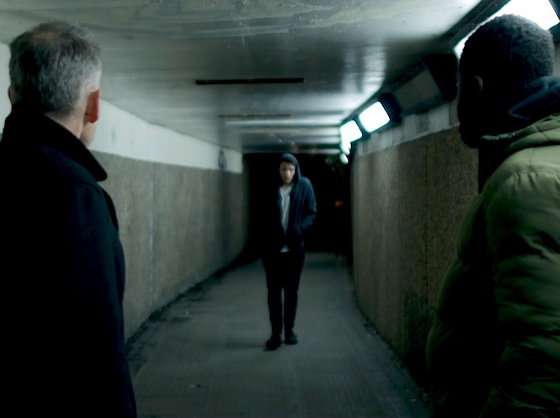
    Taking the films in the order they were shown, first up is Under the Full Moon (2020, Ziyang Liu, UK, English, 9 mins, ★★★★☆), about a guy who has his phone pickpocketed and decides to confront the mugger. The most noteworthy aspect here is the whole short is achieved in a single unbroken eight-minute take. I love stuff done in single long takes; at this point it’s a bit of a cliché to enjoy such things — a real film nerd kind of obsession — but, sod it, it’s still cool. To do a thriller storyline like that — something which requires management of tension and suspense, and of information being revealed at the right time in the right way — is even more impressive. You might say, “well, that’s what theatre is — a drama performed in ‘one take’”, but theatre doesn’t have to factor in camerawork; making sure we’re seeing the right stuff at the right time, framed in the right ways. Under the Full Moon manages every different element almost perfectly, the only real flaw coming right near the end, when the camera fails to clearly capture a phone screen with an incoming call, so the director resorts to a subtitle to make sure we get this final ironic twist. And that’s the other thing: this isn’t just a technical stunt, or an exercise in escalating suspense, but a dramatic work with some neatly-drawn character parts and a sense of dramatic irony. Really strong work.

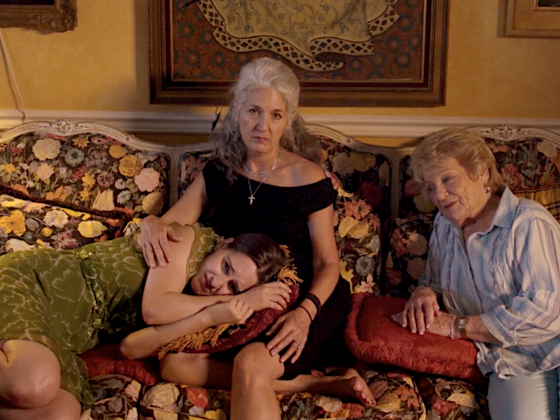
    The winner (told you I’d spoil it) was Flush Lou (2020, Madison Leonard, USA, English, 9 mins, ★★★★★), and I entirely agree. It’s a black comedy about the reaction of three women to the death of a man: his daughter (who narrates), his wife, and his mother. It’s got a quirkiness that could be inappropriate, but the tone is juggled just right that it remains hilarious rather than at all distasteful. It’s there in the performances, the shot choices, the editing — the piece really works as a whole to hit precisely the right note. It might call to mind the work of someone like Wes Anderson, but it’s far from a rip-off; it also reminded me of certain just-off-reality American-suburbia-skewering TV shows, like The Riches or Suburgatory (I’m sure there are some more mainstream examples that are eluding my reach right now). Also, it manages to pack eight chapters into its eight minutes, without ever feeling like that’s an unnecessary affectation; if anything, it helps clarify the structure, which is exactly the kind of thing chapters are good for. A huge success all round.

    Flush Lou

    At the other end of the seriousness spectrum was the winner of the audience vote, The Monkeys on Our Backs (2020, Hunter Williams, New Zealand, English, 8 mins, ★★★★★), a documentary about the mental health of farmers in New Zealand. I think we often have a very positive view of New Zealand — they seem like nice people; their government is doing awesomely well; they make great movies; they’re good at rugby; and so on. But the country has one of the highest suicide rates in the developed world, and mental health problems disproportionately affect those living and working in isolated rural communities. This is not only a succinct explanation of the problems, with real-life examples as well as expert opinions, but also talks about the solutions, what help is out there and how it’s working. Plus it’s a beautifully shot film (some outtakes in black & white at the beginning show the fundamental quality underlying the colour photography in the rest of the film), with lovely views of countryside life, as if to help remind you that the world is a wonderful place. A wholly different film to Flush Lou, but an equally deserving winner.

    The shortest of this year’s five is Players (2020, Ava Bounds, UK, English, 3 mins, ★★★★☆), but that’s not the most noteworthy thing about it. This is: it was made by a 14-year-old. But you’d never guess, because it has a competency and, more strikingly, a surrealism that belies someone much more experienced. Heck, the sound design most reminded me of David Lynch! And the comparison goes beyond the sound work, with an ending that calls to mind some of Lynch’s work where nature and technology clash. Subtitled “a clearly confused film”, I think that was somewhat how the judges felt about its mix of retro costumes and music, computer-generated vocals, and a sci-fi sting in the tail. It’s the kind of film that clearly doesn’t work for everyone — just another way it’s a natural successor to Lynch, then. A 14-year-old making a competition-worthy short film is incredible in itself, but that it also merits so many comparisons to David fucking Lynch? Remarkable.

    The Monkeys on Our Backs

    The final film was Home (2020, Hsieh Meng Han, UK, English, 10 mins, ★★★☆☆), in which a girl living with her mother in a single room in a dingy apartment block finds the communal toilet locked, but then hears music coming from a nearby ventilation grill. Climbing through, she finds herself in a brightly-lit world of opulence, with people in elegant clothes dancing to genteel music, and an array of luscious food on offer. She even makes a friend. But then uptight officiousness arrives in the form of a stuffy manager, who refuses to let her use the toilet. It’s like a modern socially-conscious take on Alice in Wonderland, though I’m not sure what point it was ultimately making — kindness is nice and everyone deserves to be allowed to use the toilet?

    If any of that tickles your fancy, don’t forget you can still watch the whole event, free, here.

    Disclosure: I’m working for AMPLIFY! as part of FilmBath. However, all opinions are my own, and I benefit in no way (financial or otherwise) from you following the links in this post or making purchases.

    The Mole Agent (2020)

    It’s Day 2 of the AMPLIFY! film festival (new content goes live at 1am, FYI). Among today’s additions is the UK premiere of The Mole Agent — one of 18 UK premieres that are part of the festival.

    My review of that in a moment, but first, also debuting today are…

    Incidentally, I’d recommend Rose Plays Julie, an engrossing and powerful psychological thriller (I’ll review it in full soon, time permitting).

    The Mole Agent
    (2020)

    2020 #231
    Maite Alberdi | 90 mins | digital (HD) | 1.85:1 | Chile, USA, Germany, Netherlands & Spain / Spanish

    The Mole Agent

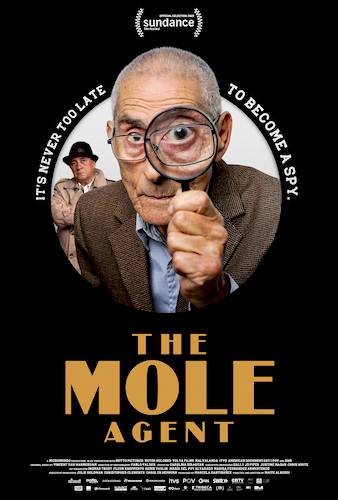
    It’s easy to make The Mole Agent sound like the setup for a comedy: it’s about a doddery 83-year-old who must learn to be a spy. And, indeed, there are scene where the film is very amusing; particularly early on, when the octogenarian in question, Sergio Chamy, struggles to get to grips with the technology he’ll need to use, much to the exasperation of his spymaster, Rómulo Aitken.

    Except that premise, which the film has leant its promotion on (note the tagline on the above poster: “it’s never too late to become a spy”), is slightly misleading. Aitken isn’t a spymaster, he’s a private detective, who’s been hired to investigate allegations of abuse at an old people’s home — hence the need for an old person to go in as an undercover observer. It’s not exactly Bond, or even Le Carré, is it?

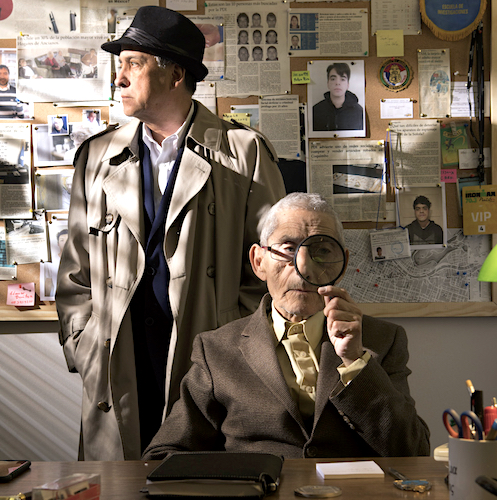
    Indeed, director Maite Alberdi leans into a different genre — film noir — shooting the early briefing scenes with a heavy use of venetian blinds, either peering through them or employing their distinctive shadows. It’s a level of visual panache you’re not used to from a conventional documentary. It might lead you to question if what you’re watching was entirely documentary in nature, were it not for the fact that these scenes take place in the ‘safety’ of the PI’s office —it’s not unreasonable to assume the film crew semi-staged a couple of ‘scenes’ to add a bit of visual interest. (They clearly did it for the promo photos, too. I mean, just look at this one…)

    Secret agent men

    The real questions of form begin to emerge once Sergio begins his undercover mission. To be able to film what he’s up to, the documentary crew have inveigled themselves into the same old people’s home with the cover story that they want to make a film about a new resident — so when Sergio turns up, what a perfect coincidence, and excuse to focus their filming on him. Except… if this care home is abusing its residents, are they going to continue doing that with a film crew present? Heck, surely they wouldn’t even agree to a film being made at all?

    Well, the whole investigative goal goes out the window pretty quickly, anyway. Sergio is initially diligent about snooping around and secretly recording his reports for Rómulo, but he soon begins to make friends and become involved in the life of this little community. The other residents become his friends, and he’s more invested in their wellbeing as their comrade than as an outside observer. Concurrently, the film becomes less interested in the comedic fumbles of an octogenarian secret agent, and more in exploring the lives of these old people. Sergio’s fellow residents aren’t faceless possible-victims, but characters we get to know too.

    What Sergio ultimately finds (spoilers!) is neglect — not by the staff, but by the families that shoved their elders away and forgot about them. For the film, that’s a much bigger observation; one on the state of society as a whole, rather than the misdeeds of a single care home. (If anything, the home is wholly vindicated, because we see how much they care for and support their residents.)

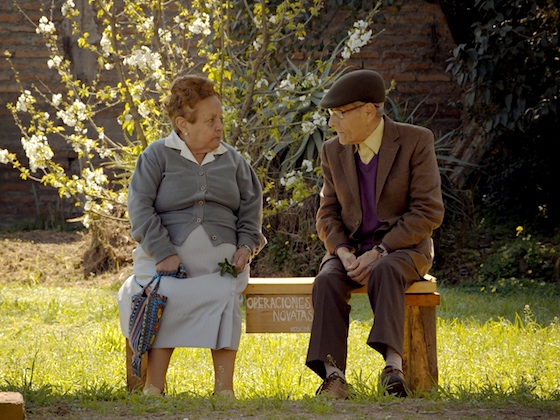
    Friends to the end

    If The Mole Agent has a fault it’s that it can be a little slow at times — though, given the pace these (often delightful) oldies move at, perhaps that was unavoidable. But it’s worth the investment nonetheless, because it’s ultimately a powerfully affecting experience. It’s a film that intrigues you with its laughable premise, then swings round to punch you in the emotions with a crystal-clear message.

    4 out of 5

    The UK premiere screening of The Mole Agent is on AMPLIFY! until Friday 13th November. It’s on general release in the UK from 11th December.

    Disclosure: I’m working for AMPLIFY! as part of FilmBath. However, all opinions are my own, and I benefit in no way (financial or otherwise) from you following the links in this post or making purchases.

    Jodorowsky’s Dune (2013)

    2018 #228
    Frank Pavich | 90 mins | Blu-ray | 1.78:1 | France & USA / English, French, German & Spanish | 12A / PG-13

    Jodorowsky's Dune

    In 1974, director Alejandro Jodorowsky was hot off a pair of psychedelic projects — “acid Western” El Topo and surrealist fantasy The Holy Mountain — that had brought some cult attention and success (El Topo was the original “midnight movie”, while The Holy Mountain was apparently second only to that year’s Bond film at the Italian box office). Consequently, his French distributor, Michel Seydoux, offered to produce whatever he wanted to do next. Jodorowsky’s answer was Dune. He’d never read it, but he had a friend who said it was fantastic.

    So begins the crazy story of how a director of surrealist Mexican art-films came this close to making an epic space opera out of one of the most acclaimed science-fiction novels ever written, but, in his failure, accidentally helped give birth to Star Wars (sort of), Alien (indirectly), and possibly the entire history of screen science-fiction that did actually get made in the ensuing 40 years. Sounds like a bit of a stretch? Um, well, yeah… but that doesn’t stop some of this documentary’s contributors from asserting it, and they do kind of have evidence.

    Mind you, Jodorowsky’s Dune is full of interviewees making grand assertions, not least the eponymous filmmaker himself. He unironically describes his Dune as “the most important picture in the history of humanity”. He pitches himself as a prophet, thinks of his crew as spiritual warriors, and is convinced the film was going to be a great message for humanity; that it would literally change the world. The lack of self-awareness when he considers Douglas Trumbull to be full of his own importance is palpable. Jodorowsky’s regard for himself and the project may seem deluded, but at least he was committed. They spent two-and-a-half years developing this movie, including storyboarding every shot and getting exactly the right kind of people for the cast and crew — he pursued Dalí literally around the world to persuade him to play the Emperor; he rejected Trumbull, not because of an ego clash, but because he felt he was a technician rather than a spiritual person. He’s a bit barmy, but Jodorowsky definitely believed what he was doing was some grand transcendent enterprise.

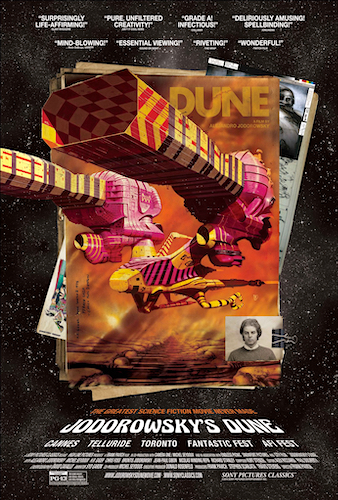
    A Chris Foss spaceship design for Dune

    Such an attitude might get you far with arty types, but it doesn’t wash with the moneymen of Hollywood. The film had a projected budget of $15 million, and they went to the Hollywood studios seeking the last $5 million. In hand they had a giant tome containing all the storyboards, the costume and production designs, and so on. The book convinced them — it was well planned out and reasonably costed — but this barmy director — whose only previous films were weird psychedelic experiences; whose response to “make it under two hours” was, “why? If it needs be, it’ll be 12 hours, or 20!” — he didn’t fill them with confidence. And so they didn’t get the money, and the film fell through. Well, duh. Surely they could see how that was going to go? Maybe people just weren’t as savvy in the ’70s, especially these optimistic, committed artists.

    All the documentary’s interviewees act like this was a problem with Hollywood moneymen having no vision, but c’mon, it’s easy to see where they were coming from. Plus, the fact that “the book convinced them” is just the word of Seydoux. Maybe Jodorowsky’s history and attitude was just a convenient excuse, because a lot of the stuff that was designed and planned is quite out there, especially to the mind of a ’70s Hollywood suit. It brings us back to how everyone’s making grand assertions: they all act like the film was going to be an unquestionable masterpiece, but it seems to me there’s a much higher chance it would’ve been terrible. For one thing, there’s doubt over if they even could have made it. It was an insanely ambitious project, with plans to do things George Lucas wouldn’t even attempt in the prequel trilogy, never mind what he struggled to get done in 1977. But there’s a first time for everything — 2001 still holds up, after all, and that was made seven years earlier. Still, I don’t know how successful Jodorowsky’s surrealist mindset would’ve made it as a movie — it probably would’ve been even less palatable to a mainstream audience than the Lynch version.

    Dune storyboards

    That said, there seems little doubt Jodorowsky was ahead of his time here. For starters, the idea of making a 12-hour film isn’t so ludicrous anymore. In the deleted scenes (there’s a hefty 46 minutes of them on the Blu-ray), he acknowledges people wouldn’t sit through that, saying he was prepared to release it in chunks if necessary — so, just like Lord of the Rings would do to huge success 25 years later? Jump forward another 20 years, and it’s even how they’re doing Dune, in two parts! Of course, it was unprecedented in 1975; and, decades later, Rings was still seen as a gamble, but it paid off and Hollywood is now littered with franchises where instalments connect up as closely as TV series. And what of TV series, where you’re also seeing 12-hour (or longer) single narratives.

    Aside from general questions of form, when you look at some of Dune’s storyboards and plans you can see mirrors to stuff that wouldn’t be done until later. This is where the claim that Jodorowsky’s work on Dune led to Star Wars, Alien, et al, comes from, because you can see parallels between what he did and what would come after. His film was never made, but they produced 20 copies of that book I mentioned, and only two are known to exist (one with Jodorowsky, one with Seydoux). The rest were left with Hollywood studios. Were they passed around behind-the-scenes? Did the likes of Lucas and Spielberg and Ridley Scott and Mike Hodges and James Cameron really see them and pilfer ideas? Or is it just coincidence — Jodorowsky thought of them first but couldn’t execute them, then others thought of them independently and pulled it off. Pick your own side.

    However, the claim that Dune led almost directly to Alien is less dubious. After he rejected Trumbull, Jodorowsky saw John Carpenter’s Dark Star and was impressed enough to hunt down its visual effects guy, Dan O’Bannon. Concept artists he hired included Chris Foss (painter of sci-fi book covers, mainly spaceships); Moebius (French comic book artist, for costume designs and storyboards); and H.R. Giger (German artist, who designed the dark and twisted world of the film’s villains). Those who know their Alien history might recognise all of those names: after Dune fell through, O’Bannon went on to write Alien, and all three of those designers followed on to the project. Maybe Alien would have come together just as well without the lead-in from Dune, we’ll never know, but those connections are pretty striking.

    Giger at work on Dune

    Lest you feel bad for everyone just ripping Jodorowsky off, he was able to recycle some of the ideas himself. His vision for Dune was only broadly faithful (one of the better deleted scenes is about his attitude to adaptation, which it seems Frank Herbert agreed with; i.e. that it’s not about being faithful, but reimagining something as a new, different work of art), and so he had plenty of fresh ideas that, presumably, weren’t tied up in the rights to Dune. Jodorowsky and Moebius piled some of these directly into later comic book collaborations, like The Incal and The Metabarons. A good idea never dies, I guess. Well, whether they were good ideas or just good in Jodorowsky’s mind, I don’t know. It does make me interested to read those books, though.

    Jodorowsky’s Dune is an interesting “what if” in the history of science-fiction cinema, and this documentary does a good job of being a making-of for a movie that was never made. (If you think this review reads like I’ve just regurgitated the entire story, I promise, there’s a lot more in the film; not to mention the unique benefits of hearing it from the horses’ mouths, rather than my abridgement for the sake of appending my own opinions.) Some critics assert the documentary does more than just recount interesting anecdotes; that it offers some kind of transcendent viewpoint about the creation of art. Maybe if you’re of a similarly spiritual disposition to Jodorowsky himself, that’s what you’ll take from it. For me, it’s most interesting as a window into what might have been. If it had been made, would Jodorowsky’s Dune occupy the place of Star Wars in our culture? Its devotees think so. I don’t, to be honest. But it’s fun to think about.

    4 out of 5

    The trailer for Denis Villeneuve’s new adaptation of Dune will be released later today.

    The 100-Week Roundup IX

    I’ve not been doing too well with reviews lately — this is my first for over a fortnight, having missed self-imposed deadlines for the likes of Knives Out (on Amazon Prime), The Peanut Butter Falcon (on Netflix), Joker (on Sky Cinema), and Spaceship Earth (on DVD & Blu-ray). I’ve also slipped on these 100-week updates — this one should really have been at the end of July, and there should’ve already been another in August, with a third due soon. Oh dear.

    So, it’s catchup time, and it begins with my final reviews from August 2018

  • The Most Unknown (2018)
  • Zorro (1975)


    The Most Unknown
    (2018)

    2018 #185
    Ian Cheney | 92 mins | digital (HD) | 2.35:1 | USA / English

    The Most Unknown

    This film is an experiment. Nine scientists meet for the first time in a chain of encounters around the world. It begins under a mountain, and ends on a monkey island.

    In this documentary, nine scientists working on some of the hardest problems across all fields (the “most unknowns”) meet each other in a daisy chain of one-on-one interviews / lab tours. It not only touches on the basics of what the unknowns they’re investigating are, but also how they go about investigating or discovering these things — the day-to-day realities of actually “doing” Science. Alongside that, it reveals the scientific mindset; what motivates them. The nine individuals are very different people working on very different problems in very different fields, but the film draws out the similarities in their natures that drive them to explore the unknown.

    If you’re concerned it might be all a bit “inside baseball” if you’re not a science geek, don’t be. These people work in vastly different fields — to us laypeople they’re all “scientists”, but to each other their specialities make them as different from one another as we are from them. This, arguably, is an insight in itself. It feels kind of obvious — of course a physicist and a microbiologist are completely different types of scientist — but I do think we have a tendency to lump all scientists together. Think of news reports: it’s not “chemists have discovered” or “psychologists have discovered”, it’s “scientists have discovered”.

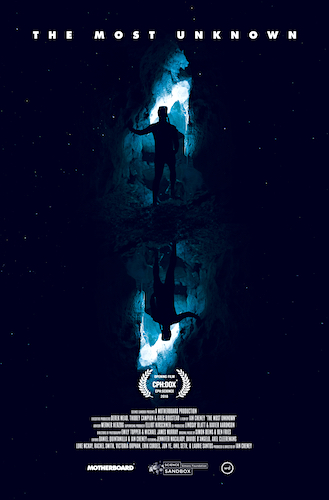
    Science, innit

    It also reminds you that scientists are humans too, via little incidental details. For example, the equipment that vibrates samples to sheer out the DNA is labelled, “My name is Bond, James Bond. I like things shaken, not stirred.” Or the woman who plays Pokémon Go on her remote research island, because the lack of visitors means you find really good Pokémon there.

    You might also learn something about movies. The last scientist, a cognitive psychologist, talks about how people assess the quality of movies. Turns out, rather than considering their overall experience, they tend to focus on two points: the peak of how good it was, and how it ended. Pleasantly, this kinda confirms my long-held theory that an awful lot of movies are judged primarily on the quality of their third act. (My exception to this “rule” has always been films that lose you early on and put themselves on a hiding to nothing. Well, science can’t explain everything, I guess.)

    Plus, as a film, it’s beautifully shot. A lot of this science is taking place in extreme locations, which bring with them a beauty and wonder of their own.

    4 out of 5

    The Most Unknown is currently available on YouTube from its production company, split into nine instalments. (It used to be on Netflix, but was removed just the other day. If I’d published this review on time…)

    Zorro
    (1975)

    2018 #186
    Duccio Tessari | 118 mins | digital (HD) | 1.85:1 | Italy & France / English | PG / G

    Zorro

    This Italian-French version of the adventures of the famous masked vigilante (played by the great Alain Delon) is tonally similar to Richard Lester’s The Three Musketeers: genuine swashbuckling (including some elaborate stunt-filled sequences) mixed with plenty of humour and daftness. Plus, being set in 19th century California but filmed in Spain, it also has more than a dash of the Spaghetti Western in its DNA. The whole mix makes it a lot of fun.

    Of particular note is the final sword fight, an epic duel for the ages. It sees Zorro and chief villain Colonel Huerta pursue each other around the castle, clashing blades at every turn, at first accompanied by a crowd of spectators but, as their fight moves higher and higher, ending atop the bell tower, each with a rapier in one hand and a flaming torch in the other, thrashing their weapons at each other with all the vigour and vitriol of men who really, really want to kill each other.

    Another highlight is, arguably, the cheesy main theme. On the one hand it’s slathered all over the film inappropriately; on the other, it underlines the light, silly, comic tone. Plus it’s sung by someone called Oliver Onions. Can’t beat that.

    4 out of 5