Our Kind of Traitor (2016)

2016 #191
Susanna White | 108 mins | streaming (HD) | 2.35:1 | UK & France / English, Russian & French | 15 / R

Our Kind of Traitor

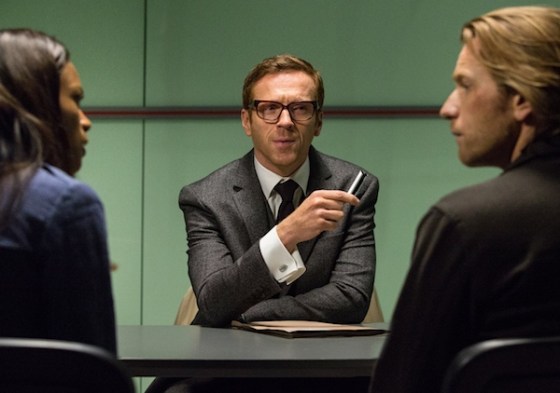
Based on a John le Carré novel, Our Kind of Traitor sees a couple of holidaying Brits, Perry and Gail MacKendrick (Ewan McGregor and Naomie Harris), befriending a Russian chap called Dima (Stellan Skarsgård), who it turns out has links to the Mafia and wants our hapless heroes to deliver an information-filled USB stick to British intelligence. As MI6 (primarily represented by Damian Lewis) seek to act on the information, the MacKendricks get drawn into the espionage game thanks to their relationship with Dima.

Some of Traitor’s detractors have a problem with it right from the off, finding the premise to be inherently ridiculous. I disagree. In fact, I think it’s quite a good plan on Dima’s part: to use an unsuspected casual acquaintance to smuggle important documents to the authorities. The way the MacKendricks continue to be involved does wind up stretching credibility, but that’s narrative structure for you — it’d be a real trick to construct a satisfying relay of perspective characters.

If anyone could pull that off it’s probably Le Carré, but this is not his most complicated plot — there are even less twists or double-crosses than you’re probably expecting — but as a tense thriller it satisfies often enough. However, Le Carré as author, plus screenwriter Hossein Amini and director Susanna White, seem to be more interested in the story’s real-world resonances. They’re using a thriller plot to bring up the kind of probably-genuine corruption we get in government today. On the one hand it feels a little obvious, especially to those of certain political leanings, but on the other it’s worth highlighting. An impassioned speech by Damian Lewis to some of his superiors sums it up, probably rather too neatly for some discerning critics.
British intelligence

Lewis is always good value, both in scenes like that and in his tentative partnership with McGregor. Although the MacKendricks are our point-of-view characters, the innocent normal people we should relate to, McGregor’s Perry is ultimately a little flat and Harris is underused. The real star is Skarsgård as the gregarious and foul-mouthed Russian banker, who is by turns unsettlingly dangerous and engagingly likeable. Or perhaps it’s the beautiful cinematography by DP Anthony Dod Mantle — the varied international locations are particularly effective at adding scale to a story that’s really about the personal interactions of four or five people.

Our Kind of Traitor is not the very best Le Carré adaptation, especially given the increasing number we’re being treated to these days, but it’s still a reasonably engrossing thriller with something to say about contemporary geopolitics.

4 out of 5

The Saint’s Return (1953)

aka The Saint’s Girl Friday

2016 #154
Seymour Friedman | 65 mins | download | 4:3 | UK / English

The Saint's Return

Long-time readers may remember I reviewed all eight of RKO’s Saint films back in 2012. That series ended amidst an argument over rights (and they replaced it with the ever-so-similar Falcon series, which I also reviewed), but a decade later this continuation movie happened. I wasn’t even aware it existed until it was brought to my attention in the comments on another film. It’s technically not part of the same series (it was made years later by Hammer, believe it or not) so it’s harder to come by, but eventually I tracked it down… as a download that was clearly sourced from a VHS (it even lost tracking at one point!) that was quite possibly recorded off the telly.

The story sees Simon Templar, aka the Saint, rushing back to England to help a friend, but she’s killed in suspicious circumstances before he arrives. Investigating her death, Templar finds she was indebted to the River Gang, and sets about bringing them down.

The Saint, with a girl

Although this was made years after the RKO films and by a different studio, it’s not a reboot or remake. Even allowing for those terms having become more applicable recently than they probably were in the ’50s, The Saint’s Return actually seems to be making a concerted effort to appear connected to the earlier series: near the start there’s a small scene where Inspector Fernack, the Saint’s regular nemesis/ally in the NYPD, acknowledges that Templar has left for England, which serves no purpose other than to suggest a connection to the other films. It’s even shot in a way that’s reminiscent of the older films (though, I don’t know, had low-budget studio filmmaking changed much in the intervening decade?)

That said, there are changes: the Saint is now an American, for no particular reason, and it’s more serious than I remember the other films being; but that might be my memory being clouded by the Falcon films, which were similar but lighter. In a rare feat for these movies, it managed to trick me with a plot twist, as I incorrectly guessed who secretive villain ‘The Chief’ would turn out to be. That’s either an achievement or a sign of me underestimating the film just because it’s old and cheap…

The Saint, with another girl

Taking the lead role is Louis Hayward, who originated the Saint on screen fifteen years earlier in RKO’s first film, The Saint in New York. He only played the role once before, but nonetheless makes a convincing return here. The rest of the cast includes Britain’s answer to Marilyn Monroe, Diana Dors, whose charms haven’t dated, and a minor role for one Russell Enoch — aka William Russell, who’d go on to find fame in the title role of the BBC’s The Adventures of Sir Lancelot, before ensuring his screen immortality as one of the original leads in Doctor Who.

Still, there’s more to The Saint’s Return than before-they-were-famous star-spotting. Although it seems to be the black sheep of the Saint film family, it’s actually a pretty good little thriller. Indeed, there were definitely worse films in the series proper. I’m not going to quite stretch to four stars for it but, for fans of the series, it’s worth tracking down.

3 out of 5

Review Roundup

In today’s round-up:

  • Partners in Crime… (2012)
  • Charlie Bartlett (2007)
  • Florence Foster Jenkins (2016)


    Partners in Crime…
    (2012)

    aka Associés contre le crime… “L’œuf d’Ambroise”

    2016 #189
    Pascal Thomas | 105 mins | streaming (HD) | 1.85:1 | France / French & Italian | 12

    Partners in Crime…

    André Dussollier and Catherine Frot star as Agatha Christie’s married investigators Tommy and Tuppence (here renamed Bélisaire and Prudence) in this third in a series of French adaptations of Christie stories (best I can tell, the first two aren’t readily available in English-friendly versions).

    Based on the short story The Case of the Missing Lady, it sees Tommy and Tuppence Bélisaire and Prudence investigating the disappearance of a Russian heiress at a suspicious health farm, while also quarrelling about their relationship. It’s very gentle comedy-drama, even by the standard of Christie adaptations, with a thin mystery, thin humour, and thin character drama, which all feels a little stretched over its not-that-long-but-too-long running time. I shan’t be seeking out its two antecedents.

    2 out of 5

    Charlie Bartlett
    (2007)

    2017 #9
    Jon Poll | 97 mins | streaming (HD) | 1.85:1 | USA / English | 15 / R

    Charlie Bartlett

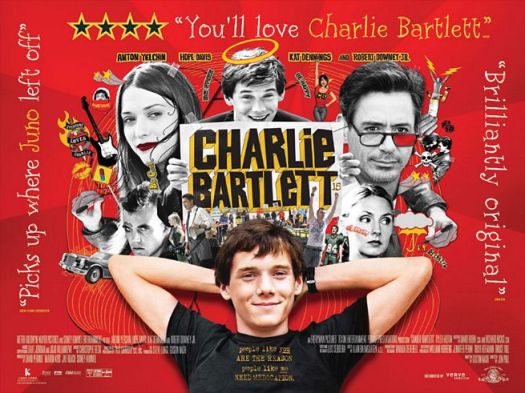
    Anton Yelchin is the eponymous rich kid trying to fit in at a regular high school, which he does by becoming an amateur psychiatrist to his classmates, in a comedy-drama that plays as the ’00s answer to Ferris Bueller. It starts out feeling rather formulaic and predictable, running on familiar high school movie characters and tropes, but later develops into something quite emotional. It’s powered by excellent performances from Yelchin and Robert Downey Jr, as the school’s unpopular and unprepared principal.

    4 out of 5

    Florence Foster Jenkins
    (2016)

    2017 #34
    Stephen Frears | 106 mins | streaming (HD) | 2.35:1 | UK / English | PG / PG-13

    Florence Foster Jenkins

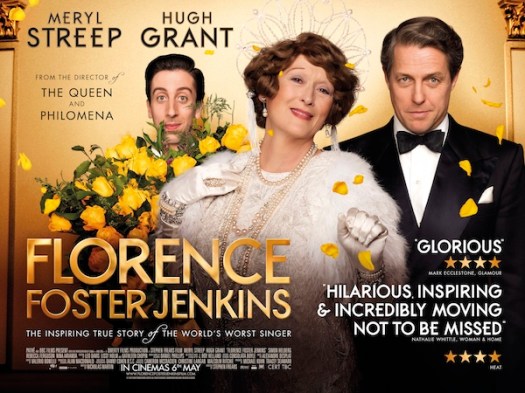
    Try to ignore the fact Meryl Streep nabbed an Oscar nomination away from someone more deserving (for example, Amy Adams. Well, no, definitely Amy Adams), and she gives a good turn as the titular society lady who couldn’t sing for toffee but thought she was fantastic, and used her wealth and influence to launch a concert career. She’s only enabled by her doting… assistant? Lover? Husband? You know, the film blurs that line (deliberately, I think) and I’ve forgotten what he was. Anyway, he’s played by Hugh Grant, who is also good.

    It’s a gently funny comedy, as you’d expect from the subject matter, but one that reveals a surprising amount of heart and depth through Florence’s attitude to life, as well as how her men (who also include The Big Bang Theory’s Simon Helberg as the third lead; also good) attempt to care for her needs.

    4 out of 5

  • Hell or High Water (2016)

    2017 #19
    David Mackenzie | 102 mins | streaming (HD) | 2.35:1 | USA / English | 15 / R

    Hell or High Water

    Oscar statue2017 Academy Awards
    4 nominations — 0 wins

    Nominated: Best Picture, Best Supporting Actor, Best Original Screenplay, Best Editing.


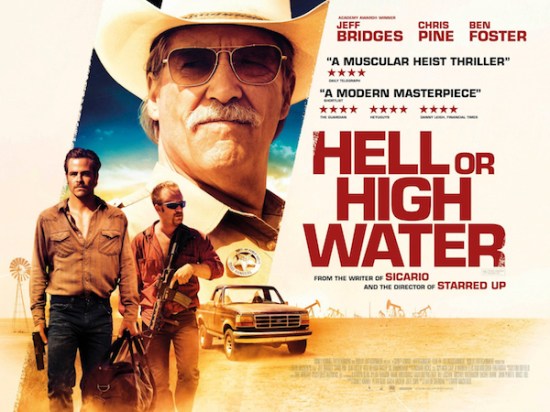
    The line between right and wrong, legal and illegal, is blurred once again by the writer of Sicario in this tale of two brothers (Chris Pine and Ben Foster) committing a series of bank robberies for reasons beyond greed, and the two Texas Rangers (Jeff Bridges and Gil Birmingham) hunting them down.

    I don’t think it would be unkind to describe Hell or High Water as a genre picture: it’s a crime thriller about bank robbers and the police out to catch them, with its setting and tone also bringing something of the Western — or, rather, neo-Western. (It bugs me a little when people refer to films not set in the Old West as “Westerns”, because that seems an inherent part of the genre to me. Naturally, the term “neo-Western” has already been coined, and I feel it’s one we should start using more widely.) There is something more to it than that though, which might explain its slightly incongruous presence among 2017’s Best Picture nominees. In part it’s a social drama, the characters’ motivations based in very topical concerns, including their plan that represents a form of revenge against the banks who have it coming.

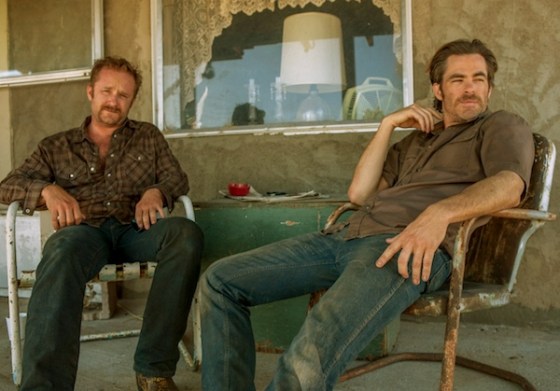
    Pair of crooks

    In another part it’s a character drama. Indeed, the acting is the best part. Jeff Bridges subsumes himself in the character, an old lawman on the verge of retirement, but still sharp and capable, who won’t know what to do with himself once he’s put out to pasture — this is his last great hurrah. He got all the plaudits because he’s Jeff Bridges, but it doesn’t feel massively outside his wheelhouse. Conversely, Chris Pine is practically a revelation. Best known for leading blockbusters, here he convinces as a father who’s finally trying to do the right thing for the future of his kids, whether that thing is legal or not. When these two finally come face to face, it’s nail-biting. That’s to do no disservice to Ben Foster, as Pine’s wildcard brother, who perhaps has less honourable intentions; or Gil Birmingham as a fellow Ranger, who Bridges spends most of the film mercilessly teasing, though it turns out conceals an underlying affection for his friend.

    Credit is also definitely due to director David Mackenzie, who certainly has an eye for a shot and a way with constructing an action sequence, for which credit must also be due to editor Jake Roberts. Similarly to cinematographer Giles Nuttgens, who evokes a dusty West Texas with its own kind of sandblasted desolate beauty.

    Pair of cops

    Hell or High Water is a very good film, a neo-Western crime thriller genre movie that is exceptionally well directed, shot, and performed. Yet somehow it feels out of place among the Best Picture nominees — like, it’s not that good. Of course, Oscar has a long history of nominating films that aren’t good enough, and Hell or High Water is better than most of them. So while I don’t feel I can stretch to giving it five stars, I certainly recommend it highly.

    4 out of 5

    Hell or High Water is available on Amazon Prime Video UK from today.

    Nightcrawler (2014)

    2017 #63
    Dan Gilroy | 118 mins | Blu-ray | 2.40:1 | USA / English | 15 / R

    Nightcrawler

    Dan Gilroy’s neo-noir thriller is part “state of the nation” observational drama and part character study.

    The character in question is Louis Bloom (Jake Gyllenhaal), a young man who, like so many in modern America, struggles to find paid employment. Indeed, as the film opens he’s resorted to stealing fences to hawk to scrap metal dealers — and, when cornered by a security guard, also resorts to violence. That’s the kind of man Bloom is, which will become important as the film goes on. On his way home he comes across the aftermath of a near-fatal car accident, and witnesses the freelance news cameramen rushing to the scene. For some reason this job strikes Bloom as glamorous, so he buys a camera and a police scanner and throws himself into it. His boundary-pushing enthusiasm soon puts him on the way to success, racing around nighttime L.A. chasing bloody imagery. It’s a cutthroat industry, but Bloom is prepared to go pretty far for exclusive footage…

    Any well-informed viewer isn’t likely to glean much from Nightcrawler about the state of modern America. That Bloom is desperate for employment is more of an inciting incident than a dissected issue, though it does also partially fuel a subplot when he employs an assistant. That US TV news is all about shock value — “if it bleeds it leads” — is a truism that’s decades old, too. If the film contributes anything to that discussion it’s to wonder if things have reached a nadir. Writer-director Gilroy says he was trying to tell an objective and realistic story, but it’s coming from a very cynical, almost satirical place about TV news. Or maybe local US news really is that extreme, I don’t know. Either way, this observational stuff isn’t bad, but nor is it revelatory.

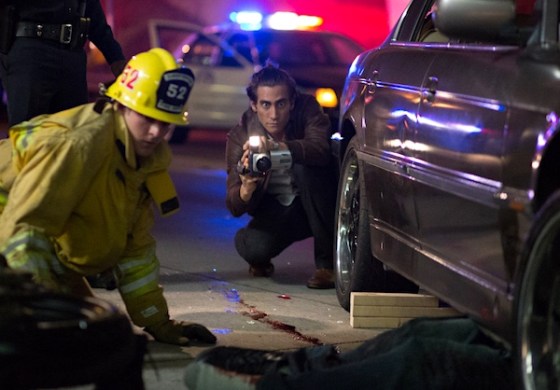
    If it bleeds it leads

    Where the film really flies is in its characters. There are impressive supporting performances, from Riz Ahmed as the uncertain and kinda gullible young guy Bloom employs as his assistant, and Rene Russo as the outwardly confident but actually kinda desperate TV news producer Bloom sell his work to; plus an almost cameo-level appearance by Bill Paxton as a rival nightcrawler who rubs Louis up the wrong way.

    But the film belongs to Gyllenhaal. Wild-eyed, eager to please, but not quite right in how he interacts with other human beings, and with a real thirst for the gory profession he lands upon, Bloom has a sense of morality that is quite removed from the norm. From the start we’re in no doubt that this is a guy prepared to take relatively extreme measures to secure what he wants, but how far will he go? As he begins to establish himself as a respectable businessman — or, at least, someone who wants to be thought of as respectable — how much has his attitude changed, if at all? Gyllenhaal immerses himself in the role, skilfully negotiating Bloom’s swings from smarmy charm to emotionless non-engagement with the horrors he films. He’s physically transformed too: he lost weight, didn’t eat, and stayed up nights in preparation for the role. On the Blu-ray, Ahmed comments that the literal hunger Gyllenhaal was enduring contributed to his performance as a guy who is so hungry (for success) he’ll do anything necessary to achieve it.

    (Talking of the Blu-ray, its only special feature (aside from an audio commentary) is a five-minute featurette that briefly features the two real-life nightcrawlers who consulted on the film. They share a couple of quick anecdotes about what the real job is like, which is quite fascinating — it’s a shame there’s not a fuller feature about those guys and their work. I don’t know if it would sustain a whole feature documentary — maybe it would — but a decent-length DVD extra would’ve been nice.)

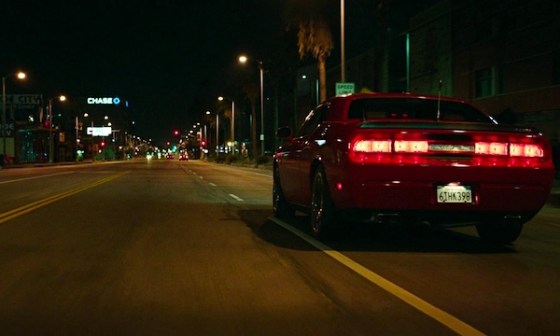
    Nighttime L.A. car chase

    Outside of its characters, Nightcrawler impresses with technical merits. The lensing of nighttime L.A. by DP Robert Elswit is highly evocative, a netherworld where flashing red-and-blue lights illuminate scenes of carnage. The film’s pace is apparently unhurried but constantly engrossing. You’re not exactly sucked into this world alongside Bloom (Gilroy’s right that presenting him as unnecessarily aggressive upfront serves to stall sympathy from the viewer), but you become an interested observer, unable to look away — like a rubbernecker at an accident, appropriately enough. Several scenes, especially in the film’s second half, generate a level of nail-biting tension, while a climactic car chase is an action scene for the ages. Gilroy’s brother Tony, a producer on the film, was one of the architects of the Bourne franchise, and you wonder if he brought some expertise to the realisation of that sequence. This isn’t a film for adrenaline junkies on the whole, but that scene is a kick.

    Driven by a sharp character examination from writer-director Dan Gilroy, brought to life in a compelling, committed performance from Gyllenhaal, Nightcrawler is an appropriately cynical exploration of modern morality as embodied by one outsider, moulded in the shape of a fantastic noir thriller.

    5 out of 5

    The UK TV premiere of Nightcrawler is on BBC Two tonight at 9pm, after which it will be available on iPlayer.

    Nightcrawler was viewed as part of my What Do You Mean You Haven’t Seen…? 2017 project, which you can read more about here.

    It placed 8th on my list of The 17 Best Films I Saw For the First Time in 2017, which can be read in full here.

    War on Everyone (2016)

    2017 #52
    John Michael McDonagh | 98 mins | streaming (HD) | 2.35:1 | UK / English | 15 / R

    War on Everyone

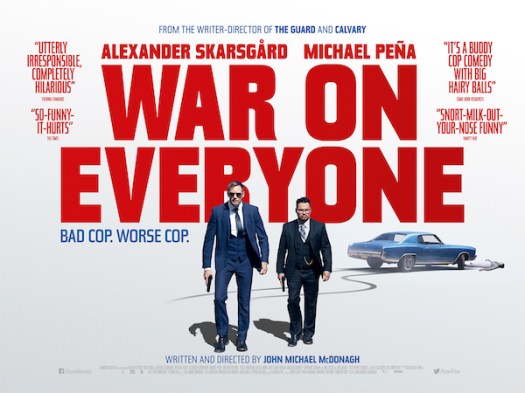
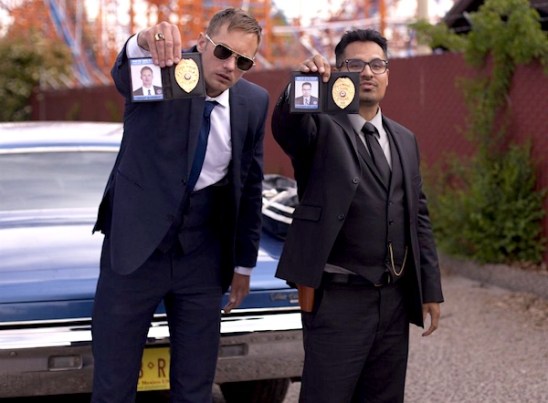
    The third feature from John Michael “older brother of the guy who made In Bruges” McDonagh, War on Everyone is a comedy crime thriller about two dodgy New Mexico cops (Michael Peña and Alexander Skarsgård) who are tricked while trying to prevent a heist and so set about tracking down the stolen money — to pocket for themselves.

    I’ve read that War on Everyone is massively offensive. Well, I mean, if you want to be precious about it, I guess some of it is. Maybe reading that left me expecting something incredibly outrageous, but sadly the film doesn’t hit those highs. I say “highs” — offensiveness for the sake of it is pointless, but some of the best material in the previous movies of the McDonagh brothers has come from a willingness to say and do un-PC things. War on Everyone doesn’t feel neutered in that regard, but nor is anything it does so striking.

    Worse, it has a rambling narrative, wandering pace, and inconsistent tone. It’s not funny enough, frankly, but nor is the crime plot interesting enough to sustain the humour drought. Peña’s comedic gifts carry some of the flat material, though barely, while Skarsgård seems a little lost in an underwritten role. He and Tessa Thompson attempt to salvage something from a romantic subplot that springs from almost nowhere and then occupies a bunch of screen time to no one’s benefit. Caleb Landry Jones fares best as a foppish strip club owner, one of the henchman to Theo James’ big bad, whose entire character is basically, “he’s English — they make good villains, right?”

    Not-so-nice guys

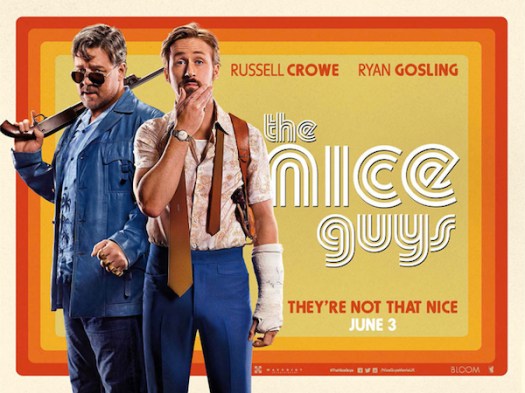
    There are broad similarities to another irreverent comedy thriller from 2006 about a pair of not-so-nice fellas investigating a somewhat-complicated crime plot, but War on Everyone just serves to demonstrate how hard it is to do what Shane Black makes look effortless in The Nice Guys. I thought War on Everyone trailed well and looked like it would hit that same level, or at least something close to it, but sadly the final result feels fumbled.

    2 out of 5

    John Michael McDonagh’s debut feature, The Guard, is on Channel 4 tonight at 12:05am. I’ve got the Blu-ray knocking around somewhere; really ought to get round to watching it…

    Don’t Breathe (2016)

    2017 #21
    Fede Alvarez | 88 mins | streaming (HD) | 2.35:1 | USA / English | 15 / R

    Don't Breathe

    One of the most talked-about thriller-cum-horror movies of last year, Don’t Breathe (which is available on Sky Cinema as of last Friday) concerns a gang of young house burglars — Rocky (Jane Levy), who’s doing it to help get her little sister away from their good-for-nothing parents; her boyfriend Money (Daniel Zovatto), who’s a bit of a dick; and Alex (Dylan Minnette), who’s secretly in love with Rocky, and whose dad runs a security company from which they ‘borrow’ the necessary information to access homes without setting off the alarms. After a big final score, they set their sights on the remote home of a chap (Stephen Lang) whose daughter was killed in a car accident, from which he netted a hefty settlement. Plus he’s blind, so it’ll be easy money. Right? As is no doubt obvious, the blind bloke turns out to have a few secrets up his sleeve… and down his basement…

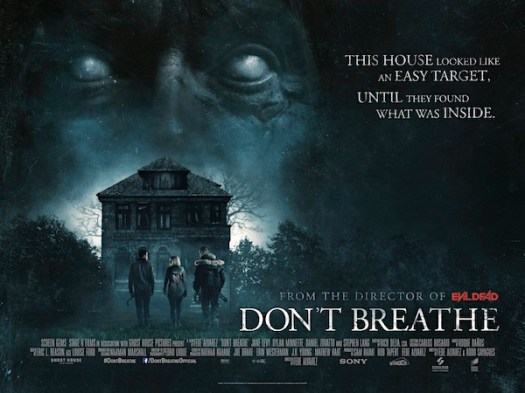
    Despite how it was advertised (doesn’t that poster scream “horror movie”?), really speaking Don’t Breathe is a thriller — it’s about a trio of crooks trying to rob a home and its owner fighting back. Though I suppose it depends what you use to define “a horror movie”, really. I tend to think of them as featuring an enemy who is either supernatural or possibly supernatural, but I suppose the only real prerequisite is that they be scary. Don’t Breathe doesn’t have a supernatural villain (though the blind man’s abilities do stretch credibility), but it’s so gosh-darn suspenseful that the viewing experience is similarly tense to a horror movie, even if outright scares are few. And one memorable scene in particular is certainly classifiable as horrific, most especially for female viewers. So, as a sub-90-minute exercise in mood and thrills it’s a very effective viewing experience; but it’s best not to stop to think about the practicalities if it were real because a lot of the film doesn’t withstand scrutiny. I won’t rehash all of the plot’s logic gaps (there are plenty of articles online that already do that, if you’re interested), but I think it’s best enjoyed as a go-along-with-it experience.

    Bad guys gone good?

    One point of contention for many seems to be the likeability or otherwise of the characters. The ostensible heroes are a gang of crooks who we first meet robbing the home of an undeserving victim, and being needlessly destructive about it too. You might think this sets the blind man up as some kind of avenging hero, but it becomes clear pretty quickly that he’s an even bigger bad guy… so are we meant to side with the crooks after all? For me, this raises a question I’ve come up against before: does a movie actually need to have any likeable characters? Some people need that, for sure, but I don’t think a film does per se. I’m not sure Don’t Breathe has really thought through its position on this issue, which makes reading online commentary about this point a funny thing. For instance, I saw someone argue that the writers make no effort to make us like the burglars — so, what’s the whole thing with Rocky trying to get her sister out of their shitty life for, then? And then another person stated that they actually found themselves liking two of the “bad guys” — so, if the burglars are the bad guys that makes the blind guy the hero? I don’t want to spoil anything, but if you’ve seen the movie you’ll know why holding that opinion is either, a) ridiculous, or b) deeply troubling…

    As I said, it’s best not to think about it too much. I think Don’t Breathe is perhaps the movie equivalent of a theme park attraction: designed to thrill you and scare you during its brief duration, not withstand plot and character scrutiny when dissected afterwards. That’s why my rating errs on the lower side, though if you want nothing more than a gripping hour-and-a-half it maybe merits another star.

    3 out of 5

    Tokyo Tribe (2014)

    2016 #149
    Sion Sono | 112 mins | streaming (HD) | 2.35:1 | Japan / Japanese | 18

    Tokyo Tribe

    Adapted from the manga Tokyo Tribe 2, the film version is a hip-hop musical, sung (or rapped) through by an expansive cast who make up the titular tribes — gangs who rule the streets of a divided near-future (or possibly alternate reality; or possibly it doesn’t matter that much) Tokyo. The world of the story is pretty barmy, and much of the plot follows suit — I’m not going to attempt to describe it, but suffice to say it involves kidnapped girls, rescue attempts, and brewing gang warfare.

    Much of the film does feel like a cartoon brought to life, with the ultra-heightened scenario and larger-than-life scenery-chewing villains — as the big bad, Riki Takeuchi hams it up so ludicrously his performance circles back round into genius. It’d definitely be an adult cartoon, though, because director Sion Sono brings a kind of trash-art, exploitation vibe, with gratuitous helpings of nudity and violence. Indeed, that direction is indicated early on when a young female police officer ventures into gang territory and is grabbed by one of the villains who, in front of a baying crowd, rips open her shirt and begins to trace a knife around her naked breasts to explain the various gang factions. It’s kind of kinky, kind of nasty, kind of distasteful, kind of not (I mean, he is a bad guy) — if you wanted to summarise the feel of the whole film in one sequence, it’s actually not a bad start.

    When too many tribes to keep track of go to war

    I watched Tokyo Tribe out of pure curiosity (a rap musical isn’t exactly my usual kind of thing) but I ended up rather loving it, which is why it made my 2016 top 20. There I summarised that its mix of “battle rap, comic grotesques, ultra violence, gratuitous nudity, more barmy notions than you can shake a stick at, and probably the kitchen sink too, [made it] possibly the most batshit-crazy movie I’ve ever seen.” So those extremes don’t bother me per se (other than to the extent they should bother me), but there’s an undoubted not-for-everyone-ness to a lot of it. That, plus some rough edges, are all that hold me back from giving it 5 stars.

    4 out of 5

    Tokyo Tribe placed 19th on my list of The 20 Best Films I Saw For the First Time in 2016, which can be read in full here.

    Cold in July (2014)

    2016 #118
    Jim Mickle | 106 mins | streaming (HD) | 2.35:1 | USA & France / English | 15 / R

    Cold in July

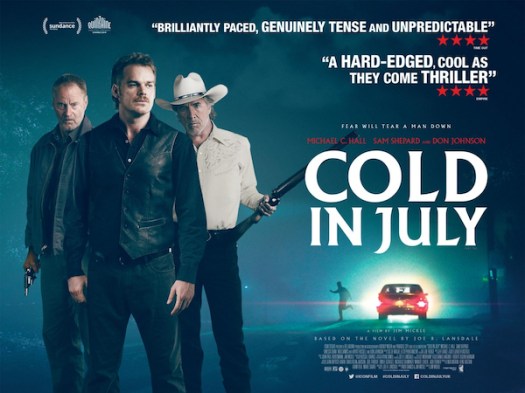
    After a family man (Michael C. Hall) shoots dead an intruder in his home, the intruder’s ex-con father (Sam Shepard) threatens his family.

    People often call for more originality in their stories, then criticise a film like this for jumping around in genre and tone. Personally, I didn’t think it changed much in either. The plot is far from straightforward — twists take the story in unexpected directions with each act (if not even more often) — but as a whole it remains a neo-noir crime thriller.

    Filling out the film beyond its story, there are some great performances — Shepard, in particular, says very little but conveys his whole character and attitude. It’s very nicely shot by Ryan Samul, and there’s an amazing score by Jeff Grace.

    At first blush Cold in July may look like just another crime thriller, but, with an unguessable narrative supported by strong filmmaking, it stands out from the crowd.

    5 out of 5

    Cold in July placed 9th on my list of The 20 Best Films I Saw For the First Time in 2016, which can be read in full here, and also featured on my list of favourite movies from the past decade, which you can read about here.

    The Nice Guys (2016)

    2016 #156
    Shane Black | 116 mins | streaming (HD) | 2.35:1 | USA / English | 15 / R

    The Nice Guys

    I’ve been struggling to think what to write in this review because, really, why I loved this movie can be thoroughly summed up in two words: it’s hilarious.

    Screenwriter Shane Black has been doing this kind of action-thriller buddy comedy for decades now, but he’s still got it where it counts — there are quotable lines galore, and visual gags that would be just as quotable if you could quote a visual. As a director he may not be a great visual stylist or anything, but in an era of ShakyCam and obfuscatory editing, his helmsmanship has a welcome clarity.

    As the titular duo, Russell Crowe and Ryan Gosling reveal heretofore unseen comedic chops (at least as far as I was aware). Crowe is more of the straight man, though gets his share of good lines, while Gosling bumbles around with pratfalls and slapstick, like in a perfectly-executed bit with a toilet cubicle door… which I would quote but, you know, visual gag. Like most of the best characters, they’re entertaining just to be around, often making scenes of exposition as entertaining as actual set pieces. Most of the villains serve as foils for our heroes, but young Angourie Rice shines as Gosling’s clever kid.

    What do you mean there's not much chance of a sequel?

    Tonally, it’s every inch a spiritual sequel to Black’s directorial debut, Kiss Kiss Bang Bang, and I’m very much OK with that. If you copy someone else it’s plagiarism; if you copy yourself it’s your style — you know, that kind of thing. If someone lets Black do another one of these once he’s finished with The Predator — either literally The Nice Guys 2 (as has been mooted, but probably ruled out by the so-so box office) or just something else in the same vein — I would be a very happy bunny.

    5 out of 5

    The Nice Guys is available on Netflix UK from today.

    It placed 11th on my list of The 20 Best Films I Saw For the First Time in 2016, which can be read in full here, and also featured on my list of favourite movies from the past decade, which you can read about here.