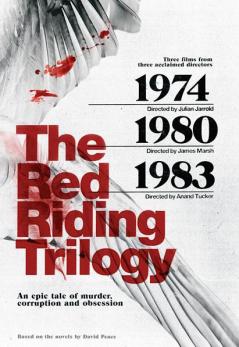
Red Riding: 1980 (2009)

aka Red Riding: In the Year of Our Lord 1980

2009 #51
James Marsh | 93 mins | TV (HD) | 15

This review contains major spoilers.

Red Riding: 1980The second instalment of the Red Riding Trilogy sets out its stall with a stunning opening montage, covering six years of the Yorkshire Ripper case in as many minutes through news footage and faux news footage. In one fell swoop this establishes its own storyline, fills in some of what’s happened since 1974, and sets itself apart from its predecessor: this one’s based on fact. Well, a bit.

Unfortunately, a factual grounding hasn’t helped the story one jot. Where the first idled, this meanders, flitting between the Yorkshire Ripper, the investigation into the Karachi Club shooting (which closed 1974), and the private life of lead character Peter Hunter. It’s the cover up surrounding the middle of these that’s the most interesting, but that’s also the bit with the least time devoted to it. Most is spent on Hunter’s investigation into the investigation of the Ripper case, though by the end it becomes apparent this exists to cover the ‘real’ story — which is, of course, the Karachi Club cover up. Consequently neither are covered with the appropriate depth: the Ripper investigation is never a serious thread, the team we follow uncovering nothing significant and the Ripper himself captured by chance, off-screen, by a previously-unseen regular constable; and the incidents at the Karachi Club, and their lasting impact, are just about clarified but given no serious weight before a last-minute explanation.

If that sounds complicated, it isn’t. As in 1974, it’s all too straightforward: the people you suspect did it actually did, as it turns out, and there’s no serious attempt to conceal that. In fairness, it just about manages one surprise, right at the end, and the moment after this — where Hunter’s murderer shows remorse with one brief, subtle facial expression — is by far the best bit of the film. Worse than the lack of suspense, 1980 seems to forget its own plot all too often. Hunter is employed by the Home Office, for example, and told to report directly to them and them alone. But then we never see those characters again, not even when he’s later dismissed by lower-ranked officers — why not return to the men he was, supposedly, actually employed by? Other plot points are pushed aside too soon, forgotten about or just abandoned.

Characters and locations resurface from the first film — an unsurprising continuity, but pleasingly almost all appear in a context that’s actually relevant to the plot, rather than a mere catch-up on a previously-known person. Some of them have great import now, their role in the trilogy apparently fulfilled, while others remain little more than cameos with no bearing on the story, suggesting an even bigger part still to play. This works quite well, creating a real world where characters come and go rather than one that is obsessively — and unrealistically — interconnected.

The same can be said of the cinematography. Marsh frequently finds a beautiful or unusual shot, enlivening proceedings considerably. The 35mm glossiness doesn’t evoke the feel of a grimy past quite so thoroughly as Jarrold’s hazy 16mm, but as this is now the ’80s perhaps that’s the point. Nonetheless, the setting conveyed is still a drab, dreary — and constantly damp — North.

Underscored by a plot that doesn’t really come together, and largely bears little relation to the other two films, 1980 is the weakest entry in the trilogy.

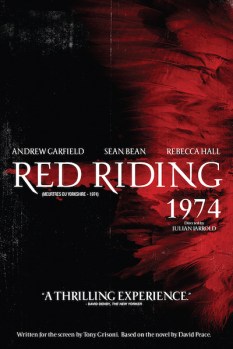
3 out of 5

Red Riding: 1974 (2009)

aka Red Riding: In the Year of Our Lord 1974

2009 #50
Julian Jarrold | 102 mins | TV (HD*) | 18

Red Riding: 1974The Red Riding Trilogy covers nine years of police corruption and child kidnap/murder in Yorkshire, amongst one or two other things, and begins here with a very film noir tale, courtesy of author David Peace and screenwriter Tony Grisoni, slathered in neo-noir stylings, courtesy of director Julian Jarrold.

Jarrold is most recently responsible for Kinky Boots, Becoming Jane and Brideshead Revisited, all of which stand in a sharp juxtaposition to the style and content of Red Riding. But turning from his lovely English-as-they-come costume dramas to something altogether nastier should come as no great surprise, for Jarrold is merely returning to his TV roots: in the mid ’90s he directed episodes of Cracker, Silent Witness and Touching Evil.

He certainly seems to know his territory, but perhaps he knows it too well — though this is also the fault of Grisoni and, perhaps, Peace — as the plot that he unfolds is not only familiar but told as if he’s all too aware we know what’s coming. The feeling one gets is of a British James Ellroy, albeit a low-rent, less complex version. (The same is true of 1980, though for me 1983 manages to escape such comparisons.) The story idles along, not exactly slow so much as in no hurry, full of near-clichéd plot points and an unrelentingly standard structure. These things aren’t necessarily a problem, but when you’ve got as big and bold a reality claim as the Red Riding Trilogy they feel out of place.

Another recent point of comparison would be David Fincher’s Zodiac — young newspaperman on the hunt for a serial killer in an inspired-by-fact ’70s setting — though this does 1974 no favours. It may be grittier than Fincher’s film, but it lacks the polish, the originality, and manages to feel slower, despite being a whole 50 minutes shorter. However much arty photography, disjointed storytelling, relatively dense accents and ‘gritty reality’ is plastered over the barebones of the tale, the familiarity of it — to both viewers and the makers, who don’t even seem to be trying — means there’s not an ounce of suspense or surprise to be had.

The cast is made up of established names, familiar faces and rising stars, many of them unfortunately stuck in familiar roles or otherwise left stranded by the unrewarding material. If they’re not quite stereotypes it’s because they’re too bland, lacking enough discernible character traits to reach such lofty heights. Occasionally this is because, with two films to come, some minor parts here have a major role later, but this can’t be said of them all. As the lead, Andrew Garfield’s journalist is as much of a stock character as the plot he finds himself in: a young reporter type, idealistic among journalists who no longer care (if they ever did), hunting to expose The Truth. Again, it could work, but is belied by the insistence — in both promotion and filmmaking style — that Red Riding is something more than Another Murder Mystery. Only Rebecca Hall, as a mother whose young daughter went missing years earlier, is granted the material to give an outstanding performance — which she does, easily justifying her recent BAFTA Rising Star nomination.

Besides Hall, the best thing about 1974 is its dull, desaturated photographing of grimy, desolate locations, where any colour that isn’t beige desperately wants to be. It suits the story and era perfectly, and the choice of 16mm seems to add a level of haziness that is equally appropriate. It’s perhaps indicative of everything this is aiming for that the most beautiful imagery is of an incinerated gypsy camp. Rendered almost black and white by the soot and desaturisation, ash floats through the air like snowflakes as Garfield stumbles through it, the whole picture a vision of Hell. It’s a kind of perverse beauty, true, but that’s also entirely in keeping with Red Riding.

1974 is a stock noir tale, dressed up with fancy filmmaking techniques and claims of realism to look like something more truthful, more real, more Important. And it makes me a little bit angry because of it. Maybe the violence is more realistically depicted than your average genre entry, maybe the police corruption is a little more plausible — then again, maybe it isn’t — but the real story here is so familiar they haven’t even bothered to hide the plot beats and twists properly, no doubt assuming a “gritty” veneer plastered over the top would do the job for them. It doesn’t. Maybe 1974’s grimy setting, brutal violence and unbeatable police corruption are all true to life, but the familiar and predictable plot leaves the realism feeling like no more than a pretence.

I was enjoying 1974 a lot more by the time the unexpectedly satisfying conclusion came around, but the sense that it had tried to pull the wool over my eyes throughout — and not in the good way a thriller should — just leaves a bitter taste.

3 out of 5

* Though I watched Red Riding: 1974 on 4HD, it’s my understanding that it was upscaled. ^

The Red Riding Trilogy

Red Riding Trilogy UKYou’d think Red Riding was a TV miniseries, wouldn’t you? After all, it was on Channel 4 on the same day for three consecutive weeks (recently repeated over three consecutive nights).
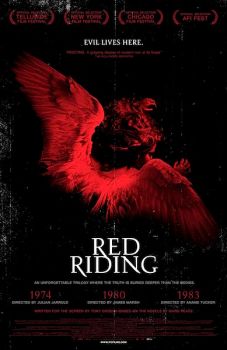
But the promotion — on iTunes, for example, or of Silva Screen’s soundtrack releases — is very keen to make reference not to “Red Riding” — as in, the title of a TV series — but “The Red Riding Trilogy” — as in, a series of films. Indeed, they are frequently referred to as “the films” (and similar variations thereof) in promotion and press, have received screenings at various film festivals and cinema releases in much of the rest of the world, including the US, and several other production and style points could also be rallied to confirm them as a film trilogy rather than miniseries.

As that’s how the makers would most like them to be regarded, then, it seems only fair to treat them as such. And so:


“The feeling one gets is of a British James Ellroy, albeit a low-rent, less complex version. The story idles along, not exactly slow so much as in no hurry, full of near-clichéd plot points and an unrelentingly standard structure. These things aren’t necessarily a problem, but when you’ve got as big and bold a reality claim as the Red Riding Trilogy they feel out of place.” More…

3 out of 5


“Where the first idled this meanders, flitting between the Yorkshire Ripper, the investigation into the Karachi Club shooting, and the private life of lead character Peter Hunter. Most time is spent on Hunter’s investigation into the investigation of the Ripper case, though by the end it becomes apparent this exists to cover the ‘real’ story — which is, of course, the Karachi Club cover up. Consequently neither are covered with the appropriate depth.” More…

3 out of 5


“Tucker’s film bests its predecessors in almost every assessable value. The story and characters have more genuine surprises and suspense than ever, while the performances are at the very least the equal of what’s gone before. Unlike the other two films, where the corrupt cops were little more than cartoon villains despite claims to the contrary, 1983 makes their brutality really felt.” More…

4 out of 5


Red Riding Trilogy USMy final thoughts about Red Riding — other than “that was disappointing” — are stuck on the reality (or not) of the police corruption it portrays. It’s difficult to know whether anyone who believes our police were never so nasty as this is naive, or whether anyone who believes they were quite this bad is paranoid. The truth no doubt lies somewhere in between.
Despite my disappointment with the majority of the Red Riding Trilogy, I intend to return to it some day: considering my enjoyment of the third instalment and the adjusted expectations that come from being disappointed first time round, the potential inherent in the trilogy means it certainly merits revisiting.

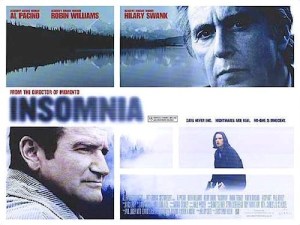
Insomnia (2002)

2009 #33
Christopher Nolan | 113 mins | DVD | 15 / R

This review contains minor spoilers.

The Dark KnightBetween becoming a Geek God with Batman Begins and The Dark Knight and coming to everyone’s attention with a stunning more-or-less-debut that managed to elbow itself right up into the IMDb Top 10 (that’d be Memento — obviously, it’s slipped since), Christopher Nolan directed this: an American remake of a Norwegian police thriller, and the only one of Nolan’s five major films not to be on that be-all of film quality, the IMDb Top 250 (the fifth is of course The Prestige, while Begins is the lowest at #106.) So is Insomnia a forgotten classic robbed of a spot, or just a footnote to the rest of Nolan’s superb career?

These days, there’s a murder mystery/thriller on the TV most weeks — heck, most days thanks to the abundance of repeat-laden digital channels — and so a film attempting one can’t just settle for the usual array of clues, suspects, interviews and twists. Insomnia looks like it’s heading down this road early on — an interview with the victim’s boyfriend in particular could easily slot into any episode of Midsomer Murders or what have you — but soon does what’s required of any film entering this territory these days: it provides more. Most obviously, despite the early plot and stylistic conventions, this is not a “whodunnit”: the killer’s identity is revealed around the halfway mark (assuming you haven’t already guessed it from the opening credits) and from then on the film gradually moves into murky moral territory, quickly leaving behind those early trappings for a set of more complex noir-ish moral conundrums.

Al Pacino’s detective, for example, is a man under pressure — not just from the case, nor the usual clichés of a messy divorce or alcoholism, but from a pending Internal Affairs investigation that may or may not be justified, and an incurable bout of insomnia brought on by the Alaskan summer’s lack of night. The pressure mounts, he makes bad decisions (which I won’t spoil here), and even if the use of these plot points was merely that they occurred it would have offered something above the norm. Hillary Seitz’s screenplay pushes it further however, digging far deeper than usual for the genre into debates about the morals of police work, what seems acceptable and what is acceptable, and perhaps even what should be acceptable. The ending may seem to offer a Hollywoodised “everything’s set right then” denouement, but while it’s true that the plot is neatly resolved the considerations raised are not so easily ignored.

Cast-wise Insomnia fares pretty well. When it was released, around the same time as the excellent One Hour Photo, everyone was amazed at Robin Williams turning in a pair of non-comedic performances. The quality of them both makes it seem only natural now however, leaving that amazement as a distant memory. His turn as novelist Walter Finch here may owe something to Kevin Spacey’s John Doe in Se7en — indeed, Nolan seems to explicitly reference that film in locations such as the corridor of Finch’s apartment building — but isn’t as lowly as an impersonation. Hilary Swank offers able support as wide-eyed young cop Ellie Burr, while Pacino does a good job portraying the confusion induced by lack of sleep, aided by some effective camerawork, editing and sound design.

In the end, the main damage done to Insomnia is inadvertently by its director: while it is undoubtedly above average for a murder mystery/thriller, its relative straightforwardness pales in comparison to the work Nolan’s done before and since. However, as with every Nolan film so far, I found my perceived enjoyment increase the more I’ve thought about it since. It may not be objectionable that Insomnia hasn’t made it onto that IMDb list then, but if it is a footnote to Nolan’s career it’s a significant and enjoyable one.

4 out of 5

BBC One are showing Insomnia tonight at 10:45pm.

In Bruges (2008)

2009 #22
Martin McDonagh | 102 mins | TV | 18 / R

This review contains minor spoilers.

In BrugesIn Bruges has gathered quite a bit of indie-level praise and acclaim, culminating in wider recognition at the Oscars and other awards ceremonies at the start of this year. For those like me, finally getting round to seeing it in the wake of all this, it comes with quite a burden of expectation on its shoulders. Can it possibly be the modern classic many make it out to be? I mean, it is set in, y’know, Bruges…
First and (perhaps) foremost, In Bruges is hilariously funny, much more so than most by-the-numbers ‘comedy’ films can manage. The easily-offended might disagree, and some jokes are a tad too obvious (Americans are fat! Fat people can’t climb tight stairs!), but it’s nice to genuinely laugh at a film rather than force the odd smirk so as to at least get something from an otherwise wasted 90 minutes. It’s also dark and occasionally tragic though, and in this respect it’s unsurprising that writer/director McDonagh started out as an acclaimed and award-winning playwright, as stage plays mix humour and darkness more frequently (and with wider extremes) than films ever dare to. His theatrical roots also go some way to explaining the amount and ferocity of the swearing (again, something plays are more prepared to indulge in), but so too the brilliance of the dialogue. That it takes a playwright to craft such a good film is perhaps an irony, but not a troubling one.

Good dialogue is wasted without a good cast however, and thankfully everyone here gives a fantastic performance. The standout is Colin Farrell as hitman Ray. He initially seems a confident, cocky, experienced young hitman, and therefore verges dangerously close to stereotype, but we soon realise he’s actually twitchy, nervous, insecure, and genuinely sorry for the sole act of violence he committed. It might look like a Black Comedy With Nasty Violence to some — certainly, there are reviews that suggest some viewers are incapable of seeing anything beyond that — but there’s a lot more depth in the characters than the surface would suggest. Brendan Gleeson and Ralph Fiennes give consummate supporting performances, like Farrell chipping away at the stereotyped facades to find the hidden facets that the script is kind enough to reveal.

The quality of McDonagh’s writing (and direction) doesn’t stop with character and dialogue. The story is thematically considered, with a variety of paintings and associated imagery to occupy those who might be interested. Events are beautifully tied together and, best of all, none of the early scenes feel oddly inserted or have that nagging sense that they’re merely an excuse for something to be there later — everything works first time, and then has a seamless payoff too. Some viewers have criticised the ending, but I suspect they’re largely more used to mainstream fare and viewers who have ever enjoyed an indie film won’t bat an eyelid. All in, it’s easy to see why the screenplay has become the film’s prime awards nominee and winner.

Nominations, wins and buzz weigh heavy, but In Bruges has shoulders broad enough to carry such expectation with ease. “There’s never been a classic movie made in Bruges,” one character truthfully espouses, “until now.” It seems she couldn’t’ve been more right.

5 out of 5

In Bruges placed 2nd on my list of The Ten Best Films I Saw For the First Time in 2009, which can be read in full here.

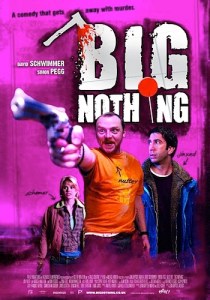
Big Nothing (2006)

2009 #12
Jean-Baptiste Andrea | 82 mins | TV | 15 / R

Big NothingBig Nothing was co-funded by the Isle of Man and Welsh film boards; it’s therefore unsurprising that it was filmed in those locations; and there’s a bunch of British actors in it… but they’re all playing Yanks and it’s set in Oregon.

And it’s as schizophrenic as this would suggest. Across its running time — and mostly in the opening half-hour — Big Nothing jumps wildly from mundane comedy to confidence scam thriller to black comedy to geeky spoof. Early on there’s a nice bit referencing The Matrix, for example; a brief moment which feels like it belongs in another film — as do many others. This flitting around makes for a showy opening, Andrea’s direction screaming “look what I can do!” in a way few films have since Guy Ritchie showed off everything he could do in Lock, Stock. It might help Andrea’s showreel, but the downside for viewers is it makes for taxing viewing and a sense that the film lacks its own identity. In short, it’s trying far too hard.

It does settle down however, improving immensely once it gets on with telling its (still loopy) story and stops trying to impress with flashy tricks. It becomes a lot funnier and a lot more enjoyable, slowly fulfilling any hopes the viewer may’ve had.

But it can’t keep it up, despite the brief running time. A long time before the credits roll it degenerates into a grab-bag of random incidents and twists strung together until the made-up-as-it-goes-along script hits something approaching a produceable page count. On the one hand this randomness at least makes it feel different, but on the other it pushes it too far — the array of twists don’t feel like natural occurrences, just plot points that are completely unforeseeable due to being equally nonsensical.

For a good stretch in the middle Big Nothing does more or less what you want it to, leaving the showy opening and desperate series of endings as unfortunate asides to a watchable film struggling to reach feature length.

3 out of 5

Runaway Train (1985)

2009 #11
Andrei Konchalovsky | 106 mins | TV | 15 / R

This review contains major spoilers.

Runaway TrainRunaway Train bagged itself three Oscar nominations and one for the Palme d’Or back in 1986, which rather begs the question, how?
On the awards-worthy side, it’s based on an Akira Kurosawa script and features grittier-than-average direction and performances. On the other, the majority of its story and supporting characters feel closer to other ’80s actioners like Lethal Weapon or Die Hard. The focus on a high concept (the title says it all), emphasis on exciting action sequences, the way the plot is structured, the faintly pantomime villains, comical supporting characters, and occasional slips into fantasy (one character was welded into his cell, the state the prison has degraded to, the whole concept of the runaway train and its computer control centre) — none of these elements suggest your typical Oscar nominee, but instead a half-forgotten minor action flick.

The lead characters and their performances, by Jon Voight and Eric Roberts, are above average for the genre — this is where two of the Oscar nods come from — but they’re not notably superior to other outstanding examples (see Bruce Willis and Alan Rickman in Die Hard). Praising the acting can only cover the two leads, at best, because the villains and supporting roles are as one-dimensional and clichéd as you’d expect from the genre. The other Oscar nomination was for editing, one that’s more obviously deserved. Visually, the sequences of the train smashing through the countryside are fairly impressive. Perhaps the camerawork deserved a nod in this respect too, as it lends the film a gritty real-world feel that may be explain some’s distraction from the otherwise familiar values. It can’t mask them all though — for example, the occasionally brutal violence is still denied any real-world punch thanks to the fantastical sheen created by some plot points.

The notable exception to most of this is the ending, where Voight’s anti-hero stands atop a train engine we — and he — know to be doomed, his prison warden nemesis handcuffed inside, and rides it out of sight into the fog. It’s a classy finale that flirts with the downbeat ending, though doesn’t quite succumb to it because we also know the young sidekick and girl have survived. Nonetheless, there’s pleasingly no postscript, simply fading to black after the engine disappears into the mist. The titular train, one might theorise, is like some mythic beast — it arrives through snow-mist, leaves devastation in its wake, and then disappears back into it. But that might be getting a bit too pretentious…

In focusing on these lofty pretensions (which may have been forced on it by nominations and some reviews), one can become distracted from the fact that, taken as a straight-up high-concept action-adventure, Runaway Train has an awful lot going for it. And if you want to get pretentious about it, well, it might just support that too.

As a final aside: one of the film’s most memorable moments, in retrospect, is down to an accident of fate. Near the end a character looks at a space shuttle on TV and muses, “with all this high technology, why couldn’t we stop it?” Just 11 days after Runaway Train’s US release, Space Shuttle Challenger disintegrated 73 seconds after launch, killing its seven crew members. For anyone aware of this correlation, it’s an incredibly poignant moment.

4 out of 5

Though the Radio Times review I’ve linked to says Runaway Train is an 18, it was reclassified in 2008. [It has since been updated.]

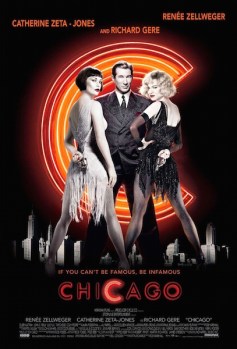
Chicago (2002)

2008 #96
Rob Marshall | 108 mins | DVD | 12 / PG-13

ChicagoI remember being distinctly unimpressed when Chicago took the Best Picture Oscar in 2003, especially as the alternatives included Gangs of New York and The Two Towers — not to mention Road to Perdition, an excellent film that was massively undervalued during award season.

In its favour are a number of memorable songs, all performed with impressive routines. On the downside, they’re all quite stagey in their choreography, though this suits the daydream-fantasy style in which they come about. In fact, the ability of film to make clear the distinction between ‘real life’ and fantasy means the film is far easier to follow than the stage version.

The story is passable enough, serving as a roadmap between the songs and offering the occasional bit of commentary/criticism on celebrity culture — it may be set in the ’20s and have been written in the ’70s, but the characters’ underhand tactics to keep their story on the front pages are as pertinent now as ever.

Five years on, Chicago isn’t as poor as expected — it manages to be consistently entertaining — but nor is it superior to the alternatives. For a current comparison, it’s only marginally better than if Mamma Mia were to trot round winning Best Picture gongs this year.

4 out of 5

After the Sunset (2004)

2008 #67
Brett Ratner | 93 mins | TV | 12 / PG-13

After the SunsetI’ve never had as much of a problem with Brett Ratner as some others. I quite enjoyed the first two Rush Hour films (though, admittedly, I was relatively young) and also liked Red Dragon (though, at the time, I hadn’t seen Silence of the Lambs), and would lay the blame for X-Men: The Last Stand at the feet of the producers who decided to save all the Wolverine backstory stuff for a spin-off, in the process disconnecting the threequel from the Wolverine-obsessed first two — what was left was pretty decent, if you ask me. After the Sunset, on the other hand, is like Woody Harrelson’s character: not much cop.
The story concerns a retired jewel thief goaded into performing one last job by the FBI officer who never caught him (that’s Harrelson’s character — you see, he’s not much of a cop! Geddit?) A decent enough premise, suggesting something Ocean’s Eleven-like; but someone didn’t think this was enough story — or, perhaps, couldn’t come up with a complex-enough security system for the jewel — and so tacked on a buddy comedy. It’s a pretty illogical one as well: the two men hate each other, so why would they spend so much time together? It feels like padding around the heist plot, but takes up more screen time. Other subplots, like Don Cheadle as the unspecified Caribbean island’s resident gangster, who wants the jewel to fund something or other, also don’t go anywhere.

Each of these plots seem to have originated in different films — some serious, some light, some thoroughly comedic. When stuck together they make for a constantly varying tone, and it’s difficult to work out which was the intended one. By the end there’s so much going on (though, barely) that the ending goes on forever, wrapping up its various near-unrelated threads in as drawn-out a manner as possible, apparently just to make the film hit a decent length. The final twist is almost good, but remains a bit underdeveloped and consequently isn’t clever enough to be worthwhile — it winds up as just another pointless extension.

Despite all this it does have its moments, thanks primarily to a skilled cast… not that I can remember any specific good bits now. It does at least mean that, if you can put the tonal and structural oddities to one side, it can be a moderately pleasant way to pass an hour and a half.

3 out of 5

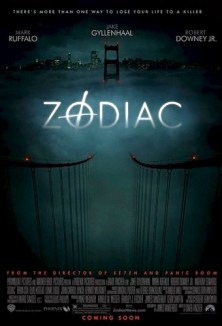
Zodiac (2007)

2008 #64
David Fincher | 151 mins | DVD | 15 / R

Context time: I’m a David Fincher fan. Se7en and Fight Club number among my favourite films of all time; I’ve always found The Game to be an immensely enjoyable thriller; much the same can be said of Panic Room, especially the famous slow motion sequence, which is one of my favourite action scenes ever; and I love The Hire series of short films, which Fincher produced but (sadly) never directed. I’ve never seen Alien³ (or Aliens, or any other entry in that series bar Ridley Scott’s first for that matter), but considering its troubled production history one might say it barely counts. All this considered, why’s it taken me so long to see Zodiac? Well, laziness, to be honest, but I’m here now. And unlike another recently-viewed highly-anticipated film (namely, Southland Tales), this was more than worth the wait.

As other reviews have pointed out, Zodiac is really a film about obsession, and it makes for as engrossing a tale as the case was for those investigating it. In following the story the film chooses to eschew normal structural niceties for fact-following, yet structure is never a problem. Yes, it jumps from character to character, and if you step back and analyse it that’s odd, but while watching it doesn’t matter one jot — this is more like real life than some shallow crime thriller dependent on a twist ending. That level of realism is key throughout, be it the period detail or the exemplary performances — both are excellent and accurate without being showy. Much like Fincher’s direction, in fact, which is appropriately more restrained than usual, though he can still display a suitable level of flair when warranted.

Some have called it slow, even dull, but I was totally engrossed throughout and never overwhelmed by the number of facts being thrown around — and I was watching it in the middle of the night when I should have been asleep. At 5AM, when it finally ended, I was even wishing there was more. (It seems a shame that the recently-released (in the UK) director’s cut adds barely five minutes.) It does exactly what it aims to: it’s not about the killer’s mind and it’s not a whodunnit; it’s about procedure, obsession, and how one deals with an unsolved mystery. The fact it isn’t definitively solved — and yet, for all the characters, there’s a way out or a solution that satisfies them — is possibly the most telling part of the whole film.

After the disappointment of the long-awaited Southland Tales, it’s especially pleasing that the long-awaited Zodiac is such a triumph. It’s easily up there with Fight Club and Se7en, and perhaps even surpasses them both. My most unreserved full marks since Dark City.

5 out of 5

Zodiac placed 2nd on my list of The Ten Best Films I Saw For the First Time in 2008, which can be read in full here.

My more thorough review of the Zodiac: Director’s Cut can now be read here.