
Sidney Lumet | 125 mins | TV | 1.85:1 | Italy & USA / English | 18 / R
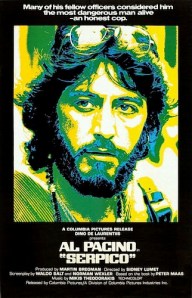 Before Murder on the Orient Express or Dog Day Afternoon, Sidney Lumet directed this true story about a New York cop battling corruption.
Noting it’s a true story, it certainly has a biographical feel. That came as a bit of a surprise, to me at least — I was expecting a thriller about a good cop exposing the corrupt ones, but instead got Frank Serpico’s life story from the time he left training on. It’s not as if it just deals with his professional career — say, showing how his early days formed his moral compass, or something — there’s lots of screen time devoted to his personal relationships too, which may or may not have been relevant to his work. More than a corrupt cop thriller, it’s a biopic about someone involved in that world.
This focus on reality begs one question: just how much is it based in the truth? It makes an uncommonly high claim to reality by including all this near-extraneous detail, but typically “true life” stories, especially those made quickly after the real events, fictionalise things for one reason or another. It wouldn’t matter if it didn’t effect the quality of the film, but I think it does: it feels a bit sloppy at times; kind of disjointed. The timeline jumps forward almost at random; things occasionally seem to go by half explained; there’s no clear throughline… This all plays into the feeling of it being like real life, where nothing — certainly not a police investigation — is as simple or straightforward as it’s usually made out to be for the movies. Which has its pros and its cons.
 As the titular copper, it’s a typically strong performance from Al Pacino. Not his best work — I don’t think the part really gives him enough to deliver that — but he’s more often than not the most engaging element of the film. This was his fifth film; considering The Godfather was just his third, and he followed this up with Part II and Dog Day Afternoon, it’s easy to see why he’s long been regarded as a Great Actor.
I feel like Serpico used to come up fairly often as a minor classic; the kind of film not a lot of people have seen these days but many more should have; but I don’t feel like I hear it mentioned any more. Obviously this is just a perception and maybe it’s a load of rubbish, but I’m afraid I side a little more with the latter-day less-mentioned side of things.
I would say it feels rather worthy, at least in part for the things I’ve mentioned about its claims to truth. It’s an interesting, sometimes compelling film, but I wouldn’t say I enjoyed or liked it. “Enjoy” is an awkward word — you wouldn’t typically say you “enjoy” Schindler’s List, but you do (you could say) enjoy its greatness. I didn’t enjoy Serpico in the way you would typically say you enjoyed something; nor did I enjoy it in a Schindler’s List way; nor did I really admire it, again for the reasons levelled above. But it has elements of interest nonetheless.

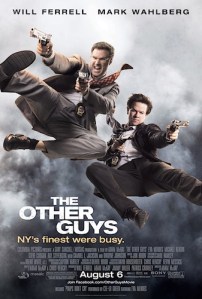 The Other Guys sounded like a great concept; so great I overlooked the fact it’s from the director of the massively over-rated
 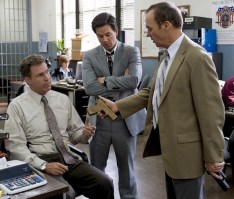 Everyone loves The Rock and Jackson; no one likes Ferrell and Wahlberg; and they’re not assigned the case, they stumble upon it. Wouldn’t it have been more fun if everyone actually hated The Big Damn Heroes who make it hard for the regular guys to do their job? If a pair of normal detectives were assigned The Big Case and had to prove themselves worthy? Maybe even put the Super Pair in the shade, rather than killing them off in the first act?
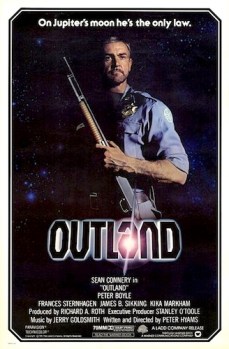 I first encountered Outland in a similar context to a lot of people, I think, based on reviews and whatnot I’ve read; that is, as “
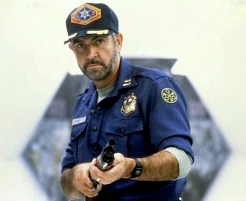 It works as well in space as it does anywhere else.
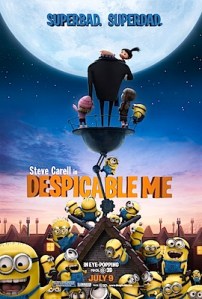 A venture into the increasingly-popular CG family film market from Universal, Despicable Me is about a supervillain who comes to question his evil ways. It was released the same year as the similarly-themed
 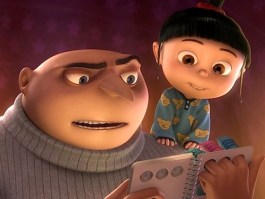 The film’s country is officially listed as USA because it’s made with American money, but it feels more like a French production (albeit dubbed with US voices). Look at those directors’ names (though only Coffin is French — Renaud is actually American); it was made entirely in a French studio (Mac Guff in Paris); and it has a kind of feel that doesn’t seem like it came from a US studio. So while technically, yes, it’s American, I don’t think the French side should be wholly ignored. I’m not saying it makes it bad, but perhaps it lessens the apparent superhero feel — that’s a very American genre, after all.
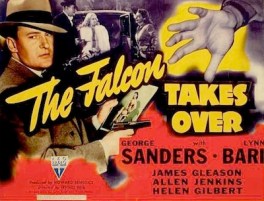 Quite outside of the Falcon film series, this third entry is notable for being the first screen adaptation of a Raymond Chandler novel. Ditching Chandler’s then-unknown Philip Marlowe in favour of the Falcon in the lead role, this is a version of the character’s second mystery, Farewell, My Lovely — which would be
  As usual, it doesn’t have the same je ne sais quoi that makes the Saint films particularly entertaining (yeah, you know I mean wit); and I can well believe it has “
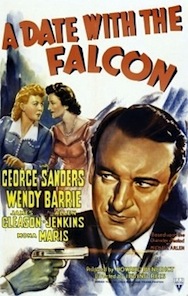 The second Falcon film sees George Sanders’ gentlemen detective investigate the disappearance of a scientist.
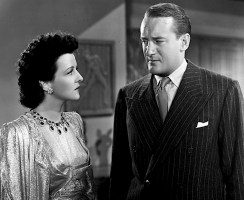 Anyway, aside from him there’s a ‘suicide’ bid and the crowd below’s reaction to it. Again it’s mostly comedy, but unlike some of the series’ DOA running gags it’s actually funny.
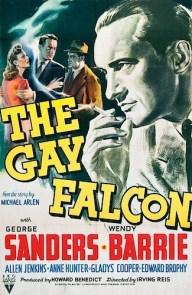 Worried about the cost of renewing the licence to popular hero the Saint, RKO instead acquired Michael Arlen’s the Falcon and essentially modelled him as a replacement, much to the chagrin of Saint creator Leslie Charteris. And who can blame him? They even cast the star of the Saint, George Sanders. Cheeky.
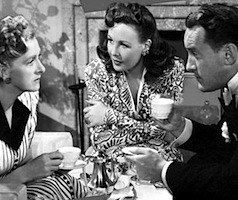 The story (the only one in the series adapted from a work by Arlen) is a solid mystery about jewellery thieves, which doesn’t seem to have quite the scale of the Saint films. Those were often contained to one city, but they felt somehow grander, like the schemes being foiled were of broad significance; here, it’s basically work for the police. To put it another way, if there was always the sensation that the Saint was an anterior James Bond, you could say the Falcon is more like Sherlock Holmes.
 The Gay Falcon makes for solid enough entertainment, mixing thrills with humour to decent effect. But despite attempts to emulate it, not least with the same leading man and woman, it’s no the Saint — they’ve not injected Gay Laurence with quite the same way with words and the supporting cast lacks a Teal or ‘Pearly’ Gates type to really make it click. Whether future entries stray further from Arlen’s original and more into Saint territory, or not, remains to be seen.
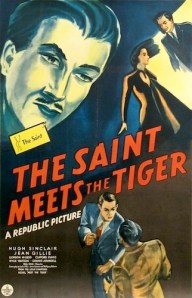 Produced in 1941 but not released until 1943, owing to Saint creator Leslie Charteris’ dispute with RKO over their new Falcon series (which is fairly unashamedly a rip-off of the successful Saint films), The Saint Meets the Tiger is a belated adaptation of Charteris’ first Saint tale, but was to be the series’ final film. Fortunately, it’s quite a good one.
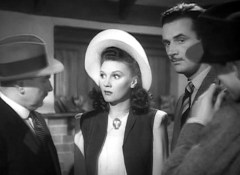 It still lacks the wit and light touch that make the Sanders films so entertaining, with only vague attempts at humour that generally raise little more than a smile. Sinclair doesn’t seem quite as wooden this time out, but he’s a straight-cut hero-type, not the kind of charmer this series really wants. In fact, one moment when he bursts into laughter, only to suddenly cut it short, is actually quite creepy. Perhaps he was trying to emulate Sanders more — the film does feel lighter than Vacation — but he still comes up short.
 The Saint’s gone on vacation indeed — with
  Apparently the villains are Nazis, though there’s absolutely nothing to suggest that here (again, that’s something I’ve since read online). The Saint knows both the villain and a Mysterious Woman of old, but it’s never explained how or why or what their relationships are. It’s like a set of stock adventure-story elements assembled without any understanding of how or why they should connect, which makes for an unsatisfying and unenthralling experience.
 The rest of the cast don’t offer much compensation. Arthur Macrae as the Saint’s cowardly friend Monty is no replacement for the parade of ex-cons he formerly hired as manservants, while Sally Gray of
 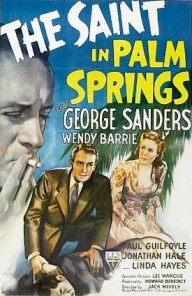 George Sanders is the Saint for the final time in a film that isn’t the series’ best, nor its worst. It also marks the final appearance by Jonathan Hale as Inspector Fernack, and third-and-final turns from both Wendy Barrie and Paul Guilfoyle. For those keeping track (or not), that’s the same four leads as the last picture! Same director too, as Jack Hively helms his third (and, of course, final) Saint adventure.
 Hale isn’t in it nearly enough unfortunately, especially considering this is his last outing. Guilfoyle has the sidekick role and at least his and Sanders’ relationship is a fun substitute. Barrie is, for once, simply the ingénue and not some form of criminal mastermind. Don’t worry, there’s another girl for that: Linda Hayes, who seems a promising match for the Saint but, though prominent early on, is ultimately disregarded. The highlight for both women comes when they get invited along for a horse ride with the Saint and have a good bitch at each other. It’s a pickle quite unlike the ones Templar usually finds himself in! I have nothing against Barrie, but quite why they sought to use her repeatedly I don’t know. And, to be frank, she worked best in
  100Films.co.uk