2013 #56
Andrew Dominik | 160 mins | Blu-ray | 2.40:1 | USA, Canada & UK / English | 15 / R
 September 1881: after admiring their leader for years through cheap magazine stories, 19-year-old Robert Ford manages to hook up with the James Gang. Little does he suspect that, just seven months later, he will be responsible for the murder of his idol, Jesse James. (That’s not a spoiler, it’s in the title.)
Ultimately released in 2007, The Assassination of Jesse James by the Coward Robert Ford found itself going head-to-head in the awards season with No Country for Old Men and There Will Be Blood. The accepted narrative of that time is about the two-horse-race between the latter two, though Jesse James fits with them in some kind of thematic and stylistic triumvirate: they’re all products of what I’d call “American mainstream art house” cinema; all classifiable as Westerns, though none in a strictly traditional sense; all more concerned with their characters and their lives than the machinations of the plot. In the end, No Country garnered most of the awards, There Will Be Blood seems to have settled in as a critical darling, but, for my money, this purest Western of the three is by far the best.
I’m not going to waste much time making direct comparisons between the three films. I suspect there’s an article in that, if someone hasn’t written it already, but it’s not one I have much interest in penning: I don’t think I’ve made much secret of my distaste for the Coen and Anderson efforts in this little threesome, both being films I never really engaged with and certainly didn’t enjoy (in fairness, I should give Blood a second shot, but even the idea of sitting through No Country again makes me shudder). The Assassination of Jesse James, however, is a film I both engaged with and enjoyed greatly.
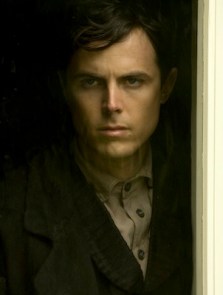 Let’s be clear, though: this is not a film for everyone. This is not an action movie set in the Wild West, which might be what’s expected from a Hollywood studio movie starring Brad Pitt. Apparently director Andrew Dominik intended to make a film with a Terence Malick vibe, so I read after viewing, which chimed with me because “Malick-esque” was one of my foremost thoughts during viewing. This is a slowly-paced two-hours-and-forty-minutes, with more shots of crops blowing gently in the breeze or riders approaching gradually over distant hills as there are flashes of violence. Despite what the studio wanted, this is not a fast-paced action Western, it’s a considered, sometimes meditative, exploration of character and theme.
The character explored is not particularly Jesse James, but Robert Ford. As the latter, Casey Affleck was largely put forward for Supporting Actor awards, which does him a disservice — the film is largely told from Ford’s perspective, and though there are asides where it follows James or other members of the gang, it begins with Ford’s arrival and ends with his departure from this world. Affleck is superb in a quiet but nuanced performance, which I would say ranges wildly without ever appearing to change. At times he is cocky and self-sure, at others cowardly and defensive, often creepy and occasionally likeable, sometimes both worldly and naïve, a perpetual wannabe who even when he achieves something is still poorly viewed. You might think the title is stating its position on him, but it really isn’t — it’s a position to be considered, a point of contrast to the man’s motives and actions; a statement that is in fact a question.
Conversely, Pitt’s Jesse James is closer to a supporting role. We see him primarily through the eyes of others; he is distant, unknowable, his moods and actions unpredictable thanks to years of law-dodging that’s led to a paranoia about his own men — not all of it misplaced.  Jesse’s mood swings are more obvious than Ford’s, but Pitt makes them no less unlikely. At times charming and a clear leader, at others he is a genuinely tense, frightening presence, without ever needing to resort to the grandstanding horror-movie grotesques offered by (Oscar winners) Daniel Day-Lewis and Javier Bardem in There Will Be Blood and No Country respectively.
Though there are other memorable and striking performances — particularly from Sam Rockwell, Paul Schneider, and a pre-fame Jeremy Renner; plus a precise, perfectly-pitched, occasional voiceover narration from Hugh Ross (who doesn’t have many credits to his name but surely deserves some more now) — the third lead is Roger Deakins and his stunning cinematography. There are many clichés to use for good-looking films, and the vast majority of the time they are trotted out as what they are and not really meant. Jesse James, however, is one most could be applied to with total accuracy. For example, there are very few — if any — films where you could genuinely take any frame and hang it as a perfect photograph; but if there is one where you could, this is it.
Deakins has reportedly said that “the arrival of the train in darkness is one of the high watermarks of his career”, and he’s right to think that. It’s a glorious sequence, made up of several shots where every one is perfectly composed and lit to create a remarkable ambience and beauty, as well as telling the story, which in this instance involves as much creation of suspense as eliciting pure artistic appreciation. Deakins did take home a few awards for his work here, but not the Oscar. I can’t remember which film did win and, frankly, I don’t care, because whichever it was this outclasses it by miles.
 This must also be thanks in part to director Andrew Dominik. Every last shot feels precisely chosen and paced. Of course, every shot in every film has been chosen and placed where it is, but the amount of thought that’s gone into that might vary. Jesse James somehow carries extra weight in this department, with no frame in its not-inconsiderable running time wasted on an unnecessary angle or take that’s allowed to run even a second too long. Somewhat famously, there was a lot of wrangling over the film’s final cut (delaying its release by a year or more), with the aforementioned debate between something faster and something even slower: a four-hour version screened at the Venice Film Festival, to a strong reception. Sadly, the intervening years haven’t seen that cut, or any of its parts, resurface (to my knowledge). That’s an hour and twenty minutes of material and I’d love to know what’s in them.
One thing in there, I’d wager, would be the performances of Mary-Louise Parker and Zooey Deschanel. Both their characters have a tiny presence in the finished product, and while that may be fine for the overall story (some would criticise how much female characters are sidelined, but that’s another debate), casting two moderately major actresses creates a disjunct with the size of their roles. I was going to say this is one of the film’s few flaws, but it’s debatable if it even qualifies as that: if they’d cast less recognisable faces, their lack of presence would pass by unnoticed.
The other thread I mentioned, seven paragraphs ago, was “theme”. The film has a lot of concurrent aspects one might consider — “loyalty” being a major one, for instance — but I think the biggest is “celebrity”. Not in the modern sense, though I’m sure there are analogies for those that wish. To pick up on what I was saying before: Ford is the main character, and the main thing he wants, even if he doesn’t realise it, is fame. He joins the James Gang because he’s enamoured with the adventurous tales he’s read; 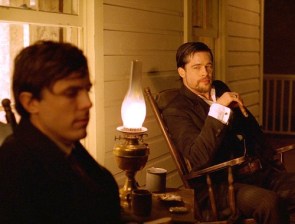 because he’s obsessed with the notoriety of Jesse. Later, once the titular deed is done, he becomes an actor (not without talent, as the narration informs us) and re-performs the act that made him famous hundreds of times. It’s his legacy, however, to not be as well-remembered as his victim; to not be as well-liked, even; not even close. There’s something there about the pursuit of fame for its own sake, if nothing else.
It’s difficult to call any film “perfect”. Certainly, there would be plenty of viewers who would consider The Assassination of Jesse James to be an overlong bore. Each to their own, and I do have sympathy with such perspectives because there are acclaimed films that I’ve certainly found to be both overlong and boring. Not this one, though. From the constant beauty of Deakins’ cinematography, to the accomplished performances, to the insightful and considered story (not to mention that it’s been cited as the most historically accurate version of events yet filmed), there are endless delights here. As time wears on and awards victors fade, it deserves to elbow its way back into the debate for the best film of the ’00s.
The UK TV premiere of The Assassination of Jesse James by the Coward Robert Ford is on ITV4 tonight at 10pm. It’s screening again tomorrow at 11pm.
It placed 3rd on my list of The Ten Best Films I Saw For the First Time in 2013, which can be read in full here.

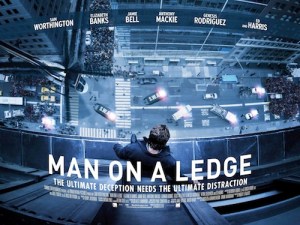 A man books into a swish hotel, has a nice meal, then climbs out the window. Onlookers and police gather. Will he jump? Or is he just a distraction?
 Frank Drebin and the crew at Police Squad are back for the usual mix of silly one-liners and farcical slapstick. Fortunately, they’re as entertaining as ever.
 Normally I’m a stickler for watching film series in order, even when it doesn’t matter, so skipping 31 sequels really isn’t my style… but this was on telly one night in July and I was in just the right mood, so
 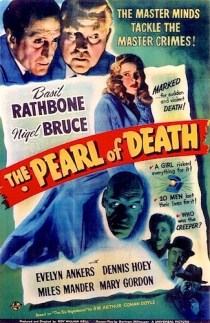 The Pearl of Death is one of the better-regarded films of the Basil Rathbone Sherlock Holmes canon, but somehow it didn’t quite click for me. That doesn’t meant there isn’t a lot to enjoy, however.
 Elsewhere, Nigel Bruce gets to indulge in a slapsticky scene that, as ever, people who dislike this interpretation of Watson would be happy to do without. Also worth noting is the female lead, British actress Evelyn Ankers: she was a regular fixture of Universal’s horror features, terrorised in no less than
 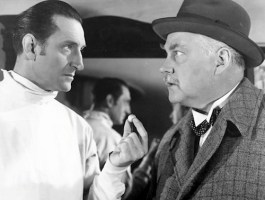 Neill somehow managed to pick one of the least dramatic. Neither of these reveal fudges are ruinous, of course, and are outweighed by the handling of sequences like Holmes setting off the museum’s alarm, the ensuing robbery, the villains stalking round a potential victim’s house, and so on. Still, I was surprised to find them so wanting.
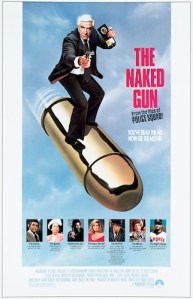 Classic spoof from the makers of
 Bruce Willis stars as a down-on-his-luck PI who stumbles into a sport/politics conspiracy in this early-’90s action-thriller from screenwriter Shane Black (
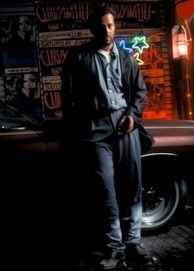 — pitch black frames punctuated by glowing coloured lights. On the whole, it looks gorgeous.
 2001’s car racing actioner
 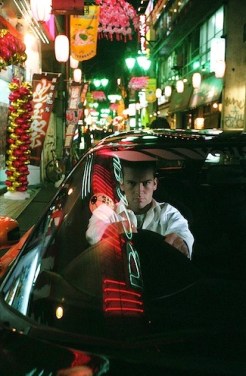 If I sound dismissive, it’s slightly affected: Tokyo Drift is surprisingly decent. Surprisingly decent for a Fast and Furious film, that is. In
  After
After 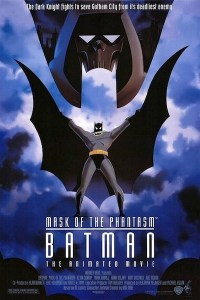 Batman movies have a habit of provoking strong reactions.
 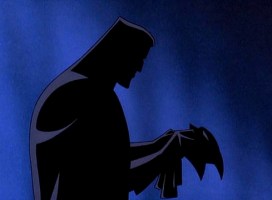 One of the main reasons the film succeeds is that look back at Bruce Wayne’s early days as a crime fighter. Batman’s origin is oft told — too oft, truth be told — but they thankfully don’t rehash it here. Instead, early in Batman’s career Bruce falls in love and finds happiness, causing him to question whether to continue down the path he’s already dedicated his life to. The scene where he talks to his parents’ grave, expressing his guilt at potentially finding happiness after so much mourning, is one of the most powerful, emotional moments in all of Batman’s many iterations.
 But instead of falling in some nasty halfway-house, Phantasm turns up trumps on all fronts.
 100Films.co.uk