
Roy William Neill | 62 mins | DVD | 4:3 | USA / English | U
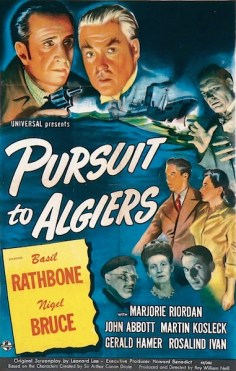 After a fun opening where Holmes and Watson have to solve the world’s most obvious riddle (naturally, Watson is completely oblivious to there even being a riddle), the original dynamic duo are tasked with escorting the heir to the throne of somewhere-or-other back to his homeland, thwarting assassination attempts as they go.
In his production notes on the Optimum DVD release, Sherlockian Richard Valley describes the 12th film in the Rathbone/Bruce Holmes series as “the runt of the litter” — which it is — though he also declares that it “has its own peculiar charm… If it’s not in the same league as Adventures of Sherlock Holmes or The Scarlet Claw, neither is it a waste of time.” Of that I am less convinced.
Ostensibly, Sherlock Holmes stories are detective mysteries. In execution, they’re as often as not about the adventures of our heroes as much as they’re about the ins-and-outs of a case. The mystery is the glue that holds it all together, though. For about the first half, Pursuit to Algiers puts its pawns in place (getting Holmes, Watson and their charge on the boat to Algiers) and sets up its mystery: who is the assassin? About halfway through, Holmes and Watson stand around and very handily list all of the suspects… which just so happen to include pretty much every supporting character. So far, so good. However, it’s only a few minutes later that we actually find out the identity of the guilty party. If the mystery is the glue, then for me this is where the film comes unstuck.
So, Holmes has found out the identity of the assassins. Does he come up with an ingenious scheme to unmask them? Does he battle them and throw them overboard? Does he do anything at all about it? No. Instead, the rest of the film descends (further) into farce as Holmes lets the villains carry on with two or three assassination attempts, 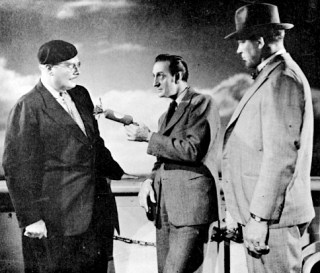 each of which he thwarts last-minute in sometimes amusing fashion. That’s not fundamentally a poor premise for an adventure comedy, I don’t think, but it doesn’t work for Sherlock Holmes. I mean, if you’re trying to prevent someone from being assassinated, why would you let the assassins carry on?! A last-minute twist reveals a sort of motivation, but it’s not a particularly convincing one in my book.
Even leaving the plot implausibility aside, I didn’t feel there was much else to recommend here. There’s altogether too much of Bruce buffooning around; there’s a half-arsed subplot about a jewel theft, seemingly tacked on so you could argue that there is a mystery in the film’s second half; and just generally, I didn’t think it hung together all that well.
Still, in a series where you’re churning out two or three a year, you’re allowed a couple of duds. Pursuit to Algiers is not completely without merit, but it’s certainly my least favourite Rathbone Holmes so far.

Pursuit to Algiers is on TCM UK today at 3pm and tomorrow at 1:45pm.
 Jason Statham plays the kind of copper who wakes up on his sofa in the middle of the night, immediately pours himself a whiskey in a mug, then goes out and beats up three youths who were trying to nick a car, in this godawful crime novel adaptation.
 At least it has some so-bad-they’re-good one-liners — “Aren’t you going to take any notes?” “Do I look like I carry a pencil?” Unfortunately, their presence meant the thing Blitz most reminded me of was
 Action comedy starring John Cusack as a hitman who has to face the life he left behind when he’s assigned a job in his hometown on the same weekend as his high school reunion.
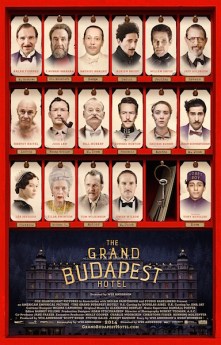 The latest from cult auteur Wes Anderson, which managed that rare feat of enduring from a March release to being an awards season contender, sees the peerless concierge of a magnificent mid-European hotel (Ralph Fiennes) accused of murdering a rich elderly guest (Tilda Swinton, caked in Oscar-winning prosthetics) and attempting to flee across the country to clear his name. More or less, anyway, because this is a Wes Anderson film and so it takes in all kinds of amusing asides, tangents, and recognisable cameos.
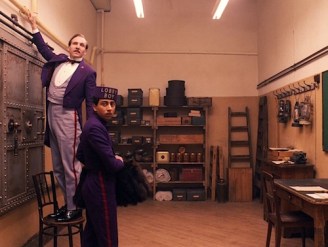 I suppose the kooky idiosyncrasies of Anderson’s brand of storytelling and filmmaking will rub some viewers up the wrong way, looking on it all as vacuous affectations signifying nothing. To each their own, but, whatever the merits (or not) of Anderson’s style as a kind of one-man genre played out across his oeuvre, The Grand Budapest Hotel displays a synthesis of contributing elements that creates a movie that’s ceaselessly inventive, surprising, amusing, and entirely entertaining.
 After winning the Best Adapted Screenplay Oscar for
 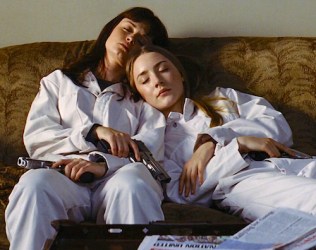 Here, Fletcher either needs to settle on one or the other, or clearly signal his intentions earlier.
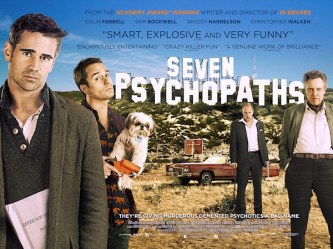 The writer-director and star of
  mainly via references to Farrell’s endeavours to pen a movie called, you guessed it, Seven Psychopaths. One wonders if there’s a hefty dose of autobiography in the writer’s struggle…
 I had absolutely zero intention of ever watching this Sylvester Stallone vehicle (which is not to be confused with John Woo’s
  Said plot all comes down to a final fight, Stallone vs Jason Momoa (of
 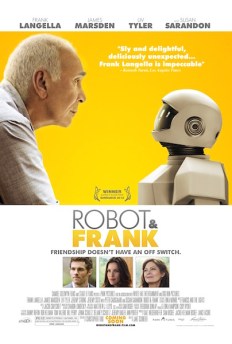 In “the near future”, Frank (Frank Langella) is an ageing jewel thief in denial about his dementia, contenting himself with visits to the local library, which is being taken over by a bunch of yuppies to turn into “the library experience”, and shoplifting from the beauty store that used to be his favourite restaurant. Concerned for his wellbeing, his son (James Marsden) gets him some home help in the form of a humanoid robot (voiced by Peter Sarsgaard). Initially reluctant to accept its presence, when the robot attempts to help by also shoplifting from the beauty store, Frank senses an opportunity…
 (part of a half-realised almost-subplot about robot rights, or something), we not only feel Frank’s (temporary) loss of his friend, but also urge the film to turn the robot back on and get back to what’s really making the movie work. The event serves a purpose (it’s the point Frank realises he’s stopped just putting up with the damn robot and actually come to appreciate its presence), but still.
 Equally, this is of a branch of science-fiction we see all too rarely on the big screen, but which is fertile ground for those wishing to explore it: using fantastical concepts to explore and enlighten our own world. Even if you learn nothing revelatory about old age and the rigours of dementia, the friendship between the robot and Frank is reason enough to enjoy.
 As presidential nominee Barack Obama talks about the American Dream, in a run-down corner of the nation a trio of small-timers plot a robbery, landing them in hot water with some nasty people.
 Steven Spielberg’s second feature (or “first” if you’re American) is based, loosely, on a true story. The fictionalised version sees Lou Jean (Goldie Hawn) breaking her husband (William Atherton) out of prison so they can travel cross state to liberate their baby from foster care. Everything goes smoothly until they accidentally kidnap a police officer (Michael Sacks), hundreds of police cars begin to follow them, and a multi-day slow-paced chase ensues.
 when filmmakers became contractually obliged to keep their compositions “TV safe”). The camerawork is frequently extraordinary, including at least one unbroken shot where the camera moves around inside and outside the car, like something out of
  100Films.co.uk