
The 100-Week Roundup covers films I still haven’t reviewed 100 weeks after watching them. Sometimes these are short ‘proper’ reviews; sometimes they’re only quick thoughts, or even just the notes I made while viewing.
This week’s selection includes three films from March 2019…
(2003)
Tom Shadyac | 97 mins | digital (HD) | 16:9 | USA / English | 12 / PG-13
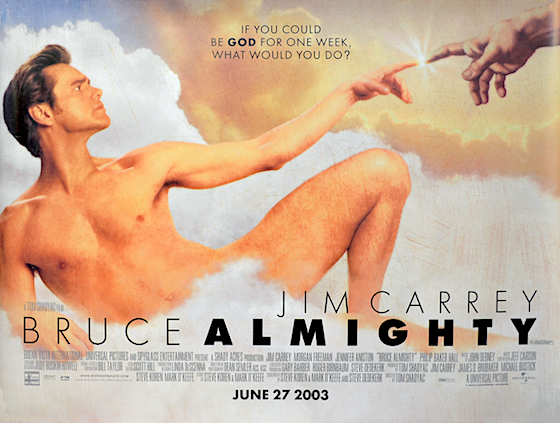
“Television reporter Bruce Nolan (Jim Carrey) doesn’t think the world is treating him fairly, but when he angrily rages against God, he actually gets a response. God (Morgan Freeman) decides to take a holiday, leaving Bruce in charge with His divine powers. As Burce puts his omnipotent powers to the test, he comes to realise that with great power comes… yeah.” — liberally adapted from IMDb
I mean, in fairness to Bruce, Spider-Man only came out the year before — maybe he just hadn’t seen it yet.
Anyway, Bruce Almighty is almost entirely fuelled by Carrey’s antics — if you enjoy his zany style, you’ll lap it up; if you hate it, there are no redeeming qualities that haven’t been done better in other broadly-similarly-themed films (see Groundhog Day, for example). I say “almost entirely” because there are brief asides where Morgan Freeman or Steve Carrell get to steal a scene. Indeed, Freeman earned the film’s only out-loud laugh from me when he casually throws in one of Carrey’s best-known catchphrases.
Personally, I’m in between on comedy-mode Carrey, and so that’s where I landed on Bruce Almighty. He doesn’t push his schtick so far that it becomes irritating to me, as in the Ace Ventura films (I quite liked them as a kid but feel I’d hate them now), but nor is it inspired enough to really transcend being just what it is.

(2018)
Wes Anderson | 97 mins | digital (HD) | 2.35:1 | USA & Germany / English & Japanese | PG / PG-13

Wes Anderson has a weird proclivity for killing dogs in his movies, so it seems almost like some kind of atonement that he’d turn around and make a movie whose title is a homophone for “I love dogs”.
This animated adventure is set in a near-future Japan, where a canine flu is spreading through the city of Megasaki. To stop it, the mayor orders all dogs be banished to Trash Island — starting with Spots, the pet of his orphaned 12-year-old nephew, Atari. So Atari steals a plane and flies to Trash Island, where he teams up with five stray dogs to search for his exiled pal.
Isle of Dogs attracted a certain amount of criticism when it was released for its treatment of the Japanese characters and, especially, language; primarily, that the Japanese dialogue is not subtitled, thereby ‘othering’ those characters because we’re prevented from engaging with them. When watching the film, my first thought was those complaints were being a bit daft: the dogs speak English, the humans speak Japanese, and we’re clearly being placed with the dogs — the humans are ‘other’ because they’re human, not because they’re Japanese. But then the film keeps jumping through hoops to get around this, for example with translators on TV to re-speak the Japanese in English; or an American exchange student to speak for another group with English dialogue. This is where it does tip into being problematic; where it can feel like a Western director playing around with another culture.
All of which said, I still very much enjoyed the film. As a fellow Anglophone admirer of Japanese culture, that aspect broadly worked for me. Setting aside the controversy, it’s still amusing, in Anderson’s normal mode, with a suitably exciting and action-packed quest narrative.

(1997)
Roberto Benigni | 116 mins | digital (HD) | 1.85:1 | Italy / Italian, English & German | PG / PG-13

“In 1930s Italy, a carefree Jewish librarian named Guido starts a fairytale life by courting and marrying a woman from a nearby city. They have a son and live happily together until the occupation of Italy by German forces, when they’re separated and sent to concentration camps. Determined to shelter his son from the horrors of his surroundings, Guido pretends that their time in the camp is merely a game.” — adapted from IMDb
Every summary of Life is Beautiful concentrates on the “they end up in the Holocaust” bit — which is fair enough, it’s rather a major thing. But this is really a film of two halves. The first is a broad, sketch-like comedy, in which Guido (played by cowriter-director Roberto Benigni) bumbles around, woos his wife, and starts a lovely life. It’s the kind of comedy in which there’s a single sequence where a bunch of sketches all pay off at once, in a series of coincidences that’s somewhere between artful and ludicrous. The second half is a kind of concentration camp comedy, which is just as unwieldy as that sounds. The almost farcical humour of the first half attempts to linger on, but it buts awkwardly against the unspeakable horrors that occur.
Eventually it comes to an ending that I was similarly divided about. It’s clearly designed to be hyper-emotional, and it pulls at some very obvious strings to get there quickly, which seems to work for many viewers, but I didn’t feel it. Why? Well, it’s based in the relationship between father and son, and I don’t think the rest of the film really is. The first half of the film is all about investing us in the relationship between Guido and his wife — we follow their relationship from the very beginning, and the film charms us and connects us to their coupling. But then the second half virtually tosses that aside to make the important relationship the one between Guido and his son. We get two or three quick scenes that incidentally suggest a good father/son bond, then it’s off to the camp, which is a whole other kettle of fish. We’re not given the time to properly buy into this father/son relationship. That’s not to say I don’t believe it, just that we’re only learning about it at the same time as we’re supposed to be affected by its endurance. Doing both at once doesn’t work, in my opinion. Now, if the first half (or even just the first act) had been about Guido and his son’s wonderful relationship before the occupation, it would have established that well and connected us to it; then, if the rest of the film unfolded as-is, I think it would have made for a much more powerful ending, because it would have had the full weight of their entire relationship behind it. Instead, as well as being a film of two halves, Life is Beautiful ends up a film of two relationships, one in each half.
Despite the film winning awards at Cannes and the Oscars, and being in the top 10% of IMDb’s Top 250, etc, this “two halves” thing — the awkward balancing act between comedy and tragedy — has been noted by critics ever since its initial release. It makes for a wavering viewing experience. It’s kind of inappropriate, but kind of isn’t; it kind of celebrates the ingenuity of the human spirit, but kind of belittles the real tragedy in the process; it’s kind of a success, but kind of a well-meaning misguided effort. It’s this sense that the film’s heart is in the right place that sees my score err upwards.

Life is Beautiful was viewed as part of What Do You Mean You Haven’t Seen…? 2019.












 The Good Place ended forever ago, right? Well, the series finale originally aired back in January, so… this year, yeah, forever ago.
 The breakout star of BBC drama The Missing here gets his own spinoff series. Julien Baptiste is a retired police detective who specialises in finding missing people, which is exactly what he did across two series of The Missing (I reviewed the second
  John le Carré’s spy mystery Tinker Tailor Soldier Spy is one of the most acclaimed works of the genre, and the 1979 TV adaptation is justly fêted as one of the great miniseries. But Tinker Tailor is actually the first book in a loose trilogy, and in 1982 they also adapted the third book (they skipped the second because its overseas settings were deemed too expensive; as I understand it, the plot also doesn’t have that much bearing on the overall events — this isn’t “one story in three parts” like many a trilogy). Smiley’s People doesn’t enjoy quite the same reputation as its forebear, and I’m afraid I’m not going to challenge that position. Like Baptiste, it’s not bad, it just lacks that je ne sais quoi that makes its predecessor a solid-gold classic. One thing they do share is a damnably complicated plot — I struggled to follow the narrative watching it one episode per day back to back, so goodness knows how anyone kept up with it once a week over a month and a half back in the ’80s.
 The other “Sherlock Holmes in the modern day” show finally came to an end last year, though I suspect its finishing shall remain more final: whereas Sherlock always had a stop-start “we could make more anytime” production, accompanied with cast & crew chatter about wanting to sporadically do make new episodes forever, Elementary is much more traditional US network TV show — and the diminishing episode orders of the final couple of seasons and summertime broadcasts of the last couple of seasons don’t suggest an enduring hit poised for a revival.
 This month, I have mostly been missing The Mandalorian season 2. Well, as regular readers will know, I never even got round to season 1. Naturally, it’s been basically impossible to avoid spoilers — though as those amount to “look which legacy character has turned up this week” rather than actual plot stuff, perhaps it will be okay. Or maybe the series doesn’t really have any plot to spoil, it’s just endless fan service — that would certainly seem to tally with some people’s view of the show. Others love it though, so I’ll see for myself… someday…

 100Films.co.uk