2012 #88
Lena Dunham | 99 mins | TV (HD) | 2.35:1 | USA / English | 15
 Some have been quick to call twenty-something writer-director-actress Lena Dunham “the voice of a generation”; usually older people who think this is how people that age are, because I’m part of Dunham’s generation and she certainly doesn’t speak for me, and you don’t have to go far or look hard on the ‘net to find similar views. But it’s turned out alright for her, as by whatever ridiculously young age she is she’s made this film, got a multi-season series on HBO (the critically divisive Girls), and recently signed a ludicrously lucrative book deal. Clearly, she speaks to someone.
Tiny Furniture, then, comes with a predisposition to dislike it from anyone who isn’t a hipster or desperate to be relevant to hipsters (I feel like this is the point at which to note that it’s recently been inducted into the Criterion Collection). It’s a slow-paced, consciously arthouse-drama-y story film about unlikeable people leading unlikeable lives. I think everyone in it is either selfish or at least self-centred, and even if you buy into any of its characters being more than that, Dunham eventually unmasks them as gits in one way or another.
It’s hard to tell if the film knows everyone appearing in it is so awful, and is inviting us to judge them in some way (be it to look down on them, or to laugh at them, or to just generally dislike them); or if it actually wants us to think they’re all alright really; or if there’s supposed to be some distinction over which ones are good and which ones not so much. If the last, it’s thoroughly unclear to those of us (that’d be most of us) who are just looking in on this self-obsessed world — all of the characters are a much for muchness in their levels of (un)relatability and (un)likeability.
 Trying to read Dunham’s intentions in these regards is complicated by the film being clearly autobiographical. And if it isn’t, it’s working overtime to suggest it is. Dunham writes, directs and stars as the lead character; said character’s mother and sister are played by Dunham’s real mother and sister; I wouldn’t be surprised to learn her friends are played by her friends. Her apparent status as ‘the voice of a generation’ and the little I’ve read about her HBO series suggests to me that this is, if not 100% true to her life experience, at least a fictionalised version of it. Which again begs the question, are we actually meant to like some of these people? To identify with them? It’s clear Dunham has no problem with putting herself down and presenting herself in a negative light, but it feels to be in an angsty, whiny, “you totally get this, yah right?” way.
Yet, for all its characters’ many faults, there is something somewhat engrossing about Tiny Furniture. It’s not the car-crash rubber-necking of watching a bunch of people you dislike make fools of themselves, nor is it a burgeoning understanding that underneath it all these are genuine, relatable people. Perhaps it’s because Dunham can, to some degree, empathise with all of her characters — that almost all have some pros to go along with their cons (except, perhaps, the men) — that she occasionally, sneakily, gets you on board.
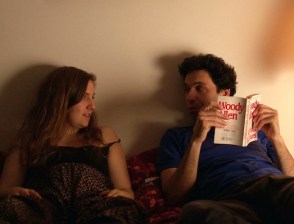 Many reviews cite Woody Allen as an influence, and it’s easy to see why: a small-scale autobiographical dialogue-driven New York-set study of specific people in a specific time. It falls short of such lofty aspirations on a few fronts, not least the evocation of the setting — there’s no trouble doubting this is set in New York, but you don’t feel the city the way you do in Annie Hall or Manhattan or many more of Allen’s works. But comparing a newcomer to a master is always a hiding to nothing for the newbie, so best not judge her too harshly for that.
Visually, the film belies its super-low-budget origins. In part this is the 2.35:1 frame, usually reserved for mega-blockbusters, which makes it ultra-filmic. In part it’s the slick interiors, cleanly shot, often with squared-off framing in longer takes, which comes across as film-literate rather than amateurish dump-the-camera. Only occasional exteriors, like grainy nighttime shots, give away the cheap roots. If nothing else, Dunham knows how to make a film look like a film.
And after all that, there’s the ending. Or, perhaps, the stopping, because does it actually End? I don’t think there’s anything inherently wrong with the concept of an opaque ending; one that, rather than resolve everything entirely, asks the audience to project their own meaning or their own imagined conclusion onto the events witnessed thus far. Rather than reach out and slap you in the face with an explanation, an effective opaque ending (such as Mulholland Drive’s) is like a hand reaching out to you, but you then must work to reach out yourself and grasp that hand. A bad one is like 3D: 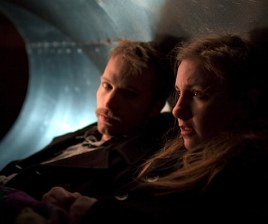 the hand is reaching out to you, but when you reach out to take it you find there’s actually nothing there; it was just an illusion.* I rather suspect Tiny Furniture’s guff about still hearing the ticking clock is that 3D hand.
That said, even as I write this, something struck me. But it’s terribly pretentious (in the full dictionary-defined sense) and so not much better. And weeks after watching the film, I can’t even remember it.
It’s difficult to know what to make of Tiny Furniture. I thought I was going to despise it, yet despite there being no clear sense of storyline, plot or even genuine thematic point, and additionally finding all of the characters to be unrelatable and largely unlikeable, I found it moderately engrossing. It’s not really good, but it’s strangely not bad either.
This review is part of the 100 Films Advent Calendar 2012. Read more here.
* I’m really quite proud of this analogy. I’m totally using it again. ^

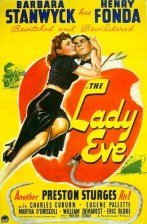 Screwball romantic comedy starring Barbara Stanwyck as a con woman who falls for her latest mark, ale heir Henry Fonda, until he discovers the truth and ditches her — and she vows revenge by conning him again. Packed with wit, Stanwyck shines as a slightly kooky, thoroughly daring con artist. Hers is the role with all the power, but Fonda’s gentler portrayal of her unconfident target is equally vital. It’s only let down by the ending, which rushes a conclusion in two minutes and didn’t seem to quite make sense. It doesn’t ruin the film, but it makes an unfortunate dent.
 I had heard Scre4m (Scream 4, if you prefer) was dreadful; a misguided, belated attempt to revive a once-popular franchise. Personally, I thought it was fun.
 It also leads to quite a good extended bit where some characters reel off a list of recent remakes, which rather highlights just how far it’s gone now. There’s lots of examples of this fun ‘meta’ stuff for film fans; for real-world-stuff too, including references to Courtney Cox and David Arquette’s marriage, Emma Roberts being in the shadow of Julia Roberts, and so on.
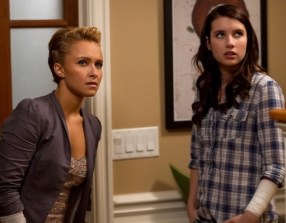 But, ultimately, all the discussion of horror movies and their rules is just window dressing: if there aren’t rules any more (which there don’t seem to be), it’s impossible for the characters to use them to survive, or for it to lend much self-reflexive weight to how the killer behaves. The only moment when it might be of use is when they predict the climax will occur at a party, and it turns out they’re having a party that very night! But then they go ahead with anyway. So much for that then.
 Though as the main development has been torture porn, and it criticises that explicitly from the very first scene, perhaps that’s still OK. In fact, they’re one step ahead again, with a nod to the most most-recent development (the
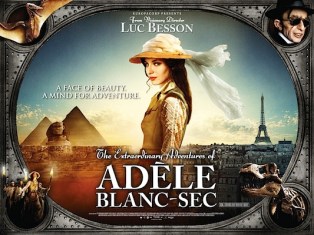 Based on the long-running bande dessinée (aka “comics”) by Jacques Tardi, The Extraordinary Adventures of Adèle Blanc-Sec is occasionally sold to English audiences with a handy quote
  And if that doesn’t put you off, the introduction-heavy opening minutes might, dense with introductions for disconnected characters and locations. Stick with it, it sorts itself out.
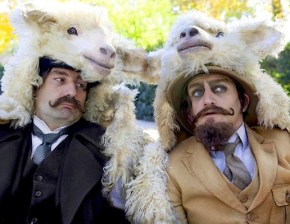 Director Luc Besson managed to build up something of a following with a regular output of films through the ’80s and ’90s, perhaps culminating artistically with the exceptional
  I suppose Adèle Blanc-Sec won’t be to everyone’s tastes. Comparisons to
 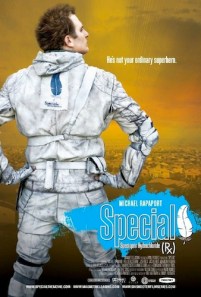 A lot of praise was slung
 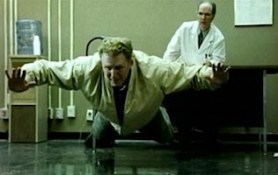 Those after a more genre-aware “real world superhero” movie would do better to stick with Kick-Ass or Super, but those who might embrace something a little different — especially something with an indie sensibility — would do well to take a look. Indeed, being a comic fan is certainly not a prerequisite for enjoyment here.
 From the makers of the successful Christmas TV shorts
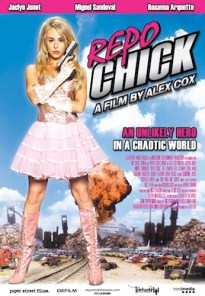 Alex Cox’s belated non-sequel (despite the title, there are apparently no links besides some cast members) to cult favourite (and
  True, the other characters are mostly dim and unlikeable, but is that a problem? We don’t need a film full of characters we like (otherwise we’d never have villains) — do we need there to be any? Or is the problem not that we don’t like them, but that their dimwittedness makes them too-easy targets for humour? I suppose it’s easier to just hate the film than grapple with such questions.
 On its release in 1956, The Court Jester was the most expensive comedy ever made, at a cost of $4 million. For that sum you could make precisely 2 minutes & 11 seconds of more recent most-expensive-ever comedy flop
  Rathbone’s character is played by the film’s fight choreographer, the 63-year-old star finding Kaye’s movements a bit fast for him at that age.
 16 years after they
  Lewis Gilbert is the director of
 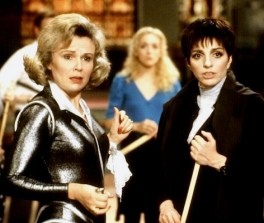 The standout from the cast is probably Julie Walters, in a relatively early big-screen role. Considering how well-known she is now she seems quite lowly billed and little-featured, but bearing in mind this is a US production from the early ’90s, it’s less surprising. She’s very good (isn’t she always?) as the group’s newest member, a posh English lady who sticks her oar in and is a bit too blunt with her comments. I seem to remember her generating most of the laughs in this comedy-drama, although that’s not to disparage anyone else’s work.
 100Films.co.uk