
Martin Scorsese | 180 mins | Blu-ray | 2.40:1 | USA / English | 18 / R
 2014 Academy Awards
5 nominations — 0 wins
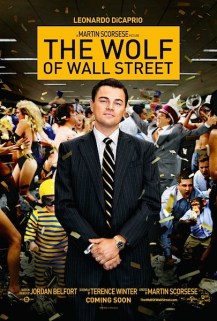 When someone says “100-million-dollar epic”, you probably don’t imagine a film about a swindling stockbroker; but, with a three-hour running time and a nine-figure budget, that’s exactly what Martin Scorsese’s black comedy biopic is.
Based on a true story, the film sees Jordan Belfort (Leonardo DiCaprio) start out as a stockbroker on Wall Street just before 1987’s Black Monday, which sees the firm he works for close down. Desperate for a job, he finds employment shilling cheap, crap shares to unsuspecting normal folk. Bringing his big-money skills into a grimy little environment, he revolutionises the way business is done, and soon finds himself back on Wall Street, where drug- and drink-fuelled parties, expensive houses, cars and yachts, and dodgy (well, flat-out illegal) business practices are the name of the day.
Some critics and viewers reckon the film is condoning or even glamourising that lifestyle. To which the only sensible response is, really?! How much must those people need their morality spelt out clearly and handed to them on a plate? Scorsese doesn’t out-and-out condemn the behaviour depicted, but nor does he present it as a jolly good time brought low by the cruel machinations of The Man. He’s more of an observer: this is what happened, both what they got away with and what they didn’t; both what was fun and exciting and what went wrong. There’s everything from moments where our own independent morality/irony is clearly meant to be brought to bear on these characters (such as the scene where they’re discussing dwarves) to sequences that outright depict the downside of their behaviour (such as the sequence where Jordan and Donnie take ‘Lemmon’, or indeed a good deal of the movie after that point). The film does not judge these people, but invites us to — 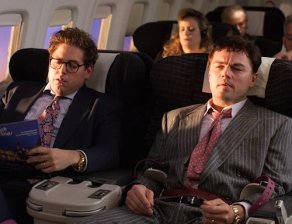 and the closing shot clearly shows how many people have already judged them to represent something desirable, regardless of what position the film might take. Some people want this lifestyle, in spite of all the problems it wrought, and even if the film had clearly condemned it that wouldn’t change. In the end, to say Scorsese approves of it purely because he doesn’t lambast it is too simplistic a reading.
Despite the real-life nature of its tale, and the fact the illegal actions surely brought misery to many, the film nonetheless works best as a comedy, which is fortunately its default tone. In the rare moments it shoots for drama, it doesn’t function quite so well — whatever the results of their action, these lives and situations are so outlandish that it’s hard to find an empathetic foothold. The characters may be based on real people, but they don’t live in a world of “real people”; but that’s OK, because I don’t imagine the actual people involved would come over as much more than “characters” if you encountered them in real life.
In this regard, every cast member is excellent. You may most easily identify that quality among the top-billed names (Leo, Jonah Hill, break-out star Margot Robbie), or the masses of recognisable faces in cameo-sized roles (Matthew McConaughey, Jon Favreau, Joanna Lumley, Jean Dujardin…),  but almost every supporting character gets a memorable line or scene, a moment where they shine brighter than everyone else; and even when the smaller roles aren’t dominating a scene, they’re part of a first-rate ensemble that functions like a well-oiled machine. My personal favourite was P.J. Byrne’s ‘Rugrat’, but yours may well be someone else.
One criticism I will hold with is that it’s too long. There’s fun packed throughout, but every now and then the pace flags or I found myself checking the clock. I can well imagine that on a re-watch the less-engrossing bits will be thumb-twiddlingly irritating while waiting for the quality memorable material to roll around. A tighter focus, probably at the writing stage but maybe it was salvageable in the edit, might’ve helped this.
And if you’re wondering how it cost $100 million, it’s packed to the rafters with CGI. Some of it is obvious (specifically, when they attempt to sail a yacht through a storm, with disastrous consequences), but there are also tonnes of more subtle digital set/location extensions and changes — check out this video if you want them revealed. Plus they used visual effects to obscure a gay orgy and avoid an NC-17. So that’s nice.
 As one of two period comedies about real-life financial crime that contended at the 2014 awards (and neither of which won a single Oscar, as it turned out), The Wolf of Wall Street is the more entertaining victor, for me. However, despite many high-points, some scattered niggles throughout its excessive running time hold back unequivocal praise.

The Wolf of Wall Street debuts on Sky Movies Premiere today at 9pm, and is already available on demand.
 You might not think superheroes lend themselves to the ultra-low-budget indie treatment, but where there’s a will there’s a way, and clearly writer-director Jordan Galland had a will.
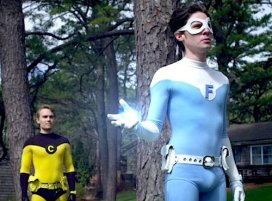 Personally, I rather liked it. It’s a little cheap, talky, and not laugh-out-loud hilarious, but it has some charm, a healthy-enough dose of professional filmmaking (I’ve seen plenty of efforts that are more amateurish), and a brisk running time that makes for a pleasant diversion. If you think you might find yourself in the sweet spot of the aforementioned diagram, it’s worth a go.
 “Don’t put metal in the science oven!”
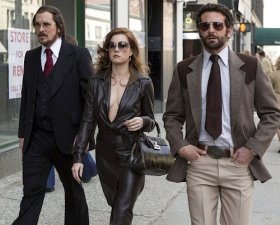 I never connected with the characters, so consequently never felt their predicaments, either romantic or professional. A halting chronologically-challenged start gives way to a middle that ultimately drags, before a “gotcha!” ending whose straightforwardness means it lacks the memorable punch of the best con movies.
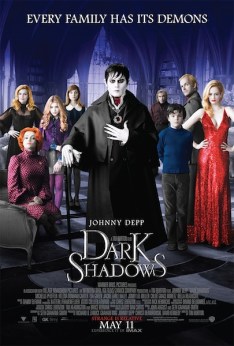 Director Tim Burton’s most recent live-action movie is an adaptation of a 1960s soap opera… albeit one featuring vampires, witches, ghosts and sundry other supernatural goings-on. You wouldn’t get that on
  Early on, it works. The first 20 to 30 minutes offer a serviceable prologue and an engaging introduction to most of the characters. It’s funny, it’s occasionally spooky, there’s a good deal of promise for a marginally-more-serious
  It’s a tonal grab bag: at times it seems to be a knowing spoof of daytime soaps, at others pushing for drama almost with a straight face; it’s sometimes deliberately and successfully comedic, at others straining too hard for a desperate laugh; it has a strain of bizarre sexuality that may be aiming at comic but is frequently just uncomfortable. This scrappiness leads to the most cardinal sin of any entertainment: it ends up a bit boring; and, in its out-of-the-blue big-battle climax, crushingly derivative.
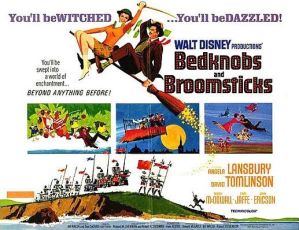 Disney attempted to replicate the success of
 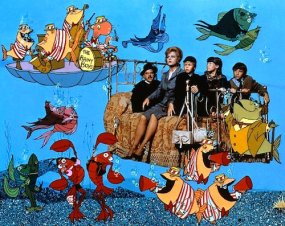 and one that’s mostly animated with our live-action heroes integrated; plus a climax where the good guys defeat one of the world’s great evils, with Poppins’ bankers here switched for the almost-as-bad Nazis. The magical special effects in that final sequence won an Oscar — and well deserved it was too. They look great, definitely holding up today, and it’s actually hard to be sure how they were all achieved.
 There seems to be a certain brand of animated film that I think looks dreadful so avoid, then I hear good things about, so I try it and find that, actually, they are really good. There was
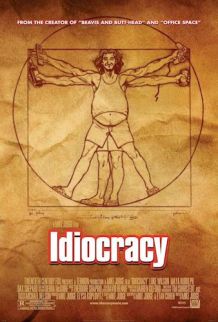 The creator of Beavis and Butthead imagines a future America in which, essentially, everyone has become his once-famous animated creations. I think — I never watched it. Basically, everyone’s a moron.
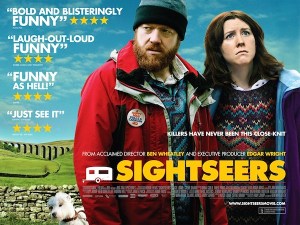 “He’s not a person Tina, he’s a Daily Mail reader.”
 I found
  The rest of the cast are a mix of old and new — clearly, some managed to wriggle out of a second go-round. Talulah Riley, Tamsin Egerton and
 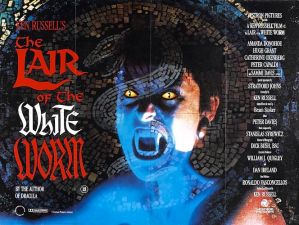 The Lair of the White Worm looks cheap, has a ridiculous story, overacted characters and overcooked dialogue, and by all rights should be a disaster. And maybe it is… but I don’t think so. In the right frame of mind, at any rate, it’s a whale of a time.
 100Films.co.uk