
Brad Bird | 83 mins | DVD | 2.35:1 | USA / English | U / PG
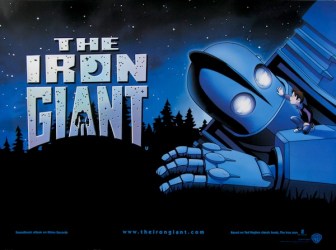 Adapted (loosely) from Ted Hughes’ children’s novel The Iron Man, the feature debut of director Brad Bird (The Incredibles, Ratatouille, now live-action stuff) relocates the book’s story to ’50s America and mixes in some Cold War elements. The film was somewhat verboten in our household when it came out, because the book was beloved and the film looked so different, but its reputation has only grown in the ensuing decade-and-a-half — and Hughes approved of it anyway.
This version sees the titular robot (voiced by Vin Diesel) crash to Earth near Maine in late 1957, the home of nine-year-old Hogarth Hughes (Eli Marienthal) and his mom Annie (Jennifer Aniston). After the giant eats the Hughes’ TV aerial, Hogarth tracks it to take a photo, and ends up saving it from electrocution when it tries to eat a power station. As the giant sneaks around the countryside eating cars and causing train crashes, it attracts the attention of government agent Fox Mulder from the FBI’s X Files Kent Mansley from the Bureau of Unexplained Phenomena (Christopher McDonald), who’s intent on uncovering and destroying the giant. Hogarth tries to hide the friendly creature with the help of artist Dean (Harry Connick Jr.), but could it be Mansley isn’t so wrong about the threat it poses?
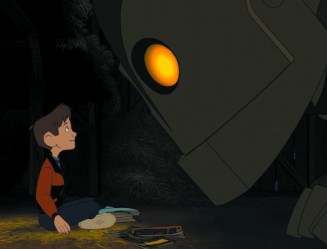 The story, as reconstructed by Bird and screenwriter Tim McCanlies, integrates influences from ’50s B-movies (very apt for a giant robot ‘monster’) and Cold War/Space Race paranoia for a potent storyline that has a different emphasis from the novel’s “world peace” finale, but nonetheless is promoting understanding of alien/foreign powers and, y’know, deep stuff like that. Alternatively — or, rather, concurrently — it’s an E.T.-esque tale of a boy and his quirky alien friend. Bird was keen to emphasise character over action and mindless spectacle, and that’s really where the film’s strengths lie.
Well, that and the technical aspects. The animation is stunningly well done, exhibiting exceptional fluidity and detail in its character animation, in particular. That’s in spite of the film having a reduced budget and time schedule thanks to the box office failure of previous animations by the studio — in Bird’s words, they had “one-third of the money of a Disney or DreamWorks film, and half of the production schedule”, but that meant greater production freedom (so long as they managed that budget). I guess that’s why the film’s ended up only growing in stature since its first release — because it’s able to be committed to its creators’ vision, rather than being battered into homogeneity by a studio desperate for a return on considerable investment.
Beautifully animated and affectingly told, with a style that nicely homages classic sci-fi movies, The Iron Giant is a film that deserves the  reputation it has gradually amassed — and which only continues to grow, I think. Last year saw the release of an extended Signature Edition, with a couple of short scenes added, which comes to US Blu-ray (alongside the original version) later this year. Just from reading about those new scenes, I’m not convinced they’ll improve the experience, but it’ll certainly be worth finding out.

The Iron Giant was viewed as part of my What Do You Mean You Haven’t Seen…? 2016 project, which you can read more about here.
This review is also part of 1999 Week.
 The third feature (but first you’re likely to have heard of) by writer-director Alexander Payne (


 Score:



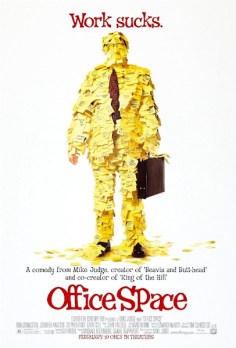 “From the creator of Beavis and Butt-Head” is not a designation that’s going to help sell a film to many people anymore. That the same fella also went on to write and direct the mediocre
  In truth, the plot doesn’t quite fill the slight running time, and Judge doesn’t seem to quite know how to end it — clearly he doesn’t want his hero figure getting caught out, but it can’t just go on forever. Fortunately, this is a comedy, and so plot matters only so much if the rest is funny. In some respects it’s a story of “first world problems” — these guys have decent jobs, making decent money, but it’s boring — but at least it finds the humour in this. Little vignettes of office life, a mix of light satire and gentle surrealism, keep the amusement ticking over too.
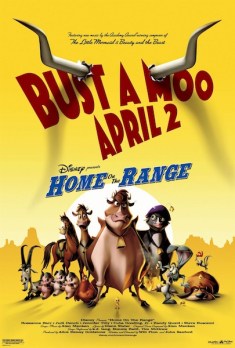 I have many goals within my film viewing, quite apart from trying to watch 100 films every year. Some I’ve completed (the Rathbone Holmes series), others are almost done (every Spielberg film), others not so much (every Hitchcock film), and others I’ve barely begun (the Zatoichi series). One of these goals is to watch every Disney Animated Classic, their canon of feature animations that currently sits at 55 titles (with another scheduled for later this year, in the US at least). I did a pretty good job on the real classics while growing up, and have since filled the gaps of the modern classics, so I’m left ploughing through their lesser periods: the content they pumped out in the war-affected ’40s, and the post-Renaissance pre-Lasseter clusterfrack that was their ’00s produce. My best hope is to uncover a hidden gem while I mop up this dross.
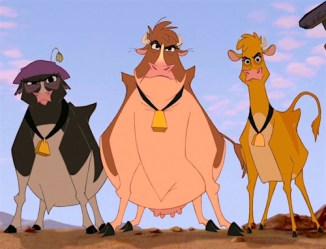 but only because it has a moderately amusing reveal in the middle of it. The animation is unremarkable, besides some terrible CG intrusions. It seems to be under the impression that “hog” is a word for “cow”, based on the number of puns. A couple of gags do land — I even laughed out loud once, though I’ve forgotten why — but the majority is resolutely uninspired.
 The first US feature from the director of


 I’ve observed before that the ’80s seem to be everywhere in film these days, and here’s another example: Turbo Kid is in every respect an homage to low-budget ’80s genre fare.
 Then there’s the score, which is of course all ’80s synths, in a similar style to the score of



 After the success of
  100Films.co.uk